

Picture this: It is a quiet morning, your coffee is brewing, and a slice of golden-brown bread pops out of the toaster. You grab a butter knife, slice off a rich sliver, and glide it across the warm surface until it melts into every crispy nook and cranny. It is one of life’s simplest comfort foods.
But when you log your breakfast into your daily tracker, what do you enter? Was that spread a modest teaspoon, or did it lean closer to a generous tablespoon?
When it comes to toast with butter calories, that quick swipe of the knife can easily double or triple the energy density of your breakfast. Let’s peel back the wrapper and look at how a tiny difference in butter portion size makes a massive impact on your daily nutrition.
Table of Contents
The Toast Substrate vs. The Butter Spread
Teaspoon vs. Tablespoon: The Direct Calorie Comparison
The Cumulative Impact: How the "Butter Math" Adds Up
Visual Estimation: Why Eyeballing Butter Fools Us
Physiological Dynamics: Digestion, Satiety, and Fat Storage
Smart Swaps for Butter Lovers
Effortless Tracking with VoCal Voice Technology
Frequently Asked Questions
The Toast Substrate vs. The Butter Spread
When calculating calories in toast with butter, it helps to think of your breakfast as two separate components: the bread substrate and the lipid spread.
A standard slice of store-bought commercial white or whole wheat bread weighs roughly 28 grams (1 ounce) and delivers a predictable baseline of 78 calories, coming mainly from complex carbohydrates.
Butter, on the other hand, is churned milk fat composed of roughly 80% pure milkfat. Because fat packs 9 calories per gram—more than twice the 4 calories per gram found in carbs and protein—even a small change in butter thickness creates a huge jump in total meal energy.
Meal Component / Portion Size | Weight (g) | Energy (kcal) | Total Fat (g) | Saturated Fat (g) | Carbohydrates (g) | Protein (g) |
Plain Toast (1 Slice, Wheat/White) | 28.0 | 78 | 1.0 | 0.2 | 13.5 | 3.0 |
Toast + 1 Teaspoon Butter | 32.7 | 112 | 4.8 | 2.6 | 13.5 | 3.0 |
Toast + 1 Tablespoon Butter | 42.2 | 180 | 12.5 | 7.5 | 13.5 | 3.1 |
Toast + 2 Tablespoons Butter | 56.4 | 282 | 24.0 | 14.8 | 13.5 | 3.2 |
Bottom Line: The plain bread accounts for less than half the energy in a heavily buttered slice! A single tablespoon of butter adds more than double the calories of the toast itself, making the spread the main variable in your morning calorie count.
Teaspoon vs. Tablespoon: The Direct Calorie Comparison

Standard kitchen measurements follow a simple 3-to-1 ratio: three level teaspoons equal exactly one level tablespoon. That means upgrading from a teaspoon spread to a tablespoon spread triples the butter volume on your slice!
The Calorie Gap
1 Teaspoon of Butter: Delivers about 34 calories. Spread over plain toast, your breakfast total sits right at 112 calories.
1 Tablespoon of Butter: Delivers roughly 102 calories. Spread over that same piece of toast, your total jumps to 180 calories.
That is a direct difference of 68 calories on just one piece of toast!
The Saturated Fat Difference
Portion size also changes the heart-health profile of your morning meal:
1 Teaspoon Butter: Contains 3.8 grams of total fat, including 2.4 grams of saturated fat.
1 Tablespoon Butter: Delivers 11.5 grams of total fat, including 7.3 grams of saturated fat.
The Dietary Guidelines for Americans recommend limiting saturated fat intake to under 10% of total daily calories starting at age 2. For a standard 2,000-calorie diet, that equals roughly 20 grams of saturated fat per day. Meanwhile, guidelines from the American Heart Association (AHA) suggest a stricter limit of less than 6% of daily calories, or roughly 13 grams per day.
A single tablespoon of butter on toast consumes over 36% of your daily saturated fat ceiling under federal guidelines and over 56% of the AHA limit! Downsizing to a single teaspoon keeps saturated fat to just 12% of the daily 20-gram target.
Bottom Line: Switching from a tablespoon to a teaspoon of butter on toast calorie count saves 68 calories and nearly 5 grams of saturated fat per slice.
The Cumulative Impact: How the "Butter Math" Adds Up
While saving 68 calories on a single slice might sound tiny, daily habits accumulate over weeks and months.
Consider a standard breakfast routine of eating two slices of buttered toast every morning:
2 Slices with 1 Teaspoon each: 224 total calories (68 calories coming from butter).
2 Slices with 1 Tablespoon each: 360 total calories (204 calories coming from butter).
The daily gap between these two choices is 136 calories. Here is how that daily difference scales up across the year:
Daily Differential = 136 kcal
Weekly Surplus = 136 kcal/day * 7 days = 952 kcal
Annual Surplus = 136 kcal/day * 365 days} = 49,640 kcal
Because roughly 3,500 calories equal one pound of stored body energy, an unmeasured extra tablespoon of butter across two slices of daily toast represents over 14 pounds of potential energy variance over a single year!
Visual Estimation: Why Eyeballing Butter Fools Us
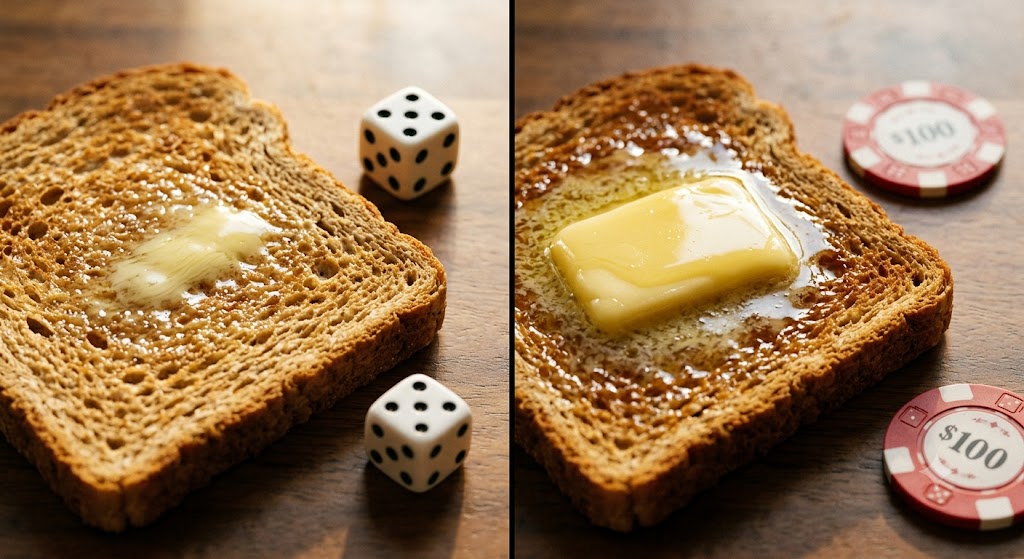
Why is butter so hard to estimate visually? Because warm toast melts butter directly into its porous surface, hiding the true volume of the spread.
Portion Metric | Weight (g) | Calorie Value (kcal) | Standard Visual Analogy |
1 Teaspoon | ~4.7 | ~34 | Size of a standard gaming die or tip of an adult index finger |
1 Pat (Restaurant) | ~5.0–7.0 | ~36–50 | Pre-cut commercial foil-wrapped square |
1 Tablespoon | ~14.2 | ~102 | Size of a poker chip or length of an adult thumb |
A light, translucent scrape across warm bread generally equals 1 teaspoon (34 calories). However, a thick, smooth coat resting visibly on top usually equals or exceeds 1 tablespoon (102 calories).
According to USDA portion guides, 1 teaspoon matches the visual size of a standard gaming die or the tip of an adult index finger, while 1 tablespoon matches the length of an adult thumb or the surface of a poker chip.
Bottom Line: Because warm toast absorbs liquid fat, visual guessing often leads us to record a teaspoon when we actually used a full tablespoon.
Physiological Dynamics: Digestion, Satiety, and Fat Storage
Combining carbohydrates and fat creates an interesting metabolic interaction during digestion:
Glycemic Response: Toast starches break down into glucose, triggering an immediate spike in blood sugar and insulin release from the pancreas.
Delayed Gastric Emptying: Adding butter introduces dietary lipids that slow down stomach emptying, blunting rapid glucose spikes and keeping you fuller for longer.
Storage Pathways: While insulin is elevated to manage glucose from the toast, the body prioritizes storing excess dietary fats. If you are in an overall calorie surplus, the dietary fat from heavy butter application is readily routed into adipose storage.
Bottom Line: Butter slows down carbohydrate digestion and helps stabilize energy levels, but consuming heavy spreads in a calorie surplus makes it easier for your body to store excess dietary fat.
Smart Swaps for Butter Lovers
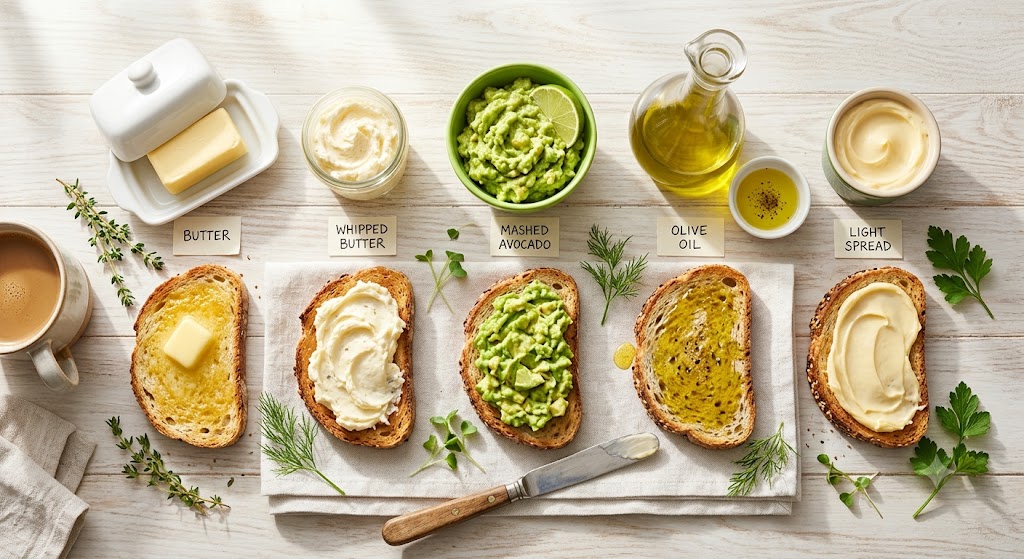
If you want to keep the savory richness of toast while managing calories in toast with butter, try these practical alternatives:
Butter Alternative / Swap | Serving Size | Calories (kcal) | Total Fat (g) | Saturated Fat (g) | Primary Health Advantage |
Standard Unsalted Butter | 1 tbsp (14.2g) | 102 | 11.5 | 7.3 | Classic rich flavor |
Whipped Butter | 1 tbsp (9.0g) | 60–70 | 7.0–8.0 | 4.5 | Aerated texture cuts calories by over 30% |
Light / Reduced-Fat Butter | 1 tbsp (14.0g) | 50–60 | 5.0–6.0 | 3.0 | Water-blended formula lowers total fat |
Extra Virgin Olive Oil | 1 tsp (4.5g) | 40 | 4.5 | 0.6 | Packed with heart-healthy monounsaturated fats |
Mashed Avocado | 1 tbsp (15.0g) | 24 | 2.2 | 0.3 | High in dietary fiber and unsaturated fats |
Swapping to whipped butter is one of the easiest hacks. Because whipped butter has air incorporated into it during manufacturing, a full tablespoon weighs only 9 grams compared to 14.2 grams for stick butter—slashing calories by a third while giving you full visual spread coverage!
Effortless Tracking with VoCal Voice Technology
Accurate tracking often breaks down because searching text databases or weighing butter on a scale during a busy morning feels tedious. Deciding whether your toast had a "pat," "scrape," or "spoonful" creates guesswork that adds up over time.
This is where VoCal changes the game. Instead of navigating drop-down menus or measuring tools, you simply speak into your phone in natural English:
"Log one slice of whole wheat toast with two teaspoons of butter."
VoCal’s natural language processing interprets your voice input, separates the bread substrate (78 calories) from the fat spread (68 calories), and logs exact USDA-backed nutrition data instantly. By taking the friction out of logging, voice tracking ensures you stay accountable without slowing down your day.
Frequently Asked Questions
1. How many calories are in one slice of toast with butter?
A standard slice of plain white or wheat toast has about 78 calories. Adding 1 teaspoon of butter brings the total to roughly 112 calories, while adding 1 tablespoon bumps it up to 180 calories.
2. Is butter on toast bad for weight loss?
No single food prevents weight loss! Butter on toast fits into a balanced weight loss plan as long as it fits within your daily calorie goals. The main challenge is portion control, as high-fat spreads add calories quickly.
3. What is the difference between a butter pat and a teaspoon?
A standard restaurant butter pat usually weighs between 5 and 7 grams, yielding about 36 to 50 calories. A level teaspoon weighs roughly 4.7 grams and contains about 34 calories.
4. Does butter on toast lower the glycemic index of bread?
Yes. The fat content in butter slows down gastric emptying, which delays carbohydrate absorption and helps blunt sharp spikes in post-meal blood sugar.
5. How can I log butter on toast accurately without a scale?
Using visual cues helps: 1 teaspoon is about the size of a single gaming die, while 1 tablespoon is roughly the size of a poker chip. Alternatively, speak your meal directly into the VoCal app for hands-free portion logging!
Disclaimer: This content is for informational purposes only and does not constitute medical advice. Always consult with a healthcare professional or nutritionist before making significant changes to your diet.