

If you have ever stepped foot in a gym, you have probably heard people whispering about the holy trinity of bodybuilding: chicken breast, broccoli, and sweet potatoes. But while protein gets all the hype for building sleeve-splitting biceps, the humble sweet potato is the real unsung hero behind those heavy lifting sessions.
Why is this bright orange tuber the ultimate sweet potato for gym-goers? Let's dive into the science of muscle-building carbs, how they fuel your gains, and exactly how many you need to pile onto your plate.
Table of Contents
The Metabolic Magic of Carbs
How Cooking Changes Your Glycemic Index
How Much Sweet Potato Should You Eat for Muscle Gain?
Are There Any Risks or Downsides?
How to Track Your Gym Gains Effortlessly with VoCal
The Bottom Line
Frequently Asked Questions (FAQs)
The Metabolic Magic of Carbs
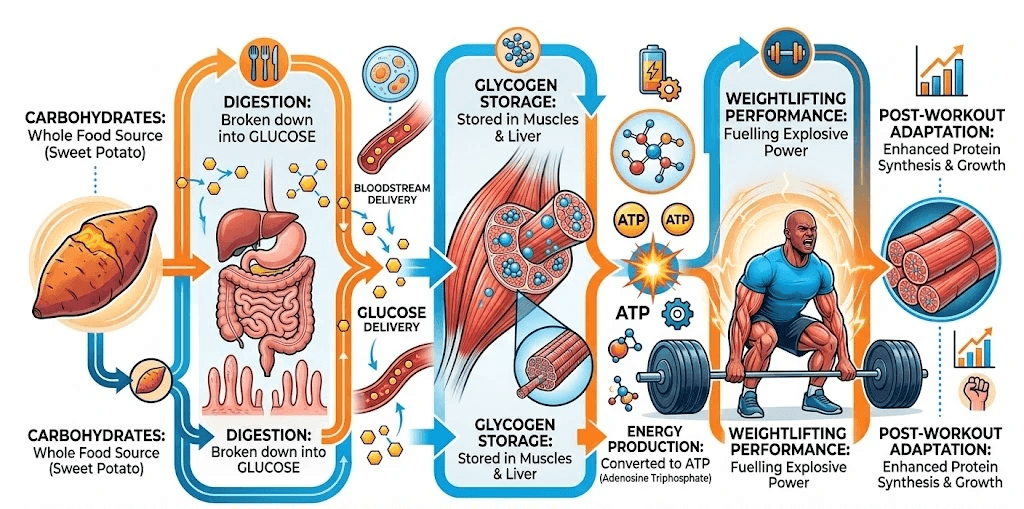
In sports nutrition, protein gets a lot of glory, but carbs are the muscle-building carbs that actually run the show. Skeletal muscle hypertrophy is an energy-intensive process that requires a continuous supply of adenosine triphosphate (ATP). Carbohydrates are the body's favorite and most efficient fuel source for generating ATP during heavy lifting, yielding much more energy per unit of oxygen than fats.
To build muscle, you need to manage your energy balance. Your Total Daily Energy Expenditure (TDEE) is calculated by multiplying your Basal Metabolic Rate (BMR) by your Physical Activity Level (PAL):
TDEE = BMR * PAL
For the guys in the gym, we calculate BMR using the Mifflin-St Jeor equation:
BMR = 10* Weight (kg) + 6.25 * Height (cm) - 5 * Age (years)+ 5
When you hit the weights hard, your body burns through stored carbs, known as glycogen. If you run out of glycogen, your body can enter a catabolic state, starting a process called gluconeogenesis—which basically means it starts breaking down your precious muscle proteins to use as emergency fuel. No one wants that!
Eating a sweet potato for gym sessions keeps your glycogen stores topped off, triggers a moderate insulin response to shuttle amino acids into your muscles, and keeps your body in prime anabolic (muscle-growing) mode.
Packed with Clean Energy (Hello, Glycogen!)
Sweet potatoes (Ipomoea batatas) are starchy powerhouses. Once digested, their complex starches break down into glucose, raising your insulin levels moderately. This triggers the mobilization of glucose transporter type 4 (GLUT4) vesicles, helping your muscles absorb glucose and activate the mammalian target of rapamycin (mTOR) pathway—the cellular master switch for muscle growth.
Here is the nutritional breakdown of a cup of sweet potato cooked in different ways, based on USDA FoodData Central:
Nutrient (per cup serving) | Boiled, Mashed (1 Cup / 328g) | Baked in Skin (1 Cup / 200g) | Raw, Cubed (1 Cup / 133g) |
Energy (Calories) | 249 kcal | 180 kcal | 114 kcal |
Total Carbohydrates | 58.1 g | 41.4 g | 26.8 g |
Dietary Fiber | 8.2 g | 6.6 g | 4.0 g |
Total Sugars | 18.8 g | 13.0 g | 5.6 g |
Net Carbohydrates | 49.9 g | 34.8 g | 22.8 g |
Protein | 4.5 g | 4.0 g | 2.1 g |
Total Fat | 0.46 g | 0.30 g | 0.07 g |
Potassium | 754.4 mg | 950.0 mg | 448.2 mg |
Vitamin A (RAE) | 2581.4 mcg | 1922.0 mcg | 943.0 mcg |
Vitamin C | 42.0 mg | 39.2 mg | 3.2 mg |
Boiled, mashed sweet potatoes are highly concentrated in net carbs, making them a fantastic bodybuilding food for bulking. However, sweet potatoes have an incomplete amino acid profile. To build serious muscle, you must pair them with high-quality, complete proteins like grilled chicken breast, lean beef, or eggs to utilize that carb-induced insulin spike.
Keeps Your Muscles Firing with Potassium

Heavy gym sessions mean sweating buckets, which drains your body of essential electrolytes. A baked sweet potato packs a whopping 950 mg of potassium per cup.
Potassium is critical for maintaining cell membrane stability and neuromuscular function. Ever had an excruciating muscle cramp mid-squat? While dehydration is a suspect, modern research suggests that muscle fatigue alters your neuromuscular control. Keeping your potassium levels up helps stabilize those nerve signals and keeps your muscles firing smoothly under heavy loads.
Rebuilds Your Tendons and Joints with Copper
Lifting heavy weights doesn't just stress your muscles; it takes a toll on your tendons, ligaments, and joints. One cup of baked sweet potato gives you about 36% of your daily copper needs.
Why does copper matter for gym-goers? It is a vital cofactor for an enzyme called Lysyl Oxidase (LOX).
LOX plays a starring role in collagen cross-linking, which gives your tendons and joints their tensile strength and elasticity. Without enough copper, your body cannot cross-link collagen properly, leaving you more vulnerable to tendon strains and joint injuries during heavy lifting.
Speeds Up Cellular Recovery with Vitamin A and C
Sweet potatoes are absolute gold mines for provitamin A carotenoids, providing up to 287% of the daily value per mashed cup.
Retinoic acid acts as a biological signal that helps satellite cells differentiate and repair damaged muscle fibers. Combined with Vitamin C, which combats oxidative stress and supports collagen synthesis, these micronutrients reduce soreness and speed up your recovery so you can get back to the gym faster.
How Cooking Changes Your Glycemic Index
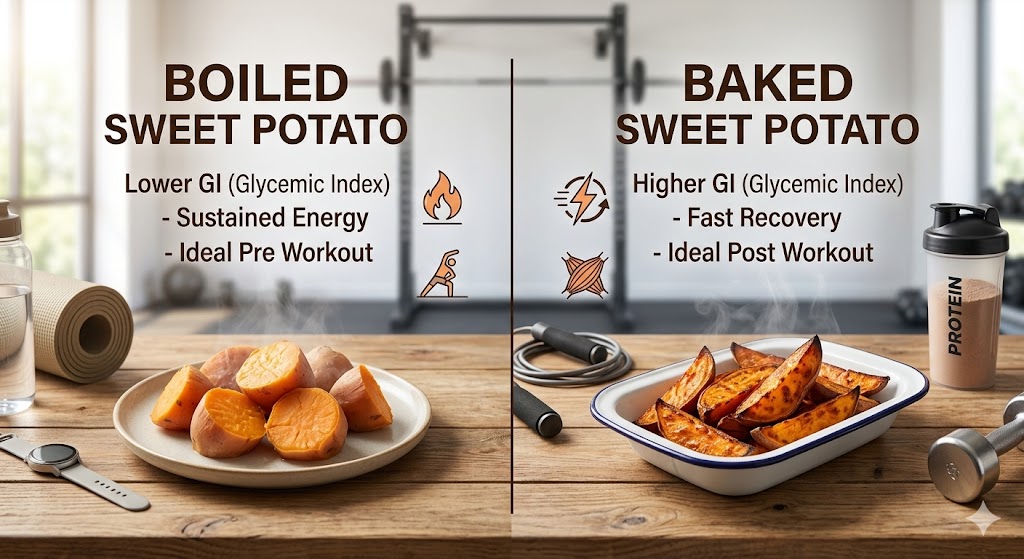
The way you cook your sweet potato completely changes how fast it releases energy:
Boiled sweet potatoes have a lower glycemic index (GI) of 41 to 50. This moist-heat process preserves the starch's structure, making it a perfect pre-workout meal for slow, sustained energy.
Baked or roasted sweet potatoes have a high GI up to 94. Dry heat breaks down the complex starches into simple sugars (like maltose). This rapid digestion is ideal for post-workout nutrition to spike insulin and replenish depleted glycogen quickly.
Pro Tip (The Cool Down): If you let your cooked sweet potatoes cool down, a process called retrogradation turns digestible starches into Type 3 resistant starch (RS3). This acts like soluble fiber, feeding your gut microbes and lowering the glycemic index.
Preparation Method | Glycemic Index (GI) | Glycemic Load (GL) Status | Starch State and Physiological Characteristics |
Boiled | 41–50 | Low to Medium | Preserves ungelatinized starch and limits rapid pancreatic amylase cleavage |
Dehydrated / Raw | 28–40 | Low | High in crystalline structure; digests slowly |
Steamed | 63 | Medium | Partial gelatinization; balanced glucose release |
Baked | 64–94 | High | Thermal degradation of starch into simple maltose |
Roasted | 79–93 | High | High starch gelatinization and breakdown into rapid-acting sugars |
How Much Sweet Potato Should You Eat for Muscle Gain?
To hit your muscle-building goals, your carbohydrate intake should match your training intensity. Major sports nutrition bodies recommend specific daily ranges:
International Olympic Committee (IOC): 4.0 to 7.0 g/kg body weight per day
American College of Sports Medicine (ACSM): 6.0 to 10.0 g/kg body weight per day
International Society of Sports Nutrition (ISSN): 5.0 to 8.0 g/kg body weight per day
For an 80 kg athlete, that is roughly 440g of carbs daily. To make it easy, here is how much sweet potato to eat for your performance meals based on your weight:
Athlete Body Weight | Pre-Workout Serving (3 Hours Prior) | Post-Workout Serving (Within 1 Hour) | Combined Carbohydrate Yield |
60 kg (132 lbs) | 150g Boiled Sweet Potato (~27g carbs) | 150g Baked Sweet Potato (~31g carbs) | ~58 g |
70 kg (154 lbs) | 200g Boiled Sweet Potato (~36g carbs) | 200g Baked Sweet Potato (~41g carbs) | ~77 g |
80 kg (176 lbs) | 250g Boiled Sweet Potato (~45g carbs) | 250g Baked Sweet Potato (~52g carbs) | ~97 g |
90 kg (198 lbs) | 300g Boiled Sweet Potato (~54g carbs) | 300g Baked Sweet Potato (~62g carbs) | ~116 g |
Are There Any Risks or Downsides?
While sweet potatoes are a premium muscle-building fuel, there are a couple of things to keep in mind:
Satiety Overload: Because they are packed with fiber and water, sweet potatoes are incredibly filling. If you are on a high-calorie bulk, eating too many might leave you too full to hit your caloric surplus goals. If that happens, try blending them into post-workout shakes or swapping some portions for denser carb sources.
Oxalates and Kidney Health: Sweet potatoes contain organic compounds called oxalates. If you have a history of calcium-oxalate kidney stones, you'll want to monitor your portion sizes and keep your hydration levels high.
How to Track Your Gym Gains Effortlessly with VoCal
Let's face it: weighing sweet potatoes, calculating net carbs, and logging them in clunky, old-school apps can feel like a second job. Who has time for manual database searches and barcode scans when you have just crushed a grueling leg day?
This is where VoCal steps in to save your sanity.
VoCal is a voice-first calorie tracking app designed to remove all logging friction. Instead of typing, you just tap the microphone and speak naturally:
"I had 250 grams of boiled sweet potato and 6 ounces of grilled chicken breast for lunch."
And boom—the AI-powered engine instantly logs your calories, net carbs, and protein breakdown.
Whether you are eating home-cooked meals, regional dishes, or a custom post-workout shake, VoCal makes consistency effortless, making it the most versatile and friendly tracker in your fitness arsenal.
The Bottom Line
Sweet potatoes are a nutrient-dense, clean carbohydrate source that provides the energy, electrolytes, and tissue-rebuilding micronutrients you need to crush your gym goals and recover like a pro.
By strategically swapping between slow-digesting boiled sweet potatoes pre-workout and fast-digesting baked sweet potatoes post-workout, you can fuel your muscle growth cycles optimally. And to make sure your macros are always on target without the stress, let VoCal handle the logging with just a simple voice command!
Frequently Asked Questions (FAQs)
Is sweet potato better than white potato for gym gains?
Both are excellent, but they serve different purposes. White potatoes have a slightly higher glycemic index, making them great for a quick energy spike. Sweet potatoes, on the other hand, are packed with Vitamin A, have more fiber, and provide slower-releasing, sustained energy when boiled—perfect for pre-workout fuel.
Can I eat sweet potato skin?
Absolutely! The skin of the sweet potato contains a high concentration of insoluble fiber. Eating the skin helps control your appetite, improves digestion, and ensures you get the full fiber benefits of this superfood. Just make sure to scrub and wash the skin thoroughly before cooking.
Is it better to eat sweet potatoes pre-workout or post-workout?
You can do both strategically! Eat boiled sweet potatoes roughly 3 hours pre-workout for slow, sustained energy. Enjoy baked or roasted sweet potatoes post-workout to trigger a faster insulin response, helping to shuttle nutrients and replenish glycogen stores rapidly.
How does VoCal help me track complex gym meals?
Unlike traditional apps that require you to scroll through endless search results for custom recipes or regional ingredients, VoCal allows you to naturally speak your meal details. Just speak into the app, and VoCal's AI breaks down your home-cooked sweet potato meals into exact calories and macros in seconds.
Disclaimer: This article is for informational purposes only. For medical advice or diagnosis, consult a professional.