

Welcome to your 50s and beyond! This is the era of wisdom, freedom, and maybe realizing that your body has started playing by a completely different set of rules. If you’ve noticed that maintaining your muscle tone feels a bit harder or you’ve had "bone density" pop up in doctor visits, you are definitely not alone.
During postmenopause, a dramatic drop in estrogen can do a real number on our muscles and bones. This biological shift often brings along two unwelcome guests: sarcopenia (the clinical term for age-related muscle loss) and osteoporosis (thinning, fragile bones).
But don’t worry! One of the absolute best ways to fight back and maintain your physical independence is simply getting enough of the right fuel: protein.
When you stand in the supplement aisle, however, you're faced with a classic showdown: whey protein vs pea protein. Which one should you scoop into your morning smoothie to keep your muscles strong and your bones sturdy?
Let's break down the science in a way that actually makes sense—no PhD required!
Sarcopenic Obesity: The Hidden Weight Loss Trap
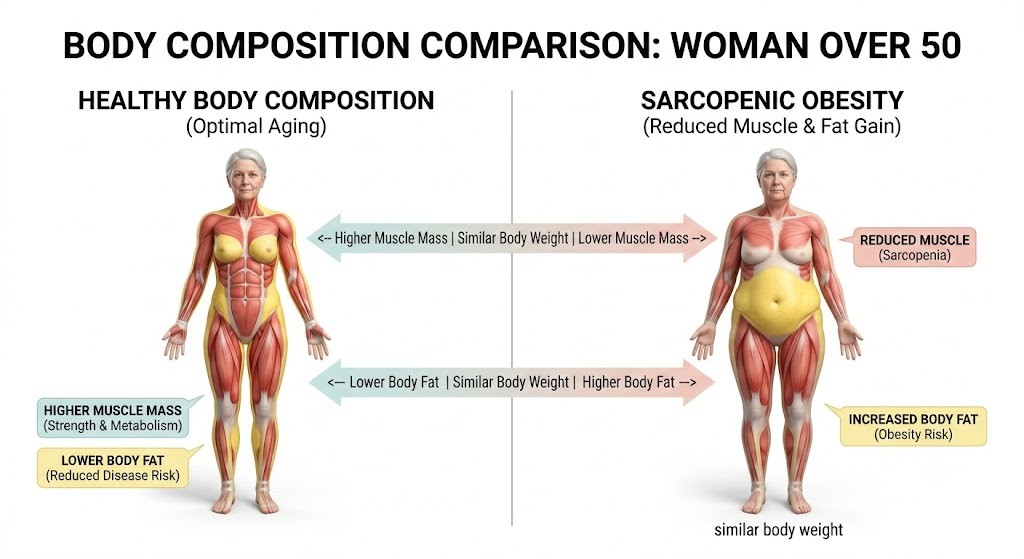
Many of us over 50 find ourselves wanting to manage our weight or support our metabolic health. Cutting back by 500 to 750 calories a day is a standard, safe way to lose about 1 to 1.5 pounds a week. But there's a major catch: when you restrict calories, your body doesn't just burn fat. It can also eat away at your precious, hard-earned muscle.
In fact, if you aren't eating enough protein while dieting, 15% or more of the weight you lose can come straight from your muscles. This can trigger a sneaky condition called "sarcopenic obesity"—where you carry more fat but less muscle, which actually slows down your metabolism and triggers unwanted inflammation.
Keeping track of those calories and protein grams can feel like a full-time job. That's where VoCal swoops in to save the day. Instead of typing every single ingredient into a clunky app, you just speak to VoCal naturally (e.g., "Just had a scoop of pea protein, a cup of spinach, and soy milk"), and it instantly logs your macronutrients. It's hands-free tracking that keeps you on target without the administrative headache.
What's the Deal with Anabolic Resistance?
As we get older, our muscles get a little... stubborn. This is a real biological phenomenon known as anabolic resistance. When you're 20, eating a small 20-gram serving of protein is plenty to tell your muscles, "Hey, let's rebuild!". But once you pass 50, your muscle-building pathways need a louder wake-up call—typically 30 to 35 grams of protein per meal to get the same muscle-building effect.
If you don't hit this threshold, your body enters a negative nitrogen balance and starts stealing amino acids from your existing muscles to run your vital organs.
To trigger muscle protein synthesis (the science term for muscle building), you need an essential amino acid called leucine. Think of leucine as the key that unlocks the "mTOR" pathway, which is the master switch for muscle growth.
Let’s look at how our two contenders stack up in the nutrition department:
Nutritional & Physical Marker | Whey Protein Isolate (per 20g serving) | Pea Protein Isolate (per 20g serving) | Clinical Significance for Women Over 50 |
Average Calories | ~78 kcal | ~80 kcal | Supports precise caloric tracking and metabolic control. |
Protein Yield | 18 grams | 15 grams | Essential for meeting elevated daily anabolic requirements. |
Leucine Concentration | Very High (~11%–13%) | Moderate (~8%) | Leucine is the key trigger for the mTOR muscle-building pathway. |
Methionine Content | High (~2.5%) | Limiting (~1.0%) | Methionine deficiency makes pea protein technically incomplete. |
Allergen & Dietary Profile | Contains dairy/lactose | Hypoallergenic, 100% vegan | Pea protein is highly suitable for those with dairy sensitivities. |
Intestinal Digestibility | Rapid absorption | High (~98% isolate digestibility) | High digestibility ensures excellent systemic amino acid availability. |
While whey protein has a natural edge in leucine levels, pea protein has its own superpowers. For example, pea protein has up to 210% more arginine than whey. While arginine won't build muscle as fast as leucine, it is a master at boosting nitric oxide, which supports your cardiovascular and heart health.
The Bottom Line: Older muscles need more protein and more leucine to stay strong. Whey is the naturally leucine-dense champion, but pea protein isolate is an incredible, gut-friendly, plant-based alternative if you increase the serving size slightly.
Muscle Retention & Recovery: Head-to-Head
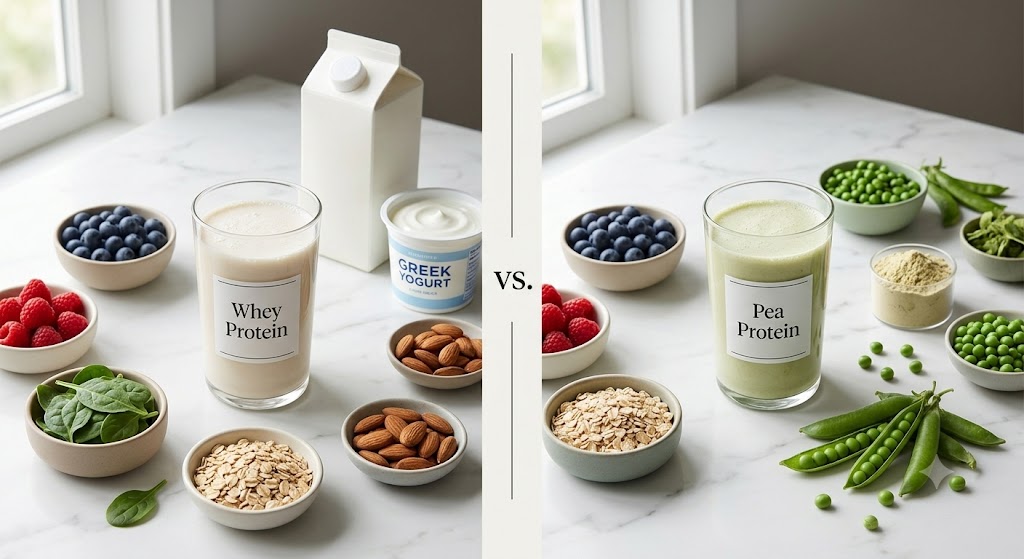
If you’re lifting weights (and yes, you should be!), long-term clinical trials show that pea protein isolate performs just as well as dairy-derived whey.
In an 8-week study comparing people using either whey or pea protein during high-intensity training, there were no significant differences in muscle thickness or overall strength gains. If your total daily protein is on point, your plant-powered muscles can lift just as heavy!
But what about the day after a tough workout when your legs feel like lead?
That is where whey pulls ahead. A double-blind trial on older adults completing a long-distance walk found that 13 days of whey protein supplementation significantly lowered creatine kinase (a biological marker of muscle damage) 24 hours post-exercise, whereas pea protein showed only intermediate recovery benefits. Whey’s rapid absorption rate helps it rush to the rescue of torn muscle fibers faster.
The Bottom Line: For long-term strength and muscle tone, both pea and whey are winners. But if you want to recover faster and minimize post-workout soreness, whey has a slight biological advantage.
The "Acid-Ash" Myth and Your Bone Health
We’ve all heard that calcium and Vitamin D are the holy grail of bone health. But did you know your bones are actually about 50% protein by volume? They rely heavily on a steady stream of amino acids to maintain their structural, organic collagen matrix.
For years, a theory called the "acid-ash hypothesis" scared people away from high-protein diets, especially animal proteins like whey. The theory claimed that eating acid-producing foods (like meat, grains, and hard cheese) makes your body acidic, forcing it to leach alkaline calcium from your bones to buffer the pH.
Good news: Science has officially busted this myth!
While high-protein diets do increase the calcium in your urine, isotopic studies prove this extra calcium comes from increased intestinal absorption, not from your bones being degraded. In fact, dietary protein works hand-in-hand with calcium to keep your bones rock-solid by:
Boosting IGF-1: Protein stimulates Insulin-Like Growth Factor 1, a hormone that directly tells your osteoblasts (bone-building cells) to get to work.
Slamming the brakes on PTH: High-protein diets suppress Parathyroid Hormone (PTH), which is notorious for triggering bone breakdown when levels are too high.
Combatting Estrogen Loss: Animal models show that whey protein concentrate directly protects against bone density loss caused by estrogen deficiency.
However, there is one major rule: you must eat enough calcium! The famous Framingham Osteoporosis Study showed that high protein intake lowers hip fracture risk only if your daily calcium intake is at least 800 mg. If you are severely calcium-deficient, a high-acid diet could still put your bones at risk.
The Bottom Line: Protein is a friend to your bones, not an enemy. Just make sure you pair your protein shake with adequate calcium and Vitamin D to keep the bone-building cycle going strong.
Your Post-50 Musculoskeletal Action Plan

If you want to prevent sarcopenia and preserve your bone density, here are your daily targets:
Clinical Target | Recommended Guideline | Physiological Outcome |
Daily Protein Intake | 1.2 to 1.6 g/kg of body weight | Slows the rate of lean muscle mass loss and maintains physical function. |
Per-Meal Protein Target | 30 to 35 grams of high-quality protein | Overcomes anabolic resistance to stimulate muscle protein synthesis. |
Post-Workout Ingestion | 30 to 35 grams within 2 hours of exercise | Maximizes skeletal muscle recovery and structural adaptations. |
Daily Calcium Intake | 800 to 1,200 mg per day | Crucial for ensuring that high-protein diets support bone mineralization. |
Daily Vitamin D Intake | 800 IU per day | Enhances intestinal calcium absorption and supports overall bone health. |
Wait, what if you prefer plant-based pea protein? No problem! You can easily hack pea protein's limiting factors by:
Bumping up the scoop size: Since pea is slightly lower in leucine, using 35 to 40 grams of pea protein isolate instead of 30 grams of whey gets you that perfect anabolic trigger.
Mixing your plant sources: Blend pea protein with rice, pumpkin, or canola protein to create a complete amino acid profile that matches the powerhouse profile of whey.
How VoCal Makes It Effortless
Reaching these numbers shouldn’t require a degree in mathematics. With VoCal, you can log your nutrient metrics by simply speaking aloud.
For example, say: "I just had a post-workout shake with 40 grams of pea protein, a cup of almond milk, and a handful of strawberries."
VoCal immediately translates your voice into a clean breakdown of your total protein distribution, calcium, Vitamin D, and caloric intake. It’s the ultimate, stress-free tool to help you stay physically independent, energetic, and structurally strong.
Frequently Asked Questions (FAQs)
Can I build muscle with pea protein as effectively as whey?
Yes! Research shows that over an 8-week period of resistance training, pea protein isolate builds muscle mass and strength just as effectively as whey protein. Just make sure your serving size is slightly larger or blended with other plant proteins to hit your leucine threshold.
Does whey protein cause bone loss due to its acidity?
Absolutely not. The "acid-ash" theory has been thoroughly debunked. High-protein diets actually improve bone health by increasing intestinal calcium absorption, boosting bone-building hormones like IGF-1, and suppressing bone-degrading parathyroid hormone (PTH).
Why do women over 50 need more protein than younger adults?
Because of a process called "anabolic resistance". As we age, our muscles become less responsive to dietary protein, meaning we need higher concentrations of amino acids (specifically leucine) per meal to trigger muscle synthesis and avoid muscle loss.
Is pea protein easier on the stomach than whey?
For many people, yes! Pea protein is completely dairy-free, lactose-free, and hypoallergenic, making it highly digestible (about 98% digestibility rate). Whey protein, while highly effective, contains lactose, which can cause bloating or digestive discomfort in dairy-sensitive individuals.
Disclaimer: This article is for informational and educational purposes only. It is not intended to provide individualized medical advice, diagnosis, or treatment. Always consult with a qualified healthcare professional before starting any new diet, supplement regimen, or exercise program.