

Picture this: you’ve just crushed a killer workout, and you decide to treat yourself to a warm, protein-packed muffin. You grab your trusty tub of protein powder, swap it in for the flour, bake it to a perfect golden brown, and take a big bite.
But wait. Why does this muffin taste like a dusty, dry hockey puck?
Baking with protein powder is a fantastic way to boost your daily protein intake. It helps support muscle health, keeps you full, and cuts down on those late-night sugar cravings. But as many amateur bakers learn the hard way, protein powders are not a simple 1-to-1 substitute for baking flour.
The biggest showdown in the shaker cup usually comes down to whey protein vs pea protein. But what happens when you bring these two rivals into the kitchen? Can you substitute plant-based pea protein for dairy-derived whey in your favorite recipes?
Let’s dive into the delicious science of high-protein baking, unpack how these powders behave in the oven, and share the ultimate rules for a perfect rise.
The Great Powder Showdown: Whey Protein vs Pea Protein
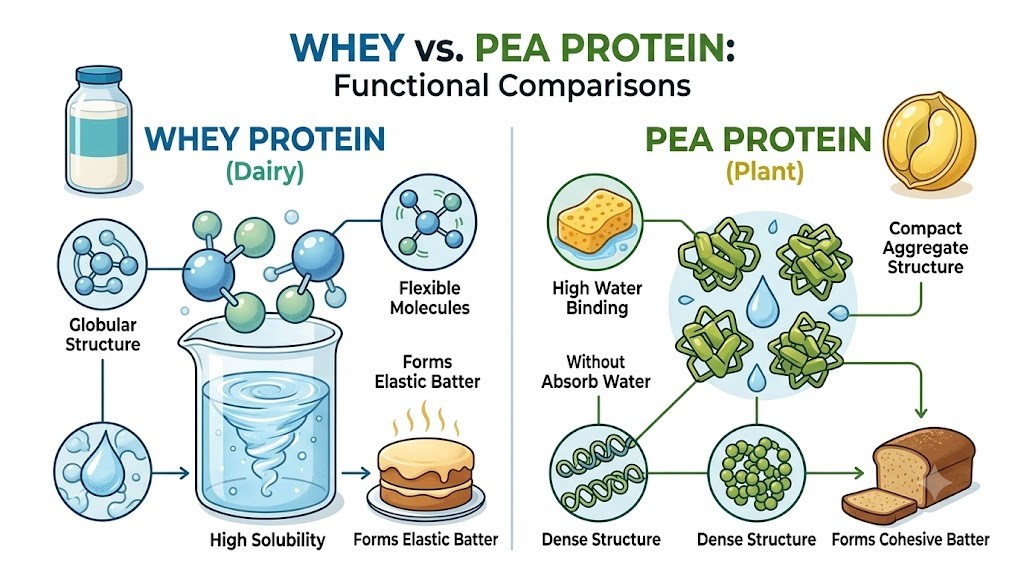
To understand how these powders behave in the oven, we have to look at their molecular DNA. They might both look like fine powders in a tub, but under the microscope, they are completely different beasts.
Whey Protein: The Dairy-Derived Globular Wonder
Whey is a byproduct of cheese making or direct milk microfiltration. It is made up of highly flexible, globular proteins (mostly beta-lactoglobulin and alpha-lactalbumin). Because its structure is rich in flexible, spiral-shaped alpha-helices, whey loves to dissolve in water. In batter, whey molecules migrate quickly to create a smooth, elastic, and stretchy film.
Pea Protein: The Rigid Plant Champion
Derived from yellow field peas (Pisum sativum L.), pea protein has a much more rigid and tightly folded molecular structure. It is packed with compact storage proteins like legumin, vicilin, and convicilin. Instead of flexible spirals, pea protein is dominated by rigid, flat structures called beta-sheets. This makes native pea protein less soluble in water and prone to a distinct earthy or "beany" flavor.
To make it taste better and mix smoother, manufacturers often use mild heat or natural glycation (bonding the protein with natural carbohydrates) to smooth out the texture and tone down the pea flavor.
Bottom Line: Whey protein is made of flexible dairy proteins that dissolve easily and create light, stretchy batters. Pea protein is a plant-based alternative with a rigid, dense structure that makes bakes much more cohesive but demands extra attention in the flavor department.
The Science of Why Protein Powder is NOT Flour
Before you start scooping, there is one non-negotiable rule of high-protein baking: protein powder is not a direct substitute for flour.
Traditional baking flour contains gluten, a protein network responsible for viscoelasticity—a fancy scientific term for the stretchiness that allows dough to trap rising gas bubbles and puff up beautifully in the oven.
Neither whey nor pea protein contain gluten. If you swap out all of your flour for protein powder, your baked goods will lack the structural strength to rise. Instead of a fluffy cake, you'll end up with a dense, crumbly mess that dries out faster than a puddle in the Sahara.
Can You Substitute Pea Protein for Whey? (The Dry Truth)
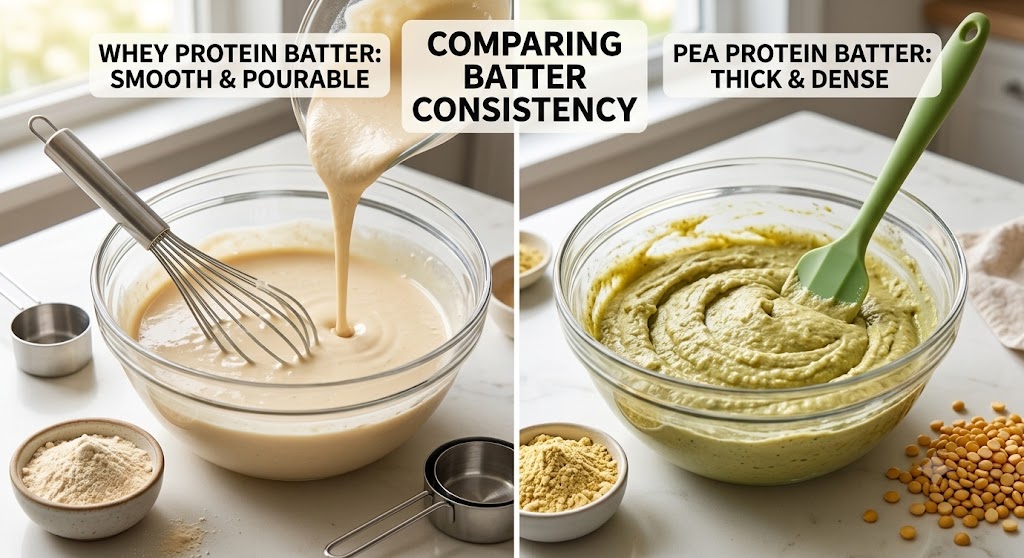
The short answer is yes, but you can’t do a straight 1-to-1 swap without some major structural adjustments.
Because of their molecular differences, plant-based proteins and animal proteins act very differently when they meet moisture and heat.
The Water Binding Sponge Effect
The biggest difference you will notice in the mixing bowl is how much liquid these powders drink up.
Pea Protein is a Moisture Sponge: Pea protein has a massive surface area with exposed water-loving domains. It has an incredibly high water binding capacity (WBC), meaning it locks onto water and holds onto it tightly.
Whey Protein is Water-Shy: Whey protein isolate has a very low water binding capacity. It leaves a lot of "free water" floating around in your batter.
If you try to substitute pea protein for whey using the exact same amount of liquid, your pea protein batter will turn into a thick, dry paste. Conversely, if you use a whey-based recipe without adjustments, the excess unbound water will evaporate during baking, leaving your whey treat dry, shrunken, and rubbery.
The Bounce and Flow of Batter
In baking science, we measure a batter's strength using the elastic modulus (G') and the viscous modulus (G'').
Pea protein keeps these values close to traditional wheat dough, helping your bakes hold their shape beautifully. This is why pea protein cookies are thick, soft, and don't over-spread on the baking sheet.
Whey protein weakens the dough network. Without adjustments, whey cookies spread out flat, get paper-thin, and turn crispy and hard at the edges.
Pro-Tips to Save Your Bakes
If your pea protein batter gets a little too clumpy, here’s a pro-tip from food science: adding a tiny pinch of table salt (specifically achieving a concentration of around 0.1 M in the liquid) triggers a "salting-in" effect. This electrostatic reaction stops the pea protein from clumping together and nearly doubles its solubility.
You can also use natural binders like ground flaxseed, chia gel, or psyllium husk to mimic gluten’s stretchiness and keep your plant-based treats cohesive.
Bottom Line: Pea protein absorbs massive amounts of water, yielding thick batters and soft, plump baked goods. Whey protein absorbs less liquid, which can cause batters to run, cookies to spread flat, and cakes to dry out if you don't adjust the moisture.
The Golden Rules of Protein Powder Substitution
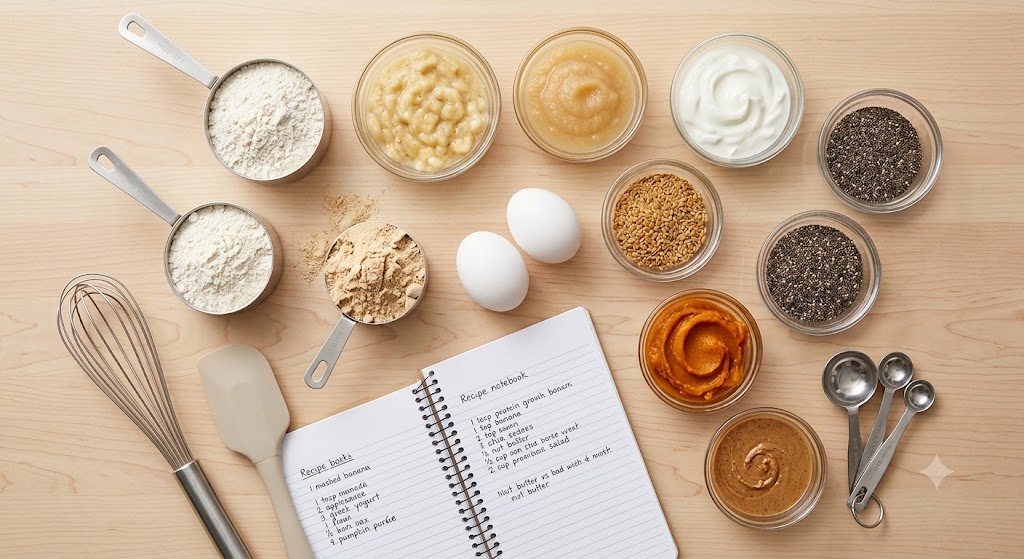
Ready to master the art of high-protein baking? Keep these four rules in your recipe book:
1. Stick to the 1/3 Limit
Never replace more than 25% to 33% of the total flour in a recipe with protein powder.
If your recipe calls for 1 cup of all-purpose flour, the golden ratio is to use 2/3 cup of flour and 1/3 cup of protein powder.
2. Tailor Your Liquid Intake
Since pea protein is much more hydrophilic (water-loving) than whey, you have to scale your liquids accordingly.
When adding a standard 30-gram scoop of whey protein, add an extra 30 to 50 mL (about 2 to 3 tablespoons) of liquid (milk, water, or yogurt).
When substituting that with pea protein, bump the liquid up to 50 to 70 mL per scoop to prevent a crumbly, dry disaster.
3. Add a Natural Humectant
To combat the drying power of protein powder, always include a moisture-boosting humectant. Mashed bananas, applesauce, pumpkin purée, Greek yogurt, or nut butters act as delicious shields that lock in moisture and keep your bakes tender.
4. Turn Down the Heat
Proteins undergo a chemical reaction with sugars (the Maillard reaction) that causes them to brown incredibly fast in the oven. To prevent your muffins from burning on the outside while staying gooey on the inside, lower your oven temperature by 25°F and check on them 5 to 10 minutes earlier than normal.
Protein Baking Comparison Tables
Use these quick-reference tables to see how these two proteins stack up in the kitchen.
Table 1: Whey vs. Pea Protein in the Kitchen
Functional Dimension | Whey Protein Isolate | Pea Protein Isolate |
Gluten Content | 0% (Naturally gluten-free) | 0% (Naturally gluten-free; hypoallergenic) |
Primary Culinary Application | Lighter, delicate bakes (pancakes, cookies, batters) | Dense, cohesive bakes (quick breads, cakes, brownies) |
Moisture Demand | Moderate; requires slight fluid compensation | Exceptionally high; requires structural humectants |
Mixing Tolerance | Low; prone to rubbery textures if overmixed | Moderate; cohesive but requires structural binders |
Table 2: Substitution Ratios by Baking Category
Baked Category | Max Flour Substitution % | Required Fluid Adjustment | Required Structural Binders |
Cakes & Muffins | Up to 33% | Add 50–70 mL liquid per scoop | Applesauce, mashed banana, or pumpkin purée |
Cookies | Up to 54% | Add 30–45 mL liquid per scoop | Nut butters, coconut oil, or whole butter |
Yeast Breads | Max 20% to 25% | Add 60–80 mL liquid per scoop | Ground flaxseed, chia gel, or psyllium husk |
Quick Breads | Up to 30% | Add 50–70 mL liquid per scoop | Greek yogurt or cottage cheese |
Nutritional Comparison & The Sneaky Sodium Secret
While both of these powders are dietary superstars, swapping them changes more than just your batter's texture—it also changes its nutritional blueprint.
Muscle Building Power
Whey protein is often called the king of muscle recovery because it is packed with essential amino acids (EAAs) and branched-chain amino acids (BCAAs), specifically leucine, which kicks muscle repair into high gear.
However, pea protein is no slouch! It is a complete plant-based protein rich in lysine and arginine. In fact, double-blind clinical trials lasting up to 12 weeks showed that individuals taking pea protein isolate gained the exact same amount of muscle thickness and physical strength as those taking whey.
The Sneaky Sodium Discrepancy
If you are watching your salt intake, here is a major surprise: commercial pea protein isolate is naturally loaded with sodium.
While raw yellow field peas contain almost no sodium, the industrial extraction process is a different story. Manufacturers use an alkali-and-acid wash (often utilizing sodium salts) to separate the protein from the starches. Because of this, a standard serving of pea protein isolate can contain up to 238 mg of sodium—taking up nearly 10% of your daily recommended limit!
By comparison, the same serving of whey protein contains a modest 65 mg.
Let VoCal Track the Chemistry for You
Adjusting recipes on the fly is a fun culinary experiment, but keeping track of the shifting macro and micronutrients can be a major headache. If you swap out 40 grams of all-purpose flour for 40 grams of pea protein, you are cutting out about 30 grams of carbs, boosting your protein by 32 grams, and adding some unexpected sodium to your day.
That is where VoCal’s voice-activated calorie tracking makes life simple.
Instead of typing, scrolling, and doing manual kitchen math, you can simply speak your modifications directly into the app:
"Substitute 40 grams of white flour with 40 grams of pea protein isolate in my banana bread recipe."
Our smart voice-parsing system immediately:
Recalculates your macros by trimming the flour carbohydrates and logging the exact protein values of your pea isolate.
Updates your dietary fiber to account for the plant-based bulk.
Flags the sodium shift, ensuring your daily logs stay 100% accurate without you having to read a single tiny nutrition label.
Frequently Asked Questions (FAQs)
Is it safe to bake with protein powder?
Yes, absolutely! Normal baking temperatures do not damage the nutritional value of whey or plant-based protein powders. The protein remains completely bioavailable for muscle synthesis and recovery.
Can I do a straight 1:1 substitution of pea protein for whey?
No. Because pea protein has a much higher water binding capacity, a direct 1:1 swap without adding extra liquid will make your batter incredibly dry, thick, and crumbly. Always scale up your liquid by 20 to 30 mL per scoop when moving from whey to pea.
Why did my whey protein bake turn out rubbery?
Whey protein is highly heat-sensitive and easily overmixed. If you over-stir whey batter, the proteins form tight, rubbery bonds. Stir your batter gently until just combined, and add moisture-rich fats like butter or nut butter to keep the crumb tender.
How do I mask the "earthy" taste of pea protein in sweet recipes?
Pea protein pairs beautifully with strong, bold flavors. Cocoa powder, peanut butter, mashed banana, cinnamon, vanilla extract, and maple syrup are fantastic natural choices to mask any lingering legume-like flavor.
Disclaimer: This is for informational purposes only. For medical advice or diagnosis, consult a professional. If you are managing hypertension or are on a sodium-restricted diet, please consult with a qualified healthcare professional before making significant changes to your protein supplementation.