

If you have ever stood in the supplement aisle or scrolled through your fitness feed, you’ve probably faced the ultimate post-workout dilemma: whey protein vs pea protein. While both of these powders are excellent at helping you hit your daily macronutrient targets on your favorite voice-tracking app, VoCal, they have a massive difference when it comes to their ecological price tag.
For years, whey has been the undisputed heavyweight champion of muscle recovery. But as climate change takes center stage, many fitness enthusiasts are wondering if their daily protein shake is carrying a heavy hidden cost to the planet.
To settle the score, environmental scientists use a tool called a Life Cycle Assessment (LCA). An LCA tracks every single resource used to make your protein powder, from the farm to your blender. And when we put whey and pea protein head-to-head, the results are nothing short of an environmental shake-up.
Here is a breakdown of how your favorite proteins stack up on greenhouse gases, water consumption, and soil health.
Pea and Whey Protein Compared
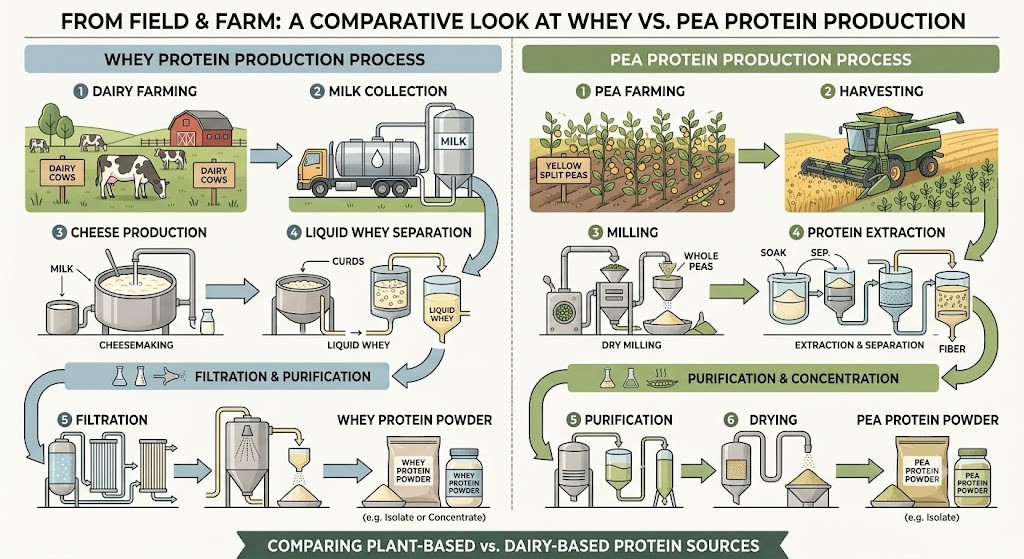
Before we dive into the hard environmental data, let's look at how these two proteins are made.
Whey protein is an animal-derived protein. It is a byproduct of the cheesemaking process. When milk is turned into cheese, the liquid whey is separated, filtered, and dried into a concentrated powder.
Pea protein is a plant-based protein made from yellow split peas (Pisum sativum). The peas are ground into a fine flour, the protein is mechanically isolated, and the mixture is dried into a clean, allergen-friendly powder.
Because whey is a dairy product, it inherits the high environmental overhead of industrial cattle farming. Pea protein, on the other hand, cuts out the "middle animal" entirely, extracting nutrients directly from the soil.
The Carbon Footprint: Bovine Burps vs. Plant Sinks
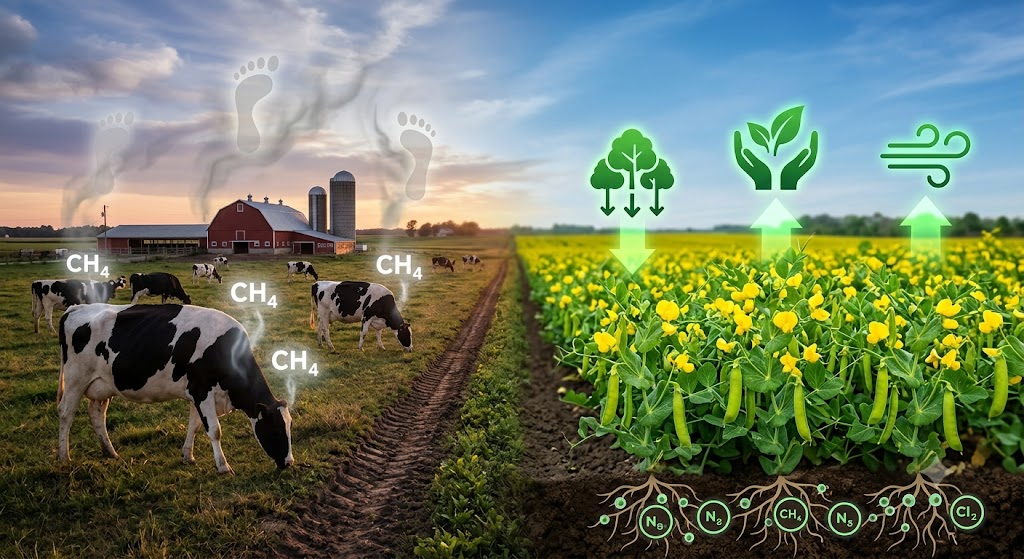
When it comes to greenhouse gas emissions, animal-based and plant-based protein systems live in entirely different atmospheres.
The Heavy Toll of Dairy
To make whey, you first need milk. Cow farming is inherently carbon-heavy for three major reasons:
Enteric Fermentation (Cow Burps): Cows are ruminant animals. Their digestive systems naturally produce biogenic methane, a short-lived but highly potent greenhouse gas that traps heat in the atmosphere. Enteric fermentation accounts for about 45% of all farm-gate emissions in dairy systems.
Manure Management: Storing and treating cow manure releases large amounts of methane and nitrous oxide.
Feed Crop Production: Growing corn and alfalfa to feed dairy cattle requires significant fossil fuel and synthetic fertilizer inputs.
Once the raw milk is harvested, processing plants require intensive electricity and heat to ultra-filter, evaporate, and spray-dry the liquid whey into a stable, dry powder. When researchers calculate the final cradle-to-gate carbon footprint of finished whey protein powder, it ranges from a heavy 13.0 to 18.0 kg of CO2 equivalents (CO2e) per kilogram of product.
The Clean Pulse Alternative
In comparison, yellow split peas do not require digestive systems to grow. Their farm-gate footprint is incredibly low—sitting at just 0.2 to 0.3 kg CO2e per kilogram of harvested crop. Even after they are wet-fractionated and dried in processing plants, the final pea protein powder sits at an average of 2.0 to 4.5 kg of CO2e per kilogram.
Summary Switching from bovine whey to pea protein isolate can reduce your supplement's carbon footprint by roughly 75% to 80%. While whey carries a heavy climate debt due to enteric methane emissions from cows, yellow peas bypass animal metabolism entirely.
The Water Footprint: Which Protein is Thirstier?
With severe water scarcity affecting major agricultural states, how much water your protein shake "drinks" before it reaches you matters.
The Diligent Drinking Habits of Dairy
To put it simply, dairy cows are incredibly thirsty. On average, producing a single kilogram of raw cow's milk requires about 628 liters of freshwater. This hydrological debt is driven by the vast amounts of irrigated feed crops (like alfalfa) cows eat, direct hydration for the cattle, and the cleaning requirements of dairy processing plants. When this milk is concentrated into whey isolate, it carries that upstream water footprint with it.
Drought-Resilient Peas
Yellow split peas are built for water conservation. Peas have relatively shallow root systems that allow them to draw surface soil moisture efficiently without draining deep groundwater aquifers.
Environmental data shows that the majority of peas in the United States are grown in dryland regions (like the Northern Plains) under rainfed conditions. They rely almost entirely on natural precipitation rather than artificial irrigation, protecting local watersheds. Life cycle modeling shows that substituting milk-derived proteins with pea protein can lower freshwater consumption by up to 92% per serving.
Summary Dairy production requires vast amounts of freshwater to grow cattle feed and sanitize processing facilities. Yellow split peas are hardy, rainfed crops that grow beautifully in dry climates, offering up to a 92% water savings compared to bovine dairy.
Land Use and Regenerative Soil Chemistry
Beyond carbon and water, we have to look at the ground beneath our feet. How much land does your protein require, and what does it do to the soil?
The Inefficiencies of Trophic Conversion
Raising animals for food is naturally land-inefficient. Livestock farming uses almost 80% of global agricultural land but delivers only 37% of our protein.
Ruminant dairy systems require extensive acreage for cattle grazing and feed cultivation. This footprint can lead to deforestation and biodiversity loss as wild spaces are converted to pastureland.
Peas are highly land-efficient because we consume them directly. Plant-based protein crops require up to 97% less land than conventional animal-sourced proteins to produce the same amount of nutrient density.
Peas’ Secret Weapon: Nitrogen Fixation
Peas also perform a biological magic trick that helps the soil. Most crops deplete soil nutrients, requiring farmers to apply synthetic nitrogen fertilizers. Producing these fertilizers is incredibly energy-intensive and releases high amounts of greenhouse gases.
But peas belong to the legume family. They have a symbiotic relationship with Rhizobium bacteria in their roots that allows them to pull nitrogen gas directly from the air and convert it into a natural fertilizer. This process eliminates the need for chemical fertilizers and leaves the soil nutrient-rich for the next crop cycle.
Summary Animal-based proteins require massive grazing and feed cropland. Switching to pea protein reduces land-use requirements by up to 97% and enriches soil naturally through symbiotic nitrogen fixation, eliminating the need for harmful synthetic fertilizers.
Satiety, Tracking, and Sparing Muscle on Low-Carb Regimens
While environmental metrics are crucial, your nutrition matters, too. When tracking your weight loss journey on the Vo-cal app, you might be keeping an eye on your carbohydrates.
The Low-Carb Metabolic Shift
If you are restricting carbohydrates on a low-carb diet (typically 60 to 130 grams per day) or a very low-carb ketogenic diet (20 to 50 grams per day), protein is your best friend.
When you sharply cut carbs, your body exhausts its stored glycogen. Because every gram of glycogen binds approximately 3 grams of water in your liver and muscles, you experience a rapid loss of fluid weight in the first 1 to 2 weeks.
During this metabolic shift, eating adequate protein protects your lean muscle mass. If dietary carbohydrates are scarce, your liver can convert amino acids into glucose via a pathway called gluconeogenesis. Dietary protein is also the most satiating macronutrient, helping suppress hunger hormones so you naturally consume fewer calories over the course of the day.
Below is a breakdown of how structured, protein-centric low-carb diets influence your body's metabolism.
Metabolic Parameter | Low-Carb Range (60-130g/day) | Very Low-Carb/Keto Range (20-50g/day) | Physiological & Clinical Mechanism |
Daily Carbohydrate Allowance | 60 to 130 g (240 to 520 kcal) | 20 to 50 g (80 to 200 kcal) | Limits glucose, shifting cellular fuel to fats and ketones. |
Initial Weight Loss Driver | Glycogen depletion | Rapid glycogen clearance | Glycogen binds 3g of water; depletion triggers rapid fluid loss. |
Insulin Response | Moderate reduction | Drastic systemic drop | Low insulin levels activate hormone-sensitive lipase. |
Average 12-Month Weight Loss | Approx. 13 lbs (6 kg) | Approx. 13 lbs (6 kg) | Initial rapid weight loss tends to equalize in the long term. |
Visceral Fat Reduction | Enhanced fat clearance | Statistically superior | Low-carb can reduce visceral fat by up to 22.8% vs. 1% for low-fat. |
Metabolic Sparing of Muscle | Protein acts as structural buffer | Gluconeogenesis substrate | Dietary amino acids prevent catabolism of muscle tissues. |
Technical Comparison of Environmental Indicators
To see the direct ecological differences between these powders, let's look at the numbers side-by-side. This table also includes precision-fermented whey, an innovative, emerging tech that brews real dairy proteins using microflora in a bioreactor without a single cow.
Environmental Indicator | Bovine Whey Protein (Mass/Economic Allocation) | Pea Protein Isolate (Yellow Split Pea) | Precision-Fermented Whey (Animal-Free) | Primary Ecological Driver |
Carbon Footprint (GWP100) | 13.0 to 18.0 kg CO2e / kg | 2.0 to 4.5 kg CO2e / kg | 0.89 to 2.5 kg CO2e / kg | Enteric methanogenesis in cows vs. crop energy inputs. |
Blue Water Consumption | High (~628 L freshwater equivalent per kg of milk) | Very Low (predominantly rainfed / green water) | Very Low (96% to 99% reduction vs. bovine milk) | Irrigated cattle feed vs. dryland pulse farming. |
Land Use Intensity | Extremely High (pasture and feed cropland) | Extremely Low (97% reduction compared to dairy) | Ultra-Low (bypasses agricultural acreage) | Trophic conversion losses in livestock vs. crop yield. |
Eutrophication Potential | High (manure runoff and synthetic fertilizer leaching) | Low (zero synthetic nitrogen inputs needed) | Minimal (highly controlled industrial process) | Nitrate leaching into waterways vs. symbiotic nitrogen fixation. |
Alternatives and Allocation Shenanigans
If you are digging into the science of sustainability, you might occasionally spot a study that claims whey has a very low carbon footprint. What gives?
The answer lies in how Life Cycle Assessments handle co-products. Because cheese and whey are produced from the same raw milk, researchers have to decide how to split the milk's environmental footprint between them.
Zero-Burden Method: Historically, raw liquid whey was treated as waste. Some older LCAs assumed that the cheese carries 100% of the environmental burden, giving raw whey a footprint of almost zero. This is misleading because whey is now a highly valuable commercial product.
Economic Allocation: This method distributes the footprint based on market value. Since cheese is worth more, it gets about 85% to 90% of the emissions, leaving whey with 10% to 15%. However, as whey prices rise, its carbon footprint share grows, too.
Mass and Physical Allocation: Recommended by the International Organization for Standardization (ISO), this method splits the footprint based on dry matter or protein content. Under physical allocation, whey is assigned its fair share of the cow's metabolic emissions, confirming that plant-based protein powders are the more sustainable and reliable choice over time.
Other factors to consider
While sustainability is a major win for pea protein, there are a few other differences to keep in mind when choosing your supplement:
Allergens and Digestion: Whey contains lactose, which can trigger gas, bloating, and stomach discomfort in about 65% of the global adult population. Pea protein is naturally dairy-free, gluten-free, and hypoallergenic, making it exceptionally gentle on the stomach.
Amino Acid Profiles: Whey is a "complete" protein, meaning it has all nine essential amino acids in perfect quantities. Pea protein is slightly low in the amino acid methionine. However, most high-quality plant-protein powders blend pea and brown rice protein together to create a complete amino acid profile that performs equally to whey for building muscle and recovery.
Taste and Texture: Whey is naturally creamy and dissolves easily in water. Poorly formulated pea protein can taste earthy or chalky, but modern, high-quality blends utilize advanced milling to deliver an incredibly smooth texture.
The Bottom Line
When it comes to your environmental footprint, pea protein is the clear winner.
By switching from bovine whey to pea protein, you can slash your supplement’s carbon footprint by up to 80% and save thousands of gallons of water.
If you prefer the taste and speed of dairy, look into emerging precision-fermented whey products. They offer the exact same amino acid performance as traditional whey but are brewed cleanly in a facility with up to 97% fewer emissions.
By paying attention to how you source your proteins and tracking your macros with VoCal, you can hit your fitness targets and take care of the planet at the same time!
Frequently Asked Questions (FAQs)
Is plant protein as effective as whey for building muscle?
Yes! Clinical trials consistently show that when plant-based proteins contain a complete amino acid profile (like a pea and brown rice blend), they support muscle growth, recovery, and strength gains just as effectively as whey.
Why is the carbon footprint of pea protein so much lower than whey?
Peas are grown directly from the soil, whereas whey requires raising a cow. Cows generate biogenic methane from digestion and manure, and require massive amounts of feed, making dairy-based whey highly carbon-intensive.
How does pea protein save water?
Peas are highly drought-tolerant, have shallow roots, and are grown primarily under dryland, rainfed conditions in the Northern Plains. Dairy farming relies on heavily irrigated cattle feed, drinking water for livestock, and facility sanitation, requiring hundreds of liters of water per serving.
Does pea protein contain allergens?
No. Unlike whey, which contains dairy and lactose, high-quality pea protein is naturally free from dairy, soy, gluten, and common allergens.
Disclaimer: This is for informational purposes only. For medical advice or diagnosis, consult a professional. Always speak with your physician or a qualified healthcare provider before starting any new dietary supplement, lifestyle change, or athletic regimen.