

You crack a few eggs into a bowl, whisk them up, throw in a handful of spinach and cheddar, and whip up a warm, golden breakfast. But right as you take that first delicious bite, a thought pops into your head: How many omelette calories am I actually eating right now?
Calculating omelette calories can sometimes feel like a high school algebra pop quiz. Is it 200 calories? 500 calories? Did that quick splash of olive oil in the pan just double your total energy intake?
Whether you are hitting the gym, cutting back on carbs, or just trying to eat a little smarter, getting your nutrition numbers right shouldn't be stressful. In this guide, we are breaking down everything you need to know about omelette nutrition—from 1 to 5 whole eggs, cooking oil traps, egg white swaps, and cheese choices. Plus, keeping track of your custom breakfast creation is a breeze when you use VoCal, the smart voice app that lets you log your meals in seconds just by speaking!
Cracking the Math: How Much Protein and Calories Are in a 1 to 5 Egg Omelette?

To figure out your baseline omelette calories and protein, we have to start with standard whole eggs. According to official data from the USDA FoodData Central repository, a single standard Large Egg (Grade A) weighs roughly 50 grams in its shell.
When you cook a plain omelette using non-stick cookware or a quick dash of low-calorie cooking spray, the caloric math scales up smoothly. One large whole egg packs about 72 calories, 6.3 grams of complete protein, and 4.8 grams of healthy fats.
The egg yolk holds almost all of the egg’s natural fats, fat-soluble vitamins (like vitamins A, D, E, and K), and essential nutrients like choline, while the egg white delivers pure, fat-free protein.
Here is how your dry-cooked whole egg omelette stacks up as you add more eggs to the bowl:
Whole Egg Volume | Total Raw Weight (g) | Total Energy (kcal) | Protein (g) | Total Fat (g) | Carbohydrates (g) | Cholesterol (mg) | Choline (mg) |
1 Large Egg | 50 g | 72 kcal | 6.3 g | 4.8 g | 0.4 g | 186 mg | 147 mg |
2 Large Eggs | 100 g | 144 kcal | 12.6 g | 9.6 g | 0.8 g | 372 mg | 294 mg |
3 Large Eggs | 150 g | 216 kcal | 18.9 g | 14.4 g | 1.2 g | 558 mg | 441 mg |
4 Large Eggs | 200 g | 288 kcal | 25.2 g | 19.2 g | 1.6 g | 744 mg | 588 mg |
5 Large Eggs | 250 g | 360 kcal | 31.5 g | 24.0 g | 2.0 g | 930 mg | 735 mg |
Bottom Line: Plain whole eggs scale predictably at roughly 72 calories and 6.3 grams of high-quality protein per egg. A classic 3-egg omelette gives you a solid baseline of 216 calories and almost 19 grams of protein before adding cooking fats or toppings.
The Pan-Frying Surprise: How Cooking Oils and Butter Shift Your Calorie Count
Here is where most breakfast lovers get tricked. You might log three eggs in your calorie tracker, but what about the butter swirled around the skillet?
Fats are energy dense, packing 9 calories per single gram compared to just 4 calories per gram for protein or carbs. Freehand pouring oil straight from the bottle can easily throw an extra 100 to 150 calories into your pan without you even realizing it.
Here is how common cooking fats compare:
Butter: A single level tablespoon (14 grams) of butter adds 102 calories and 11.5 grams of fat. If you stick to just a light teaspoon (4.7 grams), it is a far more modest 34 calories.
Extra Virgin Olive Oil (EVOO): Pure olive oil is 100% lipid. One tablespoon brings 119 calories and 13.5 grams of heart-healthy monounsaturated fat, while one teaspoon adds 40 calories.
Aerosol Cooking Spray: A quick 1-second spritz coats your pan for only about 5 calories and 0.5 grams of fat.
Cooking Fat Option | Standard Serving | Energy Yield (kcal) | Total Fat (g) | Saturated Fat (g) | Monounsaturated Fat (g) |
Aerosol Cooking Spray | 1-second discharge (~0.5g) | 5 kcal | 0.5 g | 0.1 g | 0.2 g |
Butter (Teaspoon) | 1 tsp (~4.7g) | 34 kcal | 3.8 g | 2.4 g | 1.0 g |
Butter (Tablespoon) | 1 tbsp (14g) | 102 kcal | 11.5 g | 7.2 g | 3.0 g |
Extra Virgin Olive Oil (Teaspoon) | 1 tsp (~4.7g) | 40 kcal | 4.5 g | 0.6 g | 3.3 g |
Extra Virgin Olive Oil (Tablespoon) | 1 tbsp (14g) | 119 kcal | 13.5 g | 1.9 g | 9.9 g |
When you combine whole eggs with cooking fats, total omelette calories jump up fast:
Whole Egg Base | Dry / Aerosol Spray (0–5 kcal) | + 1 tsp Butter (+34 kcal) | + 1 tbsp Butter (+102 kcal) | + 1 tbsp Olive Oil (+119 kcal) |
1 Egg Omelette | 72 kcal | 106 kcal | 174 kcal | 191 kcal |
2 Egg Omelette | 144 kcal | 178 kcal | 246 kcal | 263 kcal |
3 Egg Omelette | 216 kcal | 250 kcal | 318 kcal | 335 kcal |
4 Egg Omelette | 288 kcal | 322 kcal | 390 kcal | 407 kcal |
5 Egg Omelette | 360 kcal | 394 kcal | 462 kcal | 479 kcal |
Bottom Line: Unmeasured pan fats can quietly double your omelette's caloric weight. Cooking a 3-egg omelette in a tablespoon of olive oil increases total energy from 216 to 335 calories—a 55% jump derived completely from added fat!
Whole Eggs vs. Egg Whites: Are Egg Whites Really Worth the Swap?
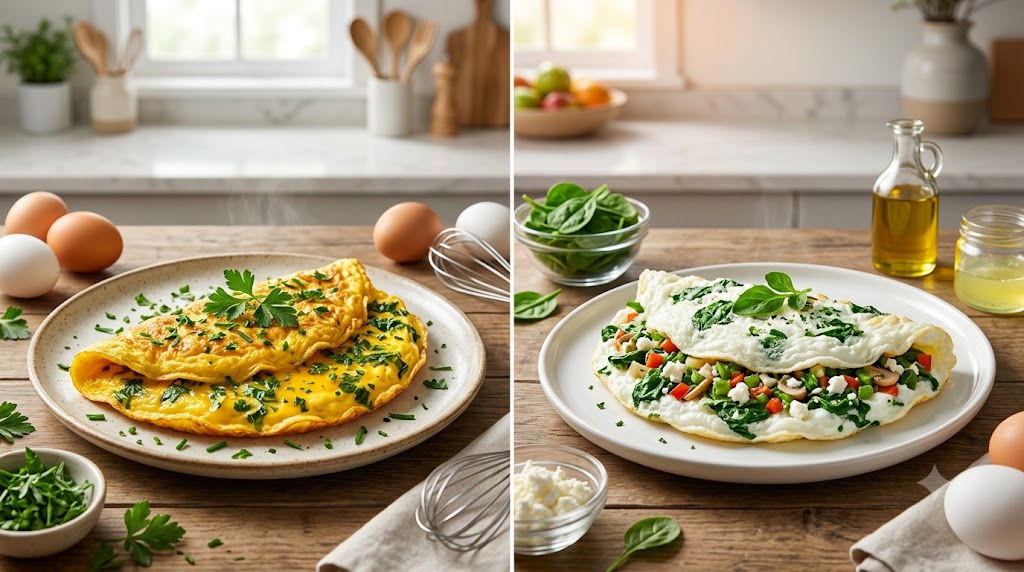
If you are cutting calories, you have probably wondered if switching to egg whites is worth skipping the tasty yolk.
Let's look at the numbers:
1 Whole Large Egg (~50g): 72 calories, 6.3g protein, 4.8g fat.
1 Large Egg White (~33g): 17 calories, 3.6g protein, 0.1g fat.
If your goal is hitting roughly 25 grams of protein in your meal, you could eat either 4 whole eggs OR 7 egg whites. But while the 4 whole eggs equal 286 calories and 19 grams of fat, the 7 egg whites deliver that same 25 grams of protein for only 120 calories and almost zero fat—saving you over 160 calories!
However, throwing away all your yolks means missing out on vital nutrients like vitamin D, lutein, and choline (which supports brain function and metabolism). That is why many fitness coaches recommend a hybrid omelette. Mixing whole eggs with extra egg whites keeps calories low while preserving those crucial yolk nutrients.
Omelette Formulation | Caloric Total (kcal) | Protein Yield (g) | Total Fat (g) | Saturated Fat (g) | Dietary Cholesterol (mg) | Primary Clinical Target |
4 Whole Eggs | 286 kcal | 25.1 g | 19.0 g | 6.3 g | 744 mg | High energy, maximum micronutrient density |
7 Egg Whites | 120 kcal | 25.2 g | 0.4 g | 0.1 g | 0 mg | Calorie-restricted protein loading |
2 Whole + 4 Whites | 213 kcal | 27.0 g | 9.8 g | 3.3 g | 372 mg | Moderate calories, high protein, balanced yolk nutrition |
1 Whole + 5 Whites | 157 kcal | 24.3 g | 5.0 g | 1.7 g | 186 mg | Low fat, high volume, essential choline retention |
Bottom Line: Pure egg white omelettes are amazing for saving calories during weight loss, but hybrid combinations (like 2 whole eggs plus 4 egg whites) offer the ultimate balance of high protein, low calories, and rich nutrients.
Say Cheese! How Cheddar, Feta, and Veggies Change Your Calorie Count
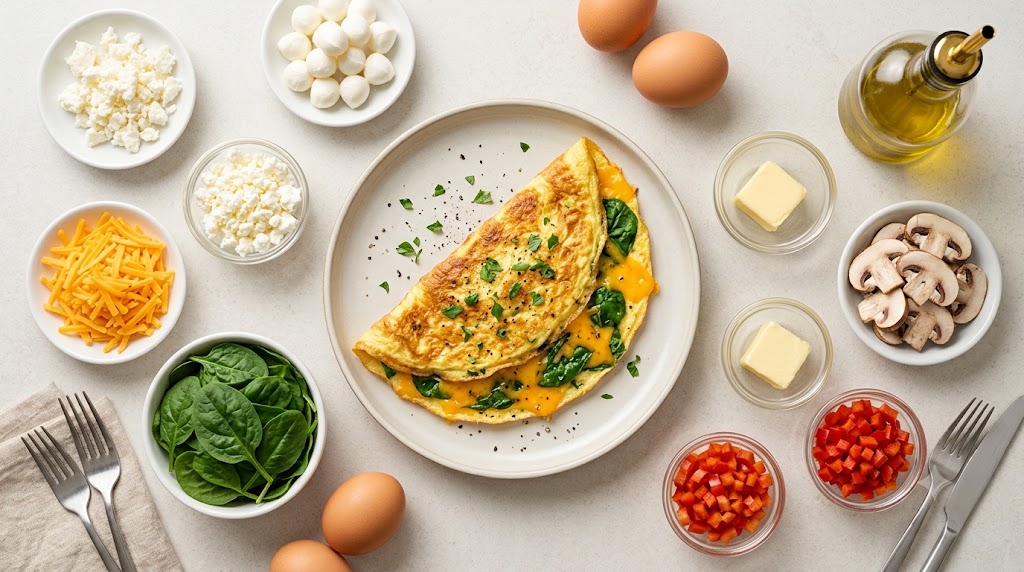
What is an omelette without delicious fillings? Adding cheese, vegetables, and herbs can turn a simple egg dish into a gourmet breakfast, but each topping shifts your total omelette calories.
Cheddar Cheese: Aged hard cheeses melt beautifully, but they are calorically dense. One ounce of shredded cheddar (about a small handful) adds 114 calories and 9.4 grams of fat.
Feta Cheese: High-moisture, tangy feta gives you big flavor for fewer calories. One ounce adds only 75 calories and 6.0 grams of fat.
Part-Skim Mozzarella: A balanced middle option supplying 84 calories and 6.3 grams of fat per ounce.
Non-Starchy Veggies: Spinach, mushrooms, onions, and bell peppers are your secret weapon for weight loss! They add fiber, volume, and nutrients for virtually no extra calories.
Ingredient / Filling | Serving Size | Energy (kcal) | Protein (g) | Total Fat (g) | Carbohydrates (g) | Dietary Fiber (g) |
Cheddar Cheese (Full Fat) | 1 oz (28g) | 114 kcal | 6.8 g | 9.4 g | 0.7 g | 0.0 g |
Cheddar (Reduced Fat) | 1 oz (28g) | 80 kcal | 7.7 g | 5.1 g | 0.8 g | 0.0 g |
Feta Cheese | 1 oz (28g) | 75 kcal | 4.0 g | 6.0 g | 1.1 g | 0.0 g |
Part-Skim Mozzarella | 1 oz (28g) | 84 kcal | 6.9 g | 6.3 g | 0.8 g | 0.0 g |
Fresh Baby Spinach | 1 cup (30g) | 7 kcal | 0.9 g | 0.1 g | 1.1 g | 0.7 g |
Sliced Button Mushrooms | 0.5 cup (35g) | 8 kcal | 1.1 g | 0.1 g | 1.2 g | 0.4 g |
Diced Red Bell Pepper | 0.5 cup (50g) | 13 kcal | 0.5 g | 0.1 g | 3.0 g | 1.1 g |
Bottom Line: Swapping full-fat cheddar for feta saves nearly 40 calories per ounce. Meanwhile, piling on mushrooms and leafy greens builds a massive, filling meal with negligible caloric impact!
The Dietitian Verdict: Is an Omelette Good for Weight Loss?
Yes, absolutely! Omelettes are widely considered one of the best breakfast options for fat loss and muscle maintenance.
Here is why dietitians love them:
Suppresses Hunger Hormones: High-protein meals trigger the release of fullness hormones like GLP-1 and PYY while reducing hunger signals. A protein-packed omelette stops mid-morning snack cravings in their tracks.
Stable Blood Sugar: Plain egg omelettes are naturally low in carbs. That means no sudden blood sugar spikes or insulin surges, making it easier for your body to burn stored fat for fuel.
What About Cholesterol? Medical research from top institutions like the Mayo Clinic confirms that for most healthy adults, eating dietary cholesterol in eggs does not raise blood cholesterol the way saturated and trans fats do. Healthy individuals can safely enjoy up to 7 whole eggs per week as part of a balanced diet.
Bottom Line: Omelettes support weight loss by keeping you full for hours and stabilizing blood sugar. Top health authorities agree that regular egg intake fits comfortably into a heart-healthy diet plan.
Track Your Custom Omelette in Seconds with VoCal
Let’s be honest: manually typing every single ingredient of your breakfast into a standard calorie tracker can be annoying. Searching for "large whole eggs," "extra egg whites," "teaspoon of olive oil," "feta cheese," and "spinach" takes way too many clicks when you are running late in the morning.
That is where VoCal steps in to revolutionize your daily routine!
Instead of typing, you simply speak naturally into your phone:
"I had a 3-egg omelette cooked in 1 teaspoon of olive oil with an ounce of feta cheese and a cup of spinach."
In an instant, VoCal uses voice recognition and USDA nutritional databases to automatically break down your meal:
3 Large Whole Eggs: 216 kcal
1 tsp Olive Oil: 40 kcal
1 oz Feta Cheese: 75 kcal
1 cup Baby Spinach: 7 kcal
Total Meal: 338 calories & 23.8g protein
No typing, no guessing, no searching through endless databases. Just tap, speak, and get on with your day!
Frequently Asked Questions (FAQs)
How many calories are in a standard 3-egg cheese omelette?
A basic 3-whole-egg omelette cooked with 1 teaspoon of butter and 1 ounce of cheddar cheese contains approximately 364 calories and 25.7 grams of protein.
What is the lowest-calorie way to make an omelette?
To make the lowest-calorie omelette possible, use 4 egg whites (68 kcal), coat your pan with a 1-second burst of aerosol spray (5 kcal), and stuff it with fresh spinach, mushrooms, and diced peppers. You get a huge plate of food for under 100 calories!
Is cooking an omelette in olive oil healthier than butter?
Both can fit into a healthy diet, but extra virgin olive oil provides heart-healthy monounsaturated fats, whereas butter contains higher levels of saturated fat. In terms of omelette calories, olive oil has slightly more calories per tablespoon (119 kcal) than butter (102 kcal) because butter contains small amounts of water.
Can I eat a 3-egg omelette every day?
Yes! Current clinical guidance shows that healthy adults can consume eggs daily without increasing cardiovascular disease risk. If you need to manage your dietary cholesterol or blood lipids, speak with your healthcare provider or try using a mix of whole eggs and egg whites.
Disclaimer: This is for informational purposes only. For medical advice or diagnosis, consult a professional.