

Whether you are whipping up a quick breakfast before heading to work or refueling after a heavy gym session, the classic omelette is an absolute superstar. Eggs are fast, affordable, packed with high-quality protein, and incredibly versatile.
But if you are trying to reach specific fitness goals, you have probably wondered: How much protein am I actually getting in my morning pan, and how do added toppings change my overall omellete calories?
Understanding the baseline numbers for Protein in Omelettes helps you build a meal that keeps you full and energized all morning. Let's break down the math egg-by-egg—from a light 1-egg bite all the way to a massive 5-egg feast.
The Base Breakdown: Plain Omelettes (1 to 5 Eggs)

According to official United States Department of Agriculture (USDA) nutrition data, a single large raw egg (about 50 grams) delivers roughly 6.3 grams of complete protein and 72 calories with virtually zero carbs.
When you cook plain eggs in a skillet without extra butter or oil, the numbers scale predictably. The mathematical formula for estimating raw base protein P(n) and caloric content C(n) for n large eggs is:
P(n) = 6.3 * n (grams of protein)
C(n) = 72 * n (kilocalories)
Here is how plain, whole-egg omelettes stack up across standard serving sizes:
Egg Quantity | Total Mass (g) | Protein (g) | Total Energy (kcal) | Total Fat (g) | Net Carbohydrates (g) |
1 Large Egg | 50 | 6.3 | 72 | 4.8 | 0.36 |
2 Large Eggs | 100 | 12.6 | 144 | 9.6 | 0.72 |
3 Large Eggs | 150 | 18.9 | 216 | 14.4 | 1.08 |
4 Large Eggs | 200 | 25.2 | 288 | 19.2 | 1.44 |
5 Large Eggs | 250 | 31.5 | 360 | 24.0 | 1.80 |
What Each Size Means for Your Diet:
The 1-Egg Bite (6.3g Protein, 72 kcal): Perfect as a light snack or as a protein binder for a veggie-packed dish.
The 2-Egg Classic (12.6g Protein, 144 kcal): A light, sensible baseline meal supplying about 25% of your daily protein needs on a standard diet.
The 3-Egg Powerhouse (18.9g Protein, 216 kcal): The gold standard for breakfast. Hitting nearly 19 grams of protein puts you right near the 20-gram target needed to stimulate maximal muscle building.
The 4-Egg & 5-Egg Feasts (25.2g to 31.5g Protein): Muscle-building heavyweights ideal for strength athletes or anyone on a low-carb protocol looking for long-lasting energy.
Egg Whites vs. Yolks: Where Does the Protein Live?
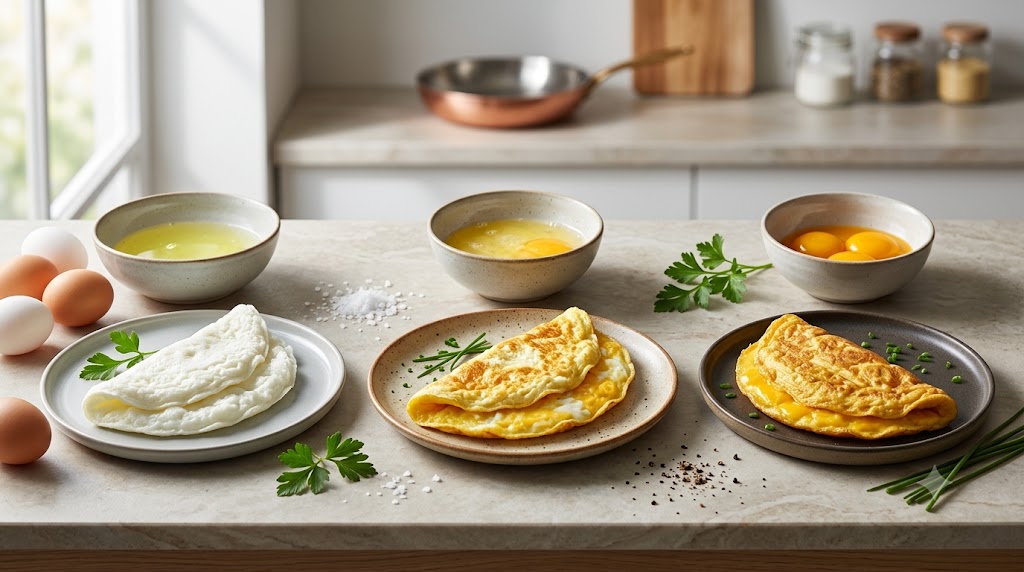
There is a common myth that all the protein sits in the clear egg white while the yolk is pure fat. In reality, the yolk holds a substantial portion of the egg's total protein!
Out of a 50g egg, the white makes up about 33 grams and the yolk makes up about 17 grams.
Component | Portion Mass (g) | Protein (g) | Energy (kcal) | Total Fat (g) | Protein Share of Calories |
Egg White (Albumen) | ~33 | 3.6 | 17 | 0.05 | 84.7% |
Egg Yolk (Vitellus) | ~17 | 2.7 | 55 | 4.50 | 19.6% |
Whole Large Egg | ~50 | 6.3 | 72 | 4.80 | 35.0% |
Nearly 43% of the overall Protein in Omelettes actually comes from the yolk! However, the egg white is exceptionally lean, offering 85% of its calories directly from protein.
The Hybrid Trick: Maximizing Volume & Protein
If you want a high-volume omelette without piling on extra fat, try blending whole eggs with additional egg whites.
For example, combining 2 whole eggs + 3 egg whites gives you:
Protein:(2 * 6.3 g) + (3 * 3.6 g) = 23.4 grams
Calories:(2 * 72 kcal) + (3 * 17 kcal) = 195 calories
Fat:(2 * 4.8 g) + (3 * 0.05 g) = 9.75 grams
You get a big, satisfying omelette with over 23 grams of protein for under 200 calories before pan oil! Don't skip all yolks, though—the yolk contains choline for brain health, eye-protecting antioxidants (lutein and zeaxanthin), and essential fat-soluble vitamins.
The Cooking Medium & Mix-Ins: Managing Omelette Calories
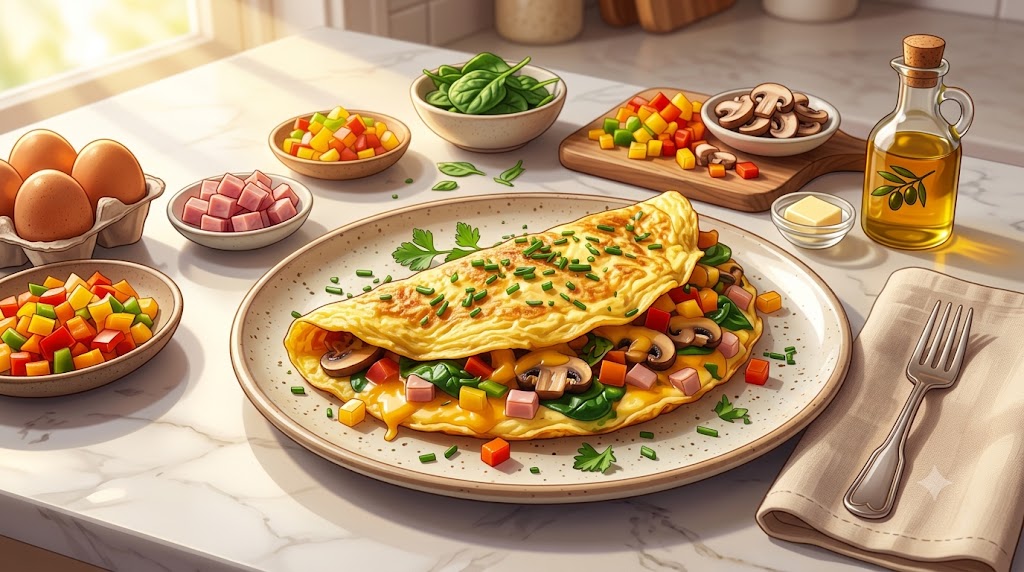
While the egg base is naturally low in calories, what you put in the skillet changes the equation quickly. A tablespoon of cooking butter or olive oil adds 102 to 119 calories, effectively doubling your meal's energy content before you even add cheese!
Add-in / Cooking Medium | Standard Portion | Energy (kcal) | Protein (g) | Fat (g) | Net Carbohydrates (g) |
Butter (Pan Fat) | 1 tsp (5g) | 36 | 0.0 | 4.1 | 0.0 |
Butter (Pan Fat) | 1 tbsp (14g) | 102 | 0.1 | 11.5 | 0.0 |
Olive Oil (Pan Fat) | 1 tbsp (14g) | 119 | 0.0 | 13.5 | 0.0 |
Reduced-Fat Cheddar Cheese | 1 oz (28g) | 79 | 7.6 | 5.0 | 0.6 |
Diced Dressed Ham | 1 oz (28g) | 40 | 6.0 | 1.5 | 0.5 |
Raw Spinach | 1 cup (30g) | 7 | 0.9 | 0.1 | 1.1 |
Diced Bell Peppers | 1/2 cup (75g) | 20 | 0.7 | 0.2 | 4.6 |
Sautéed Mushrooms | 1/2 cup (35g) | 15 | 1.1 | 0.2 | 2.3 |
Two Real-World Skillet Examples
The Lean Garden 2-Egg Omelette
2 Whole Eggs + 1 tsp Butter + 1 cup Spinach + 1/2 cup Peppers
Total: 207 Calories | 14.2g Protein | 14.0g Fat | 5.7g Net Carbs
The Loaded Western 3-Egg Omelette
3 Whole Eggs + 1 tbsp Olive Oil + 1 oz Reduced-Fat Cheddar + 1 oz Diced Ham
Total: 454 Calories | 32.5g Protein | 34.4g Fat | 1.1g Net Carbs
Notice how the choice of cooking oil and toppings shifts the total omellete calories while boosting protein intake!
Health Perks: Why Omelettes are Satiety Superstars
Keeps Hunger Away: The combination of complete protein and natural fats triggers satiety hormones (like PYY and GLP-1) while curbing ghrelin (your hunger signal).
No Sugar Crashing: Eggs contain almost zero sugar or refined carbs, so you avoid the dreaded 10 AM energy crash caused by sugary cereals or pastries.
Supports Muscle Health: Eating sufficient high-quality protein helps prevent muscle loss as you age and supports repair after workouts.
Dietary Cholesterol Updated: Current US Dietary Guidelines no longer cap cholesterol at 300 mg/day, recognizing whole eggs as a core nutrient-dense food that fits into a healthy lifestyle.
Effortless Tracking with VoCal
Trying to weigh out two eggs, measure a splash of oil, and guess how much shredded cheese you sprinkled into the pan can make tracking meals feel tedious.
With VoCal, logging your custom omelette is as simple as having a conversation! Instead of typing individual items into a search bar, just speak naturally:
"I had a three-egg omelette cooked in a teaspoon of butter with a handful of spinach and an ounce of cheddar cheese."
VoCal automatically breaks down your sentence into USDA-verified data:
3 Large Eggs: 216 kcal | 18.9g Protein
1 tsp Butter: 36 kcal | 0.0g Protein
1 cup Spinach: 7 kcal | 0.9g Protein
1 oz Cheddar: 79 kcal | 7.6g Protein
Grand Total logged instantly: 338 Calories | 27.4g Protein
No typing, no searching, and no stress.
Frequently Asked Questions (FAQs)
1. How many calories and protein are in a standard 3-egg omelette?
A plain 3-egg omelette made with large whole eggs contains approximately 216 calories and 18.9 grams of protein. If cooked with 1 teaspoon of butter, the total comes out to about 252 calories.
2. Is it better to eat egg whites or whole eggs for weight loss?
Both have advantages! Egg whites are super low in calories and virtually fat-free, making them ideal for cutting calories while keeping protein high. However, whole eggs provide essential nutrients like choline, vitamin D, and fat that promotes long-term satiety. A hybrid mix (e.g., 2 whole eggs + 2 egg whites) offers a great balance.
3. Does adding milk to an omelette add a lot of calories?
Adding a splash of whole milk (about 1 tablespoon or 15 ml) adds only around 9 calories and 0.5 grams of protein. It gives your omelette a fluffier texture without significantly impacting your daily macro totals.
4. How many eggs can I safely eat per day?
For most healthy adults, eating 1 to 3 whole eggs daily fits well within a balanced, nutrient-dense diet.
Disclaimer: This content is for informational purposes only and does not constitute medical advice. Always consult with a healthcare professional or nutritionist before making significant changes to your diet.