

Few comfort foods hit the spot quite like a golden, crispy plate of fish and chips. That warm, satisfying crunch of beer-battered white fish paired with piping hot fries and tangy tartar sauce is an absolute classic.
But if you’re keeping an eye on your daily energy intake, you might wonder: How many fish and chips calories are actually sitting on that plate?
The short answer? It varies drastically depending on whether you’re ordering at a local pub or whipping up a lighter version in your own kitchen. In this guide, we’ll break down the calorie numbers for restaurant portions, show you how to save up to 1,000 calories at home, explore delicious vegetarian swaps like banana blossom and tofu, and show you how to log it all effortlessly with VoCal!
Restaurant Fish and Chips Calories: The Crispy Truth
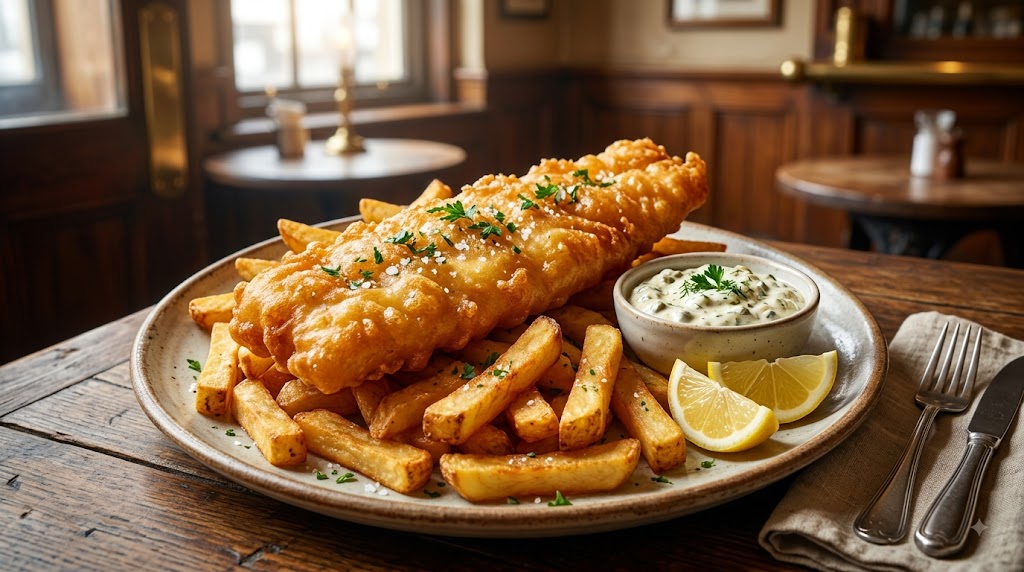
When you order fish and chips at a full-service restaurant or fast-casual spot, flavor and deep-fried crunch are the top priorities. Commercial kitchens typically use heavy wheat or beer batter, submerge the fish in hot oil, and serve up giant portion sizes that easily feed two people.
During the deep-frying process, water inside the fish and potato cooks out, and cooking oil rushes in. That deep-fat immersion turns a light piece of white fish into a calorie-dense feast.
Here is what a typical commercial restaurant serving looks like according to USDA nutrition data:
Restaurant Portion Breakdown
Restaurant Meal Component | Standard Serving Mass (g) | Energy (kcal) | Total Fat (g) | Saturated Fat (g) | Total Carbohydrates (g) | Protein (g) | Sodium (mg) |
Commercial Battered Fish Fillet | 250 | 548 | 30.0 | 6.0 | 28.0 | 42.0 | 680 |
Restaurant Deep-Fried Fries | 250 | 780 | 37.5 | 6.5 | 103.5 | 8.5 | 525 |
Full-Fat Commercial Tartar Sauce | 30 | 180 | 19.0 | 3.0 | 2.0 | 0.0 | 150 |
Total Restaurant Plate | 530 | 1,508 | 86.5 | 15.5 | 133.5 | 50.5 | 1,355 |
The Bottom Line: A full restaurant order of fish and chips packs 1,200 to 1,600 calories. That can account for over 80% of an average adult's recommended daily intake in a single meal, along with a massive hit of sodium and saturated fat!
Homemade Fish and Chips Calories: A Light & Crispy Upgrade
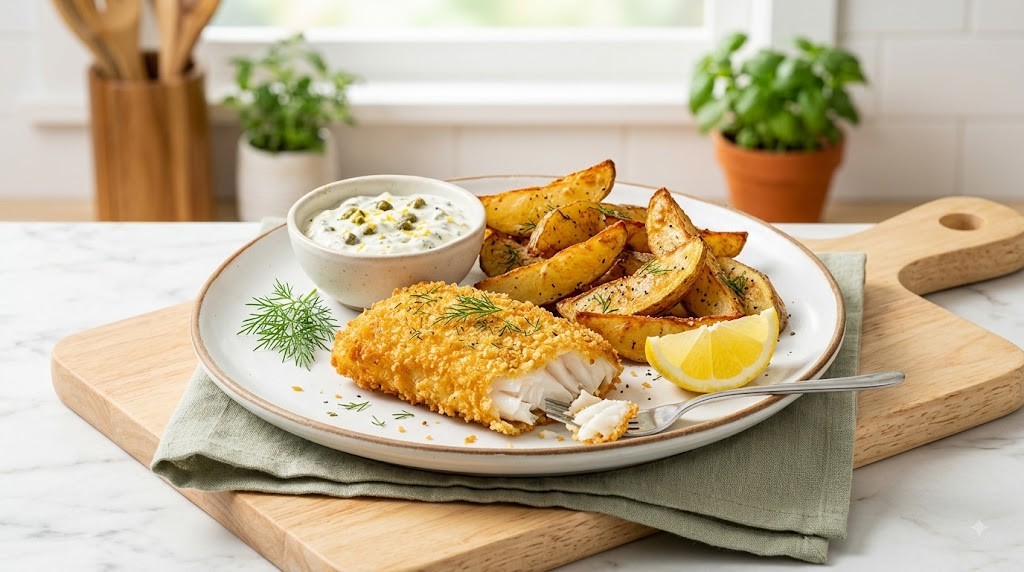
Want to enjoy the exact same comforting flavors without the calorie hangover? Preparing your meal at home puts you in complete control.
By making a few smart culinary tweaks, you can slash homemade fish and chips calories by up to two-thirds:
Ditch the Heavy Beer Batter: Swap dense flour batter for a light egg-white dip and crunchy panko breadcrumbs.
Fire Up the Air Fryer: Air-frying uses high-speed hot air and just a light mist of oil, cutting absorbed fat by up to 80% while keeping that golden crunch.
Make a Smart Sauce Swap: Replace heavy mayo-based tartar sauce with a tangy Greek yogurt blend.
Here is how the numbers stack up when you switch up your cooking method:
Restaurant vs. Homemade Calorie Comparison
Nutritional Metric | Commercial Restaurant Meal | Traditional Home Deep-Fried | Oven-Baked or Air-Fried Homemade |
Total Energy (kcal) | 1,508 | 1,020 | 510 |
Total Fat (g) | 86.5 | 52.0 | 14.5 |
Saturated Fat (g) | 2.5 | 9.0 | 2.5 |
Total Carbohydrates (g) | 133.5 | 95.0 | 62.0 |
Dietary Fiber (g) | 4.2 | 5.5 | 7.8 |
Protein (g) | 50.5 | 46.0 | 42.0 |
Sodium (mg) | 1,355 | 720 | 380 |
The Bottom Line: Switching from deep-frying to air-frying or baking cuts your total meal calories from 1,508 down to 510—saving you roughly 1,000 calories while delivering over 40 grams of lean protein!
Veg & Plant-Based Hacks: Banana Blossom & Tofu

Looking for a meat-free alternative? Plant-based fish substitutes are taking home kitchens and restaurant menus by storm!
1. Banana Blossom (Musa acuminata)
Banana blossom is the edible purple flower cluster growing at the end of a banana branch. Thanks to its layered, flaky texture, it makes a mind-blowing plant-based swap for cod or haddock fillets.
Even better? Canned banana blossom is ultra-low in calories! It delivers just 13 to 35 calories per 100 grams with zero cholesterol and plenty of dietary fiber.
2. Firm Tofu
If you want a plant-based option packed with protein, firm tofu is your best friend. Pressing firm tofu, seasoning it with sea kelp or old bay, and baking or air-frying it gives you a savory, hearty main dish.
Protein Base Nutritional Comparison (Uncooked, 100g)
Protein Base | Energy (kcal) | Protein (g) | Total Fat (g) | Carbohydrates (g) | Dietary Fiber (g) |
Atlantic Cod Fillet | 82 | 18.0 | 0.7 | 0.0 | 0.0 |
Haddock Fillet | 87 | 19.0 | 0.7 | 0.0 | 0.0 |
Firm Soy Tofu | 61 | 6.8 | 3.7 | 1.9 | 1.0 |
Banana Blossom | 13–35 | 1.3–1.7 | 0.2–0.4 | 3.0–7.0 | 2.0–5.0 |
The Bottom Line: Banana blossom gives you a super light, fibrous base that saves heaps of base calories, while firm tofu offers a satisfying, protein-dense vegetarian option.
Don't Forget the Sides: Tartar Sauce & Fries!
The fish might take center stage, but the sides can quietly double your meal's calorie total if you aren't careful.
Tartar Sauce: Standard restaurant tartar sauce delivers around 180 calories and 19g of fat in a tiny 2-tablespoon dip. Making your own with 2% Greek yogurt, capers, dill, and lemon cuts that down to just 45 to 60 calories!
French Fries vs. Air Fryer Fries: Deep-fried restaurant fries pack 312 calories and 15g of fat per 100g. Lightly spraying sliced potatoes and popping them in the air fryer lowers that to 160–190 calories with minimal fat.
Track Your Fish and Chips Calories in Seconds with VoCal
Logging deep-fried meals or customized home recipes can feel complicated with traditional calorie-tracking apps. Who wants to search through endless databases looking for the exact right batter type while their food gets cold?
With VoCal, tracking your meals is as simple as talking to a friend.
How to Voice-Log Your Meal on VoCal:
Just tap record and speak naturally! To get the most accurate calorie breakdown, mention your cooking method, protein choice, and sides:
At a Pub? Say: "Logged 8 ounces of deep-fried restaurant battered cod with 1 cup of commercial french fries and 2 tablespoons of tartar sauce." -> VoCal automatically tracks ~1,350 kcal!
Made it at Home? Say: "Logged 6 ounces of air-fried panko cod, 150 grams of air-fryer potato wedges, and 2 tablespoons of Greek yogurt tartar sauce." -> VoCal automatically tracks ~480 kcal!
No manual typing, no guessing games—just instant, accurate tracking powered by verified USDA FoodData Central data!
Frequently Asked Questions (FAQs)
1. How many calories are in a standard portion of restaurant fish and chips?
A full-sized restaurant portion of deep-fried fish and chips typically ranges between 1,200 and 1,600 calories, depending on batter thickness, oil type, and serving size.
2. Are air fryer french fries calories significantly lower than deep-fried fries?
Yes! Air-fried fries contain around 160 to 191 calories per 100g compared to 312 calories per 100g for traditional deep-fried fries, cutting total fat by up to 70%.
3. What is the lowest calorie plant-based substitute for fish?
Banana blossom (Musa acuminata) is the lowest calorie plant substitute, coming in at just 13 to 35 calories per 100 grams while providing a flaky, fish-like texture.
4. How does VoCal help me track custom homemade recipes?
VoCal uses natural voice processing to interpret your exact ingredients and cooking methods (like "air-fried," "baked," or "panko-crusted") and maps them against official USDA nutrient databases in real-time.
Disclaimer: This article is for informational and educational purposes only and does not constitute medical or personalized nutritional advice. Always consult a qualified healthcare provider or registered dietitian before making significant changes to your diet.