

Picture this: a golden, crispy piece of fish paired with a steaming pile of thick-cut fries. Whether you're grabbing takeaway on a Friday night or cooking up a pub classic at home, fish and chips is pure comfort food.
But if you’re working hard on a weight loss journey, a big question pops up: Is fish and chips good for weight loss?
The short answer? Traditional pub-style fish and chips is a heavy calorie bomb that can easily blow past your daily calorie goal. But here’s the good news: with a few smart kitchen hacks—and the effortless voice tracking power of VoCal—you can enjoy all those savory flavors without sidelining your progress!
Let’s dive into the full nutritional breakdown, smart swaps, and how to keep your goals on track.
The Big Breakdown: How Many Fish and Chips Calories Are We Talking?

To understand how fish and chips affects your body, we have to look under the hood at its energy density. Energy density simply means how many calories are packed into every bite.
White fish itself (like cod or haddock) is naturally lean, packed with high-quality protein, and great for health. But when it gets dunked in heavy batter and submerged in a deep fryer, those porous flour coats act like a sponge for hot oil. The same thing happens to white potatoes.
Because fat packs 9 calories per gram compared to just 4 calories per gram for protein and carbs, deep-frying quickly turns a healthy fish fillet into a high-calorie feast.
Here is how a standard takeaway meal stacks up against healthier homemade alternatives:
Portion Component | Traditional Commercial Preparation (~400g Total) | Optimized Air-Fried / Baked Preparation (~350g Total) | Plant-Based Tofu Alternative (~350g Total) |
Total Energy (Calories) | 850 – 1,150 kcal | 420 – 520 kcal | 380 – 460 kcal |
Total Protein | 32 – 42 g | 38 – 45 g | 22 – 28 g |
Total Carbohydrates | 85 – 115 g | 45 – 55 g | 35 – 45 g |
Dietary Fiber | 4 – 6 g | 6 – 8 g | 5 – 7 g |
Total Fats | 45 – 65 g | 10 – 15 g | 14 – 18 g |
Saturated Fats | 8 – 14 g | 1.5 – 3 g | 2 – 3.5 g |
Dominant Lipid Source | Commercial Frying Oil (Canola/Palm) | Spray Extra Virgin Olive Oil | Extra Virgin Olive Oil / Sesame Oil |
As you can see, a full order of traditional takeaway fish and chips calories can top 1,000 kcal in a single sitting!
Why Deep-Fried Foods Make Weight Loss a Challenge
To lose weight, your body needs to be in a consistent calorie deficit—meaning you consume slightly fewer calories than your body burns each day. Most health guidelines suggest cutting around 500 to 750 calories a day to lose a steady 1 to 1.5 pounds per week.
When one meal knocks out 1,000+ calories, it leaves you with very little room for the rest of your meals, snacks, and drinks.
Here’s why traditional fish and chips can make staying in a deficit tricky:
Hyper-Palatability: The combination of refined flour batter, starchy potatoes, and deep-fried fats fires up your brain's reward centers. This makes it super easy to overeat before your stomach has time to tell your brain, "Hey, I'm full!"
Carb Overload: Popular low-carb approaches—like the Mayo Clinic Low Carb framework—suggest staying around 50 grams of net carbs per day to manage blood sugar and appetite. A regular order of fish and chips delivers 85 to 115 grams of net carbs at once, completely smashing that daily limit!
Microbiome Shifts: Frequent deep-fried food intake can disrupt gut health, reducing friendly bacteria and increasing inflammation over time.
The Takeaway: You don't have to banish fish and chips forever, but relying on traditional deep-fried takeaway meals isn't ideal for steady weight management.
How to Make Weight-Loss Friendly Fish and Chips (Smart Swaps)
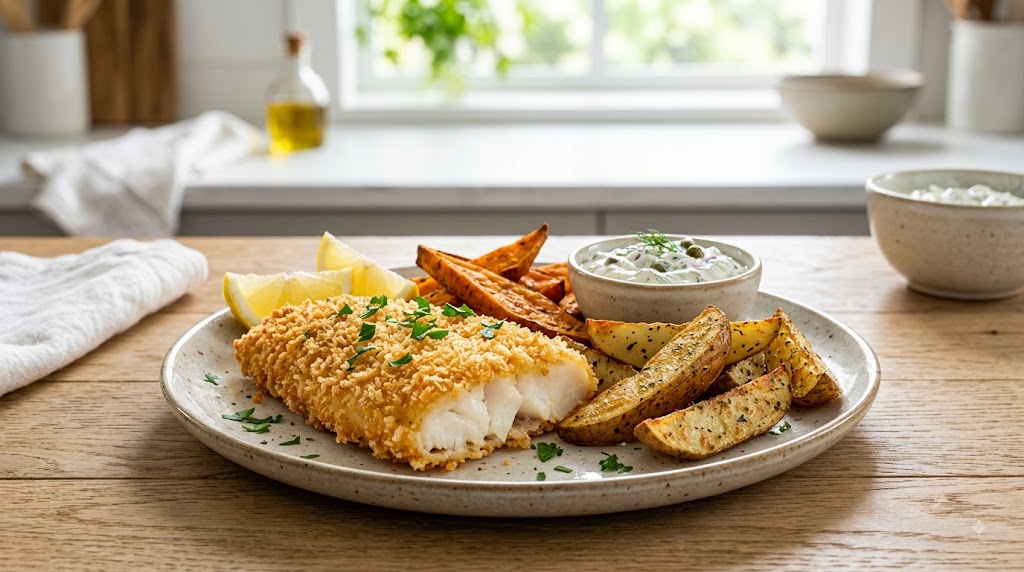
Ready for the good news? You don't have to give up crispiness to hit your goals! By swapping the deep fryer for an air fryer and making a few quick ingredient tweaks, you can cut the calories in half while keeping all the crunch.
Non-Vegetarian Swaps
Swap the Fryer for an Air Fryer: Convection heat gives you that satisfying crunch with just a light spray of olive oil, saving hundreds of fat calories.
Use Panko Breadcrumbs: Dip lean white fish (like cod, haddock, or pollock) in egg whites and lightly dust with whole-wheat panko for a crisp coat that absorbs minimal oil.
Bake Sweet Potato Wedges: Keep the skin on sweet potatoes or russet potatoes and bake them. The extra skin fiber keeps you full much longer!
Ditch Heavy Tartar Sauce: Mix non-fat Greek yogurt with lemon juice, capers, and dill for a high-protein, low-calorie dipping sauce.
Plant-Based & Vegetarian Swaps
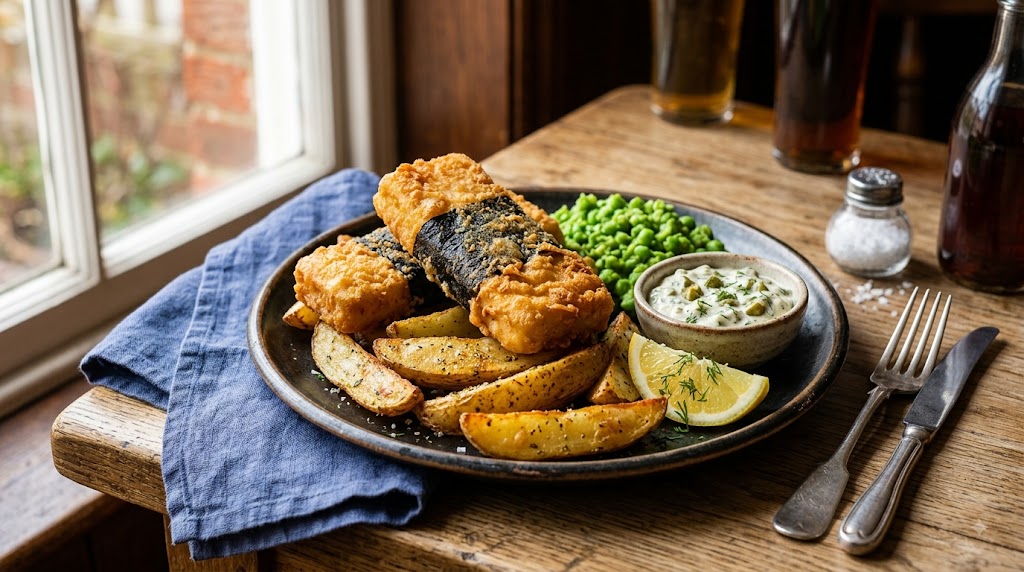
Crispy Air-Fried Tofu: Press extra-firm tofu, marinate it in lemon juice and sea vegetable flakes (like nori), then coat in seasoned chickpea flour for an amazing high-protein, seafood-flavored bite.
Air-Fried Banana Blossom: Banana blossoms offer a flaky texture similar to fish—dip them in a light chickpea flour batter and air-fry until golden.
Culinary Attribute | Standard Commercial Pub Version | Optimized Air-Fried Cod Version | Optimized Plant-Based Tofu Version |
Primary Thermal Medium | Commercial Immersion Fryer | Convection Air Fryer / Oven | Convection Air Fryer / Oven |
Added Oil Volume | 30 – 45 ml (Submerged Fat) | 3 – 5 ml (Unsaturated Spray) | 4 – 6 ml (Unsaturated Spray) |
Carbohydrate Source | Refined Flour & Fried Potatoes | Panko & Skin-On Sweet Potato | Chickpea Flour & Baked Root Vegetables |
Glycemic Impact | High (Rapid Glucose Absorption) | Moderate (Sustained Release) | Low to Moderate (High Fiber Buffer) |
Satiety Profile | Moderate (Short-Lived Satiation) | High (High Protein + Fiber) | High (High Fiber + Plant Protein) |
Dietary Compatibility | High Caloric Intake Days Only | Calorie-Restricted, Moderate-Carb | Plant-Based, Calorie-Restricted |
Logging Fish and Chips Without the Math Headache (Meet VoCal)
Trying to log a custom air-fried fish and chips recipe—or estimating a takeaway portion—in traditional calorie-counting apps can be a total headache. Typing in every single ingredient, guessing batter weights, and estimating frying oil takes all the fun out of eating.
That’s where VoCal comes in!
VoCal is an intuitive, voice-based calorie tracking app that lets you log your food simply by talking.
Instead of typing out five different ingredients, just open VoCal and say:
"I had six ounces of air-fried cod coated in panko, a cup of baked sweet potato wedges, and two tablespoons of Greek yogurt tartar sauce."
VoCal’s natural language processing instantly breaks down your meal, calculates your total calories, protein, carbs, and fats, and logs it to your day in seconds. No searching databases, no tedious typing, and zero hassle.
Final Thoughts
Is fish and chips good for weight loss? Traditional pub versions aren't great for daily diet goals, but modified homemade versions are fantastic!
By focusing on air-frying, using whole-grain or high-protein coatings, keeping portion sizes reasonable, and tracking effortlessly with VoCal, you can enjoy crisp, delicious fish and chips whenever cravings strike!
Frequently Asked Questions (FAQs)
How many calories are in a standard takeaway fish and chips?
A typical commercial takeaway order of fish and chips contains between 850 and 1,150 calories, depending on portion size and oil absorption.
Can I eat fish and chips on a low-carb diet?
Traditional battered fish and fries are high in carbohydrates (85g+ net carbs) and won't fit a standard low-carb plan. However, you can make a low-carb version by coating white fish in crushed almond flour, air-frying it, and pairing it with roasted low-carb veggies like zucchini fries.
Is air-fried fish and chips actually good for weight loss?
Yes! Air-frying cuts the added fat by up to 80% compared to traditional deep-frying. Paired with lean white fish and high-fiber sweet potato wedges, it becomes a high-protein, high-fiber meal that easily fits into a weight-loss calorie deficit.
How do I accurately track homemade fish and chips calories?
The easiest way is using a voice tracker like VoCal. Simply state the raw weight of your fish, cooking method, coatings, and side portions, and let the app handle the nutritional math instantly.
Disclaimer: This article is for informational and educational purposes only and does not constitute medical or personalized nutritional advice. Always consult a qualified healthcare provider or registered dietitian before making significant changes to your diet.