

Holy guacamole! It is no secret that America is absolutely obsessed with avocados. Over the last two decades, our love for this creamy green fruit has skyrocketed, with U.S. avocado consumption leaping from a modest 1.52 pounds per person in 1998 to a whopping 9.22 pounds per person.
But when you are standing in the grocery store produce aisle, you are usually faced with a choice: do you grab the small, dark, pebbly-skinned California Hass avocado, or the massive, shiny, smooth Florida green giant?
While both are technically avocados, they have totally different vibes, tastes, and nutritional profiles. Most importantly, if you are actively tracking your food, the hass avocado vs florida avocado calories difference might surprise you. Let’s dive into the ultimate avocado showdown to see which one deserves a spot in your grocery cart!
Meet the Contenders: California Hass vs. Florida Green-Skin

Even though they belong to the same botanical family, Hass and Florida avocados are grown in very different climates, which shapes how they look, taste, and behave on your plate.
The Hass Avocado (The Creamy King)
Origins: The Hass avocado was first grown in California in 1926 by a mail carrier named Rudolph Hass. Today, it dominates the market, making up over 80% of U.S. grocery sales.
Appearance: Small (usually 4 to 6 ounces), with thick, bumpy skin that turns a dark purplish-black when ripe.
Vibe: Highly rich, buttery, and nutty.
The Florida Avocado (The Tropical Giant)
Origins: Florida avocados represent over 50 varieties grown in the warm, humid climate of South Florida.
Appearance: Jumbo-sized (often weighing up to a pound or more!), with smooth, bright green skin that stays green even when fully ripe.
Vibe: Light, mild, and refreshing.
Don't Forget the "Pit-and-Skin" Discount!
When you are calculating your macros, remember that you don't eat the seed or the skin. On average, both Hass and Florida avocados give you about 70% to 75% of edible green flesh. Always weigh your avocado after removing the pit and peeling the skin to get an accurate count!
The Big Calorie and Nutrient Showdown
Why do these two fruits look and taste so different? It all comes down to fat and water.
Hass avocados take their time growing, packing in lots of healthy monounsaturated fats while keeping their water content low (~67% moisture). Florida avocados, on the other hand, are tropical water-lovers (~79% moisture), making them much leaner.
Using the official USDA FoodData Central database, here is how a 100-gram serving (about 3.5 ounces) of each avocado stacks up:
Nutrient | Raw Hass Avocado (per 100g) | Raw Florida Avocado (per 100g) | Variance |
|---|---|---|---|
Water | 67.0-74.4 g | 78.8 g | Florida is 6% to 17% higher |
Calories | 160-223 kcal | 120 kcal | Hass is 33% to 85% higher |
Total Fat | 14.7-20.3 g | 10.1 g | Hass is 45% to 100% higher |
Saturated Fat | 2.1-3.0 g | 2.0 g | Hass is 5% to 50% higher |
Monounsaturated Fat | 10.0-15.0 g | 5.5 g | Hass is 81% to 172% higher |
Polyunsaturated Fat | 1.8-3.6 g | 1.7 g | Hass is 5% to 111% higher |
Total Carbs | 8.0-8.5 g | 7.8 g | Roughly equivalent |
Fiber | 6.7-8.0 g | 5.6 g | Hass is 19% to 42% higher |
Sugars | 0.3-1.3 g | 2.4 g | Florida is 84% to 700% higher |
Protein | 1.8-2.0 g | 2.2 g | Florida is 10% to 22% higher |
Which Is Healthier? It Depends on Your Goals!
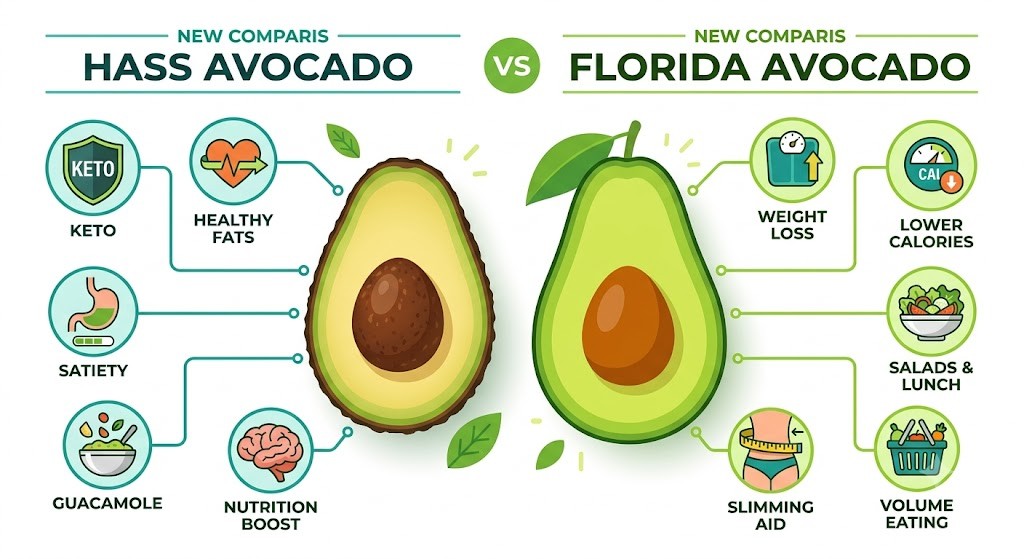
Because these avocados are so biochemically distinct, the "healthier" choice depends entirely on your personal diet plan.
1. The Low-Carb & Keto Winner: Hass
If you are following a low-carb diet or a strict ketogenic plan, your goal is to burn fat for fuel instead of carbs. A whole Hass avocado is a dream food here: it has only 3 grams of net carbohydrates (most of its carbs are fiber) and is packed with clean, fat-burning fuel.
Florida avocados are still low-glycemic, but they contain slightly more simple sugars and less fat, meaning they won't support ketosis quite as efficiently as Hass.
2. The Weight Loss & Volume Eating Winner: Florida
Are you on a calorie-restricted weight-loss plan? If so, you need a calorie deficit. Florida avocados are often marketed as "SlimCados" because they have roughly 30% less fat and fewer calories per gram.
This is perfect for volume eating! You can eat a much larger physical portion of a Florida avocado for the exact same amount of calories as a small Hass, keeping your stomach physically full and happy.
3. The Satiety (Appetite Control) Winner: Hass
Even though Hass has more calories, it might keep you full longer. Clinical studies show that the healthy monounsaturated fats (oleic acid) in Hass avocados undergo conversion in your gut into a hormone called oleoylethanolamide (OEA). OEA tells your brain that you are completely satisfied, naturally curbing your cravings for hours.
Culinary Matchmaker: How to Use Them
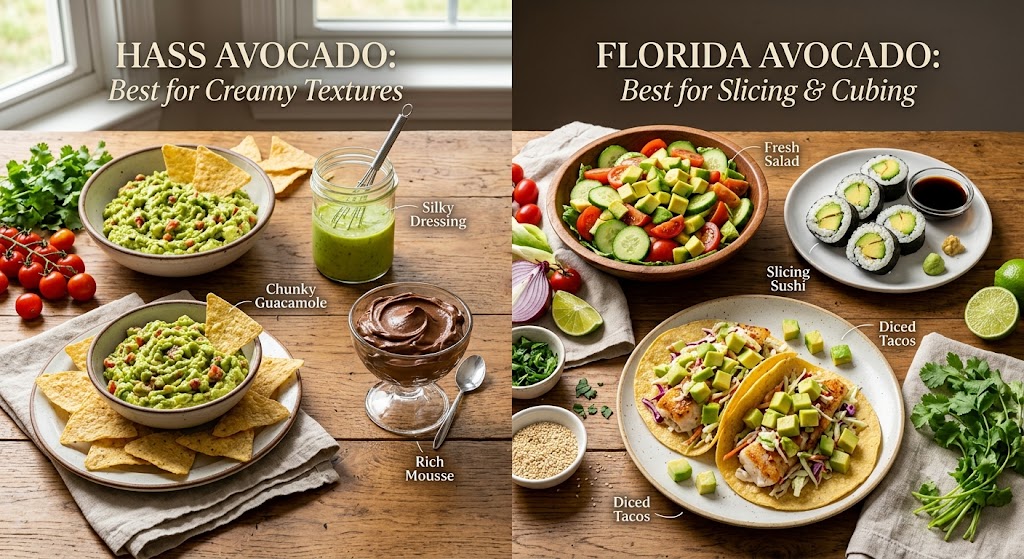
Because of their textures, these avocados have very different culinary superpowers!
Recipe Category | Optimal Variety | Why It Works |
|---|---|---|
Guacamole | Hass | Creamy lipids create a smooth, rich dip. |
Salads | Florida | Firm flesh holds its shape without turning to mush. |
Dressings | Hass | High healthy fats whip up into a dairy-free emulsion. |
Sushi & Wraps | Florida | Firm texture allows for neat, clean slicing. |
Tacos & Fajitas | Florida | Great for a firm, refreshing diced topping. |
Dessert Mousse | Hass | Whips into a velvety, rich dessert. |
Why Precise Food Tracking Matters (and How VoCal Helps)
If you are just guessing your avocado portions, you could be accidentally destroying your daily calorie goals. Take a look at how different portions compare:
Portion Type | Edible Weight (g) | Hass Caloric Yield | Florida Caloric Yield | Caloric Discrepancy |
|---|---|---|---|---|
Standard FDA Serving | 50 g | 80-111 kcal | 60 kcal | Hass is up to 85% higher |
Half Medium Fruit | 75 g | 120-167 kcal | 90 kcal | Hass is up to 85% higher |
Whole Medium Fruit | 150 g | 240-334 kcal | 180 kcal | Hass is up to 85% higher |
Whole Large Fruit | 201 g | 322-448 kcal | 241 kcal | Hass is up to 85% higher |
Jumbo Florida Fruit (Whole) | 304 g | 486-678 kcal | 365 kcal | Hass is up to 85% higher |
Most standard calorie tracking apps lump both of these into one generic entry: "Avocado, raw." If you eat a whole Florida avocado but log it as a generic medium avocado, you might think you only ate 240 calories, when you actually consumed 365 calories and missed out on key macro tracking!
This is where VoCal makes life easy. Instead of sorting through endless confusing database entries, you can just speak to log your meals:
"Hey, VoCal, log half of a medium Florida avocado for breakfast."
VoCal's smart voice-recognition automatically matches your spoken words to the exact USDA entry (NDB 171707 for Florida or NDB 100348 for Hass) to keep your macros perfectly on track. No guess-work, no tracking errors—just easy, precise voice logging.
The Takeaway
Both avocados are incredible, nutrient-dense superfoods. Grab a Hass if you are doing keto, craving a rich guacamole, or trying to stay full for hours. Pick a Florida avocado if you want to save some cash, are tracking a strict calorie deficit, or want a clean, firm dice for your tacos and salads!
Whatever your pick, make sure to log it with VoCal to keep your health goals in perfect focus!
FAQs
Are Florida avocados healthier than Hass?
Neither is universally healthier! Hass avocados are higher in heart-healthy monounsaturated fats and folate. Florida avocados contain about 30% less fat, have fewer calories, and boast significantly more Vitamin C.
Why do Florida avocados have fewer calories?
Because they are physically lighter on fat and higher in water. Fat has 9 calories per gram, while water has 0, making Florida avocados less calorically dense.
How do I tell if a Florida avocado is ripe?
Unlike Hass avocados, which turn dark purple or black, Florida avocados stay bright green. To check if it's ready, hold it in your hand and give it a gentle squeeze. If it gives slightly under pressure, it's ready to eat!
Disclaimer: The content provided in this article—including all text, graphics, nutritional tables, caloric estimates, and metabolic insights—is for informational, educational, and motivational purposes only. It is not intended to be a substitute for professional medical advice, clinical diagnosis, or treatment.