

Let's be real—avocado toast has officially graduated from a passing brunch trend to a global breakfast staple. And honestly? It deserves the crown. Combining crunchy, fiber-rich toast with creamy, nutrient-dense avocado is a match made in breakfast heaven.
But if you are keeping an eye on your daily calorie budget, you have probably wondered: how many calories in avocado toast are we actually talking about?
While a simple, home-prepped slice can be a perfectly light, energizing breakfast, restaurant versions and heavy-handed toppings can easily turn this innocent snack into a stealth calorie bomb. If you are logging your meals on a voice tracker like VoCal, specifying exactly what is on your slice is the secret to staying on track.
Let's break down the baseline calories of plain avocado toast, compare 12 of the most popular toppings, and help you build your ultimate high-satiety breakfast.
The Baseline: What’s Under the Hood of a Plain Slice?
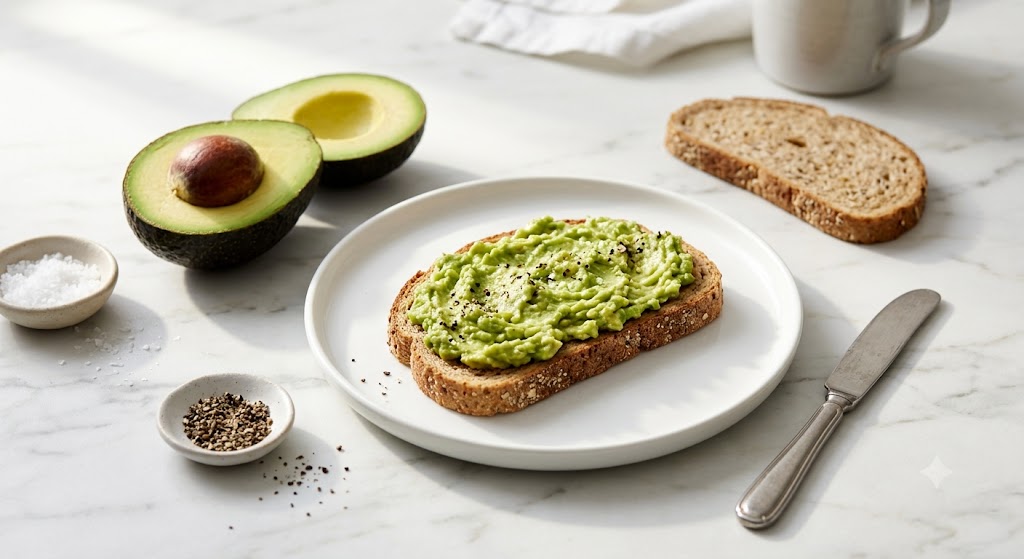
Before we go wild with the toppings, we need to establish our "naked" baseline slice. To get the most accurate numbers possible, we turned directly to the gold standard: the USDA FoodData Central database.
A standard baseline slice is made up of:
One slice of whole-wheat bread (approx. 40 grams): Choosing sourdough or sprouted whole-grain bread provides a sturdy, complex carbohydrate base with some natural plant protein.
Half of a medium Hass avocado (approx. 75 grams of edible pulp): Hass avocados are rich in heart-healthy monounsaturated fats, particularly oleic acid, which supports cardiovascular health.
When you put them together, your baseline slice lands right around 220 calories. This simple combo provides an incredible 8 grams of fiber, leaving you with only 16.5 grams of net carbs.
Here is the exact nutritional breakdown of your plain base canvas:
Baseline Avocado Toast Composition (75g Hass Avocado + 40g Whole-Wheat Bread)
Food Component | Portion Weight (g) | Calories (kcal) | Protein (g) | Fat (g) | Carbs (g) | Fiber (g) | Net Carbs (g) |
Whole-Wheat Bread | 40g | 100 | 5.0 | 1.0 | 18.0 | 3.0 | 15.0 |
Hass Avocado (1/2 Medium) | 75g | 120 | 1.0 | 11.0 | 6.5 | 5.0 | 1.5 |
Combined Baseline Slice | 115g | 220 | 6.0 | 12.0 | 24.5 | 8.0 | 16.5 |
Note: Not all avocados are created equal! Hass avocados are physically smaller and contain more healthy fats than Florida avocados, which are larger but have a lower fat content per gram. If you are subbing in a different variety or portion, your calorie counts will shift:
Avocado Variety and Portion Size Caloric Variables
Portion Size | Hass Avocado Calories | Florida Avocado Calories |
1/3 Medium (FDA Serving - 50g) | 80 | 61 |
Standard Half-Fruit (75g) | 120 | 91 |
Whole Medium Fruit (150g) | 240 | 182 |
Whole Large Fruit (201g) | 322 | 244 |
While this plain baseline is incredibly healthy, it does have one major weakness: the protein gap. Because the standard slice derives roughly 80 percent of its energy from fats and bread carbs, it lacks a solid protein anchor to keep you full all morning.
The Great Avocado Toast Topping Showdown
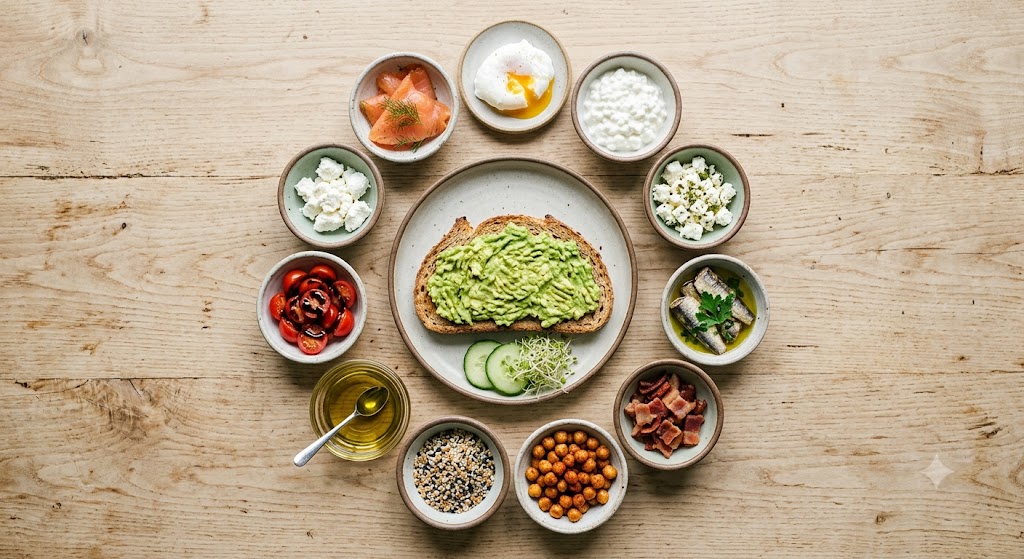
A plain baseline slice is great, but let's be honest—the real fun begins when you start decorating your toast.
To help you navigate your breakfast options, we compared 12 popular toppings (both vegetarian and non-vegetarian). The numbers below represent the extra calories and nutrients you add to your 220-calorie baseline slice.
Master Avocado Toast Topping Comparison
Topping Option | Standard Portion Size | Added Calories (kcal) | Added Protein (g) | Added Fat (g) | Added Carbs (g) | Added Fiber (g) | Primary Micronutrient Benefit |
1. Poached Egg | 1 large egg (50g) | 70 | 6.0 | 5.0 | 0.4 | 0.0 | Choline, Lutein, Vitamin D |
2. Smoked Salmon | 2 oz (56g) | 100 | 12.0 | 4.0 | 0.0 | 0.0 | Omega-3 EPA/DHA Fatty Acids |
3. Cottage Cheese | 1/4 cup (57g, low-fat) | 45 | 6.0 | 1.2 | 2.0 | 0.0 | Casein, Calcium, Vitamin B12 |
4. Crumbled Feta | 1 oz (28g) | 75 | 4.0 | 6.0 | 1.0 | 0.0 | Conjugated Linoleic Acid, Calcium |
5. Sardines in Oil | 2 oz (56g, drained) | 120 | 11.0 | 8.0 | 0.0 | 0.0 | Vitamin D, Calcium, Selenium |
6. Crispy Bacon | 1 slice (8g) | 45 | 3.0 | 3.5 | 0.1 | 0.0 | Phosphatidylcholine, Zinc |
7. Roasted Chickpeas | 1/4 cup (30g) | 120 | 7.0 | 2.0 | 20.0 | 5.0 | Iron, Folate, Resistant Starch |
8. Everything Bagel | 1 tsp (5g) | 15 | 0.5 | 1.2 | 1.0 | 0.5 | Iron, Magnesium, Selenium |
9. Olive Oil Drizzle | 1 tsp (5ml) | 40 | 0.0 | 4.5 | 0.0 | 0.0 | Polyphenols, Vitamin E |
10. Tomatoes & Glaze | 1/2 cup + 1 tsp glaze | 35 | 0.8 | 0.1 | 8.0 | 1.0 | Lycopene, Vitamin C, Potassium |
11. Soft Goat Cheese | 1 oz (28g) | 100 | 5.0 | 9.0 | 0.0 | 0.0 | A2 Beta-Casein, Riboflavin |
12. Sprouts & Cucumber | 1/4 cup + 1/2 cup | 10 | 0.6 | 0.1 | 2.0 | 0.5 | Vitamin K, Vitamin C, Silica |
Deconstructing the Toppings: Choose Your Fighter
Now, let's look at how these toppings actually impact your body and your metabolic goals. We have broken them down into three easy categories: protein anchors, savory upgrades, and plant-based volume boosters.
1. High-Bioavailability Protein Anchors
If you want to stay full past your morning meeting, you need a protein anchor. Protein is the most satiating macronutrient, and adding it to your baseline slice bridges the gap to create a balanced meal.
The Poached Egg: Slicing into a perfectly poached egg adds 70 calories and 6 grams of highly bioavailable protein. The runny yolk acts as a delicious, warm sauce, while the yolk’s lipids actually help your body absorb the fat-soluble vitamins in the avocado.
Cold-Smoked Salmon (Nova Lox): Adding 2 ounces of smoked salmon gives you an extra 100 calories and a massive 12 grams of premium protein. Salmon is loaded with long-chain omega-3 fatty acids (EPA and DHA), which are incredible for heart and vascular health.
Low-Fat Cottage Cheese: Cottage cheese is having a major moment online, and it completely deserves the hype. A quarter-cup adds just 45 calories but delivers 6 grams of slow-digesting casein protein. This slow digestion prevents premature hunger signals so you can cruise through your day.
2. Savory Upgrades: Cheeses and Bacon
Want to maximize your breakfast's flavor profile? These savory toppings pack a major punch of umami, but keep an eye on your portion sizes since they are relatively calorie-dense.
Crumbled Feta Cheese: A one-ounce serving adds 75 calories and 4 grams of protein. Feta is cured in brine, meaning it delivers over 320 milligrams of sodium. That high-salt flavor burst is actually a great tool for natural portion control.
Brisling Sardines in Oil: Adding 2 ounces of olive oil-packed, drained sardines adds 120 calories and 11 grams of protein. Sardines are a nutritional powerhouse of calcium, vitamin D, and selenium, with a very low risk of heavy metal accumulation.
Crispy Bacon: One crumbled slice of crispy bacon adds 45 calories, 3 grams of protein, and 3.5 grams of fat. While not a strong protein source, bacon triggers sensory reward pathways in the brain, meaning a tiny bit goes a very long way in satisfying savory cravings.
Soft Goat Cheese (Chèvre): Creamy chèvre adds 100 calories and 5 grams of protein per ounce. Goat's milk is rich in A2 beta-casein proteins, which are much gentler on sensitive tummies than cow's milk. It also has 0 milligrams of oxalates, making it a great choice for kidney-stone prevention.
3. Plant-Powered Volume and Crunch Boosters
If you love "high-volume eating" (eating a physically large portion of food to feel full without breaking your calorie bank), these plant-based options are your best friends.
Oven-Roasted Chickpeas: A quarter-cup adds 120 calories, but you get 7 grams of protein and 5 grams of gut-friendly fiber. They are packed with resistant starch, which digests slowly and helps prevent blood sugar spikes.
Everything Bagel Seasoning: One teaspoon of this crunchy blend adds a tiny 15 calories but loads of flavor. It is a fantastic calorie-free hack to make simple food feel exciting.
Extra Virgin Olive Oil Drizzle: Warning: A freehand "drizzle" of olive oil is one of the most common tracking mistakes. Just one teaspoon adds 40 calories of pure monounsaturated fat, and a heavy-handed tablespoon spikes your meal by 120 calories. Always measure your drizzle!
Cherry Tomatoes & Balsamic Glaze: Slicing up half a cup of cherry tomatoes and adding a teaspoon of balsamic glaze adds only 35 calories. This adds a burst of sweetness and a healthy dose of lycopene, a powerful antioxidant.
Alfalfa Sprouts and Cucumber: At just 10 calories total, loading your toast with sprouts and cucumber slices is the ultimate way to add water-rich physical volume to your meal, keeping you physically full without expanding your waistline.
The Satiety Equation: How to Beat "Food Noise"
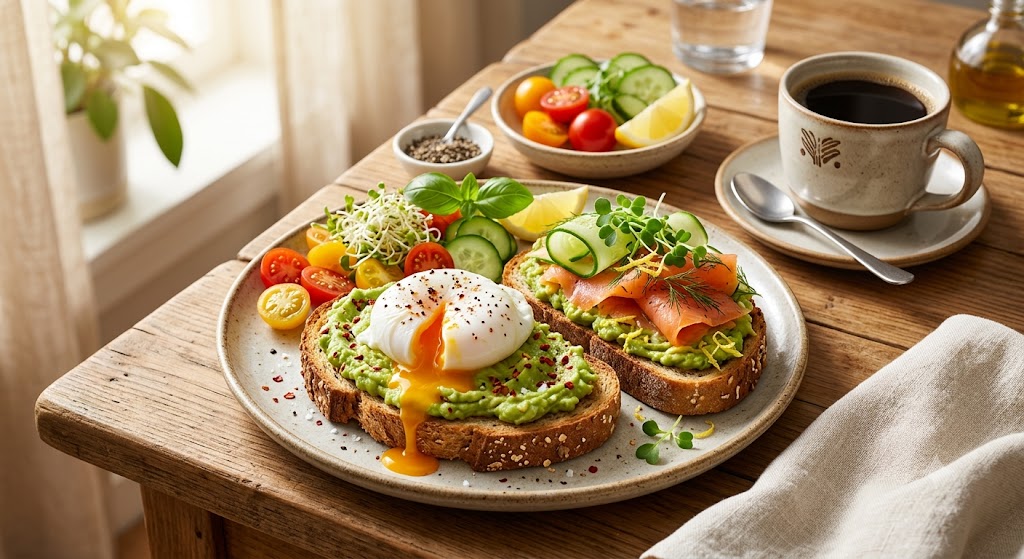
Staying full isn't just about stuffing your stomach—it is a hormonal balancing act in your gut. When you eat, your body releases hormones like GLP-1 and CCK to tell your brain you are satisfied, while shutting down ghrelin (the "feed me!" hormone).
To optimize this satiety loop, you need two secret weapons:
Dietary Fiber: Found in whole-grain bread and avocado, fiber absorbs water, slows down digestion, and delays gastric emptying, ensuring a slow, steady release of energy.
Dietary Protein: When you pair that fiber with a protein anchor (like eggs or salmon), you trigger the release of those powerful fullness hormones.
By choosing a topping that bridges the protein gap, you can completely silence "food noise" and keep your energy stable all afternoon.
Precision Voice Tracking: Speak Your Toast with VoCal
Because avocado toast is so highly customizable, simply telling a traditional fitness tracker "I ate avocado toast" is a recipe for error. You could easily under-log your calories by 200 to 300 calories!
Here are the three most common logging slip-ups:
The Pit-and-Skin Discount: A whole Hass avocado weighs about 200 grams, but once you remove the skin and pit, you only eat about 150 grams of edible flesh. If you log the whole weight, your count will be falsely inflated.
The Portion Scale Variable: The difference between half a medium Hass avocado and a whole one is 120 calories.
The Stealth Olive Oil Pour: Pouring oil straight from the bottle can add an unlogged 120 calories to your day in the blink of an eye.
This is where VoCal makes your life incredibly easy. Instead of typing, searching, and endlessly scrolling through database entries to log each individual topping, you can simply speak to our natural language voice tracker.
Just say:
"I had one slice of toasted whole-wheat bread with half of a medium Hass avocado, two ounces of smoked salmon, and a teaspoon of everything bagel seasoning."
VoCal instantly decodes your words, matches them with the USDA FoodData Central database, and accurately logs your exact calories and macronutrients in real-time. It’s fast, hands-free, and ensures you never accidentally blow your daily budget.
The Takeaway
Avocado toast isn't just a delicious breakfast—it’s a customizable nutritional powerhouse. By intentionally adding protein anchors and being mindful of portion sizes, you can design the perfect meal to smash your fitness goals. And with voice-based tracking on VoCal, logging your customized masterpiece has never been simpler.
Frequently Asked Questions (FAQs)
Is avocado toast good for weight loss?
Yes! The monounsaturated healthy fats in avocados, paired with fiber from whole-grain toast, keep you full and satisfied. To optimize it for weight loss, make sure to add a protein anchor like cottage cheese or a poached egg to keep hunger signals quiet.
Does avocado toast fit a low-carb diet?
A whole Hass avocado has only about 3 grams of net carbs. If you swap standard whole-wheat bread for a high-fiber, low-carb bread, avocado toast is a fantastic addition to a keto or low-carb lifestyle.
Why does my stomach hurt after eating cheese on avocado toast?
If you struggle with standard dairy, you might be sensitive to A1 beta-casein proteins found in cow's milk. Goat cheese contains A2 proteins, which are much gentler on digestion.
How many calories are in standard restaurant avocado toast?
A typical café-style serving of avocado toast can range from 350 to over 600 calories. Restaurants often use larger slices of artisan bread, a whole avocado, and heavy drizzles of olive oil.
Disclaimer: This article is for informational purposes only. It is not a substitute for professional medical advice, diagnosis, or treatment. Always consult a qualified healthcare professional before making major changes to your diet.