

Let’s face it: the avocado is the undisputed rockstar of the produce aisle. It’s creamy, it’s dreamy, and it has the magical ability to elevate basic toast into a gourmet experience. But if you are on a weight loss journey, you might feel a little nervous about inviting this buttery fruit to dinner. After all, isn’t it packed with fat and calories?
Yes, but don’t panic!
While losing weight ultimately requires a calorie deficit—meaning you burn more energy than you take in—the quality of what you eat matters just as much as the quantity. Keeping hunger at bay is the real secret to staying on track, and that is where the avocado shines.
Today, we are looking at how you can strategically use avocado calories for weight loss without blowing your daily calorie intake. Let's get into the delicious details!
The Avocado’s Nutritional "Resume"
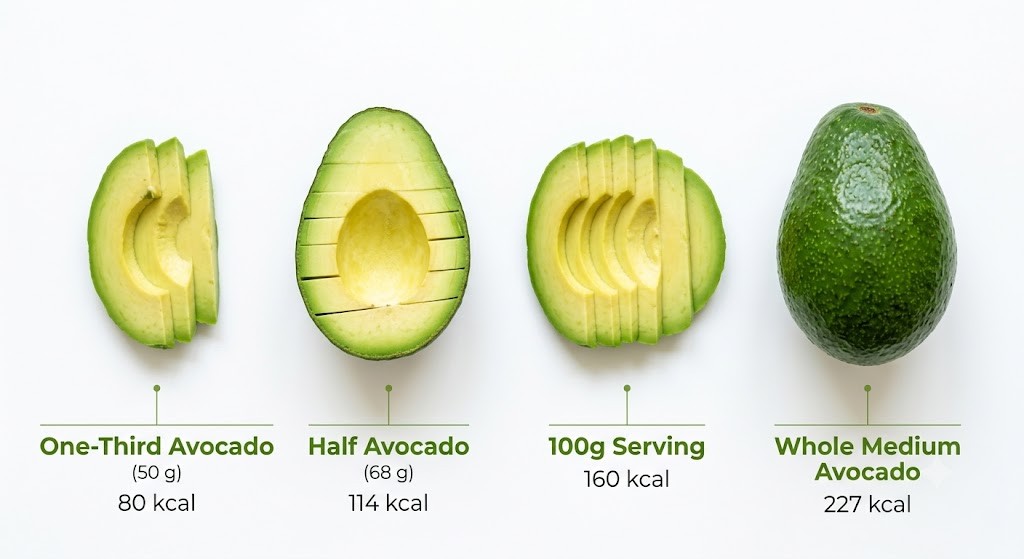
Most fruits are packed with natural sugars, but the avocado is a total rebel. It is made up almost entirely of heart-healthy monounsaturated fats, dietary fiber, and a whole lot of water. In fact, fresh Hass avocados are about 72% to 73% water by weight, which gives them a surprisingly low energy density.
So, what does that look like on your plate? According to the United States Department of Agriculture (USDA), a standard serving size is about one-third of a medium Hass avocado (50 grams), which clocks in at a modest 80 calories. However, most real-world avocado lovers tend to eat half of a medium fruit at a time (about 68 grams), which is about 114 calories.
Here is the complete nutritional breakdown across different portion sizes to help you keep your portion control on point:
Nutrient Component | NLEA Standard Serving (50 g) | NHANES Average Portion (68 g) | Standard Raw Portion (100 g) | Whole Raw Avocado (136 g) |
|---|---|---|---|---|
Energy (Calories) | 80 kcal | 114 kcal | 160–167 kcal | 227 kcal |
Total Lipid (Fat) | 8.0 g | 10.5 g | 14.66–15.4 g | 21.0 g |
Saturated Fat | 1.0 g | 1.45 g | 2.13 g | 2.90 g |
Monounsaturated Fat | 4.9–5.0 g | 6.65 g | 9.80 g | 13.30 g |
Polyunsaturated Fat | 1.0 g | 1.24 g | 1.82 g | 2.47 g |
Total Carbohydrate | 4.0 g | 5.90 g | 8.53–8.64 g | 11.80 g |
Dietary Fiber | 3.4 g | 4.60 g | 6.70–6.80 g | 9.20 g |
Total Sugars | 0.15 g | 0.21 g | 0.30–0.66 g | 0.41 g |
Protein | 1.0 g | 1.34 g | 1.96–2.00 g | 2.67 g |
Potassium | 254 mg | 345 mg | 485–507 mg | 690 mg |
Folate (Vitamin B9) | 44.5 mcg | 60.5 mcg | 81.0–89.0 mcg | 121.0 mcg |
Lutein + Zeaxanthin | 136 mcg | 185 mcg | 271 mcg | 369 mcg |
The Superfood Bonus: Avocados act as natural "nutrient boosters". Eating them alongside colorful veggies helps your body absorb fat-soluble nutrients like vitamins A, D, E, and K, plus antioxidants like lutein!
The Satiety Secret: How Avocados Fight Off Hanger
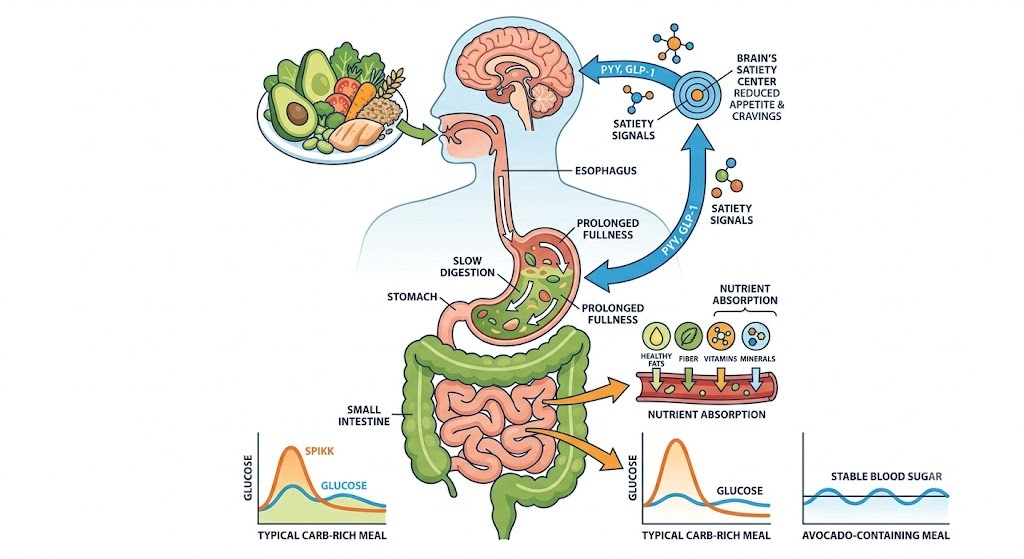
We’ve all been there: you eat a tiny, sad salad, and 45 minutes later, your stomach is growling. The magic of avocados lies in satiety—that wonderful feeling of being comfortably full and satisfied.
Avocados combine healthy fats and dietary fiber into a powerful matrix that slows down your digestion. This slow-and-steady digestion process physically keeps your stomach full longer, but it also triggers a beneficial chemical chain reaction in your gut:
Peptide YY (PYY) & GLP-1: When you eat an avocado, your body releases these gut hormones, which signal your brain that you are full.
Stably Balanced Insulin: Unlike high-carb meals that cause your blood sugar to spike and crash (hello, afternoon slump!), the healthy fats and fibers in avocados help keep your insulin levels beautifully flat.
In a study by the Illinois Institute of Technology, researchers found that when people replaced simple carbohydrates with a half or whole avocado, they reported feeling significantly more satisfied and less hungry over a six-hour period. Their blood work also showed higher levels of PYY and GLP-1, and much more stable insulin levels. Another clinical trial found that adding just half an avocado to lunch reduced the desire to eat by 28% over the next five hours.
Planning Your Daily Calorie Budget
To lose weight at a safe, sustainable pace of 1 to 2 pounds per week, health experts generally recommend aiming for a daily calorie deficit of 500 to 750 calories.
Your personal target depends on your age, biological sex, and active lifestyle. For moderately active adults (meaning you get at least 30 minutes of physical activity a day), here is a look at your daily budgets and how a half-avocado serving fits in:
Demographic Group | Age Bracket | Activity Profile | Daily Maintenance Calories | Target Weight-Loss Daily Calories | Proportional Budget of 1/2 Avocado (68g / 114 kcal) |
|---|---|---|---|---|---|
Adult Female | 19–50 Years | Moderately Active | 1,800–2,000 kcal | 1,200–1,500 kcal | 7.6% – 9.5% of daily budget |
Adult Female | 51+ Years | Moderately Active | 1,600 kcal | 1,200 kcal* | 9.5% of daily budget |
Adult Male | 19–50 Years | Moderately Active | 2,200–2,400 kcal | 1,500–1,800 kcal | 6.3% – 7.6% of daily budget |
Adult Male | 51+ Years | Moderately Active | 2,000 kcal | 1,500 kcal | 7.6% of daily budget |
Sedentary Female | 19–50 Years | Low Activity | 1,600–1,800 kcal | 1,200 kcal* | 9.5% of daily budget |
Sedentary Male | 19–50 Years | Low Activity | 2,000–2,200 kcal | 1,500 kcal | 7.6% of daily budget |
*Note: It is generally best not to drop below 1,200 calories per day for women or 1,500 calories for men to ensure your body gets all the nutrients it needs.
Want to free up a little extra room in your daily budget for some guacamole? Getting active is a great way to do it! Here is how much energy you can burn during common daily activities:
Activity Intensity | Specific Physical Activity | Calories Burned per 30 Minutes | Calories Burned per Hour |
|---|---|---|---|
Moderate | Walking Briskly (3.5 mph) | 140 kcal | 280 kcal |
Moderate | Light Gardening / Yard Work | 165 kcal | 330 kcal |
Moderate | Hiking | 185 kcal | 370 kcal |
Vigorous | Walking (4.5 mph) | 230 kcal | 460 kcal |
Vigorous | Swimming (Slow Freestyle Laps) | 255 kcal | 510 kcal |
Vigorous | Running / Jogging (5 mph) | 295 kcal | 590 kcal |
The Art of the Smart Swap
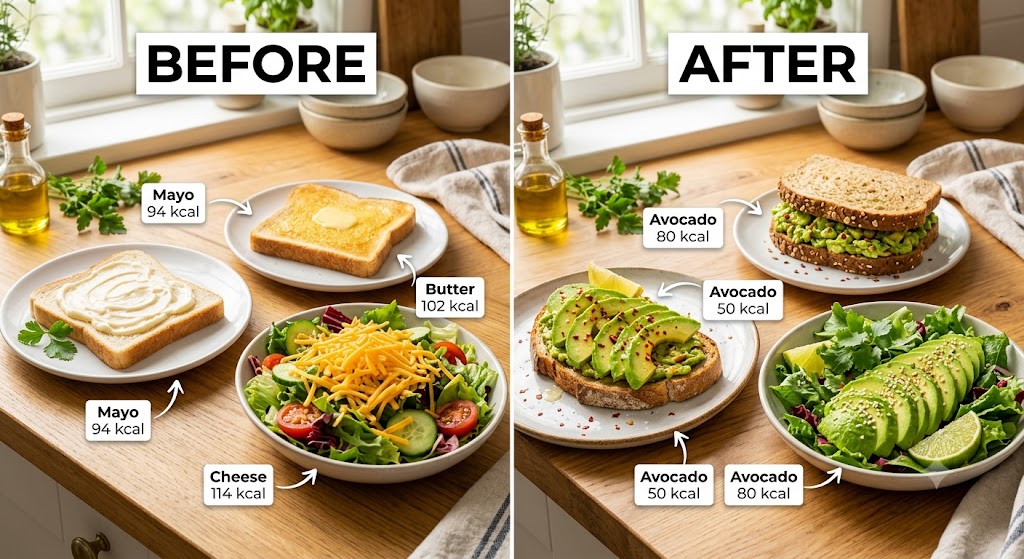
If you simply add an avocado to your current meals without changing anything else, you might end up eating more calories than you realize, which can halt your weight loss progress. The secret is strategic substitution.
Because avocados are packed with water and fiber, they are far less energy-dense than other healthy fat options like oils or nuts. Check out how they compare:
Nutrient Component | Fresh Avocado (50 g) | Extra Virgin Olive Oil (13.5 g / 1 tbsp) | Raw Walnuts (28 g / 1 oz) | Raw Almonds (42.5 g / 1.5 oz) |
|---|---|---|---|---|
Energy (Calories) | 80 kcal | 119 kcal | 185 kcal | 254 kcal |
Total Lipid (Fat) | 8.0 g | 14.0 g | 19.0 g | 22.1 g |
Saturated Fat | 1.0 g | 2.0 g | 2.3 g | 1.7 g |
Monounsaturated Fat | 5.0 g | 10.0 g | 3.8 g | 13.8 g |
Dietary Fiber | 3.4 g | 0.0 g | 2.0 g | 4.6 g |
Total Sugars | 0.0 g | 0.0 g | 3.0 g | 0.0 g |
Potassium | 254 mg | 0 mg | 125 mg | 303 mg |
Instead of adding avocado on top of everything, try these simple, waistline-friendly swaps:
Skip the Mayo, Grab the Guac: Ditch the commercial mayo (about 94 calories per tablespoon) and use creamy, mashed avocado as a spread on your sandwich.
Butter Better: Swap butter (102 calories per tablespoon) on morning toast for a spread of fresh avocado (30 grams, containing ~50 calories) to cut calories in half and load up on monounsaturated fats.
Cheese Please? No, Avocado: Swap out an ounce of cheddar cheese (114 calories) on your salad or bowl for a 50-gram serving of sliced avocado (80 calories) to save calories, eliminate sodium, and add 3.4 grams of fiber.
These easy habits can really add up! A major 30-year study from the Harvard T.H. Chan School of Public Health tracked over 111,000 people and found that replacing butter, cheese, or processed meats with fresh avocado was linked to a significantly lower risk of cardiovascular disease. Plus, long-term data shows that regular avocado lovers tend to maintain a lower body weight and BMI over time.
Log Your Way to Success with VoCal
Because avocados can vary quite a bit in size, visually estimating "half an avocado" can sometimes throw your tracking off by 50 to 80 hidden calories. Over time, those little unlogged bites can quietly sneak up on your deficit.
That is why keeping a food journal is such a game-changer. But who wants to spend ages typing, searching, and scrolling through databases just to log lunch?
With VoCal, tracking your food is as simple as sending a quick voice note. Just say:
"I just ate seventy grams of fresh avocado with two scrambled eggs and a slice of whole-wheat toast."
VoCal instantly listens, calculates the exact macronutrients, and logs it for you. It takes the friction out of calorie counting, making it effortless to stay within your daily goals while enjoying the foods you love.
The Summary
Achieving your health and weight goals doesn't mean eating boring, tasteless foods. By swapping processed fats for fresh, nutrient-dense avocados, you can naturally curb your appetite, protect your heart, and stay satisfied. Pair your delicious meals with an active lifestyle and stress-free logging on VoCal, and you'll have a sustainable routine you actually look forward to every single day!
Frequently Asked Questions (FAQs)
Are avocado calories bad for weight loss?
Not at all! While avocados are higher in calories than other fruits, they are packed with dietary fiber and healthy monounsaturated fats that slow digestion. This keeps you full for hours, helping you naturally eat fewer calories throughout the day.
Can I eat a whole avocado every day and still lose weight?
Yes, you absolutely can, as long as you stay within your overall weight loss daily calorie budget. A whole raw Hass avocado has about 227 calories. Just make sure to track it accurately so you can adjust your other meals around it.
Is avocado a low-carb food?
Yes! Avocados have a glycemic index of near zero. A standard serving contains only about 4 grams of total carbohydrates, and 3.4 grams of that is dietary fiber—leaving virtually zero active sugars.
How do I store a cut avocado so it doesn’t turn brown?
To keep your leftover half green, leave the pit in, squeeze a little fresh lemon or lime juice over the exposed flesh, and wrap it tightly in plastic wrap or pop it in an airtight container in the fridge!
Disclaimer: The nutritional and dietary guidance in this article is provided solely for educational and general informational purposes. It is not intended to serve as personalized medical advice, diagnosis, or treatment. Always consult with a qualified physician, registered dietitian, or certified healthcare professional before making any significant changes to your diet or wellness routine.