
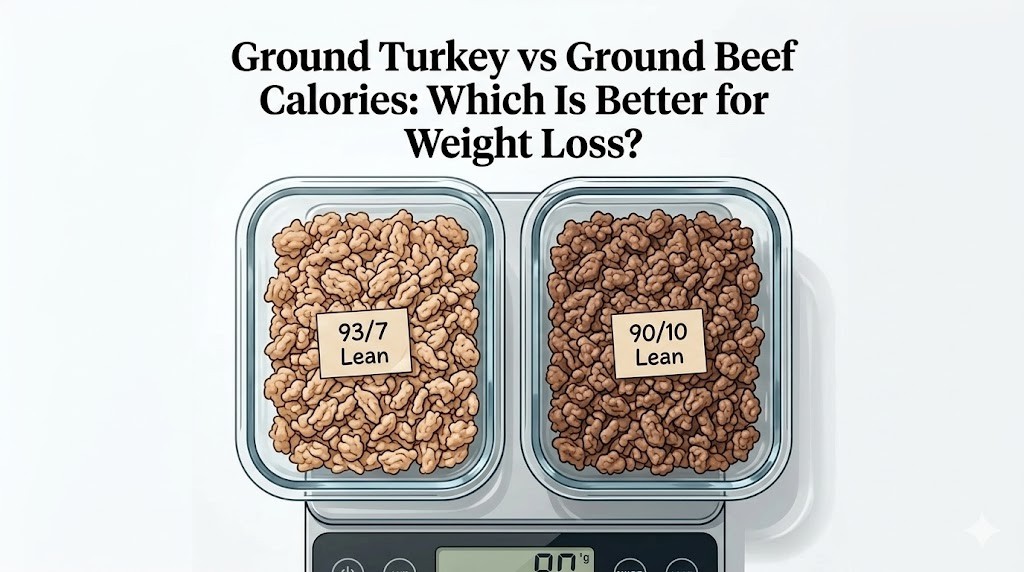
For decades, dietary guidelines have emphasized the restriction of red meat in favor of poultry to reduce calorie and saturated fat intake. This has led to a widespread public perception that ground turkey is inherently superior to ground beef for weight loss and general cardiovascular health.
However, structured nutritional data from the United States Department of Agriculture (USDA) reveals that the animal of origin is far less important than the lean-to-fat ratio printed on the product packaging. This clinical report evaluates the caloric, macronutrient, and micronutrient differences between ground turkey and ground beef, analyzing how these parameters influence physical weight loss, metabolic health, and long-term dietary compliance.
The Caloric Comparison: Lean Percentage vs. Animal Source
A common error among dieting individuals is comparing highly lean ground turkey (such as 93/7) with standard ground beef (such as 80/20) and concluding that turkey is vastly lower in energy. This comparison is structurally flawed, akin to comparing skim milk with whole milk to evaluate the healthfulness of dairy.
To establish an accurate scientific baseline, different lean-to-fat percentages must be compared directly. The table below displays USDA nutrient data for cooked 100g portions of ground turkey and ground beef across various standard commercial ratios.
Meat Type and Lean Ratio | Calories (kcal) | Protein (g) | Total Fat (g) | Saturated Fat (g) |
Ground Beef 95/5 (Extra Lean) | 174 | 26.3 | 6.8 | 3.0 |
Ground Beef 90/10 (Lean) | 204 | 25.2 | 10.7 | 4.2 |
Ground Turkey 93/7 (Lean) | 213 | 27.1 | 11.6 | 3.0 |
Ground Beef 85/15 (Regular) | 232 | 24.6 | 14.0 | 5.3 |
Ground Turkey 85/15 (Regular) | 258 | 25.1 | 17.5 | 4.6 |
Ground Beef 80/20 (Standard) | 246 | 24.0 | 15.9 | 6.1 |
When comparing equivalent or near-equivalent lean ratios, the caloric difference between the two animals is minimal. Cooked lean ground beef (90/10) contains 204 kcal per 100g, whereas cooked lean ground turkey (93/7) contains 213 kcal.
Caloric Difference (100g cooked) = |204 kcal (Beef) - 213 kcal (Turkey)| = 9 kcal
This small difference demonstrates that the animal species is not the primary driver of calorie density. Instead, the fat percentage on the label represents the primary variable.
Transitioning from standard 80/20 ground beef to lean 90/10 ground beef saves approximately 42 kcal per 100g. Conversely, purchasing regular ground turkey (85/15) under the assumption that it is a diet food results in a higher energy intake (258 kcal) than consuming standard 80/20 ground beef (246 kcal).
To optimize weight-loss programs, individuals must track these precise lean-to-fat percentages. Utilizing advanced tools like the voice-based calorie tracking application VoCal simplifies this process, allowing users to log their exact meat specifications simply by speaking, eliminating the friction of manual search databases.
Bottom Line
The lean-to-fat ratio printed on the label determines the caloric content of the meat, not the animal source. Lean ground beef (90/10) contains fewer calories than regular ground turkey (85/15), making the fat percentage the critical factor for weight loss.
Macronutrient Breakdown: Protein and Fat Quality
Protein is highly regarded as a key macronutrient for weight loss due to its high satiety index and its ability to preserve lean muscle tissue during periods of energy restriction. At identical raw lean percentages, ground beef and ground turkey exhibit remarkably similar macronutrient profiles, though minor differences in moisture loss during cooking shift the final cooked values.
For example, when comparing raw 93/7 ground beef to raw 93/7 ground turkey in a standard 4 ounce (112g) serving, the physical differences are minimal:
Raw Ground Beef (93/7): Contains 172kcal, 7.9g of total fat, and has approximately 2.4g more protein than turkey.
Raw Ground Turkey (93/7): Contains 170kcal, 9.4g of total fat, and is slightly lower in protein.
Because beef muscle fibers are slightly more protein-dense, ground beef provides a marginal protein advantage when compared at identical raw fat ratios. Once cooked, however, both options deliver an exceptional dose of complete protein containing all nine essential amino acids necessary for maintaining muscle mass.
While protein densities remain comparable, the lipid profiles of the two meats diverge significantly. Ground turkey consistently contains lower levels of saturated fat. At the lean end, cooked ground turkey (93/7) has 3.0g of saturated fat per 100g, while cooked ground beef (90/10) has 4.2g. The percentage reduction in saturated fat is calculated as follows:
Saturated Fat Reduction % = ((4.2 - 3.0)/(4.2))* 100 = 28.6%(approx)
This 29% reduction is a notable asset for individuals managing blood lipid levels. The Centers for Disease Control and Prevention (CDC) and the National Institutes of Health (NIH) recommend replacing saturated animal fats with lean protein sources to lower low-density lipoprotein (LDL) cholesterol and support long-term cardiovascular health.
Bottom Line
Ground beef offers a slight protein advantage per serving due to muscle fiber density, while ground turkey offers up to a 29% reduction in saturated fat at comparable lean levels, supporting cardiovascular health.
Micronutrient Density: The Nutritional Edge of Beef
During a caloric deficit, metabolic efficiency depends on the intake of essential vitamins and minerals. Ground beef holds a distinct advantage over ground turkey in several primary micronutrients, particularly iron, zinc, and vitamin B12.
The table below outlines the micronutrient values for cooked 100g portions of lean ground beef (95/5) and lean ground turkey (93/7) based on USDA nutritional analyses.
Nutrient | Ground Beef 95/5 cooked | Ground Turkey 93/7 cooked | Nutritive Value & Function |
Iron (mg) | 2.8 | 1.5 | Essential for oxygen transport and cellular energy metabolism |
Zinc (mg) | 6.4 | 3.2 | Supports immune defense, protein synthesis, and hormone health |
Vitamin B12 (mcg) | 2.5 | 1.5 | Required for nerve myelination and red blood cell production |
Ground beef delivers nearly double the concentration of iron and zinc compared to ground turkey. Additionally, the iron in beef is entirely heme iron, which is absorbed by the human digestive tract up to three times more efficiently than the non-heme iron found in plant-based alternatives.
Furthermore, extra-lean ground beef provides 103% of the daily recommended intake for Vitamin B12 per 100g, compared to only 64% in ground turkey. For dieting individuals, maintaining adequate intake of these nutrients is vital for avoiding iron-deficiency anemia, protecting thyroid function, and preventing metabolic slowdown.
Bottom Line
Ground beef is significantly more micronutrient-dense than ground turkey, providing nearly double the amount of highly bioavailable heme iron, zinc, and vitamin B12 to support daily energy levels.
Behavioral Compliance and Cravings: The Beef WISE Study

Successful weight loss is ultimately determined by long-term behavioral compliance. Restrictive dietary patterns that eliminate red meat can induce psychological feelings of deprivation, leading to elevated food cravings and eventual weight regain.
To evaluate whether lean red meat could be safely integrated into a weight loss program, researchers conducted the Beef WISE Study (Beef's Role in Weight Improvement, Satisfaction, and Energy). This clinical trial randomized 120 adults with overweight or obesity into two high-protein weight-reducing diets for 16 weeks :
A group consuming four or more weekly servings of lean beef.
A group restricted from eating any red meat.
The trial revealed equivalent weight loss results between the two cohorts. The lean beef group reduced their total body weight by 7.8 - 5.9%, while the non-red meat group reduced their body weight by 7.7 - 5.5%. Fat mass reductions and improvements in blood pressure and lipid panels were identical between both groups.
Significantly, the secondary analysis of the study focused on subjective behavioral measures. The group restricted from red meat reported significantly higher subjective ratings of dietary deprivation and experienced fewer reductions in intense food cravings compared to the lean beef group.
These clinical findings suggest that incorporating lean beef into a weight reduction program satisfies appetite, reduces the psychological burden of dieting, and improves long-term dietary compliance without hindering metabolic progress.
Bottom Line
The Beef WISE Study demonstrates that lean beef is medically equivalent to poultry for inducing weight loss, while providing greater dietary satisfaction and reducing psychological deprivation.
Food Safety and Safe Preparation Guidelines
Ground meats require careful handling and preparation due to the potential for microbial contamination during processing. Pathogenic strains vary between species, requiring distinct thermal inactivation thresholds.
Ground Turkey: Poultry products carry a high risk of Salmonella contamination. It is essential that ground turkey reaches a minimum internal temperature of 165F (74C) as verified by a calibrated food thermometer to guarantee pathogen destruction.
Ground Beef: Ground beef is highly susceptible to Shiga toxin-producing Escherichia coli (such as E. coli O157:H7 or O103). Ground beef must be cooked to an internal temperature of 160F (71C).
To prevent cross-contamination and minimize the risk of foodborne illness, the USDA recommends adhering to four foundational food safety practices: Clean, Separate, Cook, and Chill. Always wash prep surfaces immediately and refrigerate raw or cooked leftovers promptly.
Bottom Line
To ensure food safety, ground beef must be cooked to an internal temperature of 160F, while ground turkey requires a higher threshold of 165F to eliminate pathogenic Salmonella.
Summary Verdict: Which Is Better for Weight Loss?
Neither ground turkey nor ground beef is universally "better" for weight loss. Instead, the ideal choice depends on individual metabolic profiles, cardiovascular risk factors, and personal food preferences.
Choose Lean Ground Turkey (93/7 or higher) if the primary objective is to minimize saturated fat intake to manage LDL cholesterol or overall cardiovascular health.
Choose Lean Ground Beef (90/10 or 95/5) if the goal is to maximize dietary iron, zinc, and vitamin B12, or to reduce psychological deprivation and satisfy food cravings.
Rather than focusing on the animal source, individuals should focus on purchasing ground meats with a lean-to-fat ratio of at least 90/10 or 93/7 to ensure the protein is sufficiently calorie-sparse.
To eliminate the operational friction of tracking these numbers, the voice-based calorie tracker VoCal allows users to quickly speak their food choices into their devices, ensuring immediate and highly accurate logging of lean percentages and caloric thresholds. Dieting individuals should consult a healthcare professional or registered dietitian to tailor these dietary components to their specific medical history.
Frequently Asked Questions
Does ground turkey have fewer calories than ground beef?
Ground turkey is only lower in calories if it possesses a higher lean-to-fat percentage than the ground beef with which it is being compared. At equivalent ratios, such as 93/7 turkey and 90/10 beef, ground beef actually contains slightly fewer calories per cooked portion.
Is red meat allowed on a healthy weight-loss diet?
Yes. Clinical studies like the Beef WISE Study confirm that lean red meat can be successfully integrated into a high-protein weight-loss program without negatively impacting fat loss, blood pressure, or lipid markers.
Why is ground turkey often recommended over ground beef?
Ground turkey is historically recommended due to its lower saturated fat content. At equivalent lean ratios, ground turkey contains approximately 29% less saturated fat than ground beef, which is beneficial for cardiac risk management.
How do I ensure my ground meat is safe to eat?
Ground beef must be cooked to an internal temperature of 160F (71C), and ground turkey must reach 165F (74C). Always use a digital meat thermometer to verify these internal temperatures before consumption.
Disclaimer: The information in this article is for educational and informational purposes only and is not a substitute for professional medical advice, diagnosis, or treatment. Always consult with a qualified healthcare provider or registered dietitian before starting any new diet or making significant changes to your nutrition plan.