

Picture this: You’re walking down the grocery store aisle, determined to crush your health goals this week. You look to your left and see a colorful display of "fresh" broccoli. You look to your right and see a wall of frozen bags and metal cans.
A voice in your head probably whispers: "Fresh is always best, processed veggies are empty calories!"
But is that actually true? Or have we been falling for some classic marketing myths?
If you are trying to eat healthy, save money, and keep your meal prep simple, it's time to set the record straight. Let’s dive into the surprising science of frozen vegetables vs. fresh nutrition, bust some canned-food myths, and look at how to track it all like a pro using your favorite voice-based calorie tracker, VoCal!
The "Fresh-Stored" Paradox: Why Your Fridge Might Be Stealing Your Vitamins
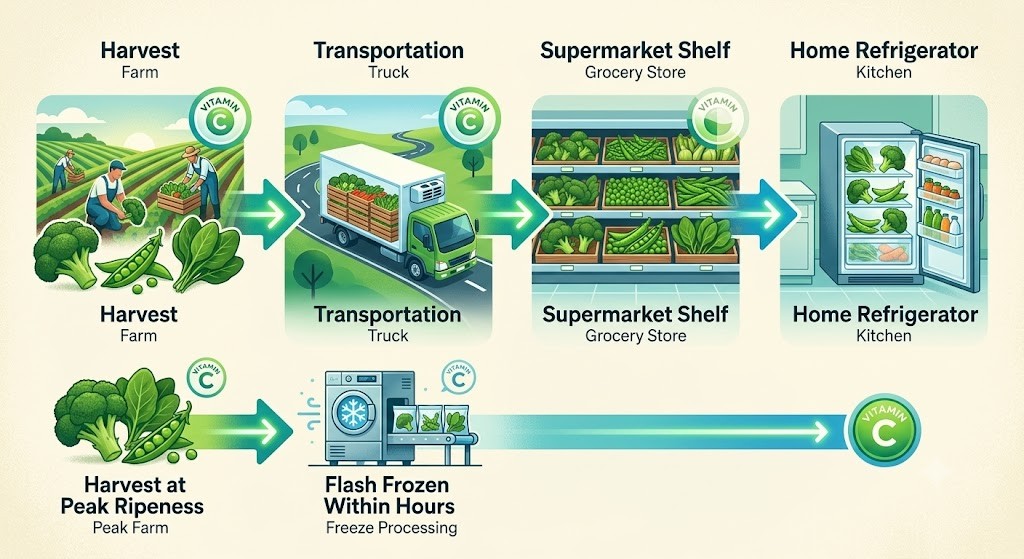
We tend to think of "fresh" vegetables as the gold standard of nutrition. And if you’re picking a tomato straight off a vine in your backyard and eating it immediately, it absolutely is.
But unless you live on a farm, that’s not how grocery shopping works.
Most "fresh" produce in the U.S. is picked before it’s fully ripe so it doesn't rot during transit. It then spends one to two weeks traveling on trucks, sitting in warehouses, and waiting on grocery shelves before you even buy it. Once it finally makes it to your fridge, it might sit there for another five days before you cook it.
During this long journey, those "fresh" veggies are actually losing nutrients every single day. Because the plant is no longer attached to its roots, it has to consume its own stored sugars and water to "breathe".
The Vitamin C Vanishing Act: Fresh green peas can lose up to 51% of their Vitamin C within just 24 to 48 hours after being harvested!
On the flip side, commercial freezing acts like a giant biological pause button. Frozen vegetables are picked at peak ripeness when they are physically bursting with nutrients. Within hours, they are flash-frozen, locking those vitamins and antioxidants in place.
This means that after a few days in your refrigerator, that "fresh" broccoli might actually have fewer vitamins than the frozen bag in your freezer!
Canned vs. Frozen: The Battle of the Preservation Methods
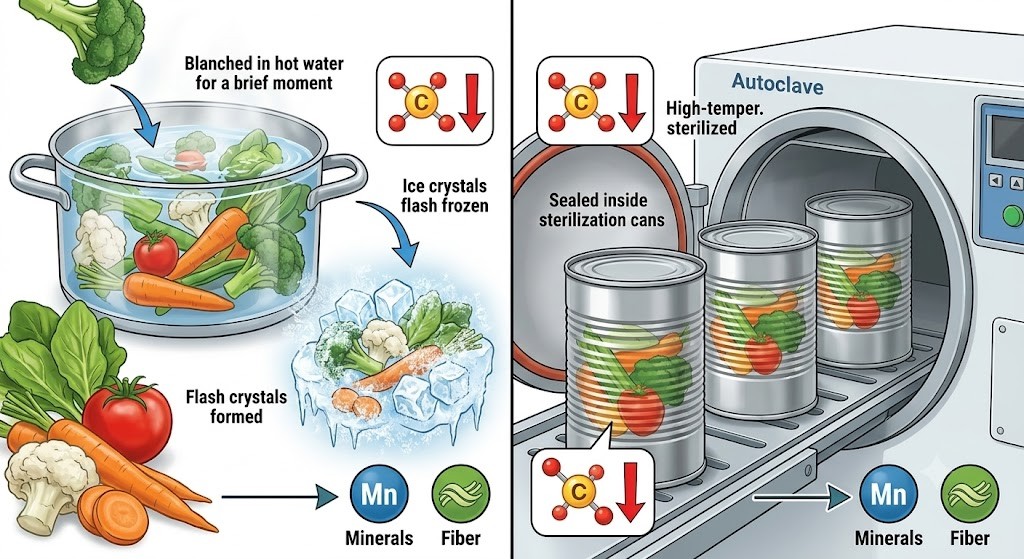
So, how do frozen and canned veggies stack up against each other?
To understand the difference, we have to look at how they are processed.
The Frozen Process
Before veggies are frozen, they go through a quick steam or hot-water bath called blanching. This is super important because it turns off the natural enzymes that cause veggies to lose their color, texture, and flavor in the freezer.
While blanching is great for keeping your veggies pretty, it does cause some delicate, water-soluble nutrients—like Vitamin C and B-complex vitamins—to sneak out into the water. On average, freezing causes about a 50% loss in Vitamin C.
The Canned Process
Canning is a bit more intense. To make canned foods completely shelf-stable (meaning they can sit in your pantry for years without going bad), they have to be sterilized inside sealed cans using high heat.
Because of this prolonged heat exposure, heat-sensitive vitamins take a bigger hit. On average, canned vegetables lose more than 60% of their Vitamin C.
The Silver Lining
But don't write canned veggies off just yet! Minerals (like iron, calcium, and potassium) and dietary fiber are incredibly tough. They don't care about heat at all, meaning canned and frozen vegetables have virtually the same mineral and fiber content as raw veggies.
To see how this plays out across different foods, check out this breakdown based on nutritional studies:
Table 1: Comparative Micronutrient Profiles and Processing Effects
Vegetable / Fruit | Processing Method | Micronutrient Alteration & Retention Status |
Asparagus | Canning | Loses approximately 30% of original Vitamin C content during sterilization. |
Asparagus | Freezing | Loses only 10% of Vitamin C after blanching and freezing. |
Green Peas | Chilled Fresh | Loses up to 51% of Vitamin C within 24 to 48 hours of post-harvest storage. |
Green Peas | Freezing | Retains higher levels of active ascorbic acid and beta-carotene than fresh-stored peas. |
Broccoli | Freezing | Retains approximately 100% of Vitamin C; exhibits higher riboflavin levels than fresh form. |
Broccoli | Fresh-Stored | Folate (Vitamin B9) levels remain superior to those found in the frozen form. |
Spinach | Freezing | Shows lower Vitamin C than fresh-stored spinach; blanching reduces water-soluble antioxidants by 50%. |
Spinach | Cooked (Frozen/Fresh) | Mineral and vitamin levels in cooked frozen spinach are virtually identical to cooked fresh spinach. |
Blueberries | Freezing | Folate levels are significantly greater in frozen blueberries than in fresh-stored forms. |
Blueberries | Fresh-Stored | Beta-carotene levels are significantly higher in fresh and fresh-stored forms than in frozen. |
Peaches | Canning | Vitamin A and Vitamin C levels remain comparable to those of the fresh fruit. |
Peaches | Freezing | Contains slightly higher Vitamin C than fresh due to added ascorbic acid for color preservation. |
Why "One Cup" of Spinach Can Mess Up Your Calorie Tracker
Here is a quick question: If you tell your voice-based calorie tracker, "I had one cup of spinach," does the app know how many calories you actually ate?
If it’s a standard tracker, it might guess. But if you want to avoid a massive tracking error, you have to be specific!
When vegetables are frozen or cooked, their cell walls break down and collapse. This means you can pack way more physical spinach leaves into a single cup than you can with raw, fluffy leaves.
Because of this physical density shift, look at how much the calories and nutrients change when you measure by volume:
Table 2: Physical and Caloric Volume Comparison of Spinach
Nutritional Parameter | Raw Spinach (1 Cup / 30g) | Frozen Spinach (Unprepared, 1 Cup / 156g) | Volumetric Variance (%) |
Mass (grams) | 30.0 g | 156.0 g | +420% |
Energy (Calories) | 7 kcal | 45 kcal | +543% |
Protein (grams) | 0.86 g | 5.70 g | +563% |
Carbohydrates (grams) | 1.10 g | 6.60 g | +500% |
Dietary Fiber (grams) | 0.66 g | 4.50 g | +582% |
Calcium (mg) | 29.70 mg | 201.20 mg | +577% |
Iron, Fe (mg) | 0.81 mg | 2.90 mg | +258% |
Potassium, K (mg) | 167.40 mg | 539.80 mg | +222% |
Sodium (mg) | 23.70 mg | 115.40 mg | +387% |
Vitamin A (RAE) (mcg) | 140.70 mcg | 914.20 mcg | +550% |
A single cup of frozen spinach actually has five times the calories and six times the fiber of raw spinach!
To help digital trackers calculate this accurately, scientists use specific math formulas to figure out exactly how many nutrients make it from the farm to your plate.
The Takeaway for Tracking: When using a voice assistant like VoCal, always mention the physical state of your food! Say "one cup of raw spinach" or "half a cup of cooked frozen spinach" to make sure your daily stats are 100% accurate.
What to Watch Out For: Sodium and BPA
While canned vegetables are super convenient and budget-friendly, there are two main things you should keep an eye on: sodium and BPA.
The Sodium Situation
Sodium chloride (good old table salt) is often added to canned vegetables to keep them firm and flavorful on shelves. Some cans pack over 20% of your daily sodium limit in a single serving!
The Quick Fix: Always look for labels that say "low sodium" or "no salt added". If you only have regular cans on hand, dumping them in a colander and rinsing them under cold water washes away up to 40% of the extra sodium!
The BPA Story
Bisphenol A (BPA) is a chemical compound historically used in the epoxy resin linings of metal cans to prevent food acids from corroding the metal. Because BPA can mimic estrogen, it has been flagged as a potential endocrine disruptor.
The migration of BPA from the lining into your food is a chemical process that speeds up under acidic conditions (like canned fruits) or high sterilization temperatures.
Table 3: Mean BPA Concentrations in Select Canned Food Products
Canned Food Category | Mean BPA Concentration (micrograms/kg) | Safety and Regulatory Threshold Context |
Canned Lentils | 21.87 micrograms/kg | Canned vegetables represent the largest source of adult dietary BPA intake. |
Canned Apricots | 4.52 micrograms/kg | Acidic environments (pH 3.6 - 4.7) accelerate the hydrolysis of epoxy liners. |
Canned Cherries | 3.92 micrograms/kg | Thermal processing during canning triggers physical leaching of residual BPA. |
Canned Pineapples | 1.86 micrograms/kg | Concentrations in fruit samples are lower than in canned legumes and stews. |
Canned Eggplant Stew | 1.67 micrograms/kg | Standard levels remain below the European Union specific migration limit of 600 micrograms/kg. |
Canned Green Peas | 1.62 micrograms/kg | Low-acid vegetables (pH 4.3 - 5.9) exhibit minimal chemical migration. |
Before you panic and throw out your pantry, here is some great news:
First, the FDA and toxicological reviews show that the human body is incredibly efficient at dealing with oral BPA. Once ingested, your liver quickly converts it into an inactive, water-soluble form called bisphenol A-glucuronide. It has a biological half-life of under 6 hours and is completely flushed out of your system in your urine within 24 hours.
Second, many modern manufacturers in the U.S. have completely phased out BPA in favor of polyester or acrylic linings. Just look for cans labeled "BPA-Free" to enjoy peace of mind!
Thermal Magic: When Processing Actually Improves Nutrition!
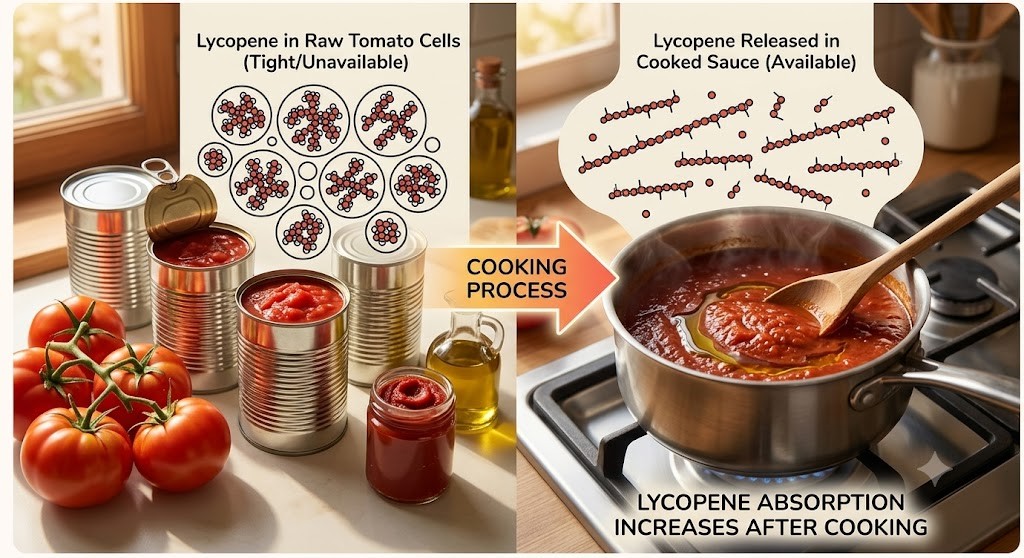
Here is one of the coolest plot twists in food science: High-temperature processing can actually make certain nutrients better!
Take lycopene, a powerful antioxidant found in tomatoes that has been linked to a healthy heart and reduced cancer risks.
In raw tomatoes, lycopene is trapped inside tough cell structures. Because of its chemical shape (the "all-trans" conformation), it is hard for your digestive tract to absorb.
But when tomatoes are heated and processed into paste or sauce, the heat breaks down those cell walls, liberating the lycopene. Even better, the heat twists the molecule into a "cis-isomer" conformation, which is highly bioavailable—meaning your body can absorb it like a sponge!
Table 4: Lycopene Content and Bioaccessibility Across Tomato Product States
Tomato Product State | Lycopene Concentration (mg per 100g) | Dominant Isomer Conformation | Human Bioaccessibility Level |
Fresh Raw Tomatoes | 0.88 - 7.74 mg | All-trans isomer | Low: Bound to the cell wall and protein matrices. |
Canned Tomato Juice | 5.00 - 10.00 mg | Partially isomerized (Cis/Trans) | Moderate: Thermal processing partially disrupts cell walls. |
Canned Ketchup | 9.90 - 13.44 mg | Partially isomerized (Cis/Trans) | Moderate-High: Concentrated via water loss and heating. |
Canned Tomato Paste | 20.00 - 40.00 mg | High concentration of Cis-isomers | High: Severe cellular disruption and long-duration heat. |
Paste Cooked with Olive Oil | Concentrated | Cis-isomer solubilized in lipid matrix | Maximum: Lipids facilitate immediate micellar absorption. |
Pro Tip: Because lycopene is fat-soluble, cooking your canned tomatoes or tomato paste with a drizzle of healthy extra virgin olive oil boosts your body's absorption by a mind-blowing 82%!
The Bottom Line: How to Mix & Match for Your Best Health
When it comes to hitting your daily veggie goals, you don’t have to pick a single side! Fresh, frozen, and canned vegetables are all fantastic tools to keep in your kitchen toolkit.
Choose Fresh when you want that satisfying, crisp crunch for raw salads, snacks, or quick seasonal meals.
Choose Frozen for your everyday cooking, stir-fries, and smoothies. It’s the ultimate way to get peak nutrition on a budget without worrying about food waste.
Choose Canned for pantry convenience, hearty stews, and tomato dishes where processing actually unlocks supercharged antioxidants like lycopene.
No matter which form you choose, the most important step is simply getting those vibrant, nutrient-dense veggies on your plate! And when you’re ready to log your meals, just tell VoCal exactly how you prepared them to keep your healthy lifestyle on track.
Now, go enjoy those veggies!
FAQs
1. Are frozen vegetables considered "processed food"?
Technically, yes, because they are washed, blanched, and cut. But they do not contain chemical preservatives, artificial colors, or extra sugar. They are simply fresh veggies that have been put on ice at their nutritional peak!
2. Does rinsing canned vegetables really help?
Yes! Giving your canned beans or veggies a good rinse under cold water can cut the sodium content by up to 40%. Just note that it might wash away a tiny bit of water-soluble vitamins, too.
3. Is it safe to eat from a dented can?
Always inspect your cans! While small dents are usually fine, you should never eat food from cans that are leaking, bulging, deeply dented, or that spurt liquid when opened. These can be signs of harmful bacteria that cause botulism.
4. How long can I keep frozen and canned vegetables?
To get the best taste and nutrition, try to eat frozen veggies within 8 to 12 months. Canned vegetables are incredibly stable and can last anywhere from 2 to 5 years in a cool pantry.
Disclaimer: This article is for informational purposes only. It does not provide medical advice, diagnosis, or treatment. Please consult a qualified healthcare professional or registered dietitian before making significant changes to your diet or nutrition plan.