

Ever stood in the supermarket produce aisle, looking at a bag of frozen broccoli like it’s the runner-up prize of healthy eating?
You’re not alone. Most of us have been taught that fresh is always best. But when it comes to frozen vegetables vs fresh nutrition, science has a pretty juicy plot twist: your freezer is actually a nutrient-saving superhero.
In fact, the veggies in your freezer might actually pack more of a nutritional punch than the "fresh" ones sitting in your fridge right now.
Here is a breakdown of the science behind keeping those vitamins locked in, the best ways of cooking frozen vegetables without losing their nutrients, and why your voice-tracker needs to know exactly how you prepped them!
The Freshness Illusion: Why "Fresh" Isn't Always Fresh
The moment a vegetable is picked, its internal timer starts ticking. Even though it's no longer attached to the earth, the veggie is still "breathing" and using up its own nutrients to stay alive.
Because of the modern grocery supply chain, "fresh" veggies can spend 1 to 2 weeks traveling from the farm to a distribution center, then to store shelves, and finally to your refrigerator crisper drawer. During this long journey, highly sensitive water-soluble vitamins—like Vitamin C and B vitamins—start to rapidly break down.
How fast do they disappear? Let's look at the numbers:
Spinach: When stored at a cozy room temperature of 20°C (68°F), fresh spinach can lose 100% of its Vitamin C in just one single week. Even under standard refrigeration at 4°C (39°F), it loses up to 75%.
Green Peas: Peas can lose up to 51% of their Vitamin C within the first 24 to 48 hours after being harvested.
Commercial freezing stops this clock by pressing a giant "pause button" on nutrient decay.
Bottom Line: "Fresh" supermarket veggies often lose a significant amount of their water-soluble vitamins during transport and storage, while freezing acts as nature’s pause button to lock those nutrients in at peak ripeness.
How Flash-Freezing Locks in the Good Stuff
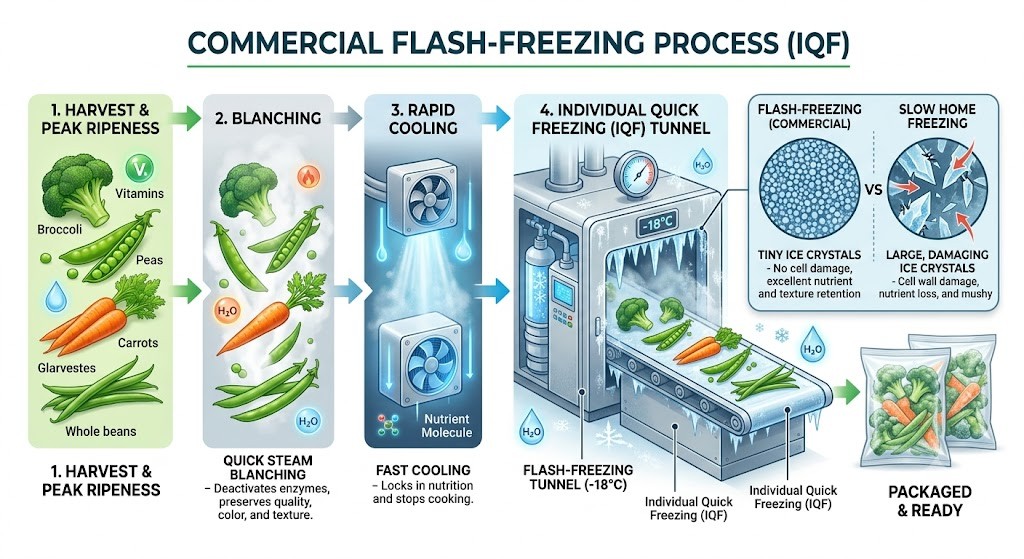
To understand why frozen is so highly rated, it helps to understand how commercial flash-freezing works.
First, veggies undergo a quick blanching process—they are briefly dipped in boiling water or steam. This heat treatment deactivates the natural enzymes (like peroxidase and polyphenol oxidase) that cause veggies to spoil, lose their bright colors, and ruin their fresh flavor.
While blanching does cause an initial loss of about 10% to 50% of water-soluble vitamins, it completely stabilizes the remaining nutrients. This prevents the slow, continuous nutrient drain that happens to fresh veggies in your fridge over time.
Next, the veggies are frozen using high-tech industrial blast freezers.
Slow Freezing (Home Freezers): Freezing foods slowly allows large, jagged ice crystals to form. These crystals puncture the plant’s delicate cell walls. When thawed, the veggie turns mushy and leaks its vitamin-rich juices.
Rapid Flash-Freezing (Industrial): Commercial freezers lower the temperature to 0°F (-18°C) or below in mere minutes. This forms tiny, uniform ice crystals that do not damage the plant cells, keeping the structure and nutrients sealed inside.
Because different vegetables have different cell structures, some handle the freezing process much better than others.
Vegetable Suitability Class | Examples | Physical and Chemical Response to Freezing | Recommendations for Culinary Use |
|---|---|---|---|
High-Starch Matrices | Green peas, sweet corn, lima beans. | Thick starch matrices maintain structural support even if partial cell rupture occurs. Minimal textural change observed. | Excellent candidates for direct-from-frozen cooking. |
Fibrous Structures | Broccoli, cauliflower, asparagus, green beans. | Highly fibrous cell walls tolerate micro-crystallization well; blanching enhances color and brightness. | Ideal for rapid steaming or microwaving to prevent structural softening. |
High-Water/Thin-Walled | Lettuce, celery, cucumbers, radishes, raw tomatoes. | Thin cell membranes are completely obliterated by ice expansion. Thawing results in total structural collapse, water loss, and a mushy texture. | Not recommended for freezing unless intended for cooked purees, soups, or sauces. |
Bottom Line: Industrial flash-freezing creates tiny ice crystals that preserve cellular structure. High-starch and fibrous vegetables hold up beautifully, while water-rich veggies are best left unfrozen.
Frozen vs. Fresh: The Ultimate Nutrient Showdown
To see how frozen stacks up against fresh in the real world, researchers at the University of Georgia teamed up with the Frozen Food Foundation for a two-year study. Led by Dr. Ronald Pegg, the team compared fresh veggies on their purchase day, fresh veggies stored in a home fridge for five days, and their frozen equivalents.
The results were eye-opening. Frozen veggies performed just as well as fresh ones, and in many cases, they actually beat the fresh-stored versions. For instance:
Folate levels in frozen corn, green peas, and blueberries were significantly higher than in fresh-stored versions.
Vitamin C and beta-carotene were much better preserved in frozen green peas than in fresh peas stored for five days.
Another landmark study from the University of California, Davis, led by Dr. Ali Bouzari, analyzed vitamins, minerals, and fiber across fresh and frozen produce. They confirmed that essential minerals (like calcium, magnesium, iron, and zinc) and dietary fiber remain completely unchanged by freezing.
Even better, fat-soluble vitamins like Vitamin E (alpha-tocopherol) were up to 50% higher in frozen green peas, green beans, blueberries, spinach, and corn compared to fresh-stored varieties.
Here is how different nutrients behave in the freezer compared to your fridge:
Micronutrient Class | Physiological Sensitivity | Behavior in Frozen Storage (vs. Fresh-Stored) | Biochemical Mechanism |
|---|---|---|---|
Ascorbic Acid (Vitamin C) | Extremely high sensitivity to heat, light, air, and water. | Highly variable. Frozen green peas and broccoli retain superior levels over fresh-stored counterparts. Frozen spinach retains less due to high surface area leaching during blanching. | Ascorbic acid is oxidized immediately upon cellular damage. Flash-freezing halts this oxidation, though the initial blanching process causes some leaching. |
Riboflavin (Vitamin B2) | Sensitive to light and thermal processing. | Highly stable. No significant statistical differences between fresh and frozen forms in seven of eight major commodities. | Riboflavin is less prone to heat degradation than vitamin C but remains susceptible to leaching in water-blanched systems. |
alpha-Tocopherol (Vitamin E) | Fat-soluble; highly sensitive to oxidative degradation. | Up to 50% higher in frozen peas, green beans, blueberries, spinach, and corn compared to fresh-stored equivalents. | Freezing halts the oxidative pathways that naturally destroy vitamin E in fresh tissues stored over several days. Thermal processing can also enhance the extractability of lipophilic vitamins from the plant matrix. |
beta-Carotene (Pro-Vitamin A) | Stable under refrigeration but susceptible to thermal degradation. | Comparable or slightly lower in frozen peas, carrots, and spinach. Highly stable in green beans and broccoli. | Carotenoids are bound within complex protein-lipid matrices. While some are lost during thermal blanching, subsequent frozen storage keeps carotenoid levels highly stable. |
Bottom Line: Major university studies show that frozen vegetables are nutritionally equal to—and often better than—fresh produce that has been sitting in your refrigerator for a few days.
The Thermodynamics of Cooking: Steam and Microwave for the Win
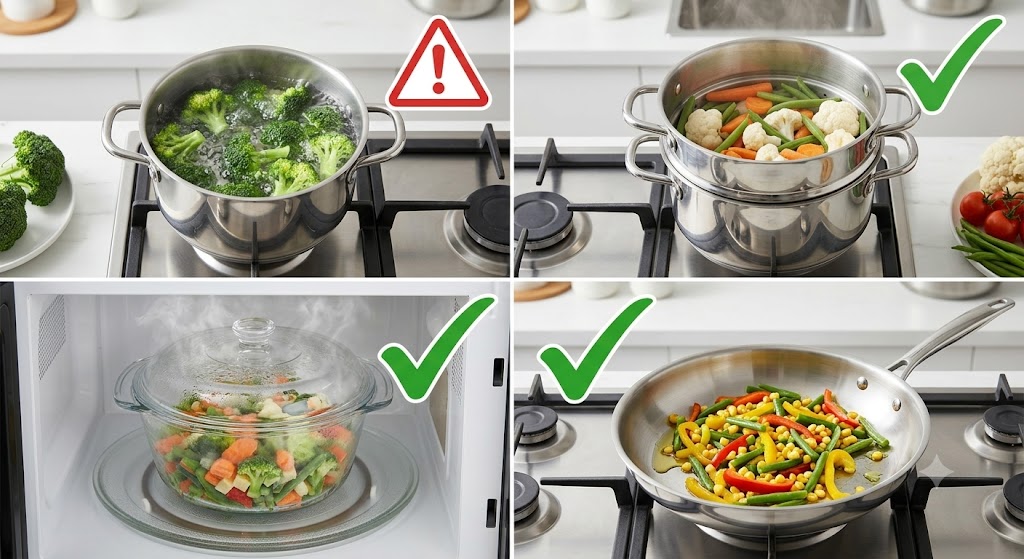
Once those frozen veggies are in your kitchen, your cooking method determines how many nutrients actually make it onto your plate. The three biggest nutrient killers are heat, time, and water.
To measure how well nutrients survive cooking, food scientists calculate True Retention (TR):
True Retention(%)=((Nutrientcooked×Weightcooked)/(Nutrientraw×Weightraw))×100
A study published in Food Science and Biotechnology tested different home cooking methods. The findings turned standard kitchen assumptions upside down:
1. Boiling is the Ultimate Nutrient Villain
When you submerge veggies in boiling water, water-soluble vitamins (like Vitamin C and B vitamins) dissolve straight into the cooking liquid. If you dump that green water down the kitchen sink, you are throwing away a massive portion of the vegetable's nutrients.
Boiled broccoli loses nearly half of its Vitamin C, retaining only 52.85%.
Boiled spinach is even worse, retaining a measly 40.12%.
2. Steaming and Microwaving are the Heroes
If you want to keep your nutrients, you need to keep your veggies out of the water.
Steaming suspends your vegetables above the water, cooking them with hot vapor. Because the veggies don't touch the liquid, they keep up to 90% of their Vitamin C.
Microwaving is even better. It uses the water molecules already inside the vegetable to cook it incredibly fast, with zero extra water needed.
In the study, microwaved broccoli actually scored a Vitamin C retention of 112.76%.
Microwaved spinach retained 91.10% of its Vitamin C.
Wait, how can retention be over 100%? The rapid, waterless cooking causes a small amount of moisture to evaporate. This concentrates the dry matter of the vegetable, making the remaining vitamins easier to extract and analyze.
While microwaving is fantastic for Vitamin C, keep in mind that the best method can vary slightly depending on the veggie. For example, microwaving preserved the most Vitamin K in spinach and chard, but caused a significant drop in crown daisy.
Furthermore, a little bit of heat actually makes some nutrients more bioavailable. Heat breaks down tough plant cell walls, making it easier for your body to absorb powerful antioxidants like lycopene in tomatoes and beta-carotene in carrots.
Bottom Line: Avoid boiling. It causes water-soluble vitamins to leach out into the discarded water. Steaming and microwaving use minimal water and quick cooking times, keeping those nutrients locked in.
Easy Kitchen Hacks for Cooking Frozen Veggies
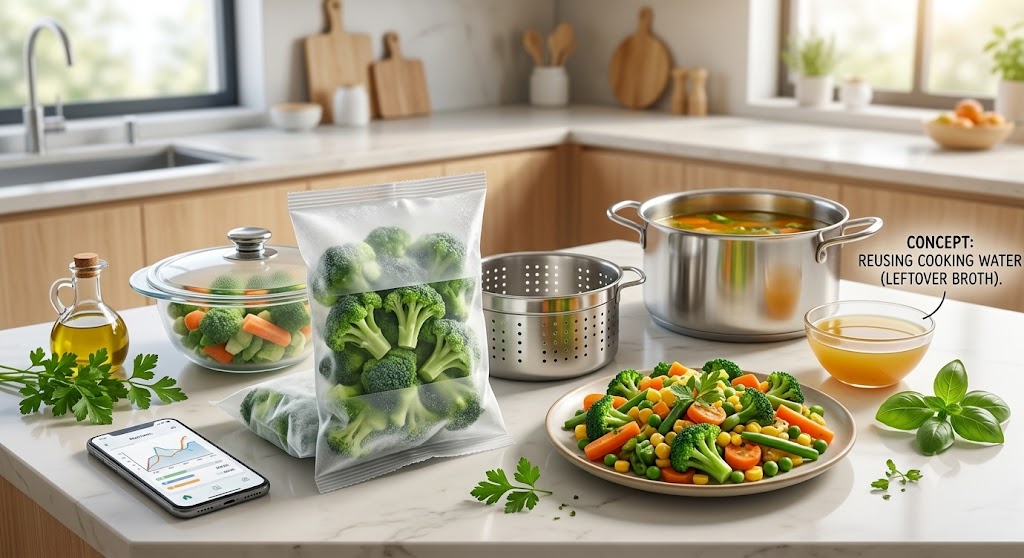
To get the absolute most out of your frozen produce, use these simple, science-backed culinary tips:
Cook Straight from Frozen: Do not thaw your veggies before cooking (except for corn on the cob). Thawing allows enzymes to reactivate, leading to structural breakdown, mushiness, and a loss of vitamins through "drip loss".
The Microwave-Steam Trick: Place frozen veggies in a microwave-safe bowl, do not add water, and cover tightly with a plate. Microwave on high for 2 to 5 minutes. Trapped steam cooks them beautifully using their own moisture.
Suspend Over Steam: If using the stovetop, place your frozen veggies in a steamer basket at least two inches above rapidly boiling water and put the lid on.
Skip the Baking Soda: Adding baking soda to cooking water keeps green veggies looking bright, but the alkaline environment chemically destroys Vitamin C and B vitamins.
Keep the Skins On: If you are freezing or buying root vegetables (like carrots or potatoes), leave the skins on. The skin acts as a natural shield, cutting nutrient loss by up to 20%. Additionally, peeling potatoes can remove up to 90% of the iron, 70% of the fiber, and 30% to 50% of the B and C vitamins.
Upcycle Your Cooking Water: If you do end up boiling your veggies, save the leftover water. It is packed with leached vitamins and minerals. Use it as a flavorful, nutritious base for soups, stews, or for cooking rice and grains.
Buy Plain, Un-Sauced Veggies: Choose plain frozen veggies over those packed with pre-made cheese, butter, or sauces. Pre-made sauces often contain hidden sodium, saturated fats, and emulsifiers. Going plain keeps things healthy and easy to track.
Bottom Line: Keeping water contact minimal, skipping chemical additives, and cooking straight from frozen are the easiest ways to keep your meals nutrient-dense.
Why Your Voice-Based Calorie Tracker Needs to Know Your Cooking Style
If you are using an advanced voice-based calorie tracking platform like VoCal, the physical changes that happen in your kitchen are incredibly important for logging accuracy.
A simple spoken command like "I had a cup of broccoli" isn't enough if you are looking for real precision. Cooking completely changes the weight, volume, and nutrient density of your food.
For example:
Volume Shifts: Spinach shrinks drastically when cooked because its cell structure collapses and releases trapped air. A cup of cooked spinach actually contains several times more raw leaf mass than a cup of raw spinach.
Weight Shifts: Boiling causes veggies to absorb water, making them heavier but diluting their nutrient density per gram. On the flip side, microwaving or roasting causes water to evaporate, concentrating their nutrients and calories per gram.
To give you highly accurate nutritional tracking, Vo-cal.com uses advanced backend processing to calculate how your cooking method affected your meal.
When you say, "I had one cup of steamed frozen broccoli," the system instantly maps three crucial data points:
The Veggie: Broccoli.
The Starting State: Commercially frozen.
The Cooking Method: Steamed.
The app's database immediately applies the correct True Retention and cooking yield factors. It logs a highly accurate nutritional profile, knowing that steaming preserved almost all of the Vitamin C.
If you had said "boiled broccoli," the system would automatically slash the logged Vitamin C record by nearly half (to reflect the 52.85% retention).
By choosing plain frozen vegetables and tracking them with precise, voice-activated tools, you can ensure your daily calorie and micronutrient goals are backed by real food science.
Bottom Line: How you cook your food changes its weight, volume, and nutrients. Logging your specific cooking method on VoCal ensures your health metrics are incredibly accurate and personalized.
Frequently Asked Questions (FAQs)
Is it better to steam or microwave frozen vegetables?
Both methods are absolutely excellent! Because steaming and microwaving keep the vegetables out of direct submersion in water, they minimize the leaching of water-soluble nutrients. Microwaving has a slight edge for speed, which reduces the time heat-sensitive Vitamin C is exposed to warmth.
Should I thaw frozen vegetables before cooking them?
As a general rule, no. Cooking vegetables straight from frozen prevents dormant spoilage enzymes from waking up and breaking down cellular structures, which would make the veggies mushy. It also prevents "drip loss"—which is when melting ice crystals wash away valuable vitamins. The only exception is corn on the cob, which should be thawed first so the heat penetrates to the center of the cob evenly.
Do frozen vegetables have added sodium or preservatives?
Plain frozen vegetables do not contain any added sodium or chemical preservatives. Flash-freezing itself acts as a natural preservation method by slowing molecular movement and preventing bacterial growth. However, frozen vegetable mixes packed with pre-made cheese, butter, or seasoning sauces are often high in added sodium, saturated fats, and emulsifiers.
Can you eat frozen vegetables without cooking them first?
It is highly recommended to cook frozen vegetables before eating them. While commercial flash-freezing is extremely sanitary, the pre-freezing blanching process is a quality-control step to stop enzyme activity, not a sterilization step. Dormant bacteria can survive freezing and multiply rapidly once thawed. Cooking to recommended safe temperatures is essential for food safety, especially for children, pregnant individuals, the elderly, or those with compromised immune systems.
Disclaimer: This article is for informational purposes only. It does not provide medical advice, diagnosis, or treatment. Please consult a qualified healthcare professional or registered dietitian before making significant changes to your diet or nutrition plan.