

Picture this: You’re standing in the grocery store aisle, staring down the deli counter. On one side, you have a beautiful, raw chicken breast. On the other, a stack of perfectly sliced, ready-to-eat deli turkey. Your stomach is rumbling, and your busy schedule is screaming for the path of least resistance.
We’ve all been there. Turkey sandwiches are the ultimate lunchtime MVP—they're fast, portable, and packed with protein. But as you reach for those convenient cold cuts, a nagging question pops up: Is choosing deli meat vs fresh meat healthier, or is your sandwich secretly sneaking in a mountain of salt and preservatives?
If you use a voice-activated calorie and nutrient tracker like VoCal to keep your macros in check, you know that not all proteins are created equal. Let’s break down the science of fresh versus processed meats, unpack what really happens at the deli counter, and help you build a better lunch.
What’s the Big Deal? Fresh vs. Processed Meat
To understand the difference, we have to look at how these meats are made. The United States Department of Agriculture (USDA) actually has strict rules about what gets to be called "fresh" and what is classified as "processed."
Fresh Meat: This is raw muscle tissue in its natural state. It hasn’t been heated, cured, salted, or smoked. The only thing that's happened to it is simple cutting, grinding, or temperature control. It's as close to the farm as you can get at the supermarket.
Processed Meat: This includes any meat that has been modified to extend its shelf life, lock in flavor, or change its texture. This includes cooking, salting, curing, fermenting, and smoking. Unfortunately, yes, this means almost all of your favorite deli counter meats—like ham, turkey slices, roast beef, and salami—fall into this category.
To make your next grocery run easier, here is a quick cheat sheet on USDA labeling terms:
Regulatory Term | USDA Definition and Requirements | Food Examples |
Fresh Poultry | Whole poultry or cuts that have never dropped below an internal temperature of 26°F | Raw chicken breast, fresh turkey thighs |
Frozen Poultry | Raw poultry stored at or below an internal temperature of 0°F | Frozen turkey breast, frozen chicken wings |
Natural | Contains no artificial ingredients or colors; minimally processed | Fresh, unseasoned ground beef |
Cured / Processed | Modified using salt, sugar, nitrates, nitrites, or chemical preservatives | Deli ham, bacon, salami, pepperoni |
And if you see "Lean" on a beef label, the USDA guarantees that a 100-gram serving has less than 10 grams of total fat, 4.5 grams or less of saturated fat, and less than 95 milligrams of cholesterol. If it says "Extra Lean," those numbers drop to less than 5 grams of total fat and under 2 grams of saturated fat.
The Nutrient Showdown: Protein & Beyond
When it comes to pure muscle-building protein, cold cuts and fresh meats are neck-and-neck. Both provide "complete" proteins, meaning they give your body all nine essential amino acids it can't make on its own.
But how do they stack up side-by-side? Let’s look at the numbers for a 100-gram serving (about 3.5 ounces):
Protein Source (100g serving) | Average Protein Content | Average Sodium Content | Saturated Fat Profile |
Fresh Chicken Breast | 21 – 23 g | ~65 mg | Very Low (~1.0 g) |
Deli Turkey Breast | 20 – 24 g | ~800 – 1,000 mg | Low (~1.0 g) |
Fresh Beef Steak | 22 – 26 g | ~60 mg | Moderate (3.0 – 5.0 g) |
Deli Roast Beef | 22 g | ~700 – 900 mg | Low-Moderate (2.0 g) |
Deli Ham (Lean) | 16 – 18 g | ~1,000 – 1,200 mg | Low (~1.5 g) |
While the protein numbers are incredibly close, fresh meat is the clear winner for overall nutrient density. When commercial deli meats are washed, cooked, and brined in high-volume facilities, they can lose a portion of their natural, water-soluble B vitamins.
On top of that, fresh, unprocessed meats are naturally packed with highly bioavailable iron and zinc, which are essential for keeping your energy levels high and your immune system strong.
The Preservation Pitfall: Sodium and Nitrates
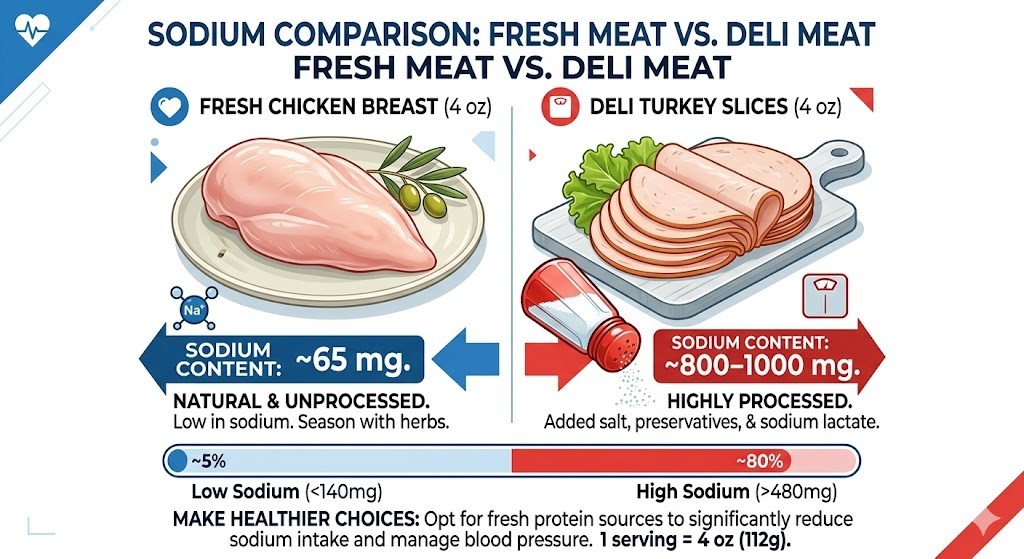
The main reason deli meats get a bad rap isn't the meat itself—it's the chemical cocktail used to keep it fresh and flavorful on store shelves.
The Sodium Trap
Sodium is a sneaky mineral. While your body needs a little bit to function, most Americans consume a whopping 3,400 milligrams a day. The American Heart Association (AHA) recommends staying under 2,300 milligrams, with an ideal limit of 1,500 milligrams daily for optimal heart health.
A single 2-ounce serving of standard deli meat (just six thin slices) can pack up to 1,000 milligrams of sodium. That is nearly half of your ideal daily limit in one sandwich.
This excess sodium acts as a preservative to stop nasty bacteria like Listeria from growing, but it also causes your body to hold onto extra water. Over time, all that extra fluid puts a heavy burden on your blood vessels, leading to high blood pressure, arterial stiffness, and a higher risk of heart disease.
Meanwhile, unseasoned fresh meats naturally contain 100 milligrams or less of sodium per serving.
The Nitrite Dilemma
To keep sliced meats looking pink and appealing instead of gray, manufacturers add sodium nitrate and sodium nitrite.
The trouble starts when you eat them. In the highly acidic environment of your stomach, these compounds can convert into N-nitroso compounds, also known as nitrosamines. Nitrosamines are known carcinogens that can damage the delicate cells lining your gut, potentially triggering tumor growth over time.
What about "nitrate-free" or "uncured" options? While they sound healthier, these products are typically cured using natural nitrate sources like celery powder or sea salt.
Biochemically, your stomach doesn't care if a nitrate came from a chemistry lab or a celery stalk; it processes them the exact same way, converting them into those same nitrosamines.
The Long-Term Health Risks
Decades of global research have highlighted the risks of eating processed meats regularly.
Colorectal Cancer: The World Health Organization (WHO) has officially classified processed meat as a Group 1 Carcinogen—putting it in the same category as other known cancer-causing agents like asbestos (though not equally dangerous). Eating just 50 grams of processed meat daily (about two slices of bacon or one hot dog) increases your relative risk of colorectal cancer by 18%.
Upper Digestive Cancers: Eating just one extra slice of deli ham (30 grams) per day is linked to a 9% higher risk of stomach cancer and a 13% higher risk of esophageal cancer.
Heart Disease & Diabetes: A famous Harvard study found that while eating fresh, unprocessed red meat didn’t show a strong link to heart disease or diabetes, eating processed meat daily boosted heart disease risk by 42% and type 2 diabetes risk by 19%.
What About Plant-Based Deli Meats?
If you're looking to cut back on animal products, plant-based deli slices made from soy, peas, or wheat gluten might seem like the perfect swap.
On the plus side, plant-based meats are entirely cholesterol-free, low in saturated fat, and contain heart-healthy dietary fiber (which animal meat doesn't have). Clinical studies show that swapping real meat for plant-based alternatives can help lower your LDL ("bad") cholesterol.
However, they aren't a perfect health food. Plant-based cold cuts are ultra-processed. To make plants taste and feel like meat, manufacturers often load them up with sodium, thickeners, and coconut oil.
Additionally, only about 12% of these products are fortified with the essential nutrients naturally found in meat, like vitamin B12, iron, and zinc. If you rely on them solely, you could run into nutritional deficiencies over time.
Top Tips for Healthier Lunch Meats

You don't have to banish sandwiches forever. Slicing fresh meat directly at home or making smarter choices at the grocery store can dramatically lower your preservative exposure. Registered dietitians recommend these practical tips:
1. Try a DIY Roast at Home
The absolute healthiest option is making your own sandwich meats. It only takes a little planning, and you control exactly what goes in.
Buy a raw, unseasoned boneless chicken breast or a beef eye of round roast.
Rub it with a low-sodium spice blend like garlic powder, onion powder, and smoked paprika.
Cook it in your oven or Instant Pot until it reaches safe internal temperatures (165°F for poultry, 145°F for pork, and 135°F for medium-rare beef).
The Slicing Secret: Let the meat cool to room temperature, then wrap and chill it in the fridge for at least two hours. Slicing cold meat makes it much easier to get thin, sandwich-ready slices with a sharp knife.
2. Choose Fresh-Sliced Over Prepackaged
If you're buying at the grocery store, skip the pegboard aisle and head straight to the deli counter. Ask for meats sliced directly off the roast or bone. They are generally less processed and contain fewer artificial coloring agents and fillers than prepackaged tub options.
3. Read the Nutrition Labels
Look for labels that explicitly say "low-sodium" or "reduced-sodium." Aim for products that contain less than 300 milligrams of sodium per 2-ounce serving. Keep the ingredient list as short as possible.
4. Switch Up Your Proteins
You don't have to use deli meat every single day. Give your body a break by building sandwiches or wraps around other high-quality proteins, like:
Hard-boiled eggs
Hummus and crisp vegetables
Canned tuna or wild salmon
Grilled tofu or tempeh
Tracking Your Balance with VoCal
Making healthier dietary changes doesn't have to be a headache. With a voice-activated tracking app like VoCal, keeping an eye on your sodium and protein intake is as simple as talking.
Instead of searching through a endless database, you can simply say: "I had two slices of low-sodium turkey breast on whole-wheat bread with spinach." The app immediately logs your sodium, monitors your daily protein targets, and helps you keep your cardiovascular health on track without the stress.
Summary: The Final Verdict
When it comes to whether choosing deli meat vs fresh meat healthier outcomes are achieved, fresh meat wins by a landslide. It gives you all the protein without the heavy sodium burden or chemical preservatives.
You don't have to live in a "food prison" where deli sandwiches are forbidden. An occasional cold cut sandwich won't derail your health, but keeping processed meats as an occasional treat rather than a daily staple is one of the best moves you can make for your body.
Frequently Asked Questions (FAQs)
Is deli meat vs fresh meat healthier for weight loss?
For weight loss, both can help you hit your protein goals, which keeps you feeling full. However, fresh meat is much better. The massive amount of sodium in standard deli meat causes water retention and bloating, and processed options often contain hidden fats and sugar additives.
Why does processed meat increase colon cancer risk?
The processing itself is the culprit. Preservatives like sodium nitrite convert into DNA-damaging nitrosamines in your stomach. In addition, smoking or cooking meats at very high temperatures creates carcinogenic chemicals that can damage your colon cells over time.
Are "uncured" deli meats actually better for you?
Not necessarily. "Uncured" or "nitrate-free" meats simply use natural sources of nitrates, such as celery powder, instead of synthetic ones. Once inside your body, these natural nitrates convert into the same nitrites and cancer-causing nitrosamines as synthetic versions.
How much sodium should I look for in healthy deli meat?
Ideally, try to find lunch meats that contain less than 300 milligrams of sodium per 2-ounce serving. Standard deli meats can easily exceed 600 to 1,000 milligrams of sodium per serving, which can quickly spike your blood pressure.
Disclaimer: If you have high blood pressure, heart disease, or kidney issues, consult a registered dietitian or primary healthcare provider to find the best sodium and nutrient targets for your body.