
Picture this: You’re standing in front of the grill on a sunny Saturday afternoon, spatula in hand, ready to cook. Suddenly, you face the ultimate cookout debate: turkey burger vs beef burger calories. You want to keep your meals aligned with your weight loss goals, so you instinctively reach for the turkey patty, assuming it is the ultimate healthy swap.
But is ground turkey actually the undisputed champion of the diet world, or have we all fallen for some clever marketing?
The truth is a bit more complicated—and a lot more interesting! Let’s break down the actual science, bust some common burger myths, and look at how these patties stack up so you can make the best choice for your health and your tastebuds.
The Great Burger Myth: It’s All About the Lean-to-Fat Ratio!
Here is a major plot twist: ground turkey isn't automatically lower in calories than ground beef.
When you compare them side-by-side, the real culprit behind the calories isn't the animal itself—it is the lean-to-fat ratio printed on the package. This ratio tells you exactly how much of the meat is lean protein versus fat.
If you compare 93% lean ground turkey with 93% lean ground beef, their calorie and macronutrient counts are practically twins. In fact, the lean beef option actually contains slightly more protein!
To show you how they compare, here is the nutritional breakdown for standard 4-ounce (112-gram) raw servings across different commercial blends:
Ground Meat Type (4-oz Raw Serving) | Calories | Total Fat (g) | Saturated Fat (g) | Sodium (mg) | Protein (g) | Iron (% DV) |
99% Lean Ground Turkey Breast | 120 | 1.0 | 0.0 | 55 | 26 | 6% |
96% Lean / 4% Fat Ground Beef | 150 | 4.5 | 2.0 | 75 | 24 | 15% |
93% Lean / 7% Fat Ground Turkey | 150 | 8.0 | 3.5 | 95 | 22 | 8% |
92% Lean / 8% Fat Ground Beef | 160 | 8.0 | 3.0 | 75 | 21 | 15% |
90% Lean / 10% Fat Ground Beef | 200 | 11.0 | 4.5 | 75 | 19 | 10% |
85% Lean / 15% Fat Ground Turkey | 230 | 17.0 | 5.0 | 80 | 19 | 8% |
80% Lean / 20% Fat Ground Beef | 239 | 17.0 | 7.0 | 75 | 19 | 15% |
73% Lean / 27% Fat Ground Beef | 340 | 30.0 | 12.0 | 75 | 17 | 10% |
As you can see, choosing an 85/15 ground turkey blend (230 calories) actually gives you more calories and fat than choosing a super lean 96/4 ground beef (150 calories)!
But what happens once they hit the grill? Cooking causes meat to lose moisture, which slightly changes the nutrient concentration. Here is how they look as cooked 3-ounce patties:
Cooked Patty Type (3-oz Serving) | Calories | Total Fat (g) | Saturated Fat (g) | Sodium (mg) | Protein (g) | Zinc (mg) | Vitamin B12 (mcg) |
99% Fat-Free Ground Turkey | 117 | 2.0 | 0.57 | 50 | 25 | 1.9 | 0.57 |
95% Lean Ground Beef | 164 | 6.4 | 2.80 | 72 | 25 | 6.0 | 2.40 |
93% Lean Ground Beef | 178 | 8.0 | 3.30 | 73 | 25 | 5.9 | 2.40 |
93% Lean Ground Turkey | 181 | 9.9 | 2.50 | 77 | 23 | 3.2 | 1.60 |
85% Lean Ground Beef | 218 | 13.0 | 4.90 | 76 | 24 | 5.6 | 2.40 |
85% Lean Ground Turkey | 219 | 15.0 | 3.90 | 72 | 21 | 3.0 | 1.40 |
The Takeaway: If you buy standard 85/15 or 93/7 blends, swapping beef for turkey won't save you any calories. The real calorie-saving superstar is 99% fat-free ground turkey breast, which has no direct ground beef equivalent.
Satiety, Protein, and the Math Behind Weight Loss
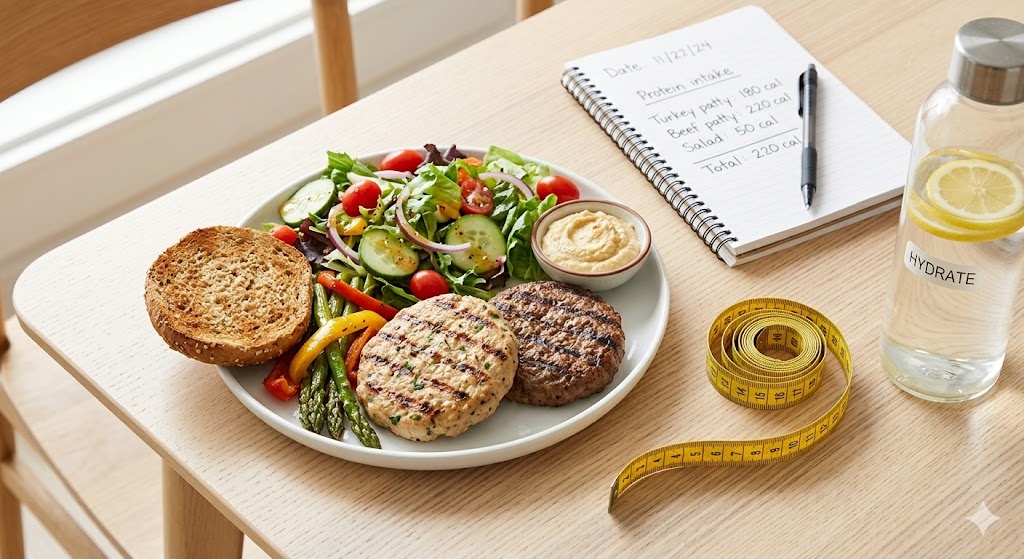
To lose weight, you need to maintain a consistent energy deficit. For a steady weight loss of 1 to 1.5 pounds per week, you generally want to aim for a daily deficit of 500 to 750 calories.
We can look at this simple weight loss relationship using this formula:
Energy Deficit= Total Daily Energy Expenditure (TDEE) - Caloric Intake
To keep your appetite happy while staying in a calorie deficit, you need to focus on protein. Protein is the most filling macronutrient because it keeps those "I'm hungry!" hormones quiet. Both beef and turkey are outstanding, high-quality proteins.
If you are looking to maximize your protein while keeping calories low, 99% fat-free ground turkey breast is a fantastic choice. It delivers a massive 25 grams of protein for just 117 calories per cooked serving.
Turkey is also rich in leucine (providing 2.035 grams per 3-ounce serving) , an essential amino acid that acts as a signal to help your body preserve calorie-burning muscle tissue while you lose fat.
However, there is a catch. Because ultra-lean turkey breast has almost no fat and a low pH of 6.13, it can dry out very quickly on the grill. To prevent their burgers from tasting like cardboard, many cooks add high-calorie binders like eggs, oil, or breadcrumbs. These additions can quickly add back the calories you were trying to save!
Saturated Fat: The Heart-Health Connection
While calories rule the weight loss scale, your heart health depends on the types of fat you eat. Ground beef is naturally higher in saturated fats. Eating too much saturated fat can raise your LDL ("bad") cholesterol, which can increase the risk of cardiovascular issues over time.
The American Heart Association (AHA) recommends limiting your saturated fat intake to less than 6% of your daily calories. If you eat a standard 2,000-calorie diet, your daily limit can be calculated using this formula:
Daily Saturated Fat Limit=(2,000*0.06)/9 =13g(approx)
The broader Dietary Guidelines for Americans (DGA) suggest keeping it under 10% of your daily calories, which is about 20 grams.
This is where turkey gets its heart-healthy reputation. Across almost all lean-to-fat ratios, ground turkey contains about 1 gram less saturated fat per serving than ground beef.
In fact, major long-term studies from Harvard University associated replacing a daily serving of red meat with poultry with a 14% lower risk of premature death.
The Takeaway: If you are watching your cholesterol or looking to cut down on saturated fats, ground turkey is an excellent heart-healthy swap.
Micronutrient Perks: Why Beef is a Nutrient Powerhouse
Before you banish beef from your kitchen, let's look at its impressive nutrient profile. While turkey wins the saturated fat battle, lean ground beef is an absolute powerhouse for essential vitamins and minerals.
Heme Iron: Ground beef provides double the iron of ground turkey. More importantly, it is heme iron, the highly absorbable form that your body uses to keep your energy levels high.
Zinc: Beef has nearly double the zinc of turkey, which is essential for a strong immune system and muscle recovery.
Vitamin B12: A 3-ounce cooked beef patty provides 100% of your daily B12 needs, which supports your nervous system and metabolic health.
Here is what you get in a cooked 3-ounce serving of 90/10 lean ground beef crumbles:
Micronutrient | Value per 3-oz Cooked Serving | % Daily Value (DV) |
Vitamin B12 | 2.4 mcg | 100% |
Zinc | 5.8 mg | 53% |
Niacin (B3) | 5.8 mg | 36% |
Selenium | 18.4 mcg | 33% |
Vitamin B6 | 0.36 mg | 21% |
Iron | 2.6 mg | 15% |
Choline | 77.7 mg | 14% |
Potassium | 368.1 mg | 8% |
If you want the nutritional benefits of red meat but with much less fat, you can also look into alternative red meats like bison or venison. These options provide the same rich iron and zinc as beef, but are naturally lean and lower in saturated fat.
Binders, Toppings, and the Sneaky "Burger Ecosystem"
We rarely eat just a plain meat patty. When you build a burger, the bun, cheese, spreads, and binders often add more calories, fat, and sodium than the actual meat!
This is especially true for turkey burgers, where recipes often include ingredients like oats, eggs, or sugary barbecue sauces to add moisture. Look at how different recipes compare:
Recipe Source | Burger Composition | Calories | Total Fat (g) | Saturated Fat (g) | Total Carbs (g) | Protein (g) |
Mayo Clinic Healthy Weight Burger | Ground turkey breast, breadcrumbs, onions, Worcestershire sauce, bun | 296 | 4.0 | 1.0 | 30.0 | 35 |
Mayo Clinic Barbecue Turkey Burger | Ground turkey breast, rolled oats, ketchup, brown sugar, spices, bun | 412 | 5.0 | 2.0 | 63.0 | 36 |
Moroccan Spiced Turkey Burger | Ground turkey patty with spices (no bun or toppings) | 215 | 14.0 | 4.0 | No Data | No Data |
Level Up Your Burger with Nutrient-Dense Toppings
Instead of using heavy binders or fatty spreads, you can make your burger juicy and delicious using smart, flavorful toppings recommended by the Cleveland Clinic :
Fresh Apple Slices: Adds a refreshing crunch, natural sweetness, and pectin (a soluble fiber that supports healthy cholesterol).
Sautéed Onions: Brimming with antioxidants like quercetin and prebiotic fibers to support your gut.
Coarse Black Pepper: A sprinkle of black pepper enhances savory flavors naturally, reducing the need for excess salt, while supporting nutrient absorption.
100% Whole-Wheat Buns: Choosing whole-grain buns provides B vitamins and heart-healthy fiber.
Safe Cooking: Keep It Healthy, Keep It Safe
Food safety is crucial when cooking ground meats. Ground poultry carries a higher risk of foodborne bacteria like Salmonella. Because grinding mixes bacteria throughout the meat, you must cook your burgers to safe internal temperatures.
Always use a reliable food thermometer to check the center of your patties :
Ground Turkey Burgers: Must reach 165°F (74°C).
Ground Beef Burgers: Must reach 160°F (71°C).
Tip: Cook your turkey burger to 160°F, remove it from the heat, and let it rest under foil for a few minutes. The residual heat will safely bring it to 165°F without drying it out!
Log Your Burger Effortlessly with VoCal
With different meat grinds, binders, toppings, and buns, tracking your calories can quickly become a chore.
A voice-based calorie tracker like VoCal makes logging your meals simple. Instead of searching through endless databases to find the exact lean-to-fat ratio you cooked, you can simply speak your meal naturally:
"Logged a cooked four-ounce patty of ninety-nine percent lean ground turkey breast with a slice of Cheddar cheese"
"Three ounces of pan-broiled ninety-three percent lean ground beef with sliced apples on a whole-wheat bun"
The app automatically interprets your voice, breaks down the ingredients, and logs your calories, protein, and saturated fat. This helps you stay consistent with your tracking and focused on your weight loss goals.
FAQs
Are turkey burgers actually lower in calories than beef burgers?
Not always! It depends entirely on the lean-to-fat ratio. A 93% lean ground turkey burger has virtually the same calories as 93% lean ground beef. Only 99% fat-free ground turkey breast is significantly lower in calories than lean beef options.
Which is better for losing belly fat, turkey or beef?
For weight loss, the most important factor is maintaining a consistent calorie deficit while eating enough protein to stay full. 99% fat-free ground turkey offers the lowest calories and highest protein density. However, if you prefer the taste of lean beef, keeping it to a 93% or 95% lean grind can fit perfectly into a weight loss plan.
How do I stop my turkey burgers from drying out without adding extra calories?
Instead of adding high-calorie binders like breadcrumbs or oil, try mixing finely minced onions, mushrooms, or bell peppers directly into your raw ground turkey. They add natural moisture, fiber, and flavor without adding extra calories!
Disclaimer: This article is for informational purposes only and is not medical advice. Consult a healthcare professional before starting any weight-loss plan.