

Let’s be honest: avocados are the undisputed darlings of the produce aisle. Whether you are mashing them into a chunky Sunday morning guacamole, slicing them over a warm grain bowl, or spreading them onto a piece of artisanal sourdough toast, this creamy "alligator pear" is hard to resist.
But if you are keeping an eye on your weight, a low-carb lifestyle, or your overall health, you've probably asked yourself: How many calories am I actually eating?
In the dieting world, we often see vague measurements like "one medium avocado" or "half a cup of cubes". But avocados are naturally high in fats, which means they are highly energy-dense. A slight estimate error can quietly throw your numbers off.
To get your nutrition tracking on point, you have to look at the numbers by weight—specifically, the golden baseline of avocado calories per 100g.
Here is a look at what makes weight-based tracking a game-changer, the exact breakdown of avocado nutrition, and a simple, hands-free way to log your meals.
Why Weighing Your Avocado is a Game-Changer
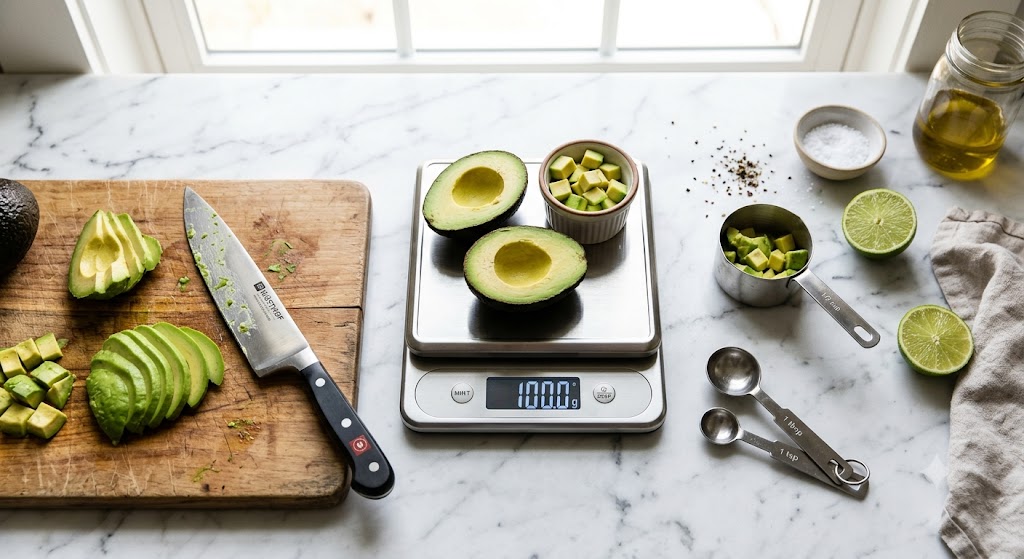
When you are tracking lower-fat foods like celery or cucumbers, eyeballing your portions is usually fine. But because avocados are packed with heart-healthy monounsaturated fats, they carry more than double the calories per gram of protein or carbs (9 calories per gram compared to 4).
This means that a tiny difference in size can mean a massive difference in your daily energy intake.
If you rely on packaged food labels, you should also know that the U.S. Food and Drug Administration (FDA) allows a 20% margin of error on nutrition facts. That means a packaged food labeled as 100 calories could easily be 120 calories.
When you track by volume (like using a measuring cup or estimating "one slice"), it is incredibly easy to over-serve yourself. Transitioning to weight-based tracking using grams is the most accurate way to keep your fitness goals on track without the guesswork.
Bottom Line Relying on vague portion sizes or visual guesses can easily stall your weight goals. Weighing your avocado in grams takes the guesswork out of your diet and gives you honest, accurate numbers.
The Magic Number: Avocado Calories Per 100g
According to the United States Department of Agriculture (USDA) FoodData Central, the official baseline for avocado calories per 100g of raw, edible flesh is 160 calories.
But remember: that is only for the creamy, delicious green pulp. When you weigh a whole, intact avocado on your kitchen scale, you have to account for the "pit and skin discount" (also known as refuse weight).
For a standard commercial Hass avocado—the bumpy, dark-purple variety we all love—the skin and the central seed make up about 30% to 33% of the total weight. So, if you throw a whole avocado on the scale and it weighs 200 grams, you are only eating about 136 to 140 grams of actual fruit.
Physical Breakdown of a Hass Avocado by Weight
Botanical Component | Percentage of Total Fruit Weight (%) | Average Weight in Medium Fruit (g) | Metabolic and Culinary Classification |
Edible Pulp (Flesh) | 65% to 73% (Standard: 70%) | 136 to 150 | Nutrient-dense lipid-fiber matrix |
Central Seed (Pit) | 13% to 20% (Standard: 16%) | 30 to 40 | Tannin-rich, starch-heavy by-product |
Outer Peel (Skin) | 11% to 15% (Standard: 12%) | 22 to 30 | Waxy, protective lipid layer |
Depending on the variety, these ratios can shift slightly. For example, Florida avocados (often marketed as "SlimCados") have a smoother, bright-green skin, a higher water content, and about one-third fewer calories than the richer Hass avocado.
But for standard kitchen logging, assuming your avocado is 70% edible flesh is a great rule of thumb.
Bottom Line 100 grams of edible raw avocado contains 160 calories. When weighing whole avocados, remember that about 30% of that weight is the skin and pit, which you will discard.
Weight-Based Avocado Portion Chart
To make your life easier, we have broken down the exact calories and nutrients for the most common avocado portion sizes. No more guessing how many calories are in "one thin slice" or a "half-avocado"!
Comprehensive Weight-Based Nutrition Table
Portion Description | Edible Weight (g) | Energy (kcal) | Total Fat (g) | Saturated Fat (g) | Monounsaturated Fat (g) | Total Carbs (g) | Dietary Fiber (g) | Net Carbs (g) | Protein (g) | Potassium (mg) | Folate (mcg) |
Single Thin Slice | 15 | 24 | 2.20 | 0.32 | 1.47 | 1.28 | 1.00 | 0.28 | 0.30 | 73 | 12 |
USDA Labeling Serving | 30 | 48 | 4.40 | 0.64 | 2.94 | 2.56 | 2.01 | 0.55 | 0.60 | 146 | 24 |
FDA Reference Serving (1/3 Medium) | 50 | 80 | 7.33 | 1.06 | 4.90 | 4.26 | 3.35 | 0.91 | 1.00 | 242 | 40 |
NHANES Average Serving (1/2 Medium) | 68 | 109 | 9.97 | 1.45 | 6.66 | 5.80 | 4.56 | 1.24 | 1.36 | 330 | 55 |
Standard Half Avocado | 75 | 120 | 11.00 | 1.60 | 7.35 | 6.40 | 5.03 | 1.37 | 1.50 | 364 | 61 |
Standard Base Portion | 100 | 160 | 14.66 | 2.13 | 9.80 | 8.53 | 6.70 | 1.83 | 2.00 | 485 | 81 |
Whole Medium Avocado | 150 | 240 | 21.99 | 3.19 | 14.70 | 12.79 | 10.05 | 2.74 | 3.00 | 728 | 122 |
Whole Large Avocado | 201 | 322 | 29.47 | 4.28 | 19.70 | 17.15 | 13.47 | 3.68 | 4.02 | 975 | 163 |
(Data is sourced directly from USDA FoodData Central, entry 171705. Net Carbs are calculated as Total Carbohydrates minus Dietary Fiber.)
Bottom Line Portion sizes can vary wildly, with a whole medium avocado containing 240 calories and a large one hitting 322 calories. Using a weight-based chart helps ensure your entries match what is actually on your plate.
The Good, the Fat, and the Fiber
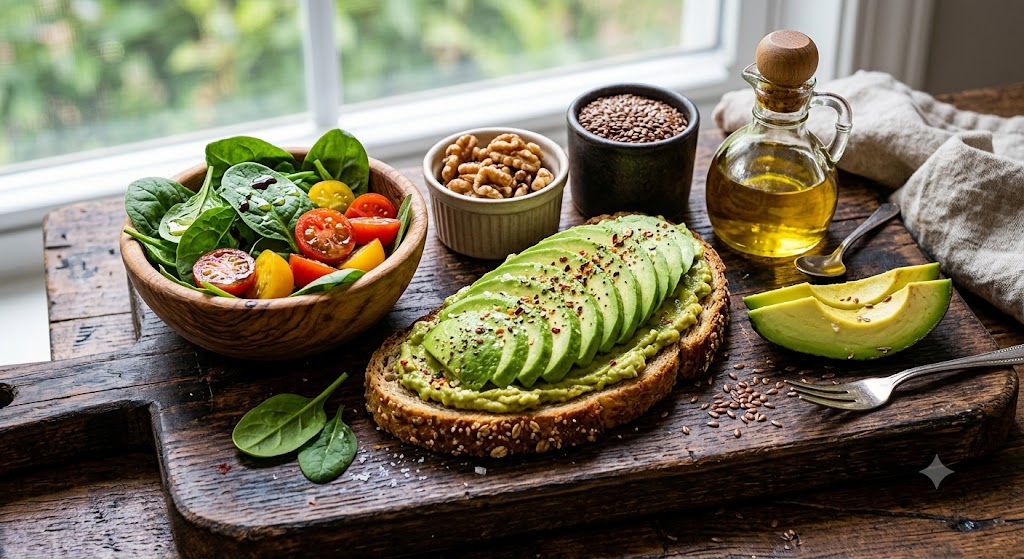
Let's look past the calories and talk about why avocados are widely considered a superfood. They are structurally unique compared to almost any other fruit because their energy comes from healthy fats rather than sugar:
Monounsaturated Fats (MUFAs): These make up nearly 67% of the total fat in an avocado. The star player here is oleic acid, which is the same heart-healthy fatty acid found in extra virgin olive oil. Oleic acid is associated with reduced inflammation, healthier blood lipid levels, and improved insulin sensitivity.
Minimal Net Carbs: If you are practicing a keto or low-carb diet, avocados are your best friend. Out of the 8.53 grams of total carbohydrates in a 100-gram serving, 6.70 grams are dietary fiber. This leaves you with a tiny 1.83 grams of net carbs!
Digestive Fiber: Avocados are packed with fiber. It contains a healthy mix of insoluble fiber (70%), which keeps your digestive system moving regularly, and soluble fiber (30%), which acts as a prebiotic to feed the friendly bacteria in your gut.
Because of this unique fat-and-fiber combination, avocados have an exceptionally low glycemic index (GI) of around 40. They slow down your digestion, keep your blood sugar stable, and help you feel full and satisfied for hours after eating.
Bottom Line Avocados are incredibly low in net carbs and packed with prebiotic fiber and monounsaturated fats. This combination keeps your blood sugar stable and supports digestive health.
Beyond Macros: Micronutrient Highlights
Avocados are also a fantastic source of vitamins and minerals:
Potassium: At 485 mg per 100g, avocados actually contain more potassium than bananas weight-for-weight. Potassium helps regulate your blood pressure and supports heart function.
Folate (Vitamin B9): With 81 mcg per 100g, avocados provide a great natural source of folate, which is essential for DNA synthesis and cellular health.
Carotenoids (Lutein & Zeaxanthin): These antioxidants are highly beneficial for eye health, helping protect your eyes from blue light and age-related macular degeneration.
Even better, because carotenoids and vitamins E and K are fat-soluble, the natural healthy fats in the avocado act as a built-in absorption booster. Eating avocado alongside other colorful vegetables helps your body absorb their nutrients much more effectively.
Bottom Line Avocados are rich in essential nutrients like potassium and folate. Their healthy fats also dramatically increase how well your body absorbs antioxidants and vitamins from your other food.
Clean Composting: What to Do with the Pit and Peel

If you love eating avocados, you probably generate your fair share of kitchen waste. While the pit and skin are solid organic material, they pose a fun little challenge for composters:
The Pit: Avocado pits are incredibly dense and packed with natural protective tannins. If you toss a whole pit into an outdoor compost bin, it can sit there unchanged for up to two years! To speed things up, carefully cut the fresh, soft pit into halves or quarters before adding it to your compost.
The Skin: The bumpy dark peel has a protective, waxy outer layer designed to retain moisture. It will break down, but it takes a bit longer than softer fruit peels. Mixing your chopped peels with high-nitrogen greens (like coffee grounds or vegetable scraps) helps speed up the decomposition process.
Bottom Line To keep your compost bin running smoothly, never toss in a whole avocado pit. Chop the fresh pit and peel into small pieces to help your garden microbes break them down quickly.
Health Precautions and Substitutions
While avocados are incredibly healthy, they might not be suitable for everyone in large amounts:
Potassium Restrictions: Because a whole medium avocado contains over 700 mg of potassium, individuals with advanced chronic kidney disease (CKD) or those on potassium-limiting medications should carefully manage their portion sizes.
Blood Thinners: Avocados contain vitamin K1 (21 mcg per 100g), which plays a role in blood clotting. If you are taking warfarin or other vitamin-K-sensitive medications, it is important to keep your daily intake stable.
Caloric Budgets: If you are on an aggressive calorie-deficit plan, the rich fat content of avocados means you should weigh your portions carefully rather than eating them unlimitedly.
If you are looking to add avocados to your weight management routine, the best approach is substitution rather than addition. Instead of adding avocado on top of your usual meals, try using it as a direct swap. Replacing butter, cheese, or heavy mayonnaise with an equal weight of creamy, mashed avocado is an excellent way to swap saturated fats for clean, monounsaturated lipids and prebiotic fiber.
Bottom Line If you have kidney disease, take blood thinners, or are on a strict low-calorie diet, be mindful of your portion sizes. Swapping out saturated spreads for fresh avocado is an easy way to level up your nutrition.
Stop Typing, Start Talking: Tracking Made Easy with VoCal
We all know that the secret to long-term weight loss is consistency. But let's be real: opening up a cluttered app, typing in search bars, and manually entering weights can feel like a chore.
Traditional apps (think Lifesum) can easily overwhelm you with bloated features—including complicated diet plans, confusing hydration logs, and stressful "Life Scores" that make you feel guilty for enjoying your food. Plus, their photo-recognition scanners often struggle to identify homemade recipes or healthy fats accurately.
That is where VoCal comes in.
Instead of typing or scanning, you simply tap the mic and speak naturally:
"I had eighty grams of raw Hass avocado."
"Add a slice of sourdough toast with fifteen grams of mashed avocado."
VoCal's conversational AI understands exactly what you mean, isolates the weight, pulls the correct nutrition data (like USDA entry 171705), and logs your calories and macros in under 15 seconds.
Traditional Manual Trackers vs. VoCal Voice Logging
Operational Metric | Legacy Manual Food Trackers | VoCal Voice-Activated App |
Logging Interface | Text search, barcode scanning, manual typing | Simple, conversational voice-recognition |
Average Time Per Meal | 3 to 7 minutes of searching and tapping | 15 seconds of natural speech |
App Experience | Cluttered menus, gamified badges, high tracking stress | Clean, single-focus interface with no distractions |
Accuracy | Prone to visual guessing or scanner errors | High precision through specific spoken weights |
By taking the friction out of food logging, VoCal helps you build sustainable habits without the tracking fatigue.
Bottom Line Traditional food tracking is slow and tedious. VoCal swaps out the typing, menus, and stress for a streamlined, conversational voice AI that logs your meals in seconds.
Frequently Asked Questions
Is it healthy to eat a whole avocado every day?
Yes, for most active and healthy adults, eating a whole avocado daily can be a highly nutritious habit. Research shows that daily avocado consumption supports healthy blood lipid levels, sleep, and overall diet quality. Just ensure you account for the 240 to 320 calories it provides within your daily energy goals.
How many net carbs are in 100g of avocado?
There are only 1.83 grams of net carbs in 100 grams of edible avocado. Since avocados are packed with 6.70 grams of dietary fiber, the glycemic impact of the remaining carbohydrates is exceptionally low.
How much does an average Hass avocado pit weigh?
The central seed of a standard medium Hass avocado typically weighs between 30 and 40 grams, making up roughly 16% of the fruit's total weight.
Disclaimer: The nutritional and dietary guidance in this article is provided solely for educational and general informational purposes. It is not intended to serve as personalized medical advice, diagnosis, or treatment. Always consult with a qualified physician, registered dietitian, or certified healthcare professional before making any significant changes to your diet or wellness routine.