

Picture this: You are standing in your kitchen at 7:00 AM, half-awake, staring at your espresso machine. You want to whip up a cafe-quality latte, but you are stuck facing the ultimate modern dilemma: almond milk vs oat milk.
With an estimated 36% of the US population living with lactose intolerance and millions more embracing plant-based diets, these two milk alternatives have officially taken over our coffee bars. But which one actually deserves the crown for your morning brew? And if you are using a voice calorie tracker like VoCal, how do these choices affect your daily targets?
Let’s break down the delicious science.
Nutritional Showdown: What’s Under the Hood?
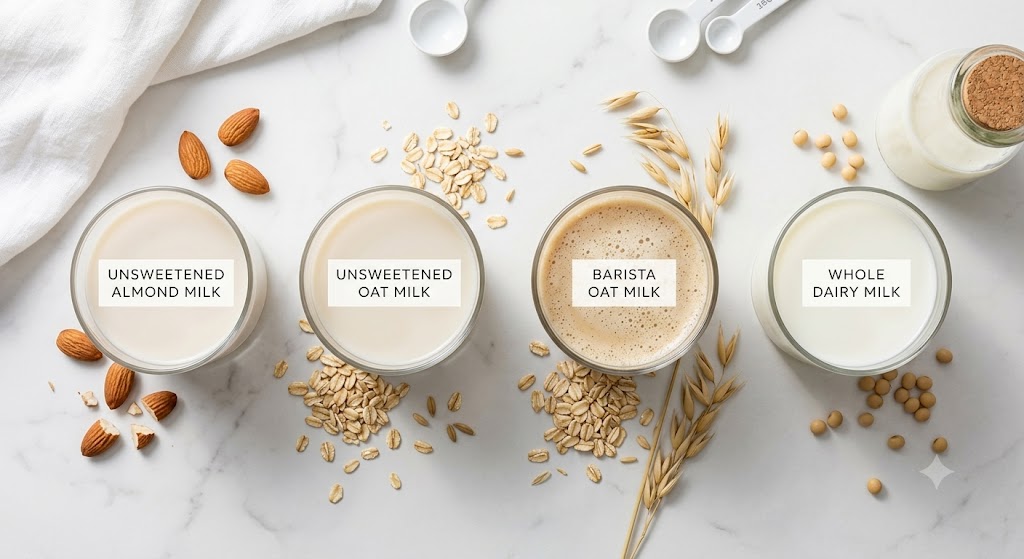
While they sit side-by-side on the grocery shelf, almond and oat milk are completely different beasts.
Unsweetened almond milk is the lightweight champ. Made by blending soaked almonds with water, it is highly filtered, leaving behind a watery, low-calorie liquid that is perfect for low-carb lifestyles.
Oat milk, on the other hand, is a grain-based drink. During processing, manufacturers add enzymes to break down the natural oat starches into simple sugars. This gives oat milk its signature natural sweetness and creaminess, but it also raises the carbohydrate and calorie count.
Here is how a 1-cup (240 mL) serving of each stacks up against traditional whole milk:
Nutrient Component (per 1 Cup) | Unsweetened Almond Milk | Unsweetened Oat Milk | Barista Oat Milk (Oatly) | Whole Bovine Milk |
|---|---|---|---|---|
Energy (Calories) | 30-40 kcal | 80-100 kcal | 120-158 kcal | 150-153 kcal |
Carbohydrates | 1.5 g | 16.0 g | 15.6-30.5 g | 11.0-11.5 g |
Total Sugars | 0.0 g | 4.0-8.0 g | 8.0-10.0 g | 11.0-11.5 g |
Dietary Fiber | 1.0 g | 2.0 g | 1.9-2.4 g | 0.0 g |
Protein | 1.0 g | 2.7 g | 2.4 g | 7.9-8.2 g |
Total Fat | 2.5-2.6 g | 1.5 g | 1.7-3.6 g | 8.0-9.4 g |
Saturated Fat | 0.0 g | 0.0-0.2 g | 0.5 g | 4.5-5.6 g |
Sodium | 117-146 mg | 100 mg | 100-120 mg | 110-121 mg |
Calcium | 422-449 mg | 248-338 mg | 300-350 mg | 309-310 mg |
Bottom Line: If your main goal is keeping your calories and carbs low, unsweetened almond milk is your best bet. But if you want a richer, more satisfying texture, oat milk brings the creamy goodness.
The Satiety Factor: Staying Fuller for Longer
Have you ever noticed that an oat milk latte keeps you full until lunchtime, while almond milk leaves your stomach growling by 9:00 AM? There is a scientific reason for that!
Oat milk naturally contains a soluble fiber called beta-glucan. Once inside your stomach, beta-glucan hydrates to form a thick, viscous gel. This gel slows down your digestion and prompts your gut to release fullness hormones like cholecystokinin (CCK) and peptide YY (PYY).
Almond milk has almost no fiber or protein, meaning it passes through your stomach rapidly without triggering these fullness signals.
Bottom Line: While oat milk has more calories, its natural beta-glucan fiber actively triggers your body’s satiety pathways to help curb overeating later in the day.
The Frothing Face-Off: Who Wins the Microfoam Battle?

If you love pouring latte art, you know that not all plant milks behave the same way under steam pressure. Creating that glossy, paint-like microfoam is all about protein chemistry.
When you steam milk, the heat unfolds the proteins. Their hydrophobic parts grab onto the air, while the hydrophilic parts hold onto the water, forming a protective, elastic shield around the bubbles to keep them from popping.
Because standard almond milk is highly diluted, it contains very little protein. There simply aren't enough protein "shields" to keep bubbles from merging, leaving you with a dry, airy foam that quickly collapses.
Oat milk proteins are much better at holding together under heat, and its natural starches keep the liquid thick to prevent the foam from separating.
Let's compare their frothing metrics:
Frothing & Performance Metrics | Almond Milk (Standard) | Oat Milk (Barista-Grade) |
|---|---|---|
Protein Concentration | Extremely low (0.4 g / 100 mL) | Moderate (1.2 g / 100 mL) |
Lipid Concentration | Moderate (1.1 g / 100 mL) | High (3.0 g / 100 mL) |
Foam Stability Index | Low (3.1 / 10) | High (8.7 / 10) |
Optimal Steaming Temp | 58°C - 63°C | 62°C - 68°C |
Texture & Mouthfeel | Thin, watery, slightly dry | Velvety, dense, comparable to dairy |
Bottom Line: Oat milk is the undisputed champion of frothing, easily creating a stable, velvety microfoam. Almond milk requires a "barista edition" blend to stand a fighting chance.
The Curdling Crisis: Why Does My Milk Separate?
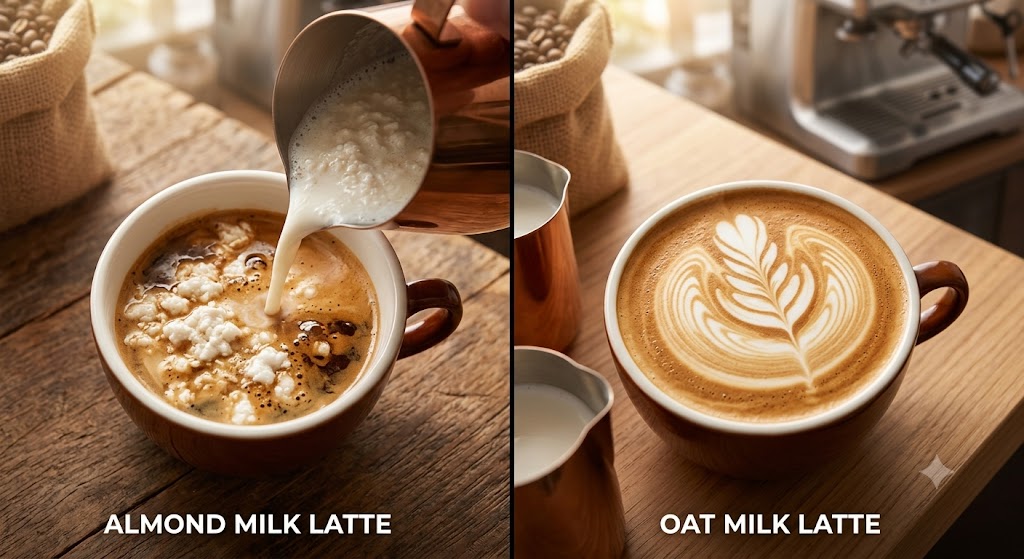
There is nothing more frustrating than pouring fresh cold milk into a hot cup of coffee, only to watch it instantly split into a grainy, curdled mess. Don't worry—your milk hasn't gone bad! This is a chemical reaction triggered by the isoelectric point of plant proteins.
The isoelectric point is the exact acidity level (pH) where a protein molecule has zero electrical charge. When this happens, the proteins lose their natural repulsion and clump together.
Coffee is naturally acidic (pH 4.8 to 5.2). The proteins in almonds have an isoelectric point of 4.5 to 5.5, meaning hot espresso easily coaxes them to separate and curdle.
To combat this, barista-grade cartons contain an acidity regulator called dipotassium phosphate. This food-safe ingredient acts as a buffer to keep the pH stable and prevent clumping. While approved as safe by the FDA, some clean-label brands are removing added phosphates to appeal to consumers wanting minimal processing.
Bottom Line: Curdling happens when acidic coffee drops plant proteins to their isoelectric point. Look for barista editions with dipotassium phosphate to keep your drinks smooth, or let your coffee cool slightly before combining.
DIY Barista Oat Milk Recipe
Want to play scientist in your own kitchen? You can whip up a clean-label, frothing-friendly oat milk at home!
Ingredient | Measurement | Scientific Purpose |
|---|---|---|
Rolled Oats | 80 g | Natural starches for body |
Warm Filtered Water (50°C) | 900 mL | Prevents a gummy texture |
Sunflower Lecithin | 2 g | Natural emulsifier |
Dipotassium Phosphate | 1.5 g | Prevents coffee curdling |
Refined Coconut Oil | 3 g | Smooth, glossy mouthfeel |
Sea Salt | 0.3 g | Highlights natural sweetness |
Steps:
Soak: Let the oats sit in warm water for 30 minutes to activate their natural enzymes.
Blend: Toss in the sunflower lecithin and dipotassium phosphate, blending on high for 90 seconds.
Strain: Run the mixture through a nut milk bag to strain out the pulp.
Emulsify: Whisk in the melted coconut oil and salt. Keep cold and enjoy within 3 days.
Why Accurate Tracking Matters for VoCal Users
If you are logging your diet using VoCal's voice command, being specific about your morning coffee is a game changer. Saying "coffee with milk" to your app leaves a massive room for error.
A splash of unsweetened almond milk adds a mere 10 kcal to your daily tracker, while a generous pour of barista oat milk can sneak in over 120 kcal! Over a week, that simple difference can translate to nearly 800 untracked calories.
Bottom Line: Always specify "unsweetened almond milk" or "barista oat milk" when logging with VoCal to keep your calorie budget 100% accurate.
FAQs
Does almond milk or oat milk taste better in coffee?
It depends on your roast! Oat milk has a sweet, cereal flavor that perfectly balances dark, chocolatey roasts. Almond milk has a lighter, nuttier flavor that lets the bright acidity of light-roasted beans or cold brew shine through.
Why does almond milk curdle but oat milk doesn't?
Almond milk has less fat and protein, making its structure less stable under the heat and acidity of coffee. Oat milk contains natural starches and soluble fibers that help prevent separation.
Is dipotassium phosphate safe to drink?
Yes, it is classified as Generally Recognized as Safe (GRAS) by the FDA. However, those managing kidney conditions may want to limit inorganic phosphates and opt for organic, clean-label alternatives.
Disclaimer: This article is for informational and educational purposes only. It does not provide medical advice, diagnosis, or treatment. Always consult with a physician, registered dietitian, or other qualified healthcare provider before starting any new diet, exercise program, or making changes to your wellness routine, particularly if you have health conditions like diabetes or heart disease.