

Standing in the grocery aisle staring at a wall of plant-based milks can feel completely overwhelming. Over the last decade, non-dairy alternatives have surged into mainstream American refrigerators, with the primary comparison battle centering on almond milk versus oat milk. While both are healthy, dairy-free choices, they are biochemically worlds apart. One is a super-light nut emulsion almost free of calories, whereas the other is a rich, creamy, starch-dense grain beverage. Grabbing the wrong one can stall your weight-loss progress, trigger blood sugar spikes, or ruin your morning latte. This guide breaks down the science of almond milk vs oat milk—from nutrition to gut health and baking. Plus, learn to track these sneaky liquid calories in 15 seconds using the voice-first app, VoCal.
Nutrition Facts: Calories, Carbs & Proteins Compared
To understand these two beverages, we have to look at how they are made. Unsweetened almond milk is a highly diluted emulsion of ground almonds and water, with the fibrous pulp strained out. This leaves a thin, watery liquid naturally very low in calories, fats, and carbohydrates. Conversely, unsweetened oat milk is produced by blending oats with water and treating the mixture with amylase enzymes, which hydrolyze starches into simple sugars, giving it a rich, sweet texture.
Here is how a standard 240 mL (8 fluid ounce) serving of each compares to dairy and plant-based milk:
Nutritional Component (per 240 mL serving) | Unsweetened Almond Milk | Unsweetened Oat Milk | Soy Milk (Unsweetened) | Cow's Milk (2% Reduced-Fat) |
Energy (kcal) | 30 | 80 – 120 | 80 – 100 | 120 – 122 |
Protein (g) | 1.0 | 2.0 – 4.0 | 6.0 – 8.1 | 8.0 – 8.2 |
Total Carbohydrates (g) | 1.0 | 14.0 – 20.0 | 3.0 – 4.0 | 11.0 – 12.0 |
Dietary Fiber (g) | 0.0 – 1.0 | 1.5 – 2.4 | 1.0 – 1.5 | 0.0 |
Total Sugars (g) | 0.0 | 4.0 – 8.0 | 1.0 | 11.0 – 12.0 (Lactose) |
Total Fat (g) | 2.5 – 3.0 | 1.5 – 3.6 | 4.0 | 5.0 |
Saturated Fat (g) | 0.0 | 0.0 – 0.5 | 0.5 | 3.0 |
Monounsaturated Fat (g) | 2.0 | Minimal | 1.0 | 1.5 |
Calcium (mg) | 470 (Fortified) | 148 – 350 (Fortified) | 294 – 300 (Fortified) | 300 – 309 |
Vitamin D (µg) | 4.0 (Fortified) | 1.7 – 2.3 (Fortified) | 2.4 – 2.7 (Fortified) | 2.7 |
Bovine milk contains 8 grams of protein per cup. Almond milk provides a meager 1 gram, and oat milk averages only 2 to 3 grams. Protein quality testing (DIAAS) shows cow's milk at 1.45 and almond milk at a low 0.39, meaning neither is a true protein substitute. However, almond milk naturally contains heart-healthy fats and vitamin E, while oat milk offers soluble fiber. Both are fortified in the US with calcium and vitamins.
Which Best Supports Your Calorie Deficit?
Weight loss relies on a sustained calorie deficit. Swapping out high-calorie drinks is the easiest way to cut calories without shrinking portions.
At only 30 calories per cup, unsweetened almond milk is a weight-loss cheat code. In clinical trials, almond milk users achieved the highest average weight loss of 3.5% over 4 weeks. However, because it contains virtually no protein or fiber, it undergoes rapid gastric emptying with a gastric protein half-life of just 36 minutes, causing 70% of participants to report elevated hunger.
Unsweetened oat milk contributes 80 to 120 calories per cup. While oat milk users achieved a lower weight loss of 1.8% over 4 weeks, its beta-glucan fiber forms a viscous gel in the gut. This delays gastric emptying, keeping nutrients in the stomach longer and steadily releasing satiety hormones like PYY and CCK. If you are not tracking calories, though, oat milk can quickly stall your progress.
Which Is Better for Blood Sugar?
If you manage prediabetes or type 2 diabetes, minimizing blood sugar and insulin spikes is crucial.
Unsweetened almond milk has a negligible glycemic index of 15 to 25. Since it has less than 1 gram of carbohydrate per cup, it will not trigger a significant insulin response, making it perfect for low-carb and diabetic meal plans.
Oat milk presents severe metabolic challenges. While intact oats improve insulin sensitivity, industrial milling destroys the grain's protective walls. To make oat milk creamy, manufacturers treat oat slurry with amylase enzymes that hydrolyze complex starches into simple maltose. This dissolved sugar is rapidly absorbed, giving even unsweetened oat milk a high glycemic index of 69 to 80 and causing sharp blood glucose and insulin spikes. Over time, this can worsen insulin resistance.
For Coffee: Which Froths Better and Tastes Best?
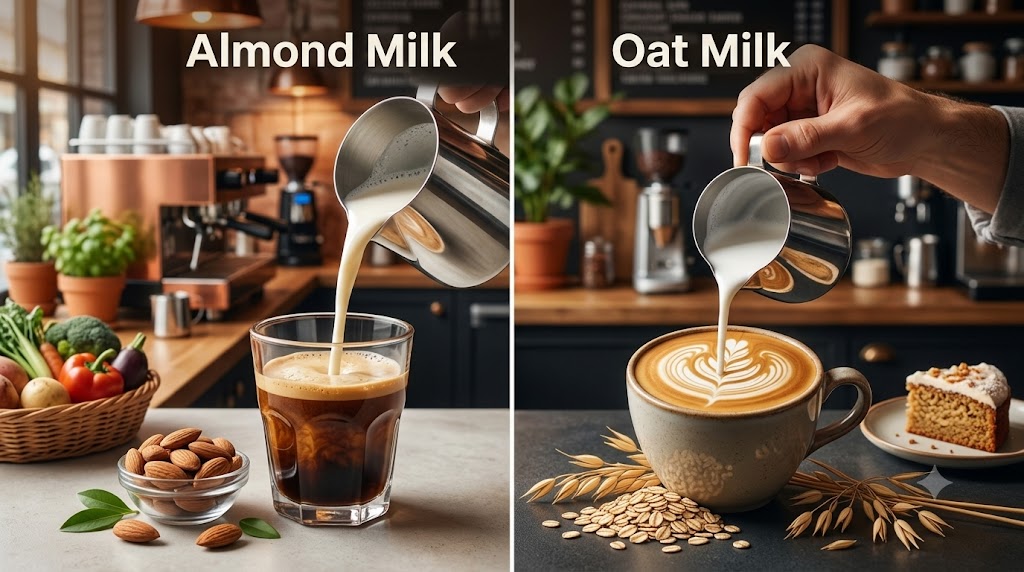
Coffee lattes rely on milk's fat and protein to build velvety texture and microfoam.
Oat milk is the ultimate barista favorite. When steamed, its proteins and lipids trap microscopic air bubbles, while its starches gelatinize to create a dense, stable microfoam ideal for latte art. Its natural maltose sugars also provide a mild sweetness that rounds out espresso’s bitterness.
Almond milk is far more difficult. Its low protein and fat content produce large, unstable bubbles. More frustratingly, standard almond milk is highly sensitive to acid and heat, causing its proteins to denature and curdle instantly when poured into hot, acidic espresso. To prevent this, use "barista edition" formulations, which contain dipotassium phosphate to act as a pH buffer, neutralizing the espresso’s acidity.
Which Is Easier to Digest?
Selecting a plant-based dairy alternative requires looking closely at fermentable sugars and industrial additives.
Unsweetened almond milk is highly low-FODMAP friendly. FODMAPs are short-chain carbs that escape digestion, drawing water into the bowel and undergoing rapid fermentation that causes gas and bloating in IBS patients. Almond milk's minimal carbohydrate profile makes it incredibly easy to digest. Oat milk, however, contains moderate fructans and galacto-oligosaccharides (GOS), which can trigger bloating in sensitive guts.
Additionally, watch out for emulsifiers like carrageenan. Preclinical studies show carrageenan can disrupt the microbiome, reduce beneficial Akkermansia muciniphila, and damage the protective mucosal barrier, promoting gut inflammation. Carrageenan also directly activates pro-inflammatory NF-kB pathways and inhibits pepsin activity, compromising protein digestion. For those with sensitive digestion, emulsifier-free plant milk is best.
Which Works Best in Cakes, Cookies & Bread?
In baking, milk is a dynamic structural hydrator. Under oven heat, milk’s sugars and proteins undergo chemical transformations that affect browning and texture.
Oat milk is a baking powerhouse. Rich in maltose (a reactive reducing sugar), it easily undergoes the Maillard reaction with flour amino acids at temperatures above 140°C (284°F).
Unsweetened almond milk is far less effective. Diluted and virtually protein-free, it lacks the reducing sugars needed to trigger the Maillard reaction, often yielding pale, dry bakes. Bakers using almond milk must manually add sugar or use egg washes to promote browning.
Environmental Impact: Water Footprint and Agricultural Sustainability
While both options have lower greenhouse emissions than dairy, their agricultural water usage differs drastically.
Environmental Metric (per 1 Liter of milk) | Almond Milk | Oat Milk | Cow's Milk (Bovine) |
Water Usage (Liters) | High (~371) | Very Low (~48) | Extreme (~628) |
Land Use (Square Meters) | Moderate (~0.5) | Low (~0.8) | Extreme (~9.0) |
Greenhouse Gas Emissions | Low (~0.7) | Very Low (~0.9) | High (~3.2) |
Almonds are extremely water-intensive. Grown in drought-prone California, irrigating almond orchards drains local aquifers and requires heavy pesticide use. Oats, however, are highly sustainable grains grown in temperate zones. They rely mostly on rainfall, require minimal pesticides, and act as a cover crop that improves soil health.
Clinical Synthesis: Decision-Making Framework for Your Daily Diet

Use this quick decision-making framework based on your dietary and health needs:
Target Objective or Clinical Condition | Recommended Plant-Based Milk | Primary Clinical Rationale |
Calorie Deficit / Pure Weight Loss | Unsweetened Almond Milk | Low energy density (30 kcal/cup) supports strict calorie limits. |
Prediabetes / Type 2 Diabetes | Unsweetened Almond Milk | Negligible glycemic load prevents blood sugar and insulin surges. |
IBS / FODMAP Sensitivity | Unsweetened Almond Milk | Low-FODMAP profile prevents rapid colonic fermentation and bloating. |
Tree Nut Allergies | Unsweetened Oat Milk | Naturally nut-free, making it a safe option for nut-allergic individuals. |
Coffee Steaming / Latte Art | Oat Milk (Barista Edition) | High viscosity and fats create a velvety, long-lasting microfoam. |
Baking Cakes, Cookies & Breads | Unsweetened Oat Milk | Rich in maltose, which drives Maillard browning and moisture retention. |
Environmental Sustainability | Unsweetened Oat Milk | Requires significantly less water and agricultural input than almond milk. |
Inflammatory Bowel Disease (IBD) | Emulsifier-Free Plant Milk | Avoiding carrageenan protects the gut lining and preserves microbial health. |
Simplify Your Calorie Tracking with VoCal
Because oat milk contains up to four times the calories of almond milk, pouring it generously into your daily coffee can easily stall weight loss. This makes precise nutrition tracking vital.
Traditional tracking is a headache, requiring manual searches and complex entries. That is why VoCal is a game-changer. VoCal is a voice-first tracking app that lets you log entire meals in just 15 seconds. Simply tap the mic and say naturally, "I had a double-shot latte with barista oat milk."
VoCal’s advanced AI translates your speech into accurate calories and macros with a 95% accuracy rate. It makes logging liquid calories effortless.
Frequently Asked Questions
Is oat milk healthier than almond milk?
It depends on your goals. Unsweetened almond milk is best for weight loss, strict calorie cutting, low-carb diets, and gut sensitivity. Oat milk wins for satiety, coffee frothing, baking, and environmental sustainability.
Why does almond milk curdle in hot coffee?
Almond milk is highly sensitive to acid and heat. When standard almond milk meets hot, acidic espresso, the proteins denature and coagulate. Using a "barista edition" formulated with dipotassium phosphate acts as a pH buffer to prevent curdling.
Does oat milk contain more sugar than almond milk?
Yes, even unsweetened oat milk has 4 to 8 grams of simple sugars per cup. This happens because the enzymes used during processing break down the oats' starches into maltose. Unsweetened almond milk has virtually zero sugar.
Is almond milk or oat milk gluten-free?
Almond milk is naturally gluten-free. Oats are also gluten-free, but standard oats can pick up gluten cross-contamination in handling. If you are gluten-sensitive, choose oat milk certified as gluten-free.
Disclaimer: This is for informational purposes only. For medical advice or diagnosis, consult a professional.