

Ah, the plant-based milk aisle. What used to be a quick grab-and-go has turned into a high-stakes, multi-option decision. Walk into any grocery store today, and you are confronted with a wall of choices: almond, oat, soy, coconut, cashew, hemp, and everything in between.
If you are managing type 2 diabetes or simply watching your blood sugar, this dairy-free decision isn't just about taste or environmental footprint—it's about how your morning splash of milk affects your insulin response and postprandial glucose.
In the ultimate metabolic showdown of almond milk vs. oat milk, which one reigns supreme for blood sugar control? Let’s dive into the clinical science, peel back the labels, and find your glycemic champion.
The Metabolic Matchup: Why Carbs and Insulin Matter
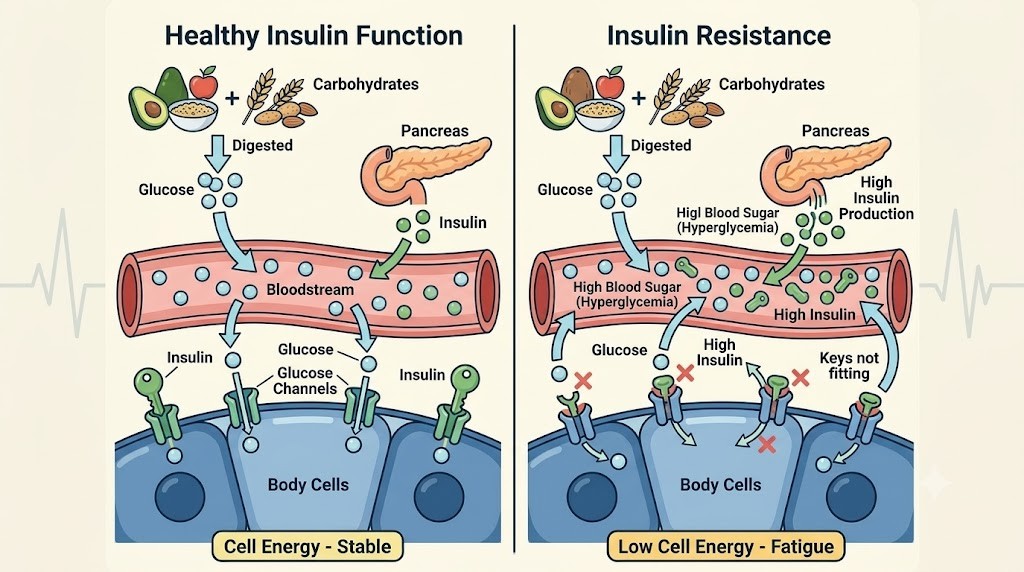
To understand how these plant-based milks affect your body, it helps to understand how carbohydrates interact with your endocrine system. When you eat or drink carbs, your digestive tract converts them into glucose, which enters your bloodstream.
In a typical metabolic state, your pancreas releases insulin. Think of insulin as a key that unlocks your cells so glucose can slide in and be used for energy. But if you have diabetes or insulin resistance, that cellular door is jammed. Glucose pools in your blood, leading to those dreaded blood sugar spikes.
To measure how fast foods raise blood glucose, experts look at two key metrics:
Glycemic Index (GI): Ranks carbohydrate-containing foods from 0 to 100 based on how rapidly they trigger a blood sugar spike compared to pure glucose. Low GI is 55 or less, medium is 56 to 69, and high is 70 or more.
Glycemic Load (GL): This is the real-world metric. It multiplies a food's GI by the actual amount of carbs in a typical serving. A glycemic load of 10 or under is considered low and easy on your blood sugar.
When comparing almond milk vs. oat milk, the glycemic load makes all the difference.
Bottom Line: Managing diabetes is all about choosing foods with a low glycemic load to keep your blood sugar stable and reduce the workload on your pancreas.
Under the Hood: How Oat Milk and Almond Milk Are Made
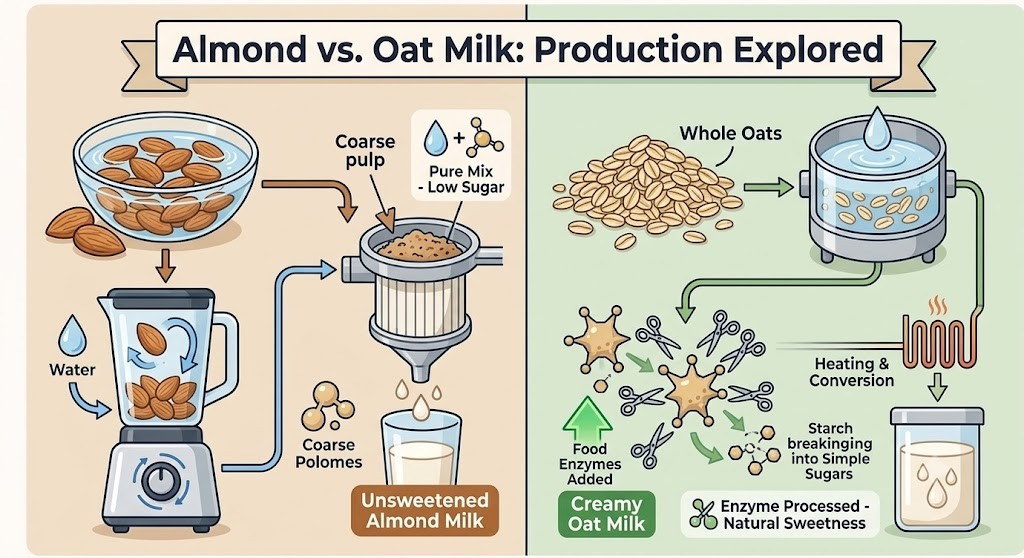
How do you get milk from an almond or an oat? (Spoiler: no tiny cows are involved). The answer lies in their processing—and this is where oat milk’s sugar secrets get exposed.
The Oat Milk "Starch Magic Trick"
Raw oats consist of about 60% starch—which is a complex carbohydrate made of long, slow-burning glucose chains. But when commercial manufacturers make oat milk, they don't just blend oats and water. They put the oats through enzymatic hydrolysis.
Industrial processors add food-grade enzymes, starting with alpha-amylase, to break down the starch's chemical bonds (alpha-1,4-glucosidic bonds) so the liquid doesn't gelatinize into thick oatmeal. Next, they use enzymes like glucoamylase to chop those starches down into simple sugars, primarily maltose and glucose.
The resulting oat milk is smooth and naturally sweet. But because the starches are essentially pre-digested, they hit your small intestine as simple sugars, causing a rapid blood sugar spike. This is why even an "unsweetened" oat milk can be loaded with naturally occurring simple sugars.
Unsweetened Almond Milk: Mechanical Simplicity
Unsweetened almond milk bypasses this enzymatic breakdown entirely. Whole almonds—which are naturally low in carbohydrates and high in healthy fats—are soaked, mechanically ground into a paste, and filtered to remove the fibrous pulp.
The resulting liquid contains only trace amounts of carbs. Because no starch is converted into sugar, it preserves a flat glycemic profile that won't irritate your blood sugar.
Processing Step | Unsweetened Almond Milk | Unsweetened Oat Milk |
Raw Ingredient | High-fat, low-carb almonds | High-starch cereal oats |
Production Style | Soaking, grinding, and pulp filtration | Slurry heating and enzyme digestion |
Enzyme Use | None | alpha-amylase and glucoamylase added |
Sugar State | Zero added, trace naturally occurring | Hydrolyzed starch turned into simple sugars |
Bottom Line: Commercial oat milk is heavily processed with enzymes that break down complex oat starches into simple, fast-absorbing sugars. Unsweetened almond milk avoids this, leaving you with a low-carbohydrate beverage that is highly stable.
Nutritional Profiles Side-by-Side
Let's look at the hard numbers. The table below compares standard fortified, unsweetened almond milk and unsweetened oat milk per 1-cup (240 mL) serving, with whole cow's milk as a reference.
Nutrient Component | Unsweetened Almond Milk (1 Cup) | Unsweetened Oat Milk (1 Cup) | Whole Cow's Milk (1 Cup) |
Calories | 30 - 39 kcal | 90 - 120 kcal | 149 - 150 kcal |
Protein | 1.0 - 1.55 g | 1.0 - 3.0 g | 7.69 - 8.0 g |
Carbohydrates | 1.0 - 1.52 g | 9.0 - 19.0 g | 11.71 - 12.0 g |
Dietary Fiber | <1.0 g | 1.0 - 2.0 g | 0.0 g |
Total Sugars | 0.0 - 0.23 g | 0.0 - 7.0 g | 12.0 - 12.32 g |
Total Fat | 2.5 - 3.0 g | 1.5 - 5.0 g | 7.93 - 8.0 g |
Saturated Fat | 0.0 - 0.21 g | 0.0 - 0.5 g | 4.5 - 4.55 g |
Calcium | 450 - 516 mg | 350 - 400 mg | 276 - 306 mg |
Vitamin D | 2.5 - 5.2 mcg | 4.0 mcg | 2.5 - 3.0 mcg |
Sodium | 125 - 186 mg | 90 - 120 mg | 102 - 105 mg |
Potassium | 170 - 351 mg | 200 - 401 mg | 322 - 381 mg |
Looking closely at the numbers, almond milk contains just 1 to 1.5 grams of carbohydrates per cup. Oat milk can pack a whopping 9 to 19 grams of carbohydrates!
Even though in-vitro glycemic index testing rates almond milk beverages around a medium 64, its glycemic load is virtually zero (less than 1) because the carbohydrate volume is so tiny. On the flip side, the carbohydrate load in oat milk means a larger dose of carbs hits your system, triggering a much higher glycemic load and potential postprandial insulin spikes.
A clinical crossover trial studying patients with type 2 diabetes found that co-ingesting oatmeal with almond milk compared to cow's milk reduced the total postprandial insulin and glucagon responses. This suggests that almond milk requires far less insulin output to keep blood sugars in check, helping you maintain long-term metabolic health.
The Fiber Fallacy: The Truth About Beta-Glucan in Oat Milk
You've probably heard that oats are great for blood sugar because they are high in beta-glucan. Beta-glucan is a brilliant soluble fiber that forms a thick, viscous gel in your digestive system, slowing down gastric emptying and buffering sugar absorption.
But here is the catch: processing oat milk destroys that helpful fiber matrix.
Industrial filtration strips away the fibrous bran layer where beta-glucans live. The high-pressure processes used to make oat milk also degrade the molecular weight and viscosity of the fiber that remains. Without that thick gel to slow things down, your body absorbs the pre-digested maltose and glucose rapidly, giving you a blood sugar spike instead of the slow burn of actual whole-grain cooked oats.
Cardiovascular and Heart Health Perks
For those managing diabetes, keeping an eye on cardiovascular health is a major priority, as insulin resistance is closely tied to heart health risks.
Unsweetened almond milk offers a great lipid profile. It is naturally rich in monounsaturated fatty acids (MUFAs), like oleic acid. MUFAs are considered heart-healthy fats that help lower "bad" LDL cholesterol while protecting "good" HDL cholesterol.
Additionally, almond milk is naturally rich in alpha-tocopherol (Vitamin E), which acts as a powerful fat-soluble antioxidant. Antioxidants protect your vascular walls from oxidative stress, which can be heightened by chronic high blood sugar.
Oat milk is low in saturated fat, but commercial brands often add canola, rapeseed, or sunflower oil to give it a creamy feel. This shifts the fat profile toward omega-6 fatty acids, which doesn't offer the same rich cardiovascular advantages as the MUFAs found in almond milk.
Pro Tips for the Grocery Store Plant Milk Aisle
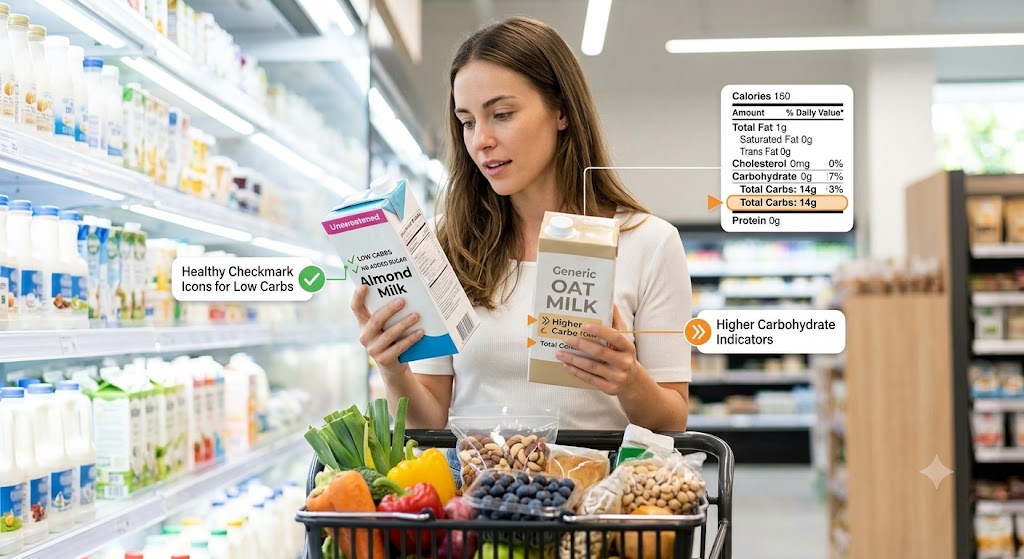
When buying non-dairy milks, these shopping strategies can help you maintain excellent blood sugar control:
Look for the "Unsweetened" Label: Avoid "Original" or "Vanilla" cartons unless they specifically say "sugar-free," as they usually pack added sugars.
Keep Carbs Below 2g: Check the nutrition panel and aim for under 2 grams of carbs per serving. Unsweetened almond milk easily clears this bar, while oat milk often fails.
Skip Carrageenan: If you have a sensitive stomach, avoid carrageenan—a seaweed-derived thickener that can irritate your gut.
Watch for Added Minerals in Kidney Disease: If you have kidney concerns (like diabetic nephropathy), check the labels for added phosphorus or potassium, as unfortified versions may be easier on your kidneys.
Frictionless Tracking with VoCal
If you have diabetes, carb counting is your ultimate daily tool. Logging your food allows you to predict blood sugar curves, measure insulin needs, and keep your body in a stable, healthy range.
But let's be honest: traditional food-tracking apps are incredibly annoying. Tapping in search terms, picking portion sizes, and dealing with manual logging fatigue is enough to make anyone want to quit tracking altogether.
That is where VoCal comes in. VoCal is a voice-first calorie and macronutrient tracking app designed to take the friction out of diet logging.
Instead of typing, searching, and dragging portion sliders, you just speak to VoCal naturally. Say: "One cup of unsweetened almond milk with double espresso" and VoCal's smart AI converts your words into accurate macro and carbohydrate data in just 5 seconds.
Whether you are tracking non-dairy milks or complex meals, VoCal makes consistency effortless, helping you identify trends and keep your blood sugar perfectly on target.
The Verdict
When comparing almond milk vs. oat milk for blood sugar control, unsweetened almond milk is the undisputed champion. Its low calorie and carbohydrate count, combined with a negligible glycemic load, makes it highly supportive of stable blood sugar and long-term metabolic health.
If you choose to enjoy oat milk, consume it occasionally and mindfully, keeping in mind its carbohydrate profile. By utilizing smart tracking tools like the voice-first VoCal app, you can easily log your morning cups, master your carb counting, and keep your body feeling its best.
FAQs
Can oat milk cause a blood sugar spike?
Yes. Because industrial processing hydrolyzes oat starches into simple, fast-acting sugars like maltose and glucose, oat milk digests rapidly and can trigger a significant blood sugar spike.
Is unsweetened almond milk keto-friendly?
Absolutely. With only 1 to 1.5 grams of carbohydrates per serving, unsweetened almond milk is highly keto-friendly and glycemic-friendly.
Why does "unsweetened" oat milk still have sugar on the label?
Even if a brand does not add cane sugar, the chemical enzymes used during manufacturing turn natural oat starches into simple sugars. The USDA nutrition label lists these as "total sugars" because they are naturally created during production.
Disclaimer: This article is for informational and educational purposes only. It does not provide medical advice, diagnosis, or treatment. Always consult with a physician, registered dietitian, or other qualified healthcare provider before starting any new diet, exercise program, or making changes to your wellness routine, particularly if you have health conditions like diabetes or heart disease.