

If you’ve stood in a bustling American coffee shop lately, you’ve probably witnessed a familiar ritual. A customer reaches the register, pauses, and asks, "Can I get that with oat milk... or wait, maybe almond milk?"
We’ve officially entered the era of the plant-based dairy alternative. Driven by rising rates of lactose intolerance, dairy allergies, and a collective push toward sustainable, plant-based living, non-dairy milks have taken over our grocery stores and refrigerators.
But while the choice used to be purely about flavor or how beautifully it frothed in a latte, many of us are now asking a much more personal question: Which one is going to make my stomach happier?
When it’s a battle of almond milk vs. oat milk for gut health, the winner isn’t always obvious. For those navigating a sensitive digestive tract, functional bloating, or conditions like Irritable Bowel Syndrome (IBS), choosing the wrong milk can turn a peaceful morning coffee into an afternoon of digestive regret.
Let’s break down the science of how these two heavyweights digest, compare their nutritional profiles, and find out which one is truly easier to digest.
Almond Milk vs. Oat Milk: The Nutritional Showdown
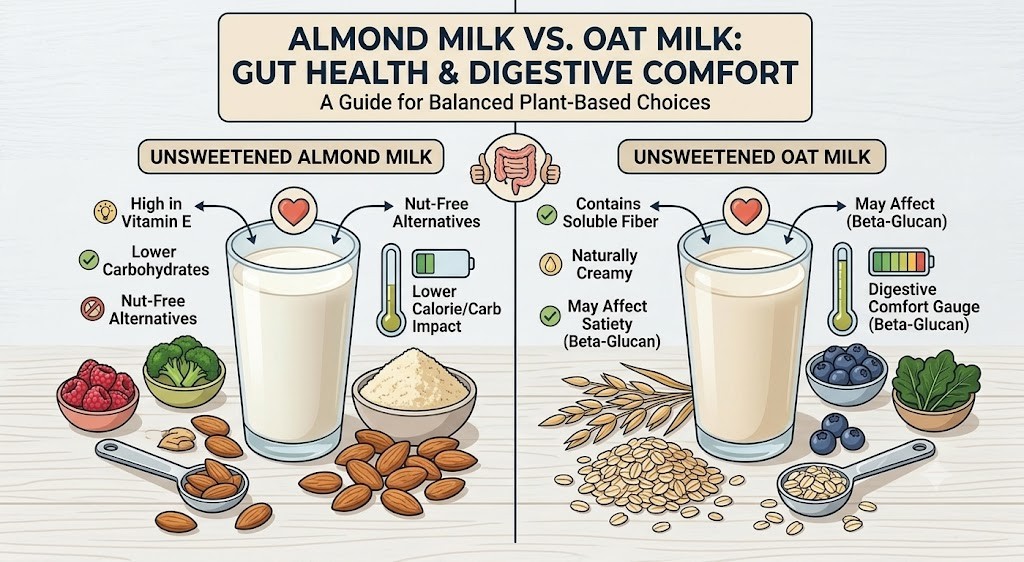
Before we look at how your gut processes these milks, we have to look at what's inside them. Unlike cow's milk, which has a very consistent nutritional profile, plant-based milks vary widely depending on how they are processed, diluted, and fortified.
Here is a look at how a standard, unsweetened 1-cup serving of each stacks up against traditional options:
Nutrient Value per 250 mL (1 Cup Serving) | Unsweetened Almond Milk | Unsweetened Oat Milk | Unsweetened Soy Milk | Whole Cow's Milk |
Energy (kcal) | 39 | 120 | 80 | 149 |
Protein (g) | 1.55 | 3.00 | 6.95 | 7.69 |
Total Fat (g) | 2.88 | 5.00 | 3.91 | 7.93 |
Saturated Fat (g) | 0.21 | 0.50 | 0.50 | 4.55 |
Carbohydrate (g) | 1.52 | 16.00 | 4.23 | 11.71 |
Dietary Fiber (g) | 0.00 | 2.00 | 1.20 | 0.00 |
Total Sugars (g) | 0.00 | 7.00 | 1.00 | 12.32 |
Calcium (mg) | 516 | 350 | 301 | 276 |
Potassium (mg) | 176 | 389 | 292 | 322 |
Sodium (mg) | 186 | 101 | 90 | 105 |
The Bottom Line: Unsweetened almond milk is the lightweight champion. It has a fraction of the calories and carbs found in oat milk. However, oat milk naturally brings a bit more protein and dietary fiber to the table, though both fall short of the protein levels found in dairy or soy milk.
Unsweetened Almond Milk: The Light-as-Air Digestibility Champ
To make almond milk, raw almonds are soaked in water, blended into a smooth slurry, and then strained to filter out the fibrous pulp. This intensive filtration process removes the vast majority of the nut's complex carbohydrates, fibers, and proteins, leaving behind a highly diluted, water-dominated emulsion.
From a digestive standpoint, this structural simplicity is a massive advantage. Because unsweetened almond milk has a negligible carbohydrate footprint, it requires almost zero enzymatic effort from your stomach and pancreas to break down.
Its glycemic index is practically zero, which prevents post-meal insulin spikes that can interfere with normal gut motility. If you are recovering from a stomach bug, managing Small Intestinal Bacterial Overgrowth (SIBO), or following a strict low-carb lifestyle, unsweetened almond milk is an incredibly gentle, non-irritating fluid base.
The trade-off? Because it is so heavily filtered, it lacks nutrient density. It contains a mere 1.5 grams of protein per cup, and it won't do much to keep you full on its own. Plus, you have to watch out for sneaky industrial additives that manufacturers use to keep the milk from separating.
The Bottom Line: Almond milk's heavy filtration removes almost all fermentable carbohydrates. This makes it an exceptionally easy, low-irritant option for highly sensitive digestive tracts, SIBO, or those recovering from gut irritation.
Unsweetened Oat Milk: The Prebiotic Powerhouse (With a Catch)

Oat milk is made by milling whole oats with water, followed by an industrial enzymatic treatment. These enzymes break down the natural starches in oats into simpler sugars, primarily maltose, which gives oat milk its signature creamy texture and subtle sweetness without any added sugar.
The crown jewel of oat milk is beta-glucan, a highly viscous, soluble dietary fiber. When beta-glucan enters your digestive tract, it absorbs water and forms a thick, gel-like matrix. This gel slows down gastric emptying and delays sugar absorption, which is why the FDA supports heart-health claims that soluble oat fiber can help lower cholesterol.
Once that beta-glucan gel reaches your large intestine, it acts as a rich prebiotic feast. Your resident gut bacteria ferment these fibers, stimulating the growth of beneficial microbes (like Bifidobacterium) and ramping up the production of short-chain fatty acids (SCFAs) like butyrate. These SCFAs are the primary fuel source for your gut lining, helping to repair tissue, strengthen tight junctions, and lower gut inflammation.
However, this prebiotic superpower comes with a catch. The high viscosity of beta-glucans can slow down digestion too much for people with gastroparesis or sluggish digestion. Furthermore, as your gut bacteria rapidly ferment the residual starches and soluble fibers, they produce gas. For those with sensitive guts or visceral hypersensitivity, this gas production can manifest as painful abdominal stretching, flatulence, and bloating.
The Bottom Line: Unsweetened oat milk is a fantastic source of prebiotic beta-glucan fiber, which feeds beneficial gut bacteria and heals your gut lining. However, its fermentable bulk and slow digestion can trigger gas and bloating if you are prone to slow transit or gas.
The FODMAP Factor: Almond Milk vs. Oat Milk for IBS
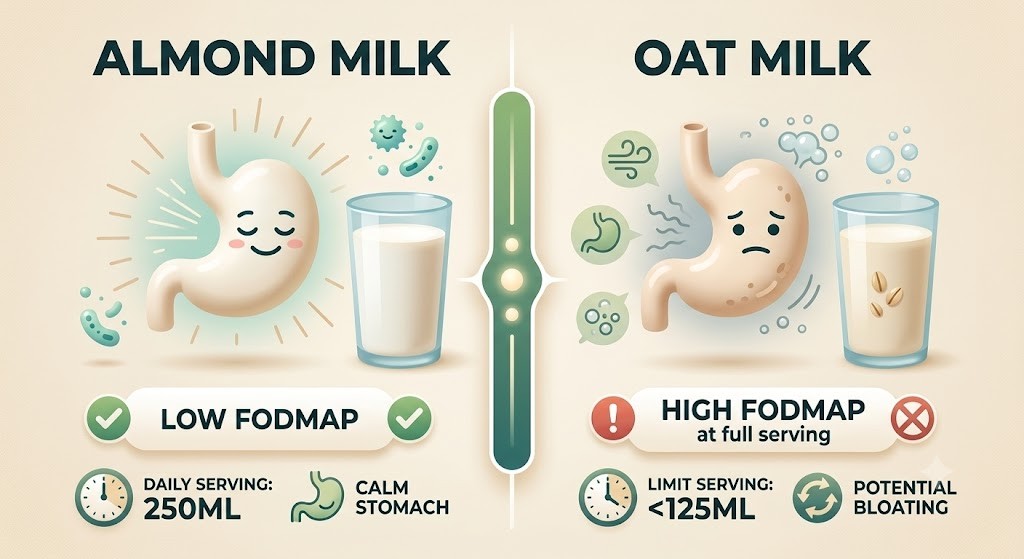
If you live with Irritable Bowel Syndrome (IBS), your comfort is largely dictated by FODMAPs (Fermentable Oligosaccharides, Disaccharides, Monosaccharides, and Polyols). These are short-chain carbohydrates that are poorly absorbed in the small intestine, drawing excess water into the bowel before undergoing rapid, gas-producing fermentation in the colon.
Let's look at how our two milks perform under the FODMAP microscope:
Unsweetened Almond Milk is Low FODMAP: Up to a standard serving of 1 cup (250 mL), almond milk is certified low FODMAP. Because it is so diluted, the natural oligosaccharides of the almonds are kept well below the threshold that triggers symptoms.
Unsweetened Oat Milk is High FODMAP: While dry oats can be low FODMAP, the industrial processing of oat milk causes soluble fructans and galacto-oligosaccharides (GOS) to leach directly into the liquid phase. Testing by Monash University reveals that oat milk is actually a high FODMAP food at a standard 1-cup (250 mL) serving.
If you have IBS, you can only safely consume oat milk in small servings of 104 mL or less (just under half a cup). Drinking a full cup can draw water into your bowel, causing diarrhea, cramping, and severe bloating. Interestingly, clinical studies show that taking enzyme supplements like alpha-galactosidase immediately before consuming GOS-rich foods can help break down these sugars and minimize osmotic distress.
The Bottom Line: Almond milk is naturally low FODMAP and safe to drink by the cupful. Oat milk becomes high FODMAP at standard serving sizes, requiring strict portion control (under 104 mL) to avoid triggering an IBS flare-up.
Sneaky Gut Barrier Irritants: Carrageenan and Gums
The digestibility of a plant milk isn’t just about the almonds or oats. Because plant-water mixtures naturally want to separate, manufacturers rely on food additives like emulsifiers, thickeners, and gelling agents. Many of these can interact negatively with your delicate gut barrier.
Carrageenan
Extracted from red seaweeds, carrageenan is a common stabilizer used in both almond and oat milks. Research shows that carrageenan can degrade the protective mucosal lining of your intestines by depleting beneficial Akkermansia muciniphila bacteria and directly inhibiting digestive enzymes like pepsin.
It disrupts tight junctions (the proteins that seal your intestinal wall), leading to increased intestinal permeability, or "leaky gut". This allows toxins to enter the submucosa, triggering inflammation. For those with ulcerative colitis or Crohn's disease, carrageenan exposure is strongly linked to disease flare-ups.
Cellulose, Guar, and Xanthan Gums
These processing gums are added to build texture, but they behave differently in your gut:
Cellulose Gum (Carboxymethylcellulose): Linked in animal studies to altered microbiomes and low-grade gut inflammation.
Guar Gum: Derived from the guar bean, this is a highly fermentable fiber. While it can act as a beneficial prebiotic and help relieve constipation, its rapid fermentation can cause intense gas, cramping, and bloating in people with sensitive bowels.
Xanthan Gum: Produced via bacterial fermentation, it can act as a mild laxative and cause minor gas in sensitive individuals.
The Bottom Line: Industrial stabilizers like carrageenan can damage your gut barrier, while processing gums can fuel excessive bloating and gas. Always read labels and aim for "clean label" milks with zero added gums or carrageenan.
Almond Milk vs. Oat Milk Digestive Comparison
To sum it all up, let's look at how these two popular milks compare side-by-side:
Digestive Feature | Unsweetened Almond Milk | Unsweetened Oat Milk |
FODMAP Status | Low FODMAP (up to 1 cup / 250 mL) | High FODMAP (at 1 cup / 250 mL; Low only up to 104 mL) |
Prebiotic Benefit | Minimal | High (rich in soluble beta-glucan fiber) |
Glycemic Impact | Low (Glycemic Index ~ 0) | Moderate to High (contains maltose from starch breakdown) |
Fermentation Risk | Very Low | Moderate to High (due to fructans and GOS) |
Gastric Transit Time | Rapid (low viscosity, low calorie density) | Delayed (forming a viscous gel in the stomach) |
Common Additives | Carrageenan, Gellan Gum, Cellulose Gum | Added Vegetable Oils, Dipotassium Phosphate, Guar Gum |
Primary Indication | IBS, SIBO, low-carb diets, functional bloating | Remission in UC, hypercholesterolemia, dysbiosis |
Which One Should You Pour?
Selecting the plant-based milk that is easiest for you to digest requires matching your choice to your specific digestive health:
Choose Unsweetened Almond Milk if: You suffer from IBS, SIBO, or frequent unexplained bloating. Its low-FODMAP nature makes it highly unlikely to trigger gas or osmotic diarrhea. Be sure to pick organic, gum-free, and carrageenan-free options.
Choose Unsweetened Oat Milk if: You are in clinical remission from ulcerative colitis or Crohn’s and want to leverage prebiotics to heal your gut lining. It is also great for heart health and lowering cholesterol. Just be sure to choose certified gluten-free oat milk if you have celiac disease or non-celiac gluten sensitivity, as oats are highly prone to gluten cross-contamination during harvesting and processing.
How to Track and Optimize Your Gut Health with VoCal
Managing your digestive health is easier when you can see the correlation between what you consume and how you feel. That's where VoCal comes in. As a voice-based calorie tracking application, VoCal lets you log your food and track your macros entirely hands-free.
Simply speak to log your plant milk of choice:
'Hey VoCal, log one cup of unsweetened almond milk.' -> Instantly logs 39 kcal, 1.5g carbs, and 0g sugar.
'Hey VoCal, log one cup of unsweetened oat milk.' -> Logs 120 kcal, 16g carbs, and 7g sugar.
This is incredibly valuable if you are following a low-carbohydrate protocol, which typically caps daily carbs between 60 to 130 grams to manage blood sugar and gut motility. Logging just a single cup of unsweetened oat milk consumes up to 30% of your daily low-carb limit. Unsweetened almond milk, on the other hand, adds practically zero carbs to your daily total.
Furthermore, tracking with VoCal allows you to monitor simple sugars like maltose, which is abundant in oat milk. These simple sugars can spike blood glucose and impact gut motility, whereas unsweetened almond milk keeps your blood sugar flat and your digestion steady. By using voice logging to keep a detailed food and symptom diary, you can easily identify whether almond milk or oat milk is your gut’s true match!
The Bottom Line: Using voice commands on VoCal makes it easy to track your daily carbs, sugar, and fiber. This is key for maintaining stable blood sugar and pinpointing exactly which ingredients are causing digestive distress.
Frequently Asked Questions (FAQs)
Is almond milk or oat milk better for bloating?
Almond milk is generally much better for avoiding bloating. Oat milk contains highly fermentable fructans (FODMAPs) and soluble fiber that gut bacteria break down, producing gas that can stretch a sensitive intestinal wall.
Is almond milk or oat milk gluten-free?
Almond milk is naturally grain-free and gluten-free. While oats are naturally gluten-free, they are frequently cross-contaminated with wheat, rye, or barley. If you have celiac disease or gluten sensitivity, you must choose oat milk labeled as "certified gluten-free".
Why does oat milk cause stomach pain?
For people with sensitive guts, oat milk can cause pain due to the rapid colonic fermentation of its soluble fibers and GOS, which creates gas and bloating. Additionally, additives like guar gum or carrageenan can irritate the intestinal lining.
Can I drink oat milk if I have IBS?
Yes, but portion control is critical! While a full 1-cup (250 mL) serving is high FODMAP and likely to trigger symptoms, a smaller serving of 104 mL or less (just under half a cup) is low FODMAP and generally safe for people with IBS.
Disclaimer: This is for informational purposes only. For medical advice or diagnosis, consult a professional.