

It’s Friday evening. You’ve crushed your meal prep all week, logged every salad, and hit your daily step goals. But then Saturday arrives—bringing brunch, pizza, or a cocktail with friends—and a familiar question pops into your head: does a weekend break your diet?
You are not alone. Many people wonder if relaxing their routine over the weekend completely ruins five days of hard work, or if a periodic treat can actually help you lose weight long-term.
The answer comes down to science, structure, and mindset. In this guide, we’ll break down the real difference between a single cheat meal and a full cheat day, how your metabolism reacts, and how you can enjoy your weekends without losing your progress.
The Math of Weekend Eating: How Caloric Drift Happens
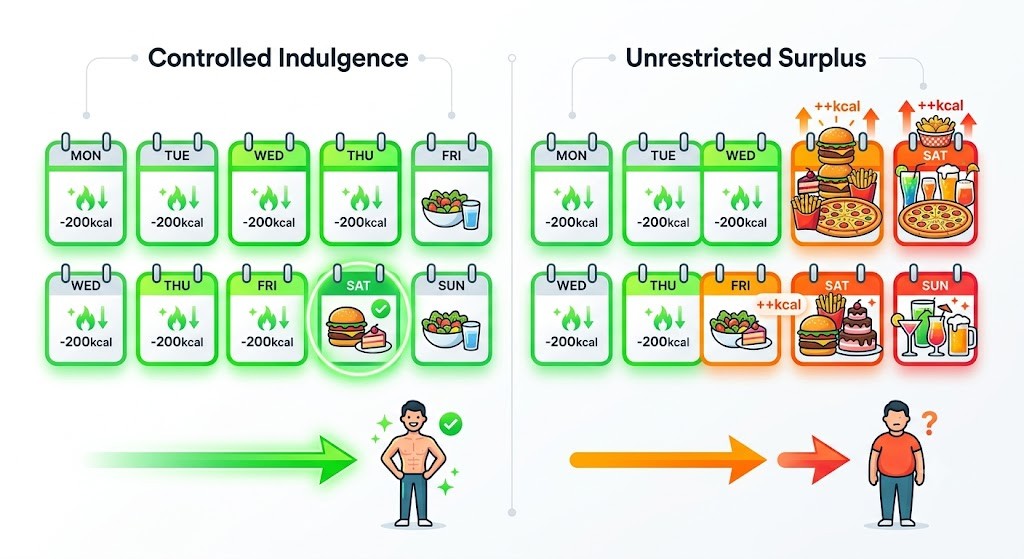
Scientists have a name for our weekend eating patterns: "circaseptan periodicity"—which is just a fancy way of saying our diet and activity levels change in a weekly cycle.
According to data from the National Health and Nutrition Examination Survey (NHANES), American adults eat significantly more calories on weekends than on weekdays, with Saturday being the highest calorie day of the week. On average, people eat an extra 181.04 kcal on Saturday, mostly coming from alcohol (+46.65 kcal), sugary drinks (+18.34 kcal), and rich, energy-dense foods (+48.77 kcal).
While an extra treat on Saturday sounds harmless, the math can add up quickly.
To lose about 1 pound of fat per week, you need a total weekly deficit of roughly 3,500 kcal (or 500 kcal a day). If you stick to your deficit Monday through Friday, you create a solid 2,500 kcal buffer. However, if your weekend turns into an unmonitored "cheat weekend," it’s surprisingly easy to eat an extra 1,250 kcal per day.
Those extra 2,500 kcal over Saturday and Sunday wipe out your entire weekday effort, bringing your net progress right back to zero.
Weekly Strategy | Mon–Fri Daily Deficit / Surplus | Sat–Sun Daily Deficit / Surplus | Net Weekly Caloric Balance | 12-Week Fat Loss Outcome |
|---|---|---|---|---|
Continuous Deficit | −500 kcal/day (Total: −2,500) | −500 kcal/day (Total: −1,000) | −3,500 kcal | ≈12 lbs fat loss |
Weekend Cheat Meals (Controlled) | −500 kcal/day (Total: −2,500) | +150 kcal/day (Total: +300) | −2,200 kcal | ≈7.5 lbs fat loss |
Unrestricted Cheat Days | −500 kcal/day (Total: −2,500) | +1,250 kcal/day (Total: +2,500) | 0 kcal (Maintenance) | Weight Loss Plateau |
Binge-Style Weekend Break | −500 kcal/day (Total: −2,500) | +1,800 kcal/day (Total: +3,600) | +1,100 kcal (Surplus) | Net Fat Gain over time |
Quick Takeaway: Taking a break over the weekend doesn't automatically ruin your diet. However, an unmonitored weekend surplus can easily erase your weekday progress and cause a weight loss plateau.
Cheat Meals vs. Cheat Days: What Happens to Your Body?

Not all dietary breaks are created equal. Nutritionists typically divide breaks into three main styles:
Unstructured Cheat Meal: A single meal where you enjoy foods outside your normal plan without strictly counting calories.
Cheat Day: A 24- to 48-hour period of unrestricted eating, which often leads to a massive excess of calories.
Structured Refeed: A planned increase in calories back up to your maintenance level, driven primarily by carbohydrates, to boost energy and keep your metabolism active.
The Hormones: Understanding Leptin
When you diet continuously, your body protects itself by slowing down your metabolic rate—a response known as adaptive thermogenesis. Your levels of leptin (the hormone responsible for keeping you full and energized) drop significantly.
Some believe that a high-calorie "cheat day" resets this metabolic slowdown. But research shows that what you eat matters just as much as how much you eat:
Carbohydrate-Rich Refeeds: Studies show that 3 days of carbohydrate-focused overfeeding can boost circulating leptin levels by 28% and increase 24-hour energy expenditure by 7%.
High-Fat Cheat Meals: Overfeeding on high-fat, fried, or ultra-processed foods doesn't trigger the same leptin boost or metabolic elevation. Instead, the excess fat calories are easily stored as body fat.
Parameter | Unstructured Cheat Meal | Unrestricted Cheat Day / Weekend | Structured Refeed (1–2 Days) | Structured Diet Break (1–2 Weeks) |
|---|---|---|---|---|
Caloric Target | Ad libitum (Uncounted) | Ad libitum (Uncounted) | Maintenance Calories | Maintenance Calories |
Macronutrient Profile | High Fat, High Sugar, High Sodium | High Fat, High Alcohol, High Carb | High Carbohydrate, Moderate Protein, Low Fat | Balanced Baseline Macros |
Leptin Elevation | Minimal to Moderate | Negligible relative to surplus | Significant surge (+28%) | Sustained normalization |
RMR Impact | Transient / Insignificant | Minimal thermic effect boost | Moderate elevation (+7%) | Attenuates metabolic adaptation |
Psychological Risk | Binge trigger in rigid dieters | High risk of disinhibition | Low (Goal-directed control) | Low (Reduces chronic diet fatigue) |
Quick Takeaway: High-fat cheat days don't "rev up" your metabolism. If you want a metabolic boost, a planned, high-carbohydrate refeed is far more effective than an all-you-can-eat cheat day.
The Mind Game: Rigid vs. Flexible Dieting

How you think about your food plays a huge role in your ultimate success. Psychologists divide dieters into two main categories: Rigid Dieters and Flexible Dieters.
The "What-the-Hell" Effect
Rigid dieters see foods in binary terms: "good" or "bad," "clean" or "junk".
When a rigid dieter eats a piece of cake on Saturday, they often feel like they've completely failed. This triggers a psychological pattern called the "what-the-hell effect"—thinking, "I already blew my diet, so I might as well eat whatever I want for the rest of the weekend!".
Studies consistently show that rigid dieting is linked to higher stress, frequent bingeing, and long-term weight regain.
Flexible Control for Long-Term Success
Flexible dieters view food on a spectrum. They understand that no single meal ruins progress. If they enjoy a slice of pizza or a vegetarian dish at a social event, they simply adjust their intake across the week.
Research shows that flexible dieters experience less anxiety, preserve more lean muscle mass, and are much better at keeping weight off long-term.
Psychological Metric | Rigid Dietary Control | Flexible Dietary Control |
|---|---|---|
Food Classification | Strict Dichotomy ("Good" vs. "Bad") | Spectrum / Contextual fit |
Response to Deviations | "What-the-Hell" Effect / Loss of Control | Autonomous Self-Correction |
Long-Term BMI Correlation | Positively associated with higher BMI | Associated with lower BMI & maintenance |
Eating Disorder Vulnerability | High correlation with binge eating symptoms | Low correlation; protective against binges |
Post-Diet Mass Retention | Lower FFM retention during post-dieting | Superior FFM preservation and stability |
Quick Takeaway: Stop labeling foods as "good" or "bad". Adopting a flexible mindset prevents small weekend treats from escalating into multi-day binges.
Weekend Timing Matters (Chrononutrition)
It’s not just what you eat on the weekend—it’s when you eat it.
Our bodies run on internal biological clocks (circadian rhythms) that influence how we process nutrients. On weekends, many people experience "social jetlag"—sleeping in late, eating late dinners, and extending their eating window.
Here is why weekend meal timing matters:
Reduced Fat Oxidation: Eating late at night coincides with high levels of melatonin (your sleep hormone), which decreases insulin sensitivity and slows down fat burning.
Extended Eating Windows: Stretching your daily eating window from 10 hours during the week to 14+ hours on weekends can disrupt metabolic efficiency.
Quick Takeaway: Try to keep your weekend eating window within 10 to 12 hours and avoid heavy meals right before bedtime to protect your body's natural fat-burning rhythms.
Smart Strategies to Enjoy Weekends Without Sacrificing Progress
You don't need to lock yourself indoors all weekend to hit your goals. Here are four simple strategies to keep moving forward:
1. Practice Calorie Banking
Instead of viewing every day in isolation, look at your weekly calorie total. Trim 100 to 150 kcal from your daily targets Monday through Friday. This "banks" 500 to 750 kcal that you can spend on Saturday night without breaking your overall deficit!
2. Choose High-Carb Over High-Fat
When enjoying extra calories, opt for carbohydrate-rich choices like pasta, sushi, rice dishes, or plant-based meals over super greasy or fried foods. Carbohydrates restore muscle glycogen and boost leptin without excessive fat storage.
3. Maintain Your Eating Window
Keep your weekend meal timing consistent with your weekdays. Enjoying dinner earlier in the evening gives your body time to digest before sleep.
4. Track Effortlessly with Voice Technology
The biggest reason people overeat on weekends is "tracking fatigue". Searching through endless food databases while out with friends is annoying, so most people stop logging altogether.
This is where VoCal changes the game.
VoCal is a voice-based calorie tracking app that lets you log your meals in seconds just by speaking. Simply say, "I had two slices of pizza and a green salad," or "Had a bowl of lentil curry with basmati rice." VoCal handles the math automatically, allowing you to maintain flexible control without missing a beat.
Dietary Strategy | Primary Objective | Execution Guidelines | Key Risk to Avoid |
|---|---|---|---|
Caloric Banking | Preserve net weekly deficit | Subtract 150 kcal/day on weekdays; add +750 kcal on Saturday | Severe weekday starvation leading to weekend binges |
High-Carb Refeed | Leptin & metabolic restoration | Elevate calories to maintenance; maximize carbs; keep fats low | High-fat, high-alcohol "cheat days" |
Circadian Anchoring | Protect metabolic sensitivity | Maintain a <12 hr eating window; avoid meals 3 hrs pre-bed | Social jetlag extending eating windows to >14 hrs |
Voice Logging (VoCal) | Eliminate tracking friction | Log meals via voice commands in real-time at VoCal | Abandoning tracking entirely during weekends |
The Bottom Line
A weekend break doesn't have to ruin your diet progress. While unrestricted, multi-day cheat binges can easily erase a weekday calorie deficit, enjoying structured cheat meals or high-carbohydrate refeeds supports both your mental health and physical goals.
By practicing weekly calorie banking, maintaining consistent meal timing, and logging your meals effortlessly using VoCal, you can enjoy your weekends while staying steadily on track.
Frequently Asked Questions (FAQs)
Does a single cheat meal ruin a week of dieting?
No! A single cheat meal might add a few hundred extra calories, but as long as your total weekly intake remains in a deficit, you will continue losing fat.
Is a cheat meal better than a full cheat day?
Yes. A cheat meal allows you to enjoy a social meal or favorite food without blowing past your weekly calorie budget. Full cheat days often lead to several thousand excess calories, which can completely neutralize your weekly deficit.
Why do I weigh more on Monday morning?
If the scale jumps up on Monday, don't worry—it’s almost certainly water weight, not fat. Extra carbohydrates and sodium cause your body to hold onto temporary water weight, which naturally drops off over the next few days.
How can I track my weekend calories without stress?
Using a voice-based calorie tracker like VoCal makes logging meals effortless. Instead of typing into an app, you can simply speak your meal description in seconds and get back to enjoying your weekend!
Disclaimer: This article is for informational purposes only and does not constitute individual medical or nutritional advice. Before making significant changes to your diet or exercise routine, consult a qualified healthcare professional or registered dietitian.