

Picture this: It is Friday evening. You have spent Monday through Thursday eating crisp salads, passing on office donuts, and hitting your workout targets like an absolute champion. But then Saturday brunch happens, Sunday pizza calls, and suddenly you are staring at a higher scale weight on Monday morning.
Naturally, panic sets in: Does weekend eating break your diet momentum entirely, or can you actually enjoy weekend flexibility and still shed pounds?
Here is the good news: You do not need to live on celery sticks seven days a week to reach your fitness goals. Your body does not care about calendar days as much as it cares about overall balance over time. Let’s dive into how weekend eating actually affects your body, why the scale jumps after Sunday dinner, and how you can make your weekends work for your weight loss goals instead of against them.
The Math Behind the Scale: Daily vs. Weekly Deficit
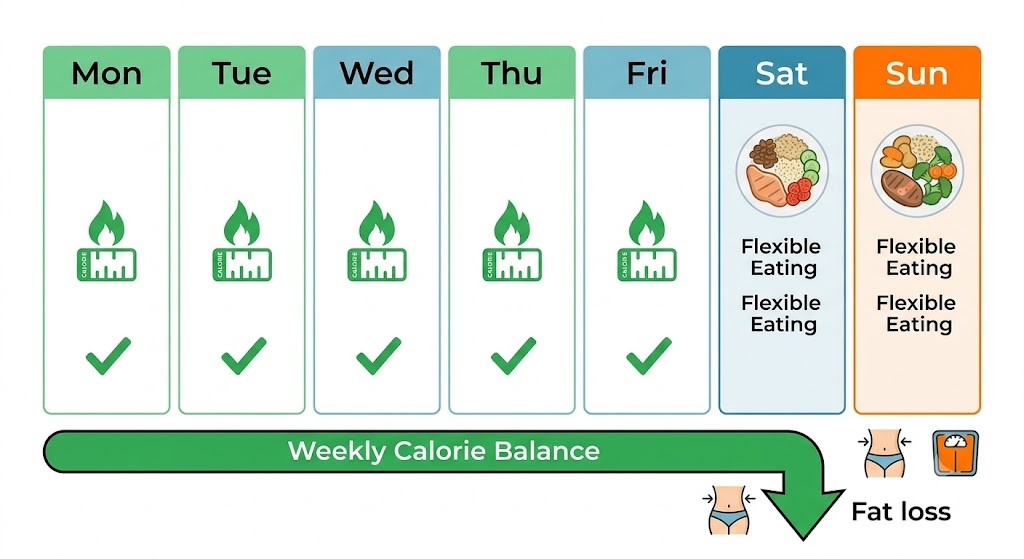
When it comes to fat loss, your metabolism works like a continuous bank account rather than a daily clock that resets at midnight. To lose weight, you need to burn more energy than you consume—creating what nutritionists call a calorie deficit.
Traditional advice suggests cutting 500 calories a day to lose about 1 pound of fat per week. But your body measures energy over days and weeks, not single 24-hour windows.
If you maintain a steady deficit during the workweek, you create a "calorie buffer". As long as your total weekly calories stay below your total weekly energy burn, fat loss continues.
However, problems arise when weekend eating turns into an unmonitored free-for-all. A single high-calorie weekend can easily erase a hard-earned weekday deficit without you even realizing it.
Scenario Profile | Mon–Fri Daily Intake | Sat–Sun Daily Intake | Total Weekly Intake | Total 7-Day Expenditure | Net Weekly Deficit / Surplus | Expected Weekly Fat Mass Change |
Strict Continuous Deficit | 1,500 kcal | 1,500 kcal | 10,500 kcal | 14,000 kcal | -3,500 kcal | -1.00 lb (-0.45 kg) |
Controlled Calorie Cycling | 1,350 kcal | 2,125 kcal | 11,000 kcal | 14,000 kcal | -3,000 kcal | -0.85 lb (-0.38 kg) |
Maintenance Weekend (Neutral) | 1,500 kcal | 2,000 kcal | 11,500 kcal | 14,000 kcal | -2,500 kcal | -0.71 lb (-0.32 kg) |
Uncontrolled Weekend Overeating | 1,500 kcal | 3,250 kcal | 14,000 kcal | 14,000 kcal | 0 kcal | 0.00 lb (Plateau) |
Weekend Binge Accumulation | 1,500 kcal | 4,000 kcal | 15,500 kcal | 14,000 kcal | +1,500 kcal | +0.43 lb (+0.19 kg) |
Assumes an average Total Daily Energy Expenditure (TDEE) of 2,000 calories per day (14,000 calories per week).
Why Does the Scale Surge on Monday Morning?

If you step on the scale every Monday morning and see a jump of 2 to 4 pounds, do not panic! You did not gain 3 pounds of pure body fat overnight.
To gain 3 pounds of actual body fat over two days, you would need to eat roughly 10,500 calories above your normal burn rate—which is exceptionally difficult during standard weekend meals.
So what is actually happening?
Water Retention from Sodium: Weekend meals, restaurant dishes, and takeout tend to contain higher sodium levels. Extra sodium prompts your kidneys to hold onto extra water temporarily.
Glycogen Refilling: Carbs are stored in your muscles and liver as glycogen. Every single gram of stored carb holds onto about 3 to 4 grams of water. When you eat extra carbs on Saturday, your body simply stores temporary water weight.
Gastrointestinal Volume: More food consumed simply means more food sitting in your digestive tract waiting to be processed.
Bottom line: A temporary Monday scale bump is usually just water weight and digestion, not permanent fat gain. Returning to your routine on Monday allows your body to shed that extra fluid within a day or two.
Calorie Cycling vs. Uncontrolled Weekend Feasts
There is a huge biological difference between planned calorie cycling (shifting more calories to the weekend while maintaining a weekly deficit) and unplanned weekend binges.
When you stay on a strict low-calorie diet for weeks on end, your body reacts to protect its energy stores. Leptin (the hormone that makes you feel full and satisfied) drops, while ghrelin (the hunger hormone) skyrockets. This hormonal shift can leave you feeling perpetually tired and hungry.
Controlled calorie cycling gives your body periodic "refeed" moments. Raising your calories slightly on weekends helps restore leptin levels, reduces diet fatigue, and makes your overall nutrition plan much easier to stick to long-term.
Physiological Marker | Continuous Linear Energy Restriction | Structured Calorie Cycling (Weekend Refeed) | Uncontrolled Weekend Binge Eating |
Weekly Net Energy Deficit | Consistent, predictable deficit | Controlled, predictable deficit | Deficit routinely erased or inverted |
Circulating Leptin Levels | Persistently suppressed | Transiently restored on higher days | Marked surge, followed by metabolic instability |
Resting Metabolic Rate (RMR) | Gradual adaptive decline | Attenuated adaptive decline | Variable; offset by excess fat storage |
Dietary Adherence & Fatigue | High psychological burnout risk | Lower burnout; high long-term sustainability | Cycles of strict restriction and guilt |
Muscle Glycogen Maintenance | Gradually depleted | Periodically re-saturated for workout performance | Over-saturated; stored as body fat |
The Real Danger: Weekend "Tracking Amnesia"
Why do so many dieters hit a weight loss plateau despite being strict during the week? It isn't because enjoying Saturday brunch is inherently bad; it is because of weekend tracking amnesia.
On weekdays, routine makes calorie tracking simple. You prep your lunch, eat standard meals, and follow a predictable schedule. But on weekends, eating out, attending social events, grabbing drinks, or trying new recipes introduces friction.
When logging meals gets tedious or complicated, most people simply stop logging from Friday night to Sunday evening. Unfortunately, a single restaurant meal with hidden cooking oils, sauces, and alcoholic beverages can easily add up to 2,000 calories—consuming your entire daily budget in one sitting.
Effortless Weekend Accountability with Voice Tracking
To avoid weekend tracking fatigue, you need a solution that fits your social life without forcing you to scroll through endless database menus at the dinner table.
This is where hands-free tools like VoCal change the game. Instead of spending minutes searching for individual ingredients, you simply tap a button and speak naturally:
"I had two slices of pepperoni pizza, four wings, and a pint of craft beer for dinner."
VoCal uses intelligent voice processing to break down your spoken words into accurate calories and macros in seconds. By removing the friction of manual logging, you keep your weekly calorie budget accurate without interrupting your weekend fun.
Dietary Self-Monitoring Strategy | Interaction Friction | Weekend Adherence Rate | Calorie Estimation Accuracy | Psychological Impact |
Paper Food Journaling | High (Requires manual entry, lookup guides, physical diary) | Low (<30% compliance) | Low (Prone to underreporting) | High tediousness and fatigue |
Traditional App Database Search | Moderate-High (Requires manual search, portion slider adjustments) | Moderate (~50% compliance) | Moderate (Frequent unlogged items) | Moderate friction; abandoned during dining out |
Voice-Assisted Tracking (VoCal) | Low (Requires only natural speech descriptions) | High (>85% compliance) | High (Captures hidden sauces, drinks, sides) | Minimal mental burden; seamless social integration |
4 Simple Tips for Weekend Flexibility Without Weight Gain
Want to eat more on weekends while maintaining steady fat loss progress? Follow these evidence-based strategies:
Bank Your Calories: If you know you have a party on Saturday, trim 100 to 150 calories off your daily intake from Monday through Thursday. That "banks" up to 600 extra calories to enjoy over the weekend without breaking your weekly deficit!
Anchor Your Meals with Protein and Fiber: Protein keeps you full and burns more energy during digestion than fats or carbs. Whether you eat plant-based or meat-inclusive diets, prioritize high-protein choices like tofu, lentils, eggs, or lean chicken before reaching for weekend treats.
Keep Steps Up on Sunday: Physical activity often drops sharply on non-working days. Counteract this by scheduling a morning walk, hiking, or aiming for 8,000 to 10,000 steps on Saturday and Sunday.
Log in Seconds Using Your Voice: Do not abandon your food diary on Friday night. Use VoCal to speak your meals aloud in real-time so you always know where your weekly balance stands.
Frequently Asked Questions (FAQs)
Can I eat whatever I want on weekends and still lose weight?
Not quite. You can eat more calories on weekends, but you cannot eat unlimited amounts. As long as your total seven-day intake creates a net energy deficit, you will lose weight.
Why does my scale weight go up on Monday even if I stayed under my weekly calories?
The sudden jump is almost always temporary water weight. Higher sodium, extra carbohydrates, and GI volume from weekend meals cause your body to retain fluids. Once you return to your routine, that water weight disappears.
Is calorie cycling better than eating the same calories every day?
It depends on your lifestyle! Research shows that both approaches produce equal fat loss if total weekly calories are identical. However, many people find calorie cycling much easier to stick to because it provides built-in flexibility for social events.
How do I accurately track calories when dining out at restaurants?
Restaurant meals often contain hidden oils, butter, and seasonings. Instead of guessing complex ingredients line-by-line, use VoCal to speak a description of your dish. Voice logging captures meal components instantly so you stay accountable with zero stress.
Disclaimer: This article is for informational purposes only and does not constitute individual medical or nutritional advice. Before making significant changes to your diet or exercise routine, consult a qualified healthcare professional or registered dietitian.