

Think of your body like your favorite smartphone. When the battery gets into that scary "red zone," the phone starts dimming the screen and closing background apps to stay alive. Your body does the exact same thing when you aren’t giving it enough fuel!
While we’re often told to "eat less" for health, eating too little can actually backfire, leading to a "starvation response" that makes you feel like a literal zombie.
If you’re wondering why you’re suddenly grumpy, freezing cold, or losing more hair than usual, your body might be trying to tell you something. Here are the signs you are eating too little calories, the risks, and how to fuel up safely with delicious veggie options.
What Happens When Your Body Goes into "Power Save Mode"?
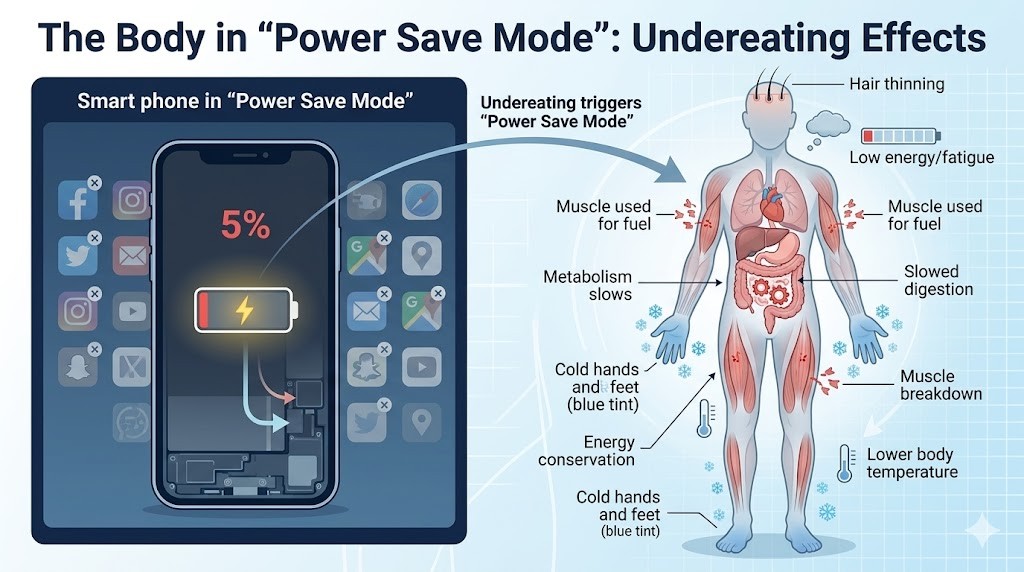
When you consistently eat below what your body needs for its Basal Metabolic Rate (BMR)—the energy needed just to breathe and keep your heart beating—your metabolism pulls a disappearing act.
This is called metabolic adaptation. Your body essentially decides that your hair and toes aren't "essential" anymore so it can keep your brain and heart running.
When you severely restrict your intake, your body triggers metabolic disturbances that can lead to a frustrating weight-loss plateau, essentially bringing your progress to a screeching halt as your system fights to conserve every bit of energy it has.
Table 1: What Happens to Your Metabolism When You Undereat?
Metabolic Parameter | What Changes | The Result |
Metabolic Rate (RMR) | Decreases (up to 23%) | You burn fewer calories at rest. |
Body Temperature | Decreases | You feel like you’re living in a freezer. |
Muscle Mass | Decreases | Your body "eats" its own muscle for fuel. |
Energy Efficiency | Increases | Your cells learn to do more with less fuel. |
The Bottom Line: Severely restricting calories slows down your metabolism, making it harder to maintain your health and weight goals in the long run.
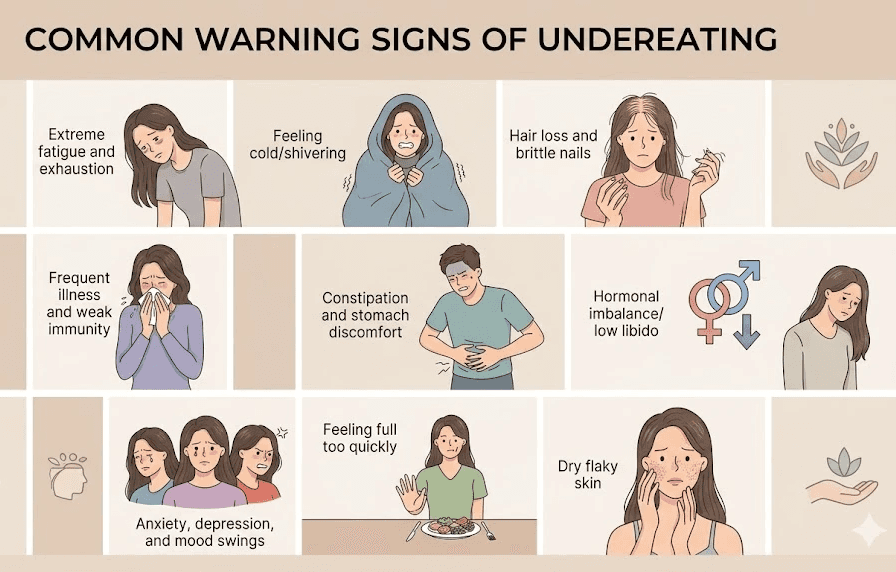
9 Warning Signs You’re Under-Fueling
1. Chronic Fatigue and Low Energy Levels
If you’re dragging yourself through the day or snapping at your coworkers over a stapler, your brain might be low on glucose. Without enough calories, you’ll experience mental fog and physical exhaustion because your body lacks the energy for basic functions like breathing and active thinking. This severe impact on your "internal battery" means even simple daily tasks feel like climbing a mountain, and your physical fitness or sports performance will likely take a massive hit.
2. Hypothermia and Increased Cold Sensitivity
When you don't eat enough, your body lowers its core temperature to save energy. Your body essentially pulls the plug on non-essential heating to keep the vital organs warm, which is why you might be shivering while everyone else is in t-shirts. This isn't just a mental chill; your core temperature actually drops as your metabolism tries to "gain time" in its search for more food, leaving you feeling like you're living in a permanent winter.
3. Hair Loss and Brittle Nails
Hair needs protein and minerals to stay put, but when nutrients are scarce, your body stops sending them to "non-essential" parts like your hair. Since your hair follicles aren't vital for keeping you alive, your body redirects protein, zinc, and iron to your heart and lungs instead. This can leave your hair looking thin, changing its texture, or causing it to fall out in clumps, while your nails might become weak and snap easily because they’ve been cut off from the nutrient supply chain.
4. Weakened Immune Function and Frequent Illness
A weak immune system is often a sign of an imbalanced diet. If your colds last for weeks or you seem to catch everything that goes around, your body likely lacks the vitamins (like A and D) to fight back. Without enough fuel, your immune system effectively goes into a "budget cut" mode, lacking the zinc and protein needed to build a strong defense force. This makes you a sitting duck for every bug going around the office, and even a simple sniffle can end up lingering much longer than it should.
5. Gastrointestinal Issues and Constipation
Eating too little can lead to gastroparesis (slow stomach emptying) and constipation. When you're undereating, your gut slows down to a crawl to squeeze every possible calorie out of the little food you do provide. This leads to that "stalled" feeling where you’re backed up for days, often resulting in less than three bowel movements a week and plenty of uncomfortable bloating because your system simply doesn't have enough bulk to keep things moving.
6. Reproductive Dysfunction and Low Libido
For women, undereating can cause the body to "turn off" reproduction to save energy. Think of it as your body's way of saying, "We can barely take care of ourselves, so we definitely can't grow a human right now." This hormonal shutdown affects your sex drive too, as testosterone and estrogen levels take a nosedive, leading to irregular periods or amenorrhea. Over time, this "system shutdown" can even lead to weakened bones and a much higher risk of fractures.
7. Depression, Anxiety, and Mood Swings
The "Minnesota Starvation Experiment" proved that undereating actually changes your brain chemistry. A starving brain is often an anxious, rigid brain that can't think clearly about anything other than food. You might find yourself feeling surprisingly apathetic, depressed, or even developing obsessive habits because your neurons are literally running on empty. It’s hard to be the life of the party when your brain is sounding a 24/7 alarm for more energy.
8. Early Satiety and Loss of Appetite
Ironically, undereating can make your stomach shrink and slow down, making you feel full way too fast (early satiety). This happens because your stomach muscles actually lose their "go-power," making it difficult for the system to process even small meals efficiently. It creates a weird loop where you feel physically stuffed and nauseous after just a few bites, even though your body is actually starving for more energy and nutrients.
9. Dermatological Problems and Dry Skin
Lack of Vitamin E and B-vitamins can make your skin dry, flaky, or even give it a yellowish tint. Your skin is often the first place to show signs of a nutrient drought, as it misses out on the Vitamin A and healthy fats it needs to stay supple. You might notice your complexion looking scaly or dull because your body is prioritizing your internal organs over your external glow, leaving your skin vulnerable to inflammation and damage.
The Long-Term Risks (The Not-So-Fun Part)
Eating too little isn't just about feeling tired. Over time, it can lead to serious health issues :
Osteoporosis: Your body "borrows" calcium from your bones, making them brittle.
Heart Issues: A lack of electrolytes can cause irregular heartbeats or a weakened heart muscle.
Anemia: Low iron or B12 leads to extreme fatigue and dizziness.
How to Fix It: Healthy Fuel for Your Body

If you’ve realized you’re under-fueling, don’t just reach for junk food! Focus on nutrient-dense, high-calorie foods to get your spark back. For a standard US diet, this means incorporating a mix of healthy fats, complex carbs, and high-quality proteins.
Table 2: High-Calorie Power-Ups for Weight Gain
Food Group | Energy Booster | Why It’s Great |
Healthy Fats | Avocado, Extra Virgin Olive Oil | Massive energy boost that supports your heart. |
Animal Proteins | Salmon, Steak, Chicken Thighs | Oily fish provides Omega-3s, while red meat is high in iron and leucine for muscle gain. |
Dairy & Eggs | Whole Milk, Greek Yogurt, Eggs | Complete proteins rich in Vitamin D and B12. |
Nuts & Seeds | Walnuts, Peanut Butter, Chia | High in protein and "good" fats; perfect for snacking. |
Grains & Carbs | Quinoa, Oats, Sweet Potatoes | Sustained energy that won't cause sugar crashes. |
Smart Habits for Safe Weight Gain:
Eat Small, Frequent Meals: Try 5–6 mini-meals if a big dinner feels overwhelming.
Drink Your Calories: Blend whole milk or soy milk with peanut butter and a banana for a quick 500-calorie shake.
Don't Fear the Fat: Choose chicken with the skin on, full-fat cheeses, and whole milk rather than "lite" or "skim" versions.
Layer Every Meal: Add a fried egg to your avocado toast, or top your chili with a handful of shredded cheddar cheese.
Track Smarter with VoCal
One reason we undereat is simply forgetting to log or losing track of our busy days. VoCal makes it incredibly easy. Instead of typing in 20 different ingredients, just say: "I had a 6-ounce ribeye steak with a medium baked potato and a side of sautéed spinach."
Voice-based logging has been shown to be up to 98% accurate and significantly reduces "tracking fatigue". It’s a great way to ensure you're hitting your minimum calorie needs without the stress of manual data entry.
FAQs
How many calories is "too little"?
It depends on your age, height, and activity level, but generally, eating below your BMR consistently is considered undereating. Consult a pro to find your specific number.
Can undereating make it harder to lose weight?
Yes! Due to metabolic adaptation, your body slows its calorie-burning to a crawl to survive.
Are these symptoms reversible?
Most are! Increasing your intake safely with nutrient-dense foods can restore your energy, skin, and mood.
Disclaimer: This content is for informational purposes only and is not a substitute for professional medical advice, diagnosis, or treatment. If you are experiencing symptoms of undereating or suspect an eating disorder, please consult a healthcare professional or a registered dietitian immediately.