
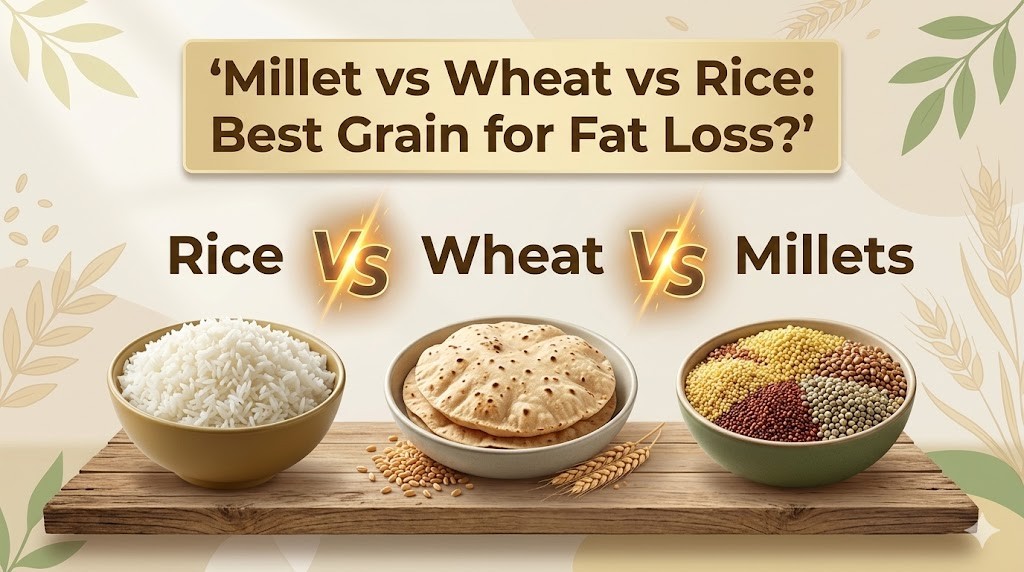
For years, our dinner plates have been a battleground between "Team Rice" and "Team Wheat." But lately, a group of ancient "super grains"—the millets—has crashed the party and is stealing the spotlight. If you’re trying to shed some extra kilos, you might be wondering: should you stick to your comforting bowl of rice, your reliable rotis, or make the switch to millets?
Let’s break down the nutritional showdown to see which grain helps you lose fat while keeping your tummy happy!
The Ultimate Nutritional Showdown
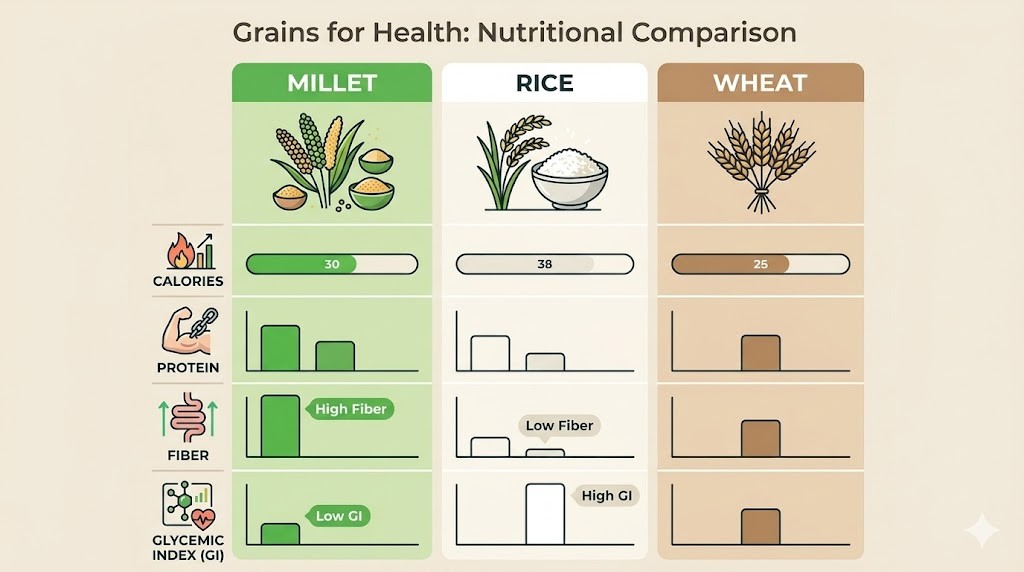
When it comes to fat loss, not all calories are created equal. We need grains that keep us full, nourish our muscles, and don't send our blood sugar on a roller coaster ride.
Here is how they stack up per 100g:
Nutrient (per 100g) | Millets (Average) | Rice (White/Polished) | Wheat (Whole) |
Energy (kcal) | 320 - 360 | 345 - 350 | 330 - 340 |
Protein (g) | 7.0 - 12.5 | 6.5 - 7.1 | 11.8 - 13.0 |
Dietary Fiber (g) | 8.0 - 15.0 | 0.2 - 0.5 | 10.5 - 11.5 |
Glycemic Index (GI) | 52.7 (Low) | 72 - 89 (High) | 60 - 70 (Medium) |
Gluten-Free? | Yes | Yes | No |
Why Millets are the Secret Weapon for Fat Loss
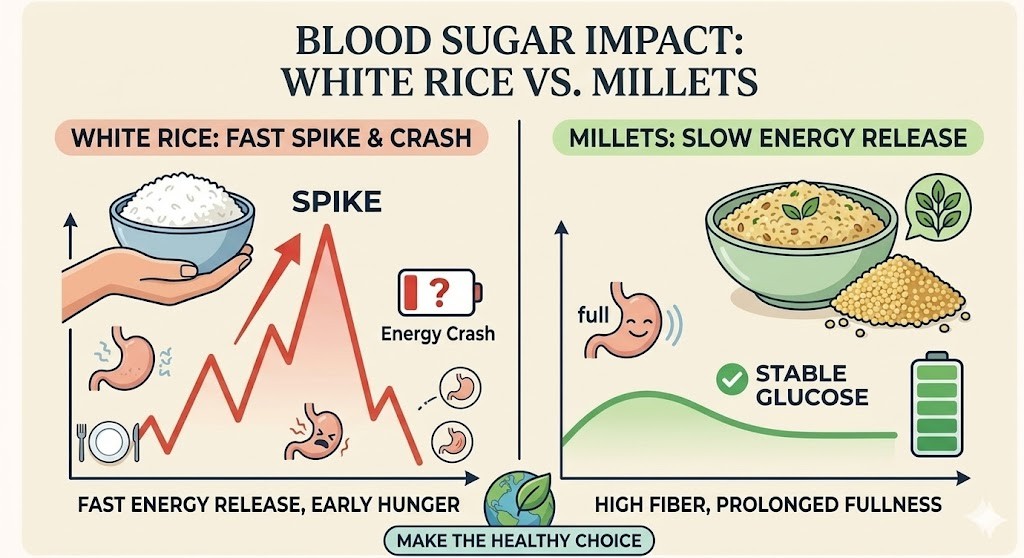
One of the biggest benefits of eating millets for weight loss is their incredible fiber content. Millets can have up to 50 times more fiber than white rice! This fiber acts like a "satiety shield," slowing down your digestion and keeping the "hunger monster" at bay for hours.
The Blood Sugar Secret: Low Glycemic Index (GI)
Ever felt a "sugar crash" after a big rice meal? That’s because white rice has a high GI, causing a rapid spike in insulin—your body’s main fat-storage hormone. Millets, however, have a low GI (averaging around 52.7), which means they release energy slowly and steadily. This stable environment makes it much easier for your body to burn stored fat instead of storing more of it.
Meet the Millet Superstars
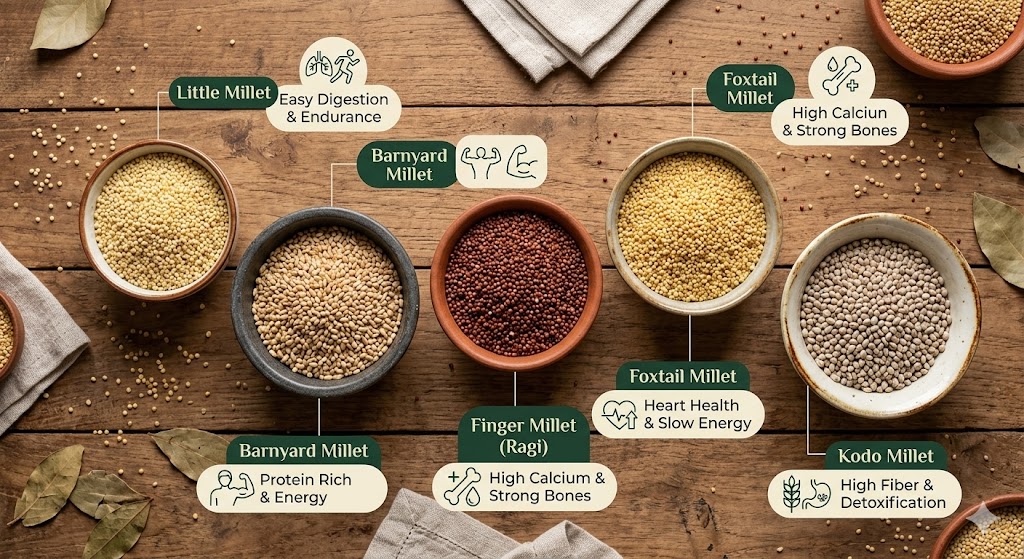
Different millets bring different "superpowers" to your weight loss journey :
Little Millet: Research shows it contains bioactive compounds that might actually fight the "FTO protein"—a known culprit in fat deposition.
Barnyard Millet: The "Fiber King." It is packed with resistant starch, which has been shown to reduce Body Mass Index (BMI) in clinical trials.
Finger Millet (Ragi): It is loaded with calcium (3x more than milk!) and tryptophan, an amino acid that helps curb stress-related snacking.
The Verdict: Which Grain Wins?
While whole wheat and brown rice have their place, millets are the clear winners for anyone serious about fat loss. They offer more fiber, better blood sugar control, and a massive boost of minerals like iron and magnesium.
Pro Tip: You don't have to switch overnight! Try replacing your rice with foxtail millet or swapping your wheat roti for a Jowar (sorghum) roti once a day. Your gut (and your waistline) will thank you!
Don't Let Tracking Spoil the Fun!
We get it—trying new grains like Foxtail, Kodo, or Barnyard millet can make calorie tracking feel like a math exam. Is it "cooked"? Is it "raw"? Who has time for that?
That’s where VoCal comes in. Instead of spending 15 minutes searching through endless databases, you can just send a 15-second voice note. Just say, "I had a bowl of Barnyard Millet upma with peas and carrots," and our AI does the heavy lifting. It’s 10x faster than traditional apps, so you can spend less time logging and more time enjoying your healthy meal!
FAQs
Q: Can millets cause bloating?
Since they are high in fiber, your body might need a few days to adjust. Start small and drink plenty of water!
Q: Is Ragi (Finger Millet) good for weight loss?
Absolutely! It’s rich in protein and fiber, though it has a slightly higher GI than other millets, so it's best enjoyed in whole form rather than fine flour.
Q: Are millets gluten-free?
Yes! All millets are naturally gluten-free, making them perfect for those with sensitive tummies.
Disclaimer: Consult a healthcare professional before making major dietary changes, especially if you have conditions like diabetes or thyroid issues.