
Walking down the dairy aisle used to be simple. You’d grab a gallon of milk, maybe some butter, and head to the checkout. But today? It’s a high-stakes battleground of "superfoods." On one side, you have Greek yogurt—the reigning champ of healthy breakfasts. On the other, the massive "cottage cheese comeback" has turned this lumpy classic into a social media protein superstar.
If you’re trying to hit your macros, you probably want to know: which one is actually the better protein powerhouse? Let’s break down the "Team Curd" vs. "Team Tangy" showdown to see which deserves a spot in your fridge.
The Tale of the Tape: Protein by the Numbers
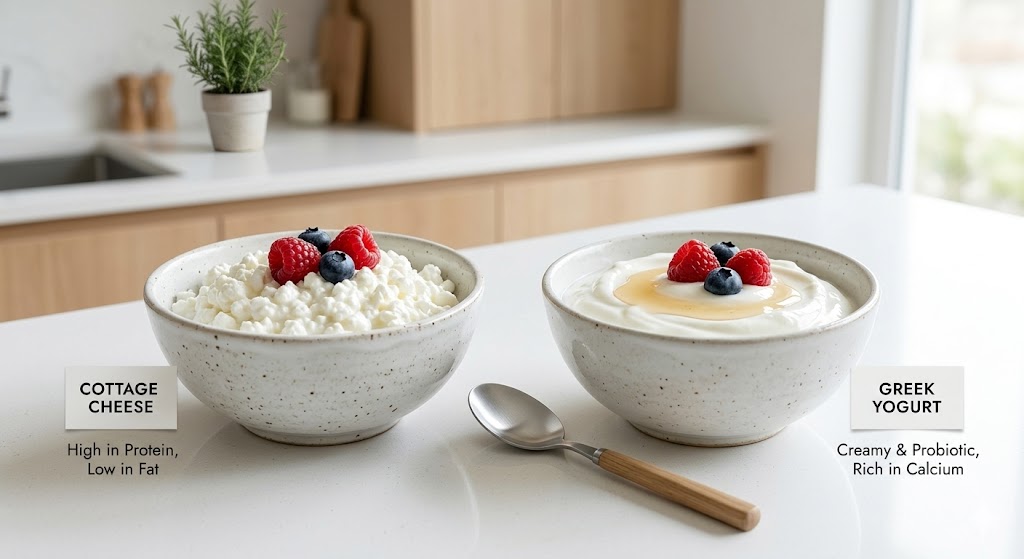
When we look strictly at the numbers, cottage cheese usually takes the gold medal for pure protein density. For every 100 g (3.5 oz) serving of low-fat cottage cheese, you get about 10.5 to 11 grams of protein . Plain Greek yogurt is right on its heels, usually landing at 10.2 grams per 100 g (3.5 oz).
Here is how they stack up side-by-side per 100 g (3.5 oz) serving:
Nutrient (Low-Fat/2%) | Cottage Cheese (100 g / 3.5 oz) | Greek Yogurt (100 g / 3.5 oz) |
Protein | ~10.5g - 11.0g | ~10.2g |
Calories | ~81 kcal | ~59 - 70 kcal |
Calcium | ~83mg - 111mg | ~110mg |
Sodium | ~308mg - 364mg | ~38mg - 61mg |
The Verdict: While both are incredible sources, cottage cheese provides slightly more protein per gram. However, Greek yogurt is often lower in calories, which is great for those who want to maximize their protein-to-calorie ratio.
Slow vs. Fast: How Your Body Uses the Protein

It’s not just about how much protein you eat; it’s about how your body handles it. Both of these are "complete proteins," meaning they have all nine essential amino acids your muscles need to grow and repair .
Cottage Cheese: The "Slow and Steady" Winner
About 80% of the protein in cottage cheese is casein. This is a slow-digesting protein that forms a "gel" in your stomach, releasing amino acids into your bloodstream over several hours. This makes 100 g (3.5 oz) of cottage cheese the ultimate pre-bedtime snack to keep your muscles fueled while you sleep .
Greek Yogurt: The Post-Workout Speedster
While also high in casein, Greek yogurt contains more whey protein than cottage cheese. Whey is the "fast" protein—it hits your system quickly . This makes a cold 100 g (3.5 oz) serving of Greek yogurt an ideal post-gym snack to kickstart recovery .
Beyond Protein: The Health Perks
While protein is the star of the show, these two bring different "sidekicks" to the nutritional party.
Greek Yogurt for Gut Health: Because it’s fermented, Greek yogurt is loaded with probiotics (the good bacteria). These help with digestion and keep your immune system in fighting shape .
Cottage Cheese for Thyroid Support: It’s a surprising source of selenium, a mineral that’s crucial for thyroid health and protecting your cells from damage .
The Calcium Factor: If you’re team "strong bones," Greek yogurt has a slight edge, offering more calcium per 100 g (3.5 oz) than its lumpy rival .
A Note on the "Salt Trap"
There is one area where cottage cheese loses: sodium. To keep those curds fresh and tasty, manufacturers add salt. A 100 g (3.5 oz) serving of cottage cheese can have over 300 mg of sodium—significantly more than the 38–61 mg found in the same amount of Greek yogurt . If you’re watching your blood pressure, look for "low-sodium" versions .
How to Track Like a Pro with VoCal
Whether you’re blending cottage cheese into your pancake batter or topping your Greek yogurt with berries, keeping track of these grams shouldn't feel like a math test. With VoCal , you can simply speak your meal into your phone.
Instead of scrolling through endless databases to find the difference between "nonfat" and "2%," you can just say, "I had 100 grams of low-fat cottage cheese with peaches." The voice-based AI handles the rest, ensuring your protein logs are accurate without the headache of manual typing .
Frequently Asked Questions
Which has more protein per 100 g (3.5 oz)?
Cottage cheese usually has a slight lead with about 10.5g–11g, while Greek yogurt averages around 10.2g.
Is one better for weight loss?
Cottage cheese is often ranked higher for satiety (fullness) because the curds require more chewing and the casein protein digests slowly .
Does Greek yogurt have more probiotics?
Yes. Most Greek yogurt contains live active cultures. Only specific brands of cottage cheese (labeled "live and active cultures") contain probiotics .
Disclaimer: This content is for informational purposes only and is not a substitute for professional medical advice, diagnosis, or treatment. Always seek the advice of your physician or other qualified health provider regarding any medical condition .