

Ah, the avocado. It is the undisputed king of brunch, the star of taco night, and quite possibly the most Instagrammed fruit on the planet. But if you are trying to keep your health goals on track, you’ve probably paused mid-slice to ask yourself: just how many calories in one avocado are you actually eating?
While some old-school diet apps might make you feel guilty for loading up on guacamole, the real story behind avocado calories is much more reassuring. The secret lies in understanding how your avocado's size affects its calorie count, and how its unique mix of healthy fats and fiber actually works with your metabolism—not against it.
Let’s break down the math on your favorite green superfood so you can track your meals without the stress.
Edible Weight vs. Whole Weight: Slicing Through the Confusion
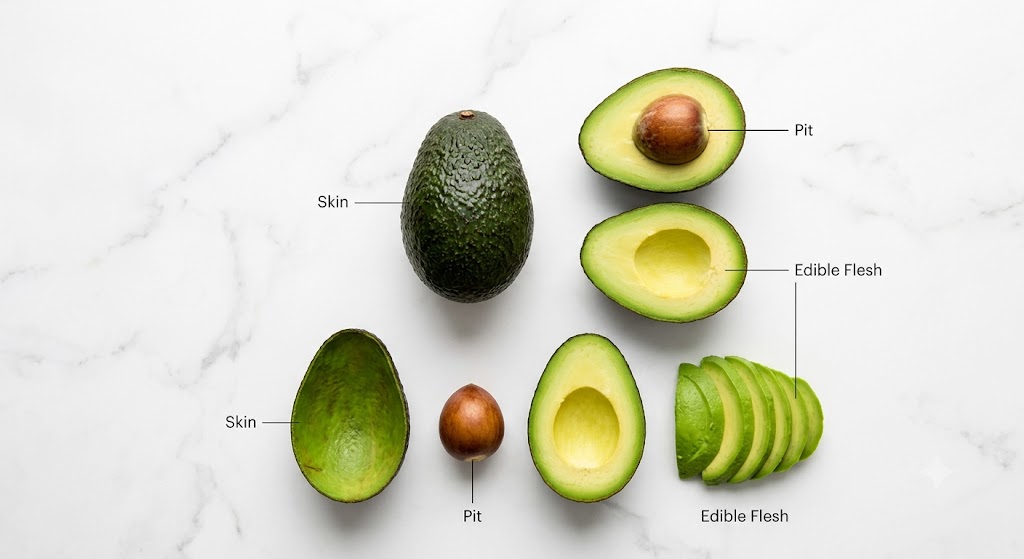
When you put a whole avocado on your kitchen scale, you aren't just weighing the creamy green goodness. You are also weighing the heavy pit (stone) and the thick, leathery skin.
For the common Hass avocado—which makes up over 95% of the avocados we eat in the US—the skin and pit act as a natural "tax" on your food weight. Botanical studies show that the edible flesh makes up about 70% to 72% of the avocado's total weight. The pit accounts for roughly 16%, and the skin takes up the other 12%.
This means if you log a whole "medium" avocado as weighing 150 grams without subtracting the pit and skin, you are accidentally over-logging about 72 calories!
Here is how whole weights translate into actual edible weights and calorie counts, according to USDA standards:
Table 1: Hass Avocado Sizing, Gram Yields, and Caloric Calculations
Sizing Classification | Commercial Caliber | Average Whole Weight (Ounces) | Average Whole Weight (Grams) | Edible Flesh Yield (Grams, ~70%) | Calories in One Avocado (Edible Portion) |
Small | Caliber 84 to 96 | 3.75 – 4.75 oz | 106 – 135 g | 74 – 95 g | 118 – 152 kcal |
Medium | Caliber 60 to 70 | 4.75 – 7.50 oz | 135 – 213 g | 95 – 149 g | 152 – 238 kcal |
Large | Caliber 48 | 7.50 – 9.50 oz | 213 – 269 g | 149 – 188 g | 238 – 301 kcal |
Extra Large | Caliber 32 to 40 | 9.50 – 13.75 oz | 269 – 390 g | 188 – 273 g | 301 – 437 kcal |
Note: Sizing data is based on standard US commercial imports. Calorie counts are calculated using the USDA standard of 1.6 calories per gram of edible Hass avocado flesh.
Bottom Line: Before you log your avocado, remember to subtract about 30% of its whole weight to account for the inedible skin and pit. You only want to count the calories of the flesh you actually eat!
Calories and Macros by Avocado Portion Size
Unlike most fruits that are packed with simple sugars, the avocado is loaded with healthy fats. In fact, about 75% to 80% of its calories come from heart-smart monounsaturated fats—specifically oleic acid, which is the same star player found in extra virgin olive oil.
If you are eating a whole, medium-sized Hass avocado, you're getting about 240 calories. But because the FDA updated the official serving size to one-third of a medium avocado (50 grams), a standard single serving is only 80 calories.
If you are on a low-carb or ketogenic diet, avocados are your ultimate best friend. Even though a medium avocado has 13 grams of carbohydrates, a whopping 10 grams of that is dietary fiber. This leaves you with a tiny 3 grams of net carbs and practically zero sugar!
Let's take a closer look at the nutritional breakdown for different portion sizes:
Table 2: Macronutrient Profiles Across Standard Avocado Serving Sizes
Nutrient Component | FDA Reference Serving (1/3 Medium, 50g) | Typical Portion Size (1/2 Medium, 75g) | Whole Medium Avocado (150g Flesh) | Whole Large Avocado (201g Flesh) |
Energy (Calories) | 80 kcal | 120 kcal | 240 kcal | 322 kcal |
Total Fat | 8.0 g | 12.0 g | 23.0 g | 29.0 g |
— Monounsaturated | 5.0 g | 7.0 g | 15.0 g | 19.7 g |
— Polyunsaturated | 1.0 g | 1.5 g | 3.0 g | 4.0 g |
— Saturated | 1.0 g | 1.5 g | 3.0 g | 4.0 g |
Total Carbohydrate | 4.0 g | 6.0 g | 13.0 g | 17.0 g |
— Dietary Fiber | 3.0 g | 5.0 g | 10.0 g | 14.0 g |
— Total Sugars | 0.0 g | 0.0 g | 0.0 g | 1.0 g |
Net Carbohydrates | 1.0 g | 1.0 g | 3.0 g | 3.0 g |
Protein | 1.0 g | 1.0 g | 3.0 g | 4.0 g |
Note: Values are rounded to align with FDA labeling and USDA FoodData Central guidelines.
Bottom Line: A typical whole medium avocado has about 240 calories and 23 grams of fat. But because it's packed with fiber, it has only 3 grams of net carbs, making it highly blood-sugar friendly.
The "Nutrient Booster" Effect and Extra Micronutrients

Think of avocados as nature's ultimate wingman. They don't just bring their own nutrients to the table—they make other healthy foods work better.
Many essential vitamins (like vitamins A, D, E, and K) and key antioxidants are fat-soluble. Because avocados contain 15 grams of healthy fats per 100 grams of flesh, eating them alongside veggies dramatically boosts your body's ability to absorb those nutrients. Toss some avocado into your salad, and you are instantly unlocking more nutritional value from your tomatoes and leafy greens!
On top of that, avocados are loaded with:
More Potassium than Bananas: A whole medium avocado delivers 760 milligrams of potassium (compared to 422 milligrams in a medium banana), which is a key mineral for keeping your blood pressure in check.
Folate: A single serving provides 10% of your Daily Value (DV) for folate, supporting cellular growth and energy.
Vitamin E: It offers 6% of your DV of vitamin E per serving, acting as a powerful antioxidant to keep your immune system strong.
Bottom Line: Avocados act as a natural "nutrient booster," helping your body absorb fat-soluble vitamins while offering a rich supply of heart-healthy potassium and skin-loving antioxidants.
Satiety & Appetite Control: Why Avocado Calories Hit Differently

If you have ever eaten a low-fat salad and found yourself rummaging through the snack drawer an hour later, you know that not all calories are created equal. Refined carbs can trigger rapid blood sugar spikes followed by a crash, leaving you feeling hungry and tired.
Avocados take a completely different path. Clinical trials show that replacing refined carbohydrates with the fat-and-fiber combo of an avocado triggers the release of Peptide YY (PYY) and GLP-1—the gut hormones that signal your brain that you are genuinely full.
In one study, adding just half a Hass avocado to a lunch meal reduced participants' desire to eat by 28% over the next three to five hours. Even better, in a massive six-month trial of over 1,000 adults, eating one large avocado daily did not cause weight gain or increase belly fat. Because the avocado kept them full and satisfied, they naturally ate fewer empty, processed calories throughout the day.
Bottom Line: The unique fat-and-fiber matrix of avocados boosts your natural fullness hormones, keeping you satisfied for hours and helping you manage your weight without constant hunger.
Endothelial Protection: Protecting Your Blood Vessels
The benefits of avocados aren't just about weight management; they also do wonders for your blood vessels.
When you eat grilled animal proteins (like a beef burger patty), your stomach can act as a chemical reactor, creating inflammatory compounds that cause your blood vessels to constrict post-meal. But clinical research at UCLA found that adding 68 grams of fresh avocado (about half a fruit) to a burger patty completely prevented that blood vessel constriction and kept blood flowing smoothly.
Even though the avocado added 114 calories and 11 grams of fat to the meal, it suppressed vascular inflammation and didn't cause a spike in triglycerides compared to eating the burger alone. Over time, replacing saturated fats like butter or processed meats with avocado can lower your risk of cardiovascular disease by up to 16%!
Bottom Line: Pairing avocado with your meals acts like an anti-inflammatory shield, keeping your blood vessels healthy and protecting your heart.
Meet VoCal: The Voice Calorie Tracking App That Does the Math for You
Let's be honest: manual calorie tracking can be a massive pain. To track the calories in one avocado perfectly using old-school apps, you have to weigh the whole fruit, weigh the leftover pit and skin, do the subtraction, and search a database. No wonder most people quit tracking after just a week!
That is where VoCal comes in. As the world’s easiest voice-based calorie tracking app, VoCal eliminates the friction of manual search and visual guesswork.
Instead of typing or taking pictures under perfect lighting, you just tap the mic and say: "I had half a medium avocado on toast with two eggs."
VoCal’s smart AI instantly parses your food, automatically applies the pit-and-skin discount, and logs your calories, healthy fats, and fiber in under five seconds.
Table 3: Voice Tracking vs. Traditional Calorie Apps
Feature | Traditional Database Apps | Photo-Based Scanning | VoCal Voice Tracking |
Average Logging Time | 2 to 5 minutes per meal | 8 to 15 seconds per scan | Under 5 seconds |
Pit & Skin Discount | You have to calculate it manually | Often miscalculates visual depth | Automatically applied by AI |
Language Support | English database search only | Limited visual context | 11 Indian languages supported |
Meal Customization | Sifting through thousands of entries | Struggles with mixed or layered foods | Understands natural, casual descriptions |
Note: Support parameters based on VoCal features and comparative calorie application testing.
Whether you're trying to hit your weight loss goals or simply aiming to eat more whole foods, VoCal keeps you consistent without the tracking headache.
Bottom Line: Don't let the math of fresh produce slow you down. By using voice-first tracking with VoCal, you can log your healthy fats and stick to your goals in seconds.
Frequently Asked Questions (FAQs)
How many calories are in half an avocado?
A typical half of a medium Hass avocado (about 75 grams of edible flesh) contains roughly 120 calories and 11 grams of healthy fat.
Do avocados burn belly fat?
"Spot reduction" (burning fat from one specific spot) is a biological myth. However, because avocados are highly satisfying and help control insulin spikes, they support overall fat loss and prevent your body from storing excess visceral (abdominal) fat.
How do I store half an avocado so it doesn't brown?
Squeeze a little lime or lemon juice over the exposed flesh, wrap it tightly in plastic wrap (pressing it directly against the flesh to keep air out), and pop it in the fridge. The vitamin C in the citrus acts as a natural antioxidant to slow down the browning process!
Is it okay to eat a whole avocado every day?
Absolutely! As long as it fits into your overall daily calorie goals, eating a whole avocado daily offers incredible benefits for your heart, skin, digestion, and fullness.
Disclaimer: This is for informational purposes only. For medical advice or diagnosis, consult a professional.