

We’ve all been there. You’re standing in the grocery store aisle, looking at a bag of frozen broccoli, and then looking over at the fresh, bright green crown in the produce section. A little voice in your head whispers, "Is buying the frozen one a lazy cop-out? Am I losing out on vitamins?"
For decades, the "fresh is best" culture has made us feel downright guilty about shopping in the freezer section, leaving us to believe frozen veggies are a lesser, nutrient-depleted option. But is that true? When we look closely at frozen vegetables vs fresh nutrition, the science paints a completely different—and highly reassuring—picture.
Let’s dive into the fascinating post-harvest chemistry of vegetables, how freezing actually works, and how keeping your freezer stocked can be the ultimate hack for your health, wallet, and calorie-tracking goals with apps like VoCal.
The Freshness Illusion: What Happens Post-Harvest
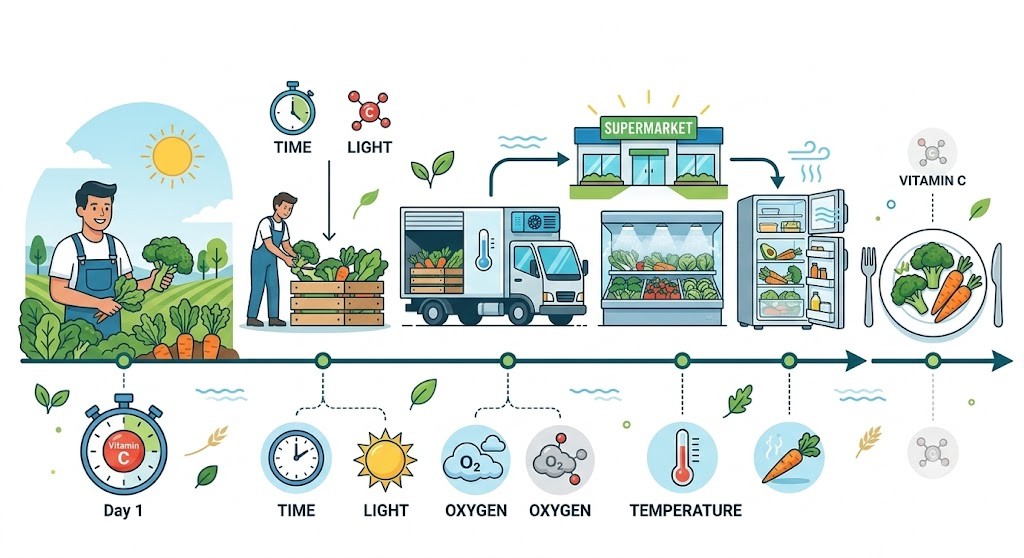
Here is a reality check: the "fresh" produce in your supermarket isn't as fresh as you think.
Vegetables are living, breathing organisms. The moment they are harvested and snipped from their roots, their internal survival countdown begins. To stay alive, the plant starts consuming its own moisture and nutrient reserves in a process called cellular respiration.
In the United States, fresh produce is often picked before it is fully ripe so it doesn't bruise or spoil during transport. By the time those veggies are packaged, loaded onto trucks, shipped to your local grocery store, and purchased by you, 1 to 2 weeks have easily flown by. Then, they might sit in your fridge for another few days before you cook them.
During this transit time, sensitive water-soluble vitamins degrade rapidly due to heat, light, and oxygen exposure.
Vitamin C is highly unstable and is used by food scientists as the primary baseline for nutrient loss.
Green peas can lose up to 51% of their Vitamin C within the first 24 to 48 hours after harvest.
Fresh spinach left at room temperature can lose up to 100% of its Vitamin C in less than 4 days.
Bottom Line: "Fresh" vegetables at the supermarket undergo a long, post-harvest transit timeline, during which they lose a significant portion of their sensitive vitamins before they ever reach your plate.
Flash-Freezing: Nature's Smart Pause Button
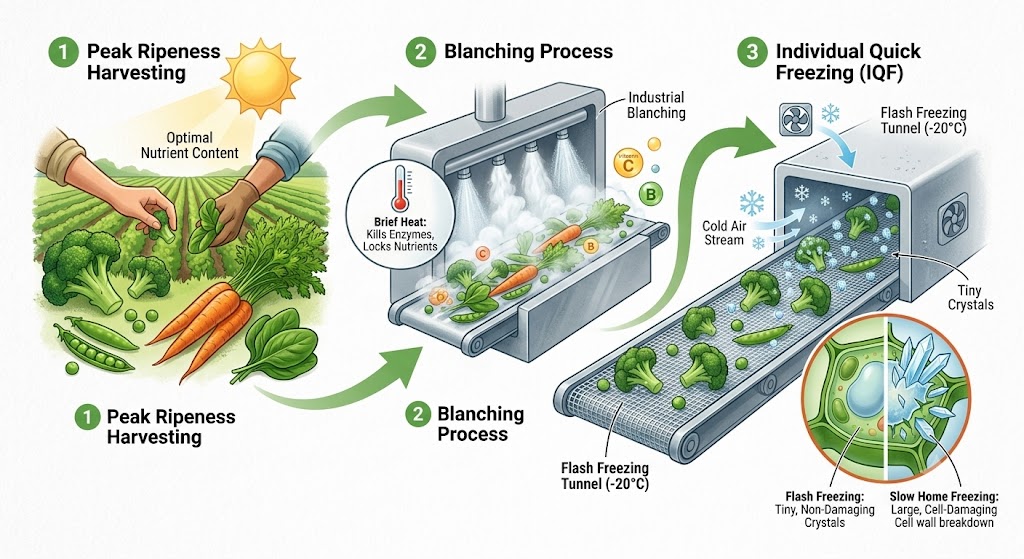
This is where the freezer aisle steps in to save the day. Vegetables destined for the freezer are harvested at their absolute peak of ripeness, when they are bursting with the maximum amount of vitamins, minerals, and antioxidants.
Within just hours of being picked, they go through a highly optimized two-step preservation pipeline.
1. The Hot Bath (Blanching)
Before vegetables are frozen, they are briefly exposed to boiling water or steam. This process, called blanching, deactivates ripening enzymes that would otherwise cause the veggies to spoil, turn brown, lose their texture, or develop off-flavors while in the freezer.
While the heat from blanching does cause some water-soluble vitamins (like Vitamin C and B-complex) to leach out, the loss is relatively minor compared to other methods. For example, asparagus loses around 30% of vitamin C during canning, but only 10% during blanching and freezing.
On the bright side, the heat actually denatures tough plant cell walls, which can make fat-soluble vitamins (like A and E) and carotenoids more bioavailable and digestible for your body.
2. Cryogenic Flash-Freezing (IQF)
Immediately after blanching, the vegetables are rapidly cooled and subjected to Individual Quick Freezing (IQF) at temperatures reaching -20°C (-4°F) or lower.
This step is a thermodynamic miracle. When you freeze food slowly at home, large ice crystals form, puncturing the delicate plant cell walls. When thawed, those cells leak their nutrient-rich fluids, leaving you with mushy, tasteless veggies.
But industrial flash-freezing prevents this. Because the temperature drops so rapidly, only tiny micro-crystals form. This locks the cellular structures in place, preserving both crisp textures and high nutrient yields.
Bottom Line: Blanching and flash-freezing act as nature’s pause button. While blanching causes a minor drop in water-soluble vitamins, it completely locks in the remaining nutrients at peak ripeness for months to come.
What the Science Says: The Battle of the Beakers
To settle the frozen vegetables vs fresh nutrition debate once and for all, world-class researchers have run head-to-head tests.
The UC Davis Study
A major study led by Dr. Diane Barrett at the University of California, Davis, evaluated the nutrient retention of eight different fruits and vegetables. They compared fresh-picked veggies, refrigerated produce stored for 3 to 10 days, and frozen produce stored for up to 90 days.
The results? There were no statistically significant differences in total nutritional value. In fact, minerals like calcium, magnesium, zinc, copper, and iron—which are highly stable inorganic compounds—remained completely intact. Even better, the frozen vegetables actually boasted higher levels of Vitamin E and riboflavin (Vitamin B2) compared to their refrigerated "fresh" counterparts.
The University of Georgia Study
Another study led by Dr. Ronald Pegg at the University of Georgia simulated typical household shopping habits (storing fresh veggies in a home fridge for 5 days).
They discovered that the levels of Vitamin A, Vitamin C, and folates in frozen vegetables were generally equal to, and in multiple cases superior to, the fresh-stored produce. Frozen green peas and green beans, in particular, retained dramatically higher concentrations of ascorbic acid (Vitamin C) than fresh ones that had sat in a fridge drawer for 5 days.
The Ultimate Storage Showdown
Let’s look at how fresh, fresh-stored, frozen, and canned vegetables stack up across the board.
Nutrient / Metric | Fresh (Optimal: Local/Immediate) | Fresh-Stored (Supermarket standard: 5-10 days) | Frozen (Industrial Flash-Frozen: 0-12 months) | Canned (Thermal Processing: 1-5 years) |
Vitamin C Retention | Maximum potency (100% baseline) | High degradation (30-100% loss depending on species) | Stable retention (10-50% loss from initial blanching) | Low retention (average loss of >60% due to sterilization heat) |
Vitamin A / Beta-Carotene | Baseline | Minimal degradation | Highly conserved; physical accessibility often improved | Often enhanced or more bioavailable due to heat |
Minerals & Dietary Fiber | Fully conserved | Fully conserved | Exceptionally stable; negligible change during storage | Stable, but water-soluble minerals can leach into packing liquid |
Sodium Content | Negligible (naturally occurring) | Negligible (naturally occurring) | Negligible (except when packaged in commercial sauces) | Often elevated; rinsing can reduce added sodium by up to 50% |
Lycopene Bioavailability | Standard baseline | Minimal change | Moderately increased | Significantly increased (e.g., canned tomatoes) |
B-Complex Vitamins | Baseline | Gradual decline during cold storage | Moderate retention; minor loss during blanching | Low retention; highly sensitive to thermal processing |
Calorie Tracking, Glycemic Control, and Metabolic Magic
If you are on a weight loss journey, managing your blood sugar, or utilizing calorie-tracking apps, frozen vegetables are your secret weapon.
No More Guesswork: Standardized Servings
One of the most frustrating parts of calorie counting is the wild variability of fresh produce. A raw crown of broccoli has stems, leaves, and varying moisture levels, making it hard to eyeball a portion.
Commercially frozen vegetables, however, are packaged under strict FDA Standards of Identity (SOIs) and Reference Amounts Customarily Consumed (RACCs). This means they have a highly consistent portion-to-mass ratio.
If you use a voice-based calorie tracker like VoCal, logging your meals is incredibly easy. You can simply tap your microphone and say, "I had one cup of frozen riced cauliflower," and get an instantly accurate, validated caloric and carbohydrate count.
The Low-Carb Satiety Superstars
For weight management, low-carb, and ketogenic diets, non-starchy vegetables are essential. High-protein, high-fiber meals have been shown to regulate hunger hormones like ghrelin and peptide YY, helping you feel fuller for longer.
Non-starchy frozen vegetables like spinach, broccoli, and zucchini retain 100% of their gut-healthy dietary fiber during freezing. This fiber slows down your digestion, preventing sudden blood sugar spikes and saving you from the dreaded "carb crashes" that trigger sweet cravings.
Vegetable Type | Common Examples | Carbohydrate Profile | Recommended Role in Weight Loss / Low-Carb Diets | Tracking Considerations (VoCal) |
Non-Starchy | Spinach, Broccoli, Cauliflower, Zucchini | Very low carb, high fiber, low glycemic load | Excellent for volume eating, promoting satiety, and insulin control | Minimal impact on daily carb limits; highly consistent logging |
Starchy | Corn, Green Peas, Potatoes, Sweet Potatoes | Moderate to high carb, starch-dense | Energy-dense; can be linked to weight gain if unmonitored | Require precise logging to prevent exceeding targeted daily carb counts |
Bottom Line: Commercially frozen veggies provide highly standardized portions, making them incredibly easy to log accurately on voice-based tracking apps like VoCal.
Staying Safe: Food Safety & Freezer Basics
While frozen veggies are nutritional champions, it's important to keep food safety in mind.
Microbes Enter Dormancy—They Don't Die!
A common myth is that freezing kills bacteria. In reality, keeping food at 0°F (-18°C) simply hits the pause button on microbial activity, putting bacteria, yeasts, and molds into a dormant state. Once thawed, those microbes wake right back up and can multiply at the exact same rate as they would on fresh produce.
Watch Out for Listeria
The primary pathogen of concern in the freezer section is Listeria monocytogenes. Unlike most bacteria, Listeria can survive and grow in cold environments, like your refrigerator.
Because frozen vegetables are blanched, many people mistake them for being fully cooked and eat them cold in salads or smoothies. To stay perfectly safe, always follow the on-pack cooking instructions and cook your frozen veggies thoroughly to eliminate any microbial risks.
Bottom Line: Freezing inactivates germs but does not kill them. Always heat your frozen vegetables thoroughly before serving to ensure total food safety.
Kitchen Secrets: How to Cook for Maximum Nutrients

You’ve bought the perfect bag of frozen veggies, but how you cook them in your kitchen determines how many nutrients actually make it into your body.
The Winners: Steaming and Microwaving: These are the gold standards for nutrient retention. Both methods use very little water and short cook times, meaning water-soluble B and C vitamins stay locked inside the vegetable instead of escaping.
The Sauté and Air Fry Secret: Cooking your frozen veggies with a splash of healthy fat (like olive oil) not only tastes amazing but dramatically boosts your body’s absorption of fat-soluble vitamins (A, E, and K).
The Loser: Boiling: Immersing your veggies in a pot of boiling water is the easiest way to flush your vitamins down the drain. If you do boil them, save that nutrient-rich water to use as a base for soups or stews!
Bottom Line: Skip the boil! Stick to steaming, microwaving, or sautéing with a healthy oil to keep your vitamins on your plate and in your body.
Your Action Plan for Shopping and Tracking
Ready to build the ultimate nutrient-rich routine? Keep these simple hacks in mind:
Vary Your Veggies: Use fresh produce for raw crunch (like in salads) and load up on frozen vegetables for smoothies, soups, stir-frys, and side dishes.
Read the Labels: Stick to single-ingredient frozen packages. Avoid options pre-packaged in heavy sauces, which can sneakily add excess sodium, sugar, and unwanted calories to your clean meals.
Stock Up and Save: Frozen veggies are often half the cost of fresh produce in the off-season. Plus, they can be stored safely in your freezer for up to a year, drastically reducing household food waste.
Log with Your Voice: Keep your dietary tracking effortless. Open VoCal, tap the mic, and speak your exact frozen portions to maintain seamless glycemic and caloric control.
Frequently Asked Questions (FAQs)
Do frozen vegetables lose their nutritional value over time?
While frozen vegetables maintain a highly stable nutrient profile for months, their vitamins will slowly start to break down if they are stored in the freezer for more than a year. For optimal nutrition, it is best to consume your frozen stock within a few weeks to a few months of purchase.
Is blanching bad for vegetable nutrition?
Blanching does cause a minor loss of water-soluble vitamins (like Vitamin C and B-complex) because they leach into the hot water or steam. However, this quick heat treatment is essential because it destroys decay-promoting enzymes, locking the remaining nutrients in a highly stable state for long-term storage.
Do I need to wash frozen vegetables before cooking them?
No, commercially frozen vegetables are thoroughly pre-washed, peeled, and prepped during the industrial packaging process. You can cook them directly from the freezer without any prior rinsing.
Can you eat frozen vegetables without cooking them?
It is not recommended. While frozen vegetables are blanched, freezing does not sterilize them or kill off bacteria like Listeria monocytogenes, which can cause food poisoning. To stay safe, always heat frozen vegetables thoroughly before eating.
Disclaimer: This is for informational purposes only. For medical advice or diagnosis, consult a professional.