
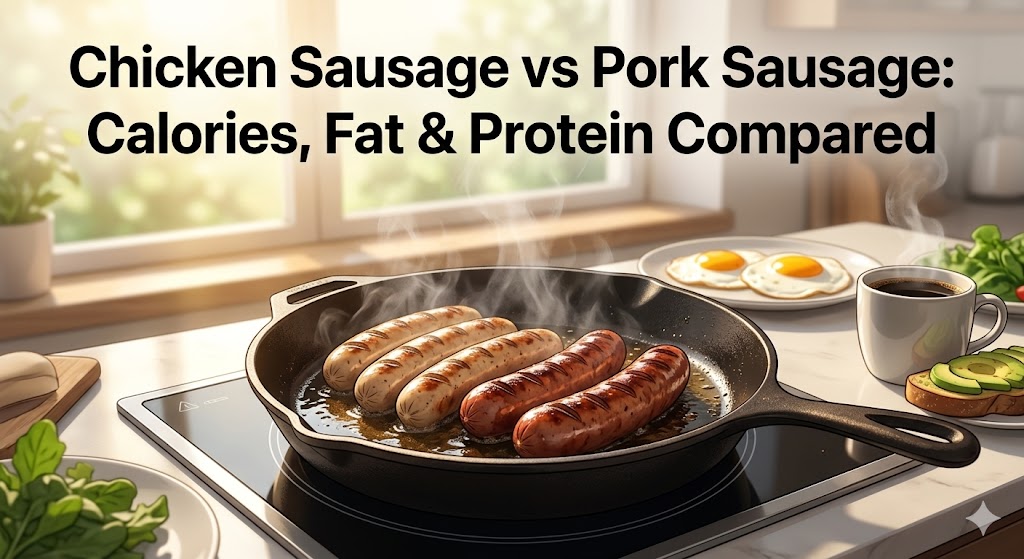
Picture this: It's Saturday morning, the coffee is brewing, and you have a pan on the stove ready to sizzle. You're craving that savory, classic breakfast sausage. But as you stand in the grocery aisle, you find yourself staring at a classic culinary debate: chicken sausage vs pork sausage.
Which one actually belongs on your plate? If you are trying to eat healthy, you've probably heard that poultry is the golden child of lean protein, while pork is the heavy, fat-rich option. But does that reputation hold up under the microscope?
In this article, we're breaking down the calories, fat, protein, and sneaky sodium levels of both options. That way, you can make the absolute best choice for your breakfast—and your heart!
What's Actually in Your Sausage?
At its core, traditional sausage is a delicious mix of ground meat, fat, spices, and sometimes a binding agent (like breadcrumbs, potato starch, or corn syrup) to keep everything together. Because it goes through salting, curing, or smoking to lock in those rich flavors, sausage is officially classified as a processed meat.
While traditional pork sausage has historically relied on naturally marbled pork fat to get its ultra-juicy, melt-in-your-mouth texture, chicken sausage uses lean poultry cuts. This simple difference in the starting meat completely rewrites the nutrition label.
Bottom Line: Traditional sausage is a mix of ground meat, spices, and fat. Because pork is naturally higher in fat than chicken, the choice of meat dramatically changes the calories and fat on your plate.
The Nutritional Showdown
Before we dive into the science, let's look at the hard numbers. Here is how chicken, pork, and even plant-based sausages stack up per serving:
Sausage Category & Specific Brand | Serving Size | Calories (kcal) | Protein (g) | Total Fat (g) | Saturated Fat (g) | Sodium (mg) | Cholesterol (mg) |
Generic Chicken Sausage | 1 link (approx. 75g) | 150 | 12.0 | 9.0 | 2.5 | 500 – 750 | 55 – 65 |
Recipal USDA Chicken Sausage | 1 link (85g) | 130 | 14.0 | 8.0 | 2.0 | 750 | 65 |
Applegate Farms Organic Chicken & Apple | 1 link (84g) | 140 | 12.0 | 8.0 | 2.5 | 740 | 55 |
Trader Joe's Sweet Italian Chicken | 1 link (approx. 75g) | 110 | 17.0 | 3.5 | 1.0 | 490 | 60 |
Aidells Chicken & Apple | 1 link (approx. 75g) | 180 | 13.0 | 12.0 | 2.5 | 670 | 60 |
Pork Sausage, Link/Patty (Cooked) | 1 link (23g) | 90 | 3.1 | 8.6 | 2.8 | 186.3 | 17 |
Generic Pork Sausage (Plain) | 100g | 250 – 350 | 14.0 – 18.0 | 20.0 – 30.0 | 7.0 – 11.0 | 500 – 700 | 70 – 90 |
Breakfast Pork Sausage (Cooked) | 100g | 280 – 380 | 15.0 – 20.0 | 25.0 – 35.0 | 8.0 – 12.0 | 600 – 800 | 70 – 100 |
Generic Vegan/Plant-Based Sausage | 1 serving (75g) | 150 | 10.0 | 10.0 | 1.0 – 3.2 | 600 – 1280 | 0 |
Calories and Weight Loss: Which Sizzles Smarter?
If you're keeping an eye on your weight, understanding energy density is your secret weapon. Energy density is simply the number of calories in a specific weight of food. It can be written as:
Energy Density =Calories / Weight of Serving
Since fat packs a massive 9 calories per gram—compared to just 4 calories per gram for protein and carbs—high-fat foods are naturally super calorie-dense.
Pork sausage calories are mostly derived from fat, making it easy to accidentally overconsume. Chicken sausage, on the other hand, gives you a volume-efficient advantage. You get to eat a satisfying portion size for nearly half the caloric cost!
Plus, chicken sausage is a lean protein powerhouse. Protein triggers the release of satiety hormones like peptide YY (PYY) and GLP-1, keeping your hunger levels locked down while you're in a caloric deficit.
Bottom Line: Chicken sausage typically has about 45% fewer calories than pork sausage, making it a fantastic, volume-friendly choice for your weight loss journey.
Saturated Fat and Your Heart
Let's talk about the F-word: fat. Specifically, saturated fat.
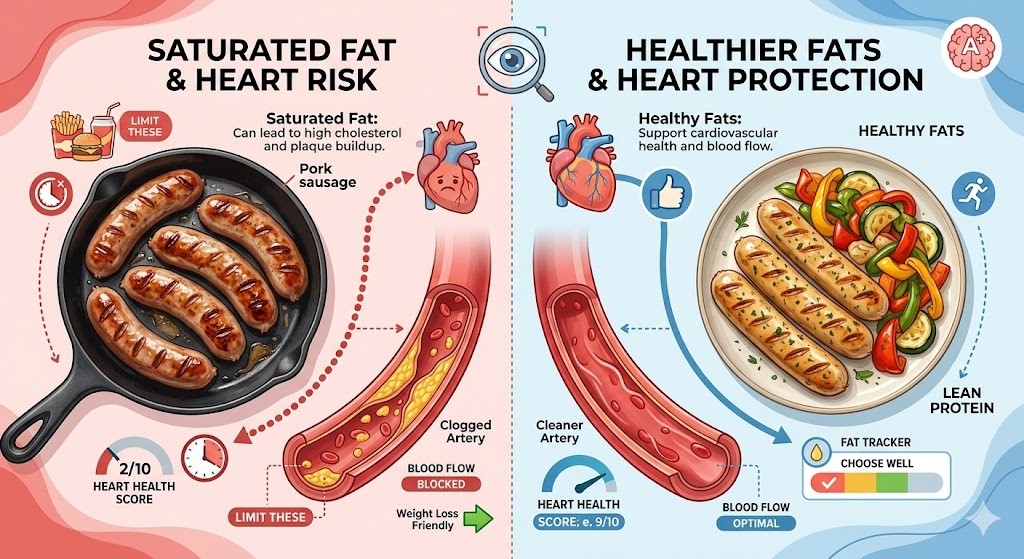
Eating too much saturated fat can raise your LDL ("bad") cholesterol, which can clog up your arteries and increase your risk of heart disease and stroke. The American Heart Association (AHA) recommends keeping saturated fat to less than 6% of your daily calories.
If you're on a standard 2,000-calorie diet, your daily limit can be calculated like this:
Saturated Fat Limit =(2000*0.06)/9 = 13.3 (approx)
This means you should aim for about 13 grams or less of saturated fat per day.
Let's look at a comparison of saturated fat per standard 100-gram serving:
Pork Sausage: 8-12g Saturated Fat
Chicken Sausage: 1.5-2.5g Saturated Fat
As you can see, a single serving of cooked pork sausage can practically wipe out your entire daily limit in one go! Chicken sausage keeps things incredibly light, leaving plenty of room for healthy, unsaturated fats (like avocados, olive oil, and nuts) later in the day.
Bottom Line: Pork sausage can contain up to six times as much saturated fat as chicken sausage. Swapping pork for chicken is an easy win for your cholesterol levels and heart health.
The Sodium Sneak Attack

But wait—before you crown chicken sausage the undisputed king of breakfast, there's a sneaky catch.
Because chicken is naturally super lean, it can taste dry and bland. To fix this, commercial food brands often dump in massive amounts of sodium and chemical preservatives to make it taste juicy and savory.
The AHA recommends a daily sodium limit of no more than 2,300 mg for most adults, with an optimal target of 1,500 mg. High sodium pulls extra water into your bloodstream, raising your blood pressure and stressing your heart.
Many popular chicken sausages pack 500 to 750 mg of sodium per serving—which is just as much, if not more, than pork sausage!
Bottom Line: Don't let the "health halo" fool you! Many chicken sausages are packed with extra sodium and preservatives to make up for the lack of fat. Always check the nutrition label.
What About Long-Term Health Risks?
The Harvard T.H. Chan School of Public Health and the Mayo Clinic have consistently shown that regularly eating processed meats can increase your risk of type 2 diabetes, colorectal cancer, and heart disease.
In fact, one large-scale Harvard study found that eating just one serving of processed red meat per day is associated with a 46% higher risk of type 2 diabetes.
Since many studies group processed poultry and processed red meats together, it's clear that the processing methods—salting, curing, and preserving with nitrates—are a big part of the problem.
Pro Dietitian Tip: Want the delicious taste of sausage without the health baggage? Try making a homemade batch! Mix lean ground chicken breast or turkey with traditional spices like ground sage, fennel, black pepper, and garlic. You'll get all the flavor with zero added chemicals!
Bottom Line: Since both pork and poultry sausages are processed meats, they both carry some health risks if eaten daily. Keep them as an occasional treat rather than a daily staple.
The Summary
Sausages are high-protein, satisfying foods, but they are also processed meats that can be high in saturated fat and sodium.
If you are looking to cut calories and protect your heart, chicken sausage is the clear winner. Just be sure to scan the nutrition label for the brand with the lowest sodium and saturated fat content, and pair it with plenty of fresh vegetables and whole grains for a perfectly balanced meal!
Speak Your Way to Healthy Eating with VoCal
Tired of squinting at tiny nutrition labels to figure out if your chicken sausage is secretly a sodium bomb? We hear you.
That's where VoCal comes in. Instead of spending ten minutes digging through database searches and typing in grams, you can track your breakfast in seconds just by talking to your phone:
"I had two links of sweet Italian chicken sausage with scrambled eggs."
VoCal's smart natural language processing does the heavy lifting, instantly logging your calories, protein, and saturated fat. It's the easiest, most stress-free way to stay on track with your health goals!
Frequently Asked Questions
Is chicken sausage healthier than pork sausage?
Generally, yes. Chicken sausage contains about 45% fewer calories, 60% less total fat, and up to 70% less saturated fat than pork sausage. However, because it is processed, it can still contain high levels of sodium and preservatives.
Can I eat chicken sausage on a low-carb or keto diet?
Absolutely! Sausages are naturally low-carb foods, typically containing only 0 to 6 grams of carbohydrates per 100-gram serving. Just check the label to ensure the brand didn't add sweet binders like corn syrup or dried fruit.
How much sodium is in a typical chicken sausage?
Most commercial chicken sausages contain between 500 and 750 mg of sodium per serving, which can easily make up 30% or more of your daily recommended intake. Look for brands labeled "low sodium" or "no added nitrates" for a heart-healthy choice.
Disclaimer: While we love geeking out over nutrition, this article is for informational purposes only. Always consult a healthcare professional or registered dietitian before making major changes to your diet.