
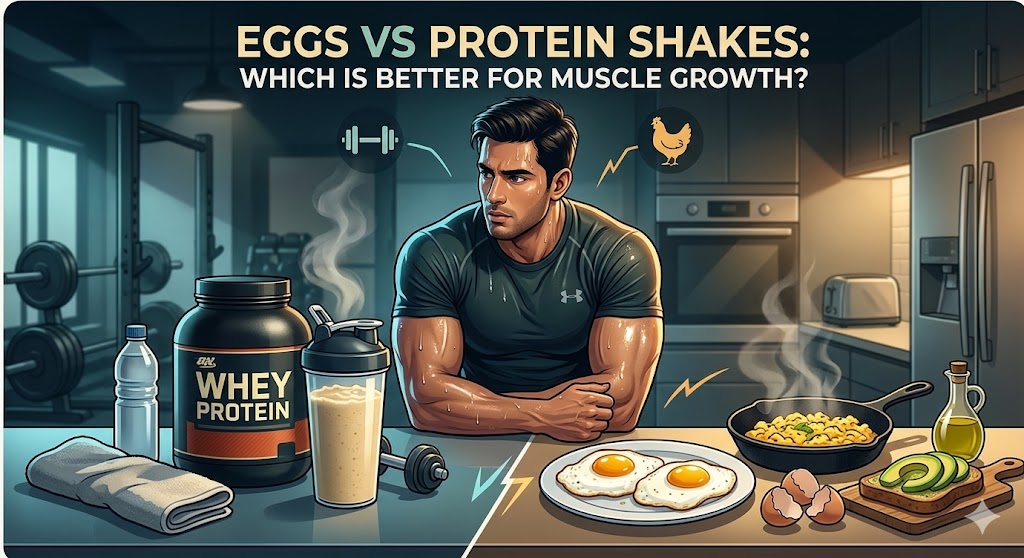
We’ve all been there. You just crushed a grueling, sweaty leg day, your quads are shaking like Jello, and your muscles are screaming for help. You walk into the kitchen, and you’re faced with the ultimate fitness dilemma: do you shake up a scoop of processed whey protein powder, or do you fire up the stove and crack open some whole farm eggs?
Both are legendary complete proteins, packed with all nine essential amino acids your body can't make on its own. But when it comes to maximizing muscle growth, digestibility, and overall vibe, they are built completely differently.
Let's settle the ultimate gym-floor debate: Eggs vs. Protein Shakes. Who wins this heavyweight bout? Let's look under the hood!
Nutritional Blueprints: Pure Isolation vs. Nature's Packaged Deal

Think of whey protein isolate as a sleek, finely-tuned sports car. It is engineered for one specific job: delivering maximum protein to your muscles with basically zero fats or carbs to slow it down.
Whole eggs, on the other hand, are like a heavy-duty adventure SUV. They bring a serious protein payload, but they package it inside a rich, nutrient-dense lipid matrix loaded with healthy fats and essential vitamins.
Let's see how four large cooked eggs stack up against one standard scoop of high-quality whey protein isolate :
Nutrient Metric | Four Large Whole Eggs (~200g) | Whey Protein Isolate (1 Scoop, ~30g) |
Energy (Calories) | ~288 kcal | ~110–120 kcal |
Protein | ~25.2 g | ~25.0–27.0 g |
Total Fat | ~19.2 g | ~0.0–1.0 g |
Saturated Fat | ~6.4 g | ~0.2–0.5 g |
Carbohydrates | ~1.4 g | ~0.5–1.0 g |
Cholesterol | ~744 mg | ~2.0–10.0 mg |
Key Micronutrients | Choline, Vitamin B12, Selenium, Vitamin D, Lutein | Calcium, Phosphorus, Potassium |
If you are on a strict cutting phase and counting every single calorie, whey isolate is your best friend. It gives you pure, concentrated protein with a lean calorie-to-protein ratio.
But don't count the humble egg out just yet! Eggs are basically nature's multivitamins. They blow whey out of the water when it comes to copper (delivering over 220% more!), selenium, energy-boosting vitamin B12, and brain-healthy choline. Plus, they won’t spike your blood sugar.
Bottom Line Summary
Whey protein isolate is your go-to for ultra-lean, low-calorie protein. Whole eggs are a nutrient-dense powerhouse that fuels your muscles while feeding your entire body with vital micronutrients.
Bioavailability: How Much Actually Reaches Your Muscles?
Slamming down protein is only half the battle—your body actually has to absorb and use it. In sports science, researchers use fancy scales called PDCAAS and DIAAS to grade protein quality based on how easily we can digest it.
Don't worry, we won't quiz you on those acronyms. All you need to know is that both eggs and whey are straight-A students :
PDCAAS: Both egg protein and whey protein score a flawless 1.0, which is the highest possible score. It means they perfectly satisfy our daily amino acid requirements.
DIAAS: This newer, gold-standard method doesn’t cap scores at 1.0. Hard-boiled eggs score an incredible 1.13, while whey protein isolate ranges from 1.09 to 1.15.
Long story short? Both options act like a VIP fast pass to muscle repair. Your body welcomes their amino acids with open arms.
Bottom Line Summary
You can’t make a wrong choice here. Both whole eggs and whey protein represent the absolute pinnacle of protein quality and digestibility.
The Fast-Acting Favorite vs. The Slow-Releasing Classic

How do these proteins spark muscle growth? It all comes down to a molecular light switch in your body called the mTOR pathway, which turns on muscle protein synthesis (MPS). The spark plug that flips this switch is an essential amino acid called leucine.
Whey: The Speed King
Whey protein is the undisputed champion of post-workout speed. It digests rapidly, flooding your blood with amino acids and leucine within 30 to 60 minutes. If your muscles are screaming for immediate post-workout recovery, whey is the express train.
Eggs: The Steady Burner
Egg protein takes a slow-and-steady approach. It digests over 2 to 3 hours, giving your muscles a continuous "slow drip" of amino acids. This makes it fantastic for keeping your muscles fed throughout the day or preventing muscle breakdown while you sleep.
Keep in mind that more isn't always better. Research shows that a moderate dose of 20 to 25 grams of high-quality protein maximally stimulates muscle growth. Double-scooping 40+ grams won’t build double the muscle; your body will just burn the excess off or excrete it.
Bottom Line Summary
Whey acts like a fast-acting lightning bolt of leucine, making it ideal for immediate post-workout recovery. Eggs act like a slow-release fuel cell, perfect for sustained muscle protection throughout the day.
The Whole-Food Matrix: Don't Throw Away the Yolks!

For decades, gym-goers have been separating egg whites and throwing yolks down the drain like they're toxic waste.
Stop doing that!
A fascinating study from the University of Illinois had weightlifters eat either whole eggs or egg whites containing an identical 18 grams of protein after a workout. The scientists used special tracking markers to see how much muscle was built.
The jaw-dropping result? The group eating whole eggs experienced a 40% greater muscle-building response than the egg white group!
Even though both groups absorbed the same amount of amino acids, something about the "whole-food matrix" of the yolk—the combination of healthy fats, vitamins, and minerals—signaled the muscles to use that protein much more efficiently.
Bottom Line Summary
Nature knows best. Eating protein in its natural, whole-food state (with the yolks!) builds significantly more muscle than stripping the fat away.
Sorry, Rocky: Why Raw Eggs Are a Muscle-Building Bust
We’ve all seen the iconic scene of Rocky Balboa chugging a glass of raw eggs at 5:00 AM. It looks tough, but scientifically, it's a terrible strategy.
When you eat raw eggs, your body can only digest and absorb about 51% of the protein. But when you cook them, heat denatures the proteins, boosting digestibility to an impressive 91%!
Furthermore, raw egg whites contain a protein called avidin, which binds to biotin (vitamin B7) and stops your body from absorbing it, potentially leading to hair and skin issues. Cooking completely neutralizes avidin. Skip the Salmonella risk, save your stomach, and turn on the stove!
Parameter | Whey Protein Isolate | Cooked Whole Eggs | Raw Whole Eggs |
Digestion Speed | Extremely Rapid (30-60 mins) | Moderate (2-3 hours) | Slow / Incomplete |
Protein Digestibility | ~99% | ~91% | ~51% |
Anabolic Signaling | High initial mTOR activation | Extended muscle protein protection | Poor amino acid availability |
Primary Use Case | Immediate post-workout recovery | Meal replacement / sustained satiety | Not recommended |
Bottom Line Summary
Cooking your eggs makes the protein nearly twice as bioavailable, kills bad bacteria, and protects your biotin levels. Rocky would have built more muscle with a scramble!
Final Verdict: How to Choose Your Champion
So, who wins the crown in the eggs vs protein shakes comparison? It honestly depends on your lifestyle, digestive tolerance, and daily goals.
Choose Whey Protein If:
You want lightning-fast recovery immediately after an intense workout.
You are on a tight calorie budget and need pure, fat-free protein.
You have no issues digesting dairy or lactose.
Choose Whole Eggs If:
You want a clean, dairy-free, highly bioavailable whole food.
You want sustained satiety to keep you full for hours between meals.
You want to leverage the 40% muscle-building boost of the whole-egg yolk matrix.
Pro Tip: Why not get the best of both worlds? Slam a whey shake immediately post-workout to kickstart recovery, and eat a plate of delicious scrambled eggs for breakfast or dinner to keep your muscle synthesis fired up all day long!
Keep Your Gains on Track Friction-Free with Vo-cal.com
Whether you’re blending up a quick post-workout shake or whipping up a 4-egg omelet, keeping track of your daily protein intake can feel like a part-time job. Digging through clunky food databases to log "large cage-free scrambled eggs" is a fast track to tracking fatigue.
This is where VoCal steps in to save your sanity.
Vo-cal.com is a revolutionary, voice-based calorie tracking app designed to take the friction out of your fitness goals. Instead of typing, you simply speak naturally: "Hey VoCal, I had four scrambled eggs and a scoop of chocolate whey isolate."
The app immediately parses your food, log your calories, and keeps you moving toward your target of 1.5 to 1.8 grams of protein per kilogram of body weight with zero effort.
Frequently Asked Questions (FAQs)
Are raw eggs better than cooked eggs for muscle building?
Absolutely not. Your body only absorbs about 51% of the protein in raw eggs compared to 91% in cooked eggs. Plus, raw eggs block the absorption of biotin and expose you to foodborne illnesses like Salmonella. Cook them up!
Can egg protein completely replace whey protein?
Yes! Eggs contain a perfect, complete amino acid profile and have a stellar digestibility rating (DIAAS of 1.13). However, whole eggs bring more fats and calories than a lean whey isolate scoop, so make sure to track your overall macros.
Will the cholesterol in whole eggs raise my risk of heart disease?
For healthy individuals, modern clinical research shows that moderate whole egg consumption does not adversely affect heart disease risk markers. The USDA actually removed its strict daily limits on dietary cholesterol because of this.
Disclaimer: Always consult a healthcare professional before making major changes to your diet, especially if you have pre-existing cardiovascular conditions.