
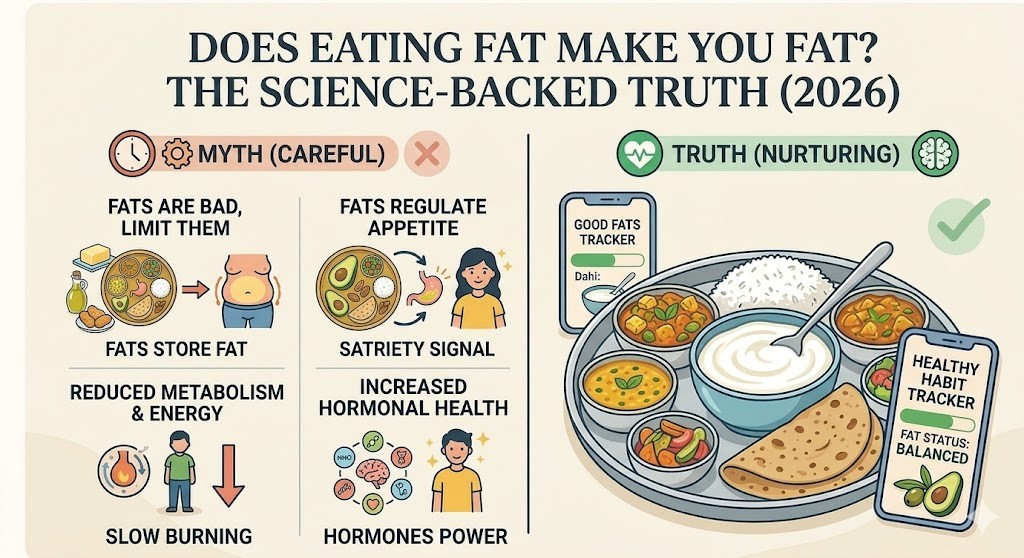
For decades, dietary fat was the "villain" of the nutrition world. The logic seemed simple: fat has more calories than anything else, so eating it must make you gain weight. This led to a "low-fat" craze that saw grocery store shelves filled with fat-free cookies and yogurts.
However, as we swapped fat for refined carbs and sugar, obesity rates actually climbed. It turns out the relationship between eating fat and "getting fat" is a bit more complicated than a simple math equation.
The Summary
Eating fat does not inherently make you fat. Weight gain is primarily driven by a total caloric surplus—eating more energy than your body burns—rather than any single macronutrient. While fat is more energy-dense and easier for the body to store as adipose tissue than protein or carbs, clinical trials show that high-quality, high-fat diets can be just as effective for weight loss as low-fat ones.
The Case Against Fat: Density and Efficiency
To be fair to the "fat-is-bad" crowd, dietary fat does have two unique properties that make it easier to overeat if you aren't paying attention.
1. High Caloric Density
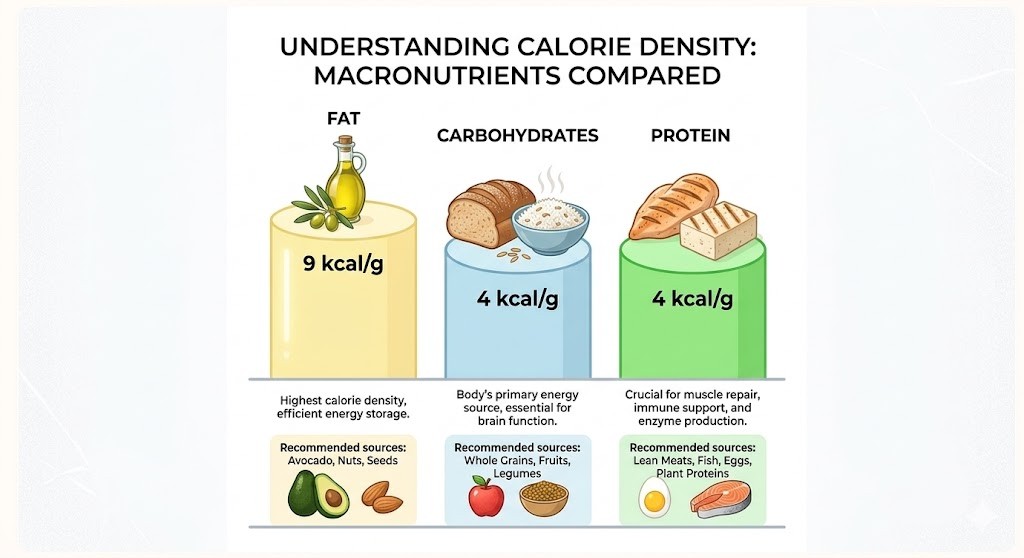
Fat is the most "bang for your buck" nutrient when it comes to energy. While protein and carbs are like lightweight fuel, fat is high-octane.
Macronutrient | Calories per Gram | Energy Density Level |
9 kcal/g | High | |
Carbohydrates | 4 kcal/g | Moderate |
Proteins | 4 kcal/g | Moderate |
Because of this density, it's very easy to consume a lot of calories in a tiny volume of food. A tablespoon of olive oil has about 120 calories—roughly the same as a large apple, but far less filling.
2. Storage Efficiency
Your body is remarkably good at saving fat for a rainy day. Converting dietary fat into body fat requires very little effort—it is stored with about 90–95% efficiency. In contrast, converting carbohydrates into body fat is a much more metabolically "expensive" process, with an efficiency of about 75–85%.
Additionally, fat has a very low Thermic Effect of Food (TEF). This is the energy your body burns just to digest your meal.
Protein TEF: 20–30%
Carbs TEF: 5–10%
Fat TEF: 0–3%
The Big Showdown: Low-Fat vs. Low-Carb
If fat was the primary cause of weight gain, then people on low-fat diets should consistently lose more weight than people on high-fat diets. But that’s not what the science shows.
The DIETFITS Trial
In one of the most rigorous studies to date, researchers followed 609 adults for a full year. One group ate a "healthy low-fat" diet, and the other ate a "healthy low-carb" (high-fat) diet. Both groups focused on high-quality, whole foods.
The result? A virtual tie. The low-fat group lost 5.3 kg and the low-carb group lost 6.0 kg. The study also found that your genetics or insulin levels didn't predict which diet would work better for you.
The POUNDS LOST Trial
Another massive study funded by the NIH (National Institutes of Health) tested four different diets with varying fat and protein levels.
Diet Type | Fat % | Protein % | Average Weight Loss (2 Years) |
Low Fat | 20% | 15% | 3.3 kg |
High Fat | 40% | 25% | 3.3 kg |
The takeaway: Weight loss depends on the calorie deficit and diet quality, not the specific ratio of fat to carbs.
Not All Fats Are Created Equal
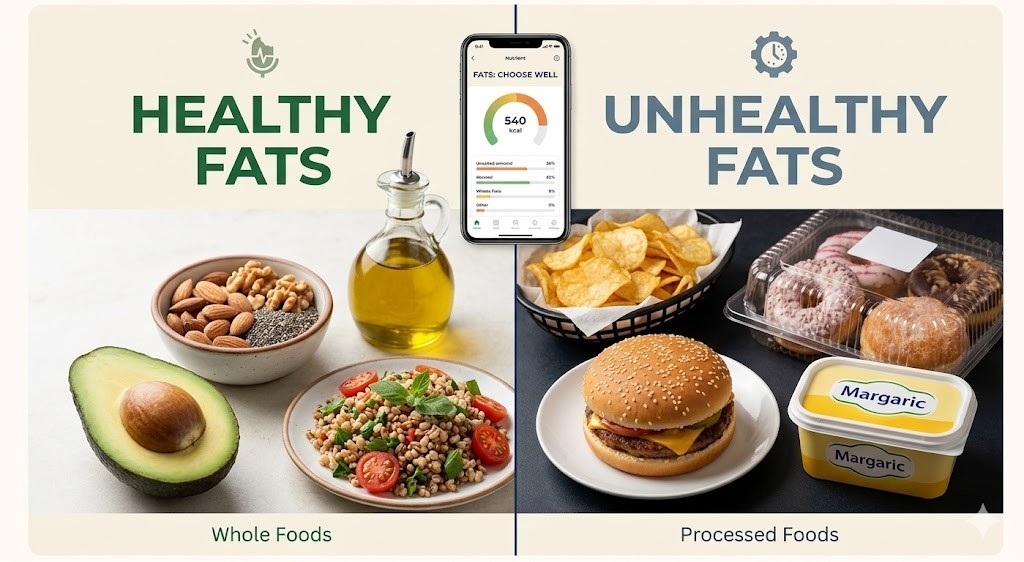
Science has shifted from "How much fat?" to "What kind of fat?". Replacing "bad" fats with "good" fats can actually prevent age-related weight gain.
Saturated Fats: Found in butter and coconut oil. High intake is linked to increased LDL ("bad") cholesterol.
Trans Fats: Found in processed snacks. These are the real villains, linked to systemic inflammation and significant weight gain.
Unsaturated Fats: Found in olive oil, avocados, and nuts. These are heart-protective and may even help with weight management by keeping you full.
The Best Vegetarian Fat Sources
Looking for a healthy way to get your fats without the animal products? These plant-based powerhouses are packed with nutrients and fiber.
Vegetarian Fat Source | Fat Content (per 100g) | Health Highlights |
Walnuts | 65 g | Loaded with Omega-3 (ALA) |
Chia Seeds | 31 g | High fiber and high satiety |
Avocado | 15 g | Creamy monounsaturated fats |
Tofu/Edamame | 5 g | Complete protein plus healthy fats |
Tahini | 53 g | Rich in calcium and healthy plant oils |
The Tracking Secret: Voice is the New Manual
The scientific consensus is that consistency is the most important factor in weight loss. But let’s be real—manually typing in every almond you eat is exhausting.
This is where voice tracking with VoCal changes the game. Research shows that voice-based calorie counting can significantly improve adherence because it removes the "hassle" factor.
Tracking Method | Time Required | Ease of Use |
Manual Entry | 3–5 minutes per meal | Low (High Friction) |
Photo Logging | 1–2 minutes per meal | Moderate |
Voice Logging | 15 seconds per meal | High (Hands-Free) |
Instead of searching a database, you just say, "I had a kale salad with half an avocado and two tablespoons of walnuts." VoCal's AI processes the natural language and logs the nutrition in seconds.
FAQ: Quick Answers to Big Questions
Does eating fat cause belly fat specifically?
Weight gain anywhere is caused by too many calories. However, trans fats and excessive saturated fats combined with high sugar can contribute more to visceral (belly) fat than healthy plant-based fats.
Should I avoid coconut oil?
Coconut oil is high in saturated fat and can raise LDL cholesterol. While it contains MCTs (which burn slightly faster), most experts recommend prioritizing extra virgin olive oil for heart health.
How much fat do I really need?
Most guidelines recommend getting 20% to 35% of your daily calories from fat. For a 2,000-calorie diet, that’s about 44 to 77 grams. Focus on quality sources like nuts, seeds, and oils.
Disclaimer: This content is for informational purposes only and does not constitute medical advice. Consult a healthcare professional before making significant dietary changes.