

There is nothing quite like that crisp snap-fizz sound when you pop open an icy cold silver can of Diet Coke. Whether you are sipping it over ice during lunch, grabbing a quick afternoon pickup, or pairing it with your favorite evening movie snack, Diet Coke is an absolute icon in the soft drink aisle.
If you are keeping an eye on your daily energy intake, you have probably wondered about diet coke calories. Is it truly zero, or is there a tiny bit of hidden energy floating inside that bubbly soda?
Here is a friendly, complete breakdown of everything you need to know about Diet Coke calories, nutrition facts, sweeteners, weight loss impact, and how to track your drinks effortlessly.
Diet Coke Calories in a Standard 12 oz Can
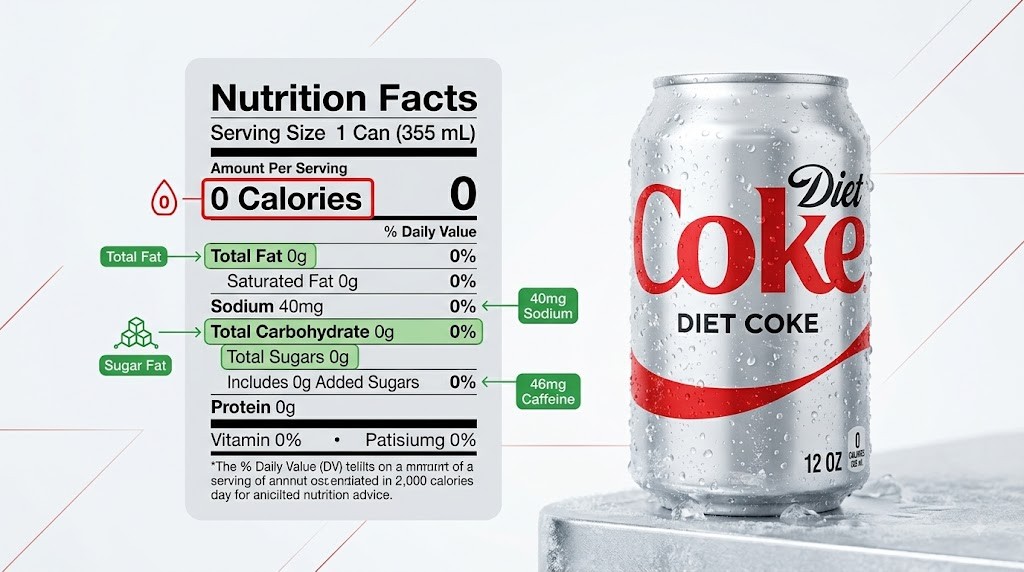
The standard 12 fluid ounce (360 mL) aluminum can is the classic benchmark for soda drinkers across America. When you look at the official Nutrition Facts panel on a regular silver 12 oz can of Diet Coke, the headline numbers are as straightforward as it gets: 0 calories, 0 grams of fat, 0 grams of protein, and 0 grams of carbohydrates.
While it does not contain energy-yielding macronutrients, Diet Coke is not completely empty of minerals. A single 12 oz can gives you 40 milligrams of sodium (about 2% of your recommended daily limit) along with 46 milligrams of caffeine. That gives you a nice little mental spark without the heavy energy crash that comes from sugar-sweetened drinks.
Nutritional Parameter | Diet Coke (12 oz Can) | Regular Coca-Cola (12 oz Can) | Coca-Cola Zero Sugar (12 oz Can) |
Calories | 0 kcal | 155 kcal | 0 kcal |
Total Fat | 0 g | 0 g | 0 g |
Sodium | 40 mg (2% DV) | 45 mg (2% DV) | 40 mg (2% DV) |
Total Carbohydrates | 0 g | 38 g | 0 g |
Total Sugars | 0 g | 38 g | 0 g |
Protein | 0 g | 0 g | 0 g |
Caffeine Content | 46 mg | 34 mg | 34 mg |
Primary Sweetener | Aspartame | High Fructose Corn Syrup | Aspartame & Ace-K |
The ingredient list includes carbonated water, caramel color, phosphoric acid, potassium benzoate (to preserve freshness), natural flavors, citric acid, caffeine, and the non-nutritive sweetener aspartame. If you grab a Caffeine-Free Diet Coke, you keep the same zero-calorie profile and 40 mg of sodium, minus the caffeine kick.
The Bottom Line: A standard 12 oz can of Diet Coke serves up zero calories, zero carbs, and zero fat, alongside 40 mg of sodium and 46 mg of caffeine.
Diet Coke Calories in a 20 oz Bottle (and Other Sizes)
Heading out on a road trip or swinging by a gas station cooler? You are probably reaching for a portable 20 fluid ounce plastic bottle. Under FDA food labeling guidelines, because a 20 oz bottle is typically consumed in one sitting, the entire bottle is evaluated as a single serving on the back panel.
Even with 66% more bubbly soda inside than a standard can, the official label on a 20 oz bottle still reads 0 calories. However, mineral and caffeine levels scale up naturally with fluid volume. Drinking a full 20 oz bottle delivers around 70 milligrams of sodium (roughly 3% of your daily value) and 77 milligrams of caffeine.
Packaging Format | Volume (fl oz / mL) | Declared Calories | Sodium Content (mg) | Caffeine Content (mg) |
Mini Can | 7.5 fl oz (222 mL) | 0 kcal | 25 mg | 29 mg |
Standard Can | 12 fl oz (360 mL) | 0 kcal | 40 mg | 46 mg |
Plastic Bottle | 16.9 fl oz (500 mL) | 0 kcal | 55 mg | 65 mg |
Retail Bottle | 20 fl oz (591 mL) | 0 kcal | 70 mg | 77 mg |
2-Liter Bottle | 67.6 fl oz (2 Liters) | 0 kcal (per 12 oz) | 40 mg (per 12 oz) | 46 mg (per 12 oz) |
If you are carefully tracking sodium for medical reasons or managing blood pressure, counting these liquid mineral contributions helps keep your daily totals accurate.
The Bottom Line: Larger bottle sizes give you more liquid refreshment, bumping caffeine to 77 mg and sodium to 70 mg, while keeping the official calorie tally at zero.
Does Diet Coke Really Have 0 Calories?
It is natural to wonder how a drink that tastes so sweet can legally claim zero calories. The answer lies in federal labeling laws and the magic of intense artificial sweeteners.
Under U.S. Food and Drug Administration (FDA) regulations (Title 21 CFR 101.9), food and beverage manufacturers are allowed to declare "0 Calories" on a Nutrition Facts panel if a single serving provides fewer than 5 calories.
Diet Coke gets its sweetness from aspartame, an artificial sweetener made from two amino acids (L-aspartic acid and L-phenylalanine). Gram for gram, aspartame actually contains 4 calories per gram—the exact same energy density as real sugar!
However, because aspartame is roughly 200 times sweeter than sugar, Coca-Cola only needs a tiny pinch (about 180 milligrams per 12 oz can) to make it taste sweet.
When you multiply that tiny sprinkle of aspartame by 4 calories per gram, plus trace amounts from caramel color and flavoring acids, a 12 oz can provides roughly 1 to 4 actual calories. Because this total is under the 5-calorie mark, federal rules round it down to zero on consumer packaging.
Furthermore, your body burns a tiny amount of thermal energy just warming that chilled liquid up to your core body temperature, completely balancing out those trace calories!
The Bottom Line: Diet Coke contains trace energy (< 4 calories per can) from its sweetener and coloring, but FDA rules allow anything under 5 calories per serving to be listed as zero.
Diet Coke vs. Coke Zero: Calories, Sweeteners, and Taste

When standing in front of the supermarket cooler, shoppers often wonder how Diet Coke compares to Coca-Cola Zero Sugar. Both drinks are zero-calorie, sugar-free carbonated soft drinks, but they are crafted with very different flavor goals in mind.
Diet Coke (1982): Formulated with its own unique flavor profile rather than copying regular Coca-Cola. It uses a blend of citric and phosphoric acids sweetened exclusively with aspartame, giving it a lighter, brighter, and slightly tart bite.
Coca-Cola Zero Sugar (2005): Engineered with the specific food-science goal of replicating the exact taste of classic sugar-sweetened Coca-Cola. It pairs aspartame with a secondary sweetener, acesulfame potassium (Ace-K), to smooth out bitterness and deliver an immediate cola sweetness.
Diet Coke also packs a slightly larger caffeine punch (46 mg per 12 oz can) compared to Coke Zero's 34 mg. When it comes to calories and macros, both choices perform identically on your nutritional log.
The Bottom Line: Diet Coke offers a distinct, crisp, tart flavor profile with 46 mg of caffeine, whereas Coke Zero uses an aspartame/Ace-K blend to closely mirror original regular Coke.
Can Diet Coke Help With Weight Loss?

If you are trying to lose body fat or stay in a controlled caloric deficit, swapping out sugar-heavy sodas for Diet Coke can be a simple, effective strategy.
Consider the math: swapping two 12 oz cans of regular soda (310 total calories) for two cans of Diet Coke saves you 310 calories every day. Over a month, that simple change removes over 9,000 calories from your diet—creating an energy gap equal to nearly 2.5 pounds of body fat!
Scientific evidence strongly backs this strategy up. A comprehensive review published in JAMA Network Open examined 17 clinical trials involving over 1,700 participants. The researchers discovered that replacing sugar-sweetened drinks with low- and no-calorie diet beverages resulted in:
Significant body weight loss (averaging about 2.3 lbs / 1.06 kg).
Reductions in body fat percentage and BMI.
Decreases in liver fat buildup.
Crucially, the clinical trials showed that switching to diet soda supported weight loss just as effectively as switching to plain water.
The main potential hurdle to avoid is "cognitive overcompensation"—the habit of telling yourself, "Since I saved calories on my drink, I can eat a huge extra order of fries". As long as you keep an eye on your overall food portions, Diet Coke is a great tool for managing weight.
The Bottom Line: Replacing sugary drinks with Diet Coke creates a sustained calorie deficit that clinical research shows effectively promotes weight loss and fat reduction.
Health, Keto, and What Happens in Your Body
Curious about how Diet Coke fits into specialized diet plans or daily health habits? Here is what science says:
Is Aspartame Safe? Yes. Major health organizations set safe daily intake limits for aspartame. For a 150-pound adult, you would need to drink almost 19 cans of Diet Coke in a single day to reach those regulatory boundaries!
Is it Keto-Friendly? Absolutely. Diet Coke has 0 grams of net carbs, 0 grams of sugar, and zero effect on blood sugar or insulin, making it completely compatible with ketogenic and low-carb meal plans.
What About Tooth Health? Because Diet Coke contains phosphoric and citric acids, drinking sodas constantly throughout the day can wear down tooth enamel over time. Sipping through a straw or rinsing your mouth with plain water afterward keeps your teeth happy and strong!
The Bottom Line: Diet Coke is safe within normal daily limits, completely keto-compliant, and non-glycemic.
Effortless Beverage and Macro Tracking with VoCal
Whether you are tracking every macro or simply monitoring your daily calorie intake, consistency is the key to achieving your fitness goals.
However, standard manual food logging apps can feel like a chore. Searching databases, typing product names, and measuring tiny additions often causes people to give up on their daily logs.
That is where VoCal makes food tracking simple and stress-free.
VoCal is a voice-first calorie tracking app that turns logging into a quick 3-second conversation. Instead of scrolling through endless search screens, you simply tap the mic and speak naturally—saying something like: "I had a 20 oz Diet Coke and a grilled chicken sandwich".
Powered by advanced AI intelligence, VoCal instantly processes your natural speech:
Voice-First Logging: Log complete meals, packaged snacks, drinks, and regional dishes without typing a word.
Photo + Voice Notes: Take a quick photo of your plate and speak a voice note to explain hidden condiments or extra cooking oils.
Automatic Macro Summaries: Instantly categorizes calories, protein, carbs, net carbs, fat, and sodium totals so you always know where you stand.
By taking the hassle out of food tracking, VoCal helps you stay consistent day after day, building long-term awareness of your eating habits.
The Bottom Line: Staying consistent with food logging is essential for long-term health; using voice-activated tools like VoCal converts natural speech directly into calorie and macro analytics in seconds.
Frequently Asked Questions (FAQs)
Does Diet Coke break an intermittent fast?
No. Because a standard serving of Diet Coke contains negligible trace calories (< 4 kcal) and zero carbohydrates, it does not trigger an insulin spike or break an intermittent fasting window from an energy perspective.
How many net carbs are in Diet Coke?
Diet Coke contains 0 grams of total carbohydrates and 0 grams of net carbs per serving, making it completely friendly for low-carb and keto diets.
Why does Diet Coke contain sodium?
The 40 mg of sodium in a 12 oz can comes from ingredients used for flavor balance and freshness preservation, such as potassium benzoate and natural buffering agents.
Is Diet Coke sweeter than regular Coke?
Artificial sweeteners like aspartame are roughly 200 times sweeter than table sugar, but the phosphoric and citric acids in Diet Coke balance that intensity out, giving it a lighter, crisper, and slightly tart finish compared to regular Coke.
Disclaimer: This is for informational purposes only. For medical advice or diagnosis, consult a professional.