

Picture this: It is 3:00 PM on a workday, your energy is dipping, and you crack open an ice-cold can of Diet Coke. You glance at the shiny silver label and see that glorious, bold number: 0 Calories. It feels like a total win for your waistline!
But if you’ve ever stopped mid-sip and wondered, does diet coke have calories in reality, or is that zero just a clever marketing trick?—you are definitely not alone.
The short answer? While the label says zero, food chemistry and federal regulations reveal that diet soda actually contains a tiny pinch of energy. Here is a fun, easy breakdown of how diet coke calories are calculated, where those hidden micro-calories come from, and whether they actually matter for your daily diet goals.
The FDA Rounding Loophole: How 4 Calories Become "Zero"
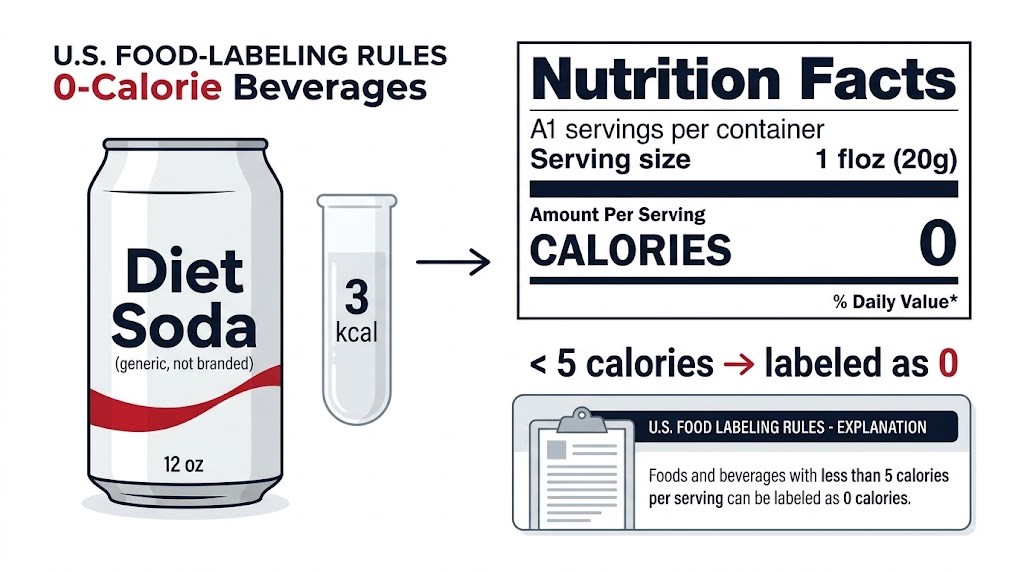
To understand where diet coke calories disappear to, you have to look at how food labels are regulated in the United States.
The Food and Drug Administration (FDA) sets strict standards under Title 21 of the Code of Federal Regulations (21 CFR 101.9) for how nutritional information is displayed on food and drink packages. Because measuring exact micro-fractions of nutrients can be tricky, the FDA uses standard rounding rules.
Under federal law, if a single serving of a beverage contains fewer than 5 calories, the manufacturer is legally allowed to round that number down to zero on the Nutrition Facts panel. For carbonated sodas, the standard serving size (what the FDA calls a Reference Amount Customarily Consumed, or RACC) is 12 fluid ounces.
When you break down the ingredients in a 12-ounce can of Diet Coke—carbonated water, caramel color, phosphoric acid, citric acid, caffeine, aspartame, and acesulfame potassium—several of those components carry actual chemical energy. When tested in a laboratory, a 12-ounce can usually measures between 1 and 4 calories.
Because 1 to 4 calories is less than the FDA's 5-calorie threshold, the label gets to print a neat, rounded "0".
Metric / Parameter | FDA Regulation (21 CFR 101.9) | Actual Chemical Content (12 oz Can) | Labeled Declaration |
Total Caloric Content | Expressed as "0" if < 5 kcal per RACC | ~1.0 to 4.0 kcal | 0 |
Total Carbohydrates | Expressed as "0g" if < 0.5g per RACC | 0.0g | 0g |
Total Sugars | Expressed as "0g" if < 0.5g per RACC | 0.0g | 0g |
Sodium Content | Expressed as "0mg" if < 5mg per RACC | 40.0mg | 40mg |
Protein Content | Expressed as "0g" if < 0.5g per RACC | ~0.18g (aspartame dipeptide) | 0g |
Bottom Line: The FDA allows drinks with fewer than 5 calories per serving to be labeled as zero-calorie beverages. In terms of raw chemistry, a standard can of Diet Coke contains roughly 1 to 4 trace calories.
Sweetener Science: Where Do Those Trace Calories Come From?

If Diet Coke has no sugar, where are those 1 to 4 trace calories coming from? The secret lies in how artificial sweeteners are made and digested.
Diet Coke uses a sweet duo: aspartame and acesulfame potassium (Ace-K).
Aspartame: Aspartame is made by joining two amino acids (aspartic acid and phenylalanine). Because it is essentially a tiny protein molecule, aspartame contains 4 calories per gram—the exact same caloric density as table sugar or chicken breast! However, because aspartame is roughly 200 times sweeter than sugar, manufacturers only need a tiny pinch (about 0.18 grams) to sweeten an entire 12-ounce can.
The math works out to less than 1 single calorie per can:
0.180 grams * 4 kcal/gram = 0.72 kcal
Acesulfame Potassium (Ace-K): Ace-K is also 200 times sweeter than sugar, but your body treats it very differently. Your digestive system cannot break Ace-K down. Once consumed, it passes into your bloodstream and is filtered out by your kidneys unchanged within 24 hours. Because your body never metabolizes it, Ace-K delivers a crisp 0.0 calories.
The remaining micro-calories come from natural flavorings and organic acids like citric acid, which your cells process in tiny amounts.
Sweetener Feature | Aspartame | Acesulfame Potassium (Ace-K) |
Chemical Structure | Dipeptide methyl ester | Synthetic oxathiazinodioxide salt |
Sweetness Multiplier | ~200x sweeter than table sugar | ~200x sweeter than table sugar |
Digestive Fate | Hydrolyzed into amino acids and methanol | Not metabolized; excreted unchanged via kidneys |
Energy Yield | 4.0 kcal / gram | 0.0 kcal / gram |
Amount per 12 oz Can | ~180 mg | ~40 mg |
Caloric Yield per Can | ~0.72 kcal | 0.0 kcal |
Bottom Line: Ace-K gives you zero calories because your body excretes it without digesting it. Aspartame has the same calorie count per gram as protein, but because it is 200 times sweeter than sugar, a tiny pinch yields less than 1 calorie per serving.
Does Diet Soda Spike Your Insulin or Blood Sugar?
A common worry among dieters, keto followers, and diabetics is whether sweet-tasting diet drinks trick the brain into spiking insulin. This idea is known as Cephalic Phase Insulin Release—the belief that tasting sweetness makes your pancreas release insulin in anticipation of sugar.
Scientists have tested this extensively in living human trials. The good news? When you drink a diet soda containing aspartame and Ace-K on its own, it does not cause a spike in blood sugar or insulin levels.
Because these artificial sweeteners do not convert into glucose in your bloodstream, your body treats them similarly to plain water when consumed without food.
Bottom Line: Extensive human clinical trials show that drinking diet soda on an empty stomach or during a fast does not spike your blood sugar or insulin levels.
Do Trace Diet Coke Calories Add Up? (How to Track Effortlessly with VoCal)
If you drink one can of Diet Coke a week, 2 to 4 trace calories will not affect your weight loss goals in any measurable way.
However, if you are a die-hard diet soda fan drinking three or four 12-ounce cans a day, those uncounted trace calories can accumulate. Drinking four cans a day means about 8 to 16 unrecorded calories daily. Over an entire year, that adds up to 2,900 to 5,800 uncounted calories—which equals almost 1 to 2 pounds of fat tissue!
If you are following a strict weight loss plan or preparing for a fitness competition, keeping tabs on every small calorie source helps keep your deficit accurate. But who wants to spend time typing soda fluid ounces into complicated fitness apps?
This is where VoCal makes nutrition tracking effortless.
VoCal is an intuitive, voice-based calorie tracking app designed to take the friction out of food logging. Instead of manually searching databases for "diet soda" and trying to guess rounding margins, you simply speak into your phone naturally:
"Hey VoCal, I had two cans of Diet Coke and a bottle of water this afternoon."
VoCal’s smart AI interprets your spoken fluid amounts, logs your liquid intake, and keeps your total daily energy count fully accurate without any manual typing.
Bottom Line: One single diet soda will not break your daily calorie goal, but drinking multiple cans a day adds up over time. Using a voice-based tracker like VoCal lets you log your drink volume in seconds so trace calories never surprise you.
Take Home Message
When asking whether diet soda really has zero calories, it helps to keep a few key facts in mind:
Labeling Rules: FDA regulations allow beverages with under 5 calories per serving to print "0 Calories" on the label. A 12-ounce Diet Coke actually contains roughly 1 to 4 trace calories.
Zero Sugar Sweeteners: Ace-K is eliminated unchanged by your body (0 calories), while aspartame contains trace protein calories but is used in microscopic amounts.
Blood Sugar & Fasting: Consuming diet soda alone does not raise blood sugar or trigger significant insulin spikes.
Volume Matters: Drinking several cans of diet soda a day can add 10 to 20 uncounted calories to your daily total.
Voice-Powered Accuracy: Logging drinks through VoCal allows you to capture fluid volume and daily macros hands-free.
Frequently Asked Questions (FAQs)
Does Diet Coke have calories if you drink a 2-Liter bottle?
Yes. While a 12-ounce can contains roughly 1 to 4 calories, drinking an entire 2-liter bottle (about 67 fluid ounces) delivers approximately 10 to 22 trace calories from its ingredients and amino-acid sweeteners.
Will Diet Coke break a fast?
For general weight loss fasting, no. The 1 to 4 trace calories in a single can are so small that they will not kick your body out of a fasted state or alter blood sugar levels significantly. However, if you are doing a strict water-only fast for medical or therapeutic reasons, plain water is still the preferred choice.
Is Diet Coke better for weight loss than regular Coke?
Yes. A standard 12-ounce can of regular Coca-Cola contains 140 calories and 39 grams of added sugar. Swapping regular soda for diet soda eliminates significant amounts of excess sugar and calories, making it easier to maintain a calorie deficit.
How do I track hidden calories in diet beverages easily?
Instead of typing entries into traditional logging apps, you can use VoCal. Simply speak what you drank into the app, and VoCal handles the calculations hands-free!
Disclaimer: This content is for informational purposes only. For medical advice, diagnosis, or personalized dietary guidance, please consult a qualified healthcare professional.