
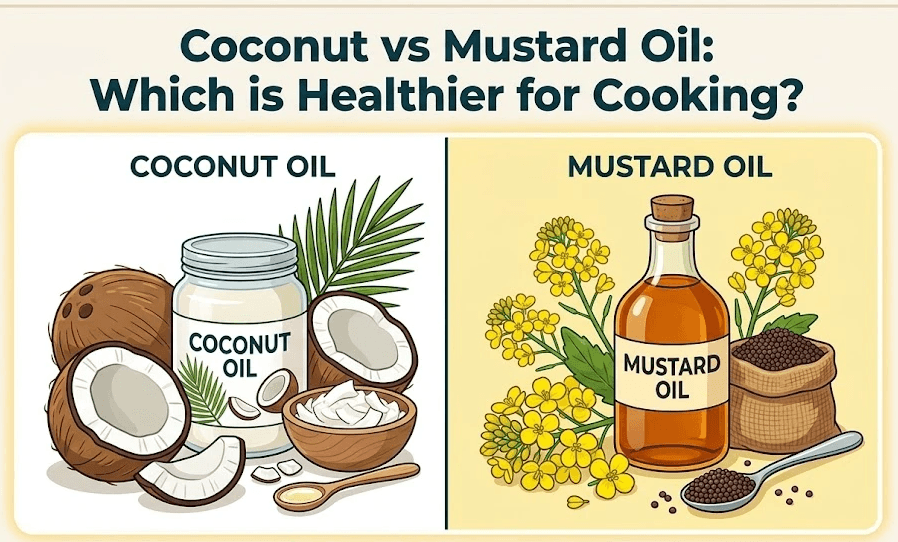
Choosing the right cooking oil can feel like a kitchen battlefield! In one corner, we have the fragrant, tropical Coconut Oil (the pride of the South). In the other, we have the pungent, bold Mustard Oil (the king of the North).
If you are using a voice-based tracker like VoCal, you already know that every drop counts—both oils pack about 9 calories per gram. But beyond the calories, which one is actually better for your heart, your waistline, and your Sunday sabzi? Let’s break it down in a way that’s easy to digest!
The Nutritional Face-Off
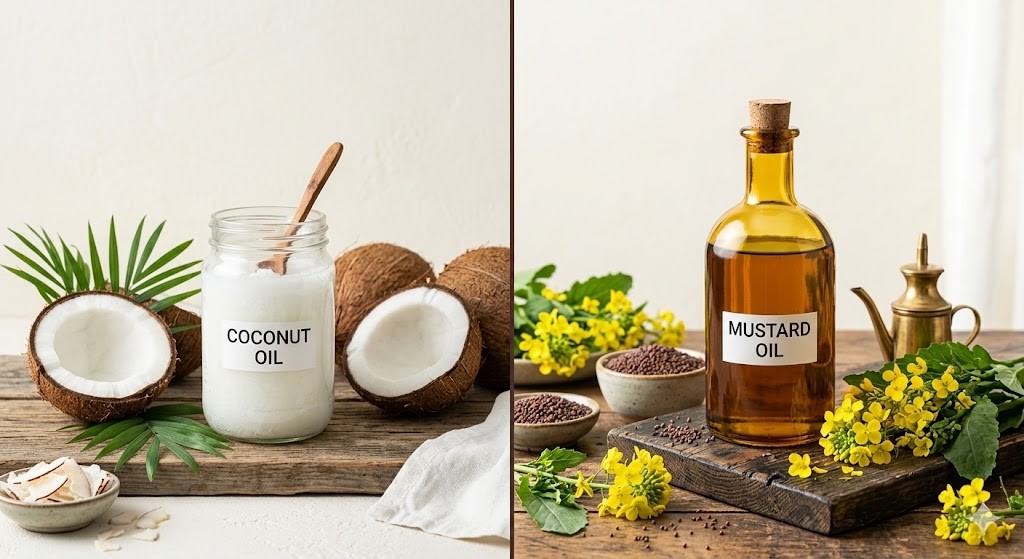
The biggest difference between these two lies in their "fatty acid" DNA. Coconut oil is famous for being a saturated fat powerhouse, while mustard oil is all about those heart-healthy unsaturated fats.
Fatty Acid Comparison (per 100g)
Nutrient | Coconut Oil (Virgin) | Mustard Oil (Cold-Pressed) |
Total Calories | 892 kcal | 884 kcal |
Saturated Fat | 82.48 g | 11.58 g |
Monounsaturated Fat (MUFA) | 6.33 g | 59.19 g |
Polyunsaturated Fat (PUFA) | 1.70 g | 21.23 g |
Omega-3 (ALA) | 0.02 g | 10.00 g |
Vitamin E | 0.11 mg | 1.50 mg |
Team Coconut: The Tropical Energy Booster
Coconut oil contains Medium-Chain Triglycerides (MCTs). Unlike other fats, MCTs go straight to your liver and get used for a quick burst of energy.
Metabolism Kick: It can help you feel full longer and may slightly boost your metabolism.
Brain Power: Some studies suggest MCTs are like "superfuel" for your brain cells.
The Catch: It’s very high in saturated fat, which the American Heart Association (AHA) warns can raise "bad" (LDL) cholesterol if you overdo it.
Team Mustard: The Heart-Friendly Pungent Punch
Mustard oil (especially the Kachi Ghani kind) is a favorite in Indian households for its "sting" and health perks.
Heart Guardian: It has a near-perfect ratio of Omega-3 to Omega-6 fatty acids, which helps fight inflammation.
Digestion Helper: It stimulates gastric juices, making it easier for your body to break down those delicious vegetarian meals.
The Controversy: It contains erucic acid, which caused a stir in older animal studies, but Indian health authorities (FSSAI) consider it safe and healthy for humans in moderate amounts.
Can They Handle the Heat?

When you're deep-frying pakoras or doing a high-heat tadka, you need an oil that doesn't smoke up and get grumpy (oxidized). Both of these oils are actually quite stable!
Stability Markers in Popular Cooking Oils
Oil Type | Refinement Level | Smoke Point (°F) | Best Culinary Use |
Mustard Oil | Kachi Ghani (Unrefined) | 480°F | Deep-frying, Tadka, Pickling |
Coconut Oil | Refined | 400°F - 450°F | High-heat Sautéing |
Coconut Oil | Virgin (Unrefined) | 350°F | Baking, Curries, Finishing |
Best Vegetarian Ways to Use Them
Since we're focusing on veg-power, here is how to make these oils shine in your kitchen:
With Coconut Oil: Try a classic Avial (mixed veg curry) or Cabbage Thoran. It’s also a great plant-based butter substitute for baking vegan cookies!
With Mustard Oil: Nothing beats it for Sarson ka Saag, Aloo Posto, or a smoky Baingan Bharta.
The Final Verdict: Who Wins?
Mustard oil is generally the better choice for your daily heart health and high-heat cooking because of its unsaturated fats. Coconut oil is a fantastic flavor enhancer and energy booster, especially for regional dishes and baking, but keep it in moderation due to its saturated fat content.
The Expert Tip: Don’t stick to just one! The ICMR and FSSAI recommend "oil rotation." Use mustard oil for your daily stir-fries and coconut oil for your weekend South Indian treats to get the best of both worlds.
Logging with VoCal
Tracking your oil intake is as easy as pie (or paratha!) with VoCal. Since oils are calorie-dense, just say: "Log 2 teaspoons of mustard oil in my dal" and let the app do the math for you.
FAQs
1. Is mustard oil better for heart health than coconut oil?
Generally, yes. Mustard oil is higher in monounsaturated fats (MUFA) and Omega-3s, which are linked to better heart health compared to the high saturated fat in coconut oil.
2. Which oil is better for weight loss?
Coconut oil is often linked to weight loss because of MCTs, which can boost energy expenditure. However, both are high in calories, so use Vo-cal to track your portions!
3. Can I use virgin coconut oil for deep frying?
Virgin coconut oil has a lower smoke point (350°F) than refined oil. For deep-frying, refined coconut oil or Kachi Ghani mustard oil is a safer bet.
Disclaimer: This content is for informational purposes only. Consult a healthcare professional before changing your diet, especially if you have heart health or cholesterol concerns.