

Picture this: It’s Monday morning. You’ve crushed your health goals all week—eating balanced meals, dodging office pastries, and getting your daily steps in. Then the weekend happened. There was pizza on Friday, brunch on Saturday, and maybe a cozy dessert on Sunday night.
You step onto the scale Monday morning, expecting a tiny bump, but instead, you see a shocking 4-pound jump!
Panic sets in. You might ask yourself: Does a weekend break break diet progress completely? Did you just erase an entire month of hard work in 48 hours?
Before you throw in the towel or vow to live on celery juice for the rest of the week, take a deep breath. Here is the scientific truth: No, one bad weekend does not ruin your weight loss.
Let's dive into what's actually happening inside your body when the weekend scale spikes—and how you can handle it without losing your sanity.
The Monday Scale Jump: Is It Real Fat?
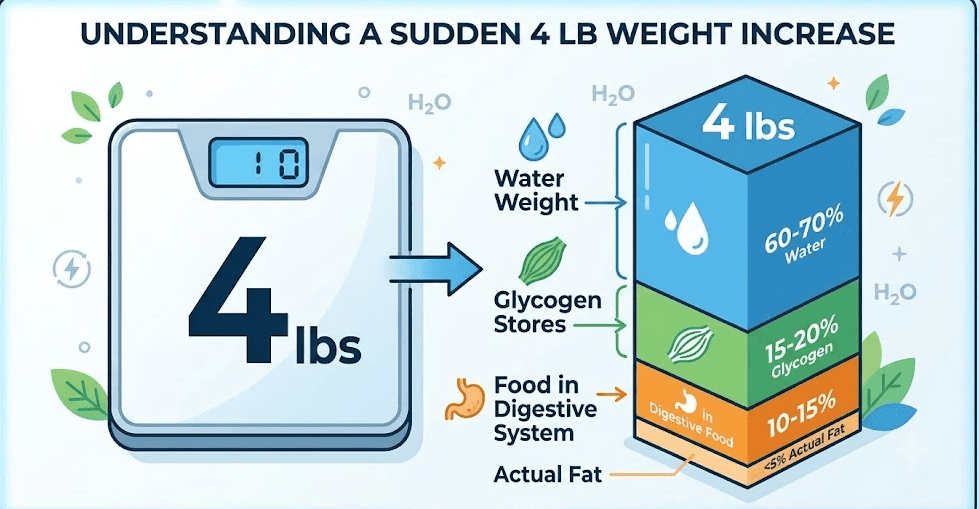
When the scale jumps three to five pounds overnight, it feels like pure fat gain. But biochemically speaking, gaining that much actual body fat over two days is almost impossible.
The Math of Body Fat
To gain just one pound of true body fat, you need to consume an energy surplus of roughly 3,500 calories above your daily maintenance needs (TDEE).
If your body normally needs 2,000 calories a day to maintain your weight, gaining three pounds of actual fat over Saturday and Sunday would mean eating a total of 14,500 calories in 48 hours! Unless you spent the weekend in an extreme competitive eating contest, you simply didn't eat enough surplus calories to build multiple pounds of new fat tissue.
So, What Is That Monday Weight?
So what is making the scale jump? It boils down to three quick-moving culprits:
Glycogen Refills: When you eat carbohydrates, your body stores them in your muscles and liver as glycogen for quick energy. Here's the catch: every single gram of stored glycogen holds onto 3 to 4 grams of water. A carb-heavy meal fills those glycogen tanks, easily adding 2 to 4 pounds of harmless water weight.
Sodium Retention: Restaurant dishes, takeout, and snacks are often loaded with extra salt. High sodium causes your kidneys to hold onto fluid to keep your body's mineral levels balanced.
Digestive Bulk: Food takes anywhere from 24 to 72 hours to pass through your digestive system. That heavy Sunday dinner is literally still sitting in your digestive tract on Monday morning!
Parameter | True Adipose Fat Accumulation | Temporary Fluid & Glycogen Retention |
Caloric Threshold | Requires a net surplus of ~3,500 kcal per pound | Occurs independently of surplus via carbs and sodium |
On-Scale Onset | Gradual shift observed over multiple weeks | Immediate overnight increase (2–5 lbs) |
Resolution Timeline | Requires weeks of sustained caloric deficit | Normalizes within 2–4 days of standard routine |
Primary Physiological Driver | Positive chronic energy balance | Osmotic shifts, glycogen synthesis, digestive volume |
Bottom Line: Monday scale spikes are almost entirely temporary water weight, restored glycogen, and undigested food—not new body fat.
Your Body Has a Weekly Rhythm (And It’s Normal!)
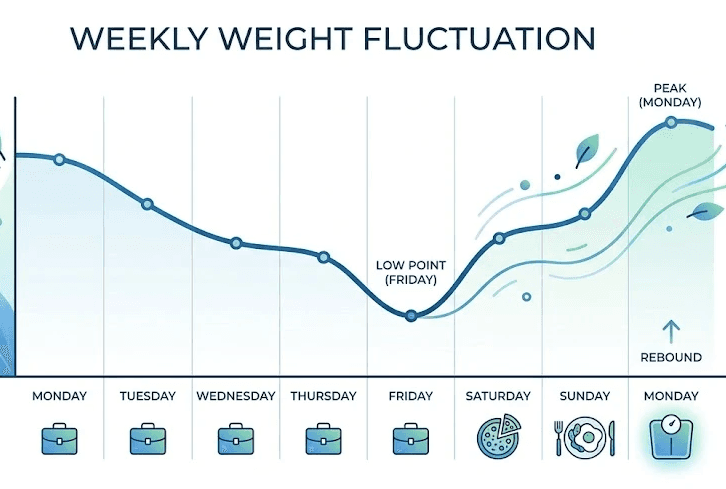
If you weigh yourself every day, you might notice a curious pattern: your weight isn't a straight line going down. Instead, it moves like a wave.
Researchers tracking weight trends found that most people reach their lowest weight of the week on Friday morning after five days of weekday routine. Weight then climbs over Saturday and Sunday, reaching a weekly peak on Monday or Tuesday morning.
In fact, normal weekly fluctuations of around 0.35% of your body weight happen across entire populations.
However, if every weekend becomes an unmonitored calorie free-for-all, those extra weekend calories can slow down your overall speed of weight loss. While one weekend won't ruin your goals, consistently eating back your entire weekday caloric deficit every single weekend will keep the scale stuck in the long run.
Bottom Line: Fluctuation is natural! Your weight naturally dips on Friday and peaks on Monday. As long as your overall weekly trend moves down over time, you are winning.
Why Do We Overeat on Weekends Anyway?
It’s not just a lack of willpower. Modern weekend routines trigger specific biological and lifestyle shifts:
Nighttime Munchies (Chrononutrition): On weekdays, work and school keep us on a strict schedule. On weekends, we stay up later, extending our "eating window". Studies show that eating late in the evening lowers glucose tolerance and fat oxidation, making late-night pizza harder to burn off efficiently.
The Sunday Slump: Physical activity—especially casual movement like walking around the office—often drops on weekends.
Liquid Calories and Good Times: Weekend social gatherings usually feature delicious food, sweet drinks, and alcohol. Alcohol packs 7 calories per gram, lowers your inhibitions, and makes high-calorie appetizers look twice as tempting.
Beware of the Psychological "What-The-Hell" Effect!

Here is the real secret: The biggest threat of a weekend break isn't the calories you ate—it’s how you think about those calories on Monday morning.
Behavioral psychologists call this the "What-The-Hell Effect" (or cognitive disinhibition).
When rigid dieters break one of their strict rules over the weekend, they often catastrophize: "Well, I ate cake on Saturday, so my diet is ruined! What the hell, I might as well eat pizza, ice cream, and chips all Sunday too!"
This all-or-nothing mindset transforms a harmless 300-calorie indulgence into a 3,000-calorie binge.
Focus Area | Rigid Mindset | Flexible, Evidence-Based Strategy |
Caloric Ceiling | Inflexible daily limit; single slip causes panic | Weekly caloric budgeting with intentional weekend allocations |
Food Choices | Strict categorization of foods as "good" or "bad" | Inflexible rules removed; all foods fit within weekly energy targets |
Lapse Response | "What-the-hell" effect; multi-day overeating | Objective acknowledgement; immediate return to baseline habits |
Tracking Method | Abandoned on weekends due to manual logging friction | Streamlined, low-friction voice logging via VoCal |
Scale Interpretation | Monday weight spike interpreted as true fat gain | Monday weight spike understood as temporary water/glycogen retention |
Bottom Line: Don't let a small slip become a total fall. A flexible mindset helps you enjoy weekend treats without falling into the all-or-nothing trap.
4 Easy Steps to Bounce Back on Monday
Instead of panicking, follow these evidence-based steps to reset your week:
1. Budget Your Calories Weekly
Think of your calories like a weekly budget rather than a rigid daily allowance. If you know you have a dinner party on Saturday, eat slightly lighter meals Monday through Thursday. This creates a natural cushion for weekend fun while keeping your total weekly deficit intact!
2. Ditch the Manual Logging Stress (Try Voice Tracking)
One reason people lose control on weekends is that logging meals manually on an app feels like homework. Searching through database lists for restaurant meals takes time and ruins the moment.
That’s where voice-based calorie tracking with VoCal makes a huge difference. Instead of typing, you can simply speak into your phone: "I had two slices of pizza and a craft beer." VoCal logs it in seconds, keeping you mindful of your intake without taking you away from social fun.
3. Flush the Water Weight Naturally
Do not starve yourself or do hours of punishing cardio on Monday! That only triggers more hunger and bingeing later in the week. Instead:
Drink plenty of plain water to help your kidneys flush out stored sodium.
Eat high-fiber vegetables and lean protein.
Go for a brisk walk to burn through excess muscle glycogen.
4. Wait Until Thursday to Re-Weigh
Give your body 48 to 72 hours to clear out excess fluid and digestive volume. By Wednesday or Thursday morning, the temporary water weight will vanish, showing your true scale weight again.
The Summary
A fun weekend with family and friends will not ruin your weight loss progress. The Monday scale spike is almost entirely temporary water retention, sodium, and glycogen refills.
By ditching rigid all-or-nothing thinking, maintaining awareness with easy voice tracking tools like VoCal, and getting right back into your normal routine on Monday morning, you can enjoy your life and reach your health goals!
Frequently Asked Questions (FAQs)
Does taking a weekend break break your diet completely?
No! Weight loss depends on your chronic calorie deficit over weeks and months, not a single 48-hour window. As long as your overall weekly average remains in a deficit, you will continue losing body fat.
How long does it take for weekend water weight to go away?
Temporary weight increases caused by glycogen and sodium usually clear up within 2 to 4 days once you resume your standard hydration, balanced diet, and regular activity routine.
Should I skip meals on Monday to make up for weekend overeating?
No. Extreme compensatory fasting often backfires by causing intense physical hunger, leading to another overeating episode later in the week. The best strategy is simply returning to your normal, nutritious baseline meals immediately.
How does voice calorie tracking help with weekend eating?
Traditional food logging apps have high "friction"—typing ingredients and searching databases takes time during social outings, leading many dieters to abandon tracking entirely on weekends. Voice tracking with VoCal lets you speak your meal in seconds, preserving calorie awareness effortlessly without interrupting your weekend plans.
Disclaimer: This article is for informational and educational purposes only and does not constitute individual medical or nutritional advice. Always consult a qualified healthcare professional or registered dietitian before making significant changes to your diet, exercise, or health routine.