

Ah, the humble sweet potato. Whether it's taking center stage at your Thanksgiving table or acting as a trusty weekday side dish, this vibrant orange tuber is a true crowd-pleaser. But did you know it’s also one of the ultimate secret weapons for your gym routine?
In the world of fitness and sports nutrition, carbs are often treated like a double-edged sword. Some people avoid them like the plague, while others load up on them. The truth is, your muscles rely heavily on carbohydrates (which are stored as glycogen) to power through intense lifting sessions and long cardio runs.
If you are looking for a whole-food carb source that delivers sustained energy, keeps hunger at bay, and packs a heavy punch of health-boosting vitamins, it's time to start looking at the sweet potato for gym performance.
Why Sweet Potatoes Are Your New Workout BFF
Sweet potatoes are far more than just a sweet treat. Unlike regular white potatoes, which belong to the nightshade family, sweet potatoes are edible roots belonging to the morning glory family. Because they are a complex carb packed with dietary fiber, they digest slowly, giving your body a steady drip of glucose rather than a massive blood sugar spike followed by an exhausting crash.
They are also incredibly dense in micronutrients that support recovery and overall health. Here is how a cooked sweet potato matches up against yams and baked sweet potatoes :
Nutrient Component | Cooked Sweet Potato (1 Cup, No Skin) | Baked Sweet Potato (1 Medium, With Skin) | Cooked Yam (1/2 Cup) |
Energy (Calories) | 249 kcal | 103 kcal | 79 kcal |
Protein | 4.0 g | 2.0 g | 1.5 g |
Fat | 0.5 g | 0.07 g | 0.1 g |
Carbohydrates | 58.0 g | 26.0 g | 19.0 g |
Dietary Fiber | 7.2 g | 3.9 g | 2.5 g |
Vitamin A | 287% DV | 102% DV | Minimal |
Vitamin C | 47% DV | 3.0 mg | 2.0 mg |
Potassium | 572 mg | 542 mg | 456 mg |
Key Gym Benefits:
Massive Vitamin A Boost: Just one medium sweet potato can easily cover your daily vitamin A needs. This fat-soluble vitamin acts as an antioxidant, supports your immune system, and helps protect your eye health.
Connective Tissue Repair: Sweet potatoes are high in vitamin C, which plays an essential role in collagen synthesis and connective tissue repair. This is perfect for helping your joints and tendons recover after heavy lifting.
No More Muscle Cramps: They are loaded with potassium, an essential electrolyte lost through sweat that regulates fluid balance, prevents muscle cramping, and manages nerve signaling during high-intensity training.
The Glycemic Index Game: Boiled vs. Baked
Here is a cool kitchen-science secret: how you cook your sweet potato completely changes how your body uses it for fuel.
This is because of the Glycemic Index (GI), a scale from 0 to 100 that ranks how quickly a food raises your blood sugar levels. For gym-goers, manipulating the GI of your pre-workout carbs is a total game-changer for energy management.
When you bake or roast sweet potatoes, the high heat gelatinizes the starch molecules, breaking them down into simple sugars like maltose, glucose, and fructose. Boiling, on the other hand, preserves more of the tuber's resistant starch, which escapes digestion and provides a much slower, controlled energy release.
Take a look at how raw sweet potatoes transform chemically when baked :
Carbohydrate Type | Raw Garnet Sweet Potato (% Dry Weight) | Baked Garnet Sweet Potato (% Dry Weight) |
Starch | 46.2% | 2.6% |
Sugars (Sucrose, Glucose, Fructose) | 22.4% | 37.6% |
Hemicellulose | 3.8% | 1.0% |
Cellulose | 2.7% | 2.5% |
Water-Insoluble Pectin | 0.47% | 0.31% |
This massive chemical shift means that different preparation methods yield very different glycemic responses :
Cooking Method | Glycemic Index (GI) Value | Glycemic Classification | Physiological Rate of Digestion |
Boiled (30 minutes) | 41 to 50 | Low | Slow, steady absorption; high retention of resistant starch. |
Boiled (8 minutes) | 61 | Medium | Moderate digestion rate; partial starch breakdown. |
Fried (in vegetable oil) | 76 | High | Rapid absorption; fat content slightly delays gastric emptying. |
Roasted (peeled) | 79 to 93 | High | Rapid digestion; severe degradation of starch structures. |
Baked (peeled, 45 minutes) | 82 to 94 | High | Immediate glucose release; complete starch gelatinization. |
Bottom Line: Boiled sweet potatoes maintain a low-to-medium GI, making them ideal for sustained endurance training. Baked or roasted sweet potatoes act like fast-digesting simple carbs, giving you an immediate burst of energy.
The Sweet Potato Pre-Workout Blueprint: Timing and Serving Sizes
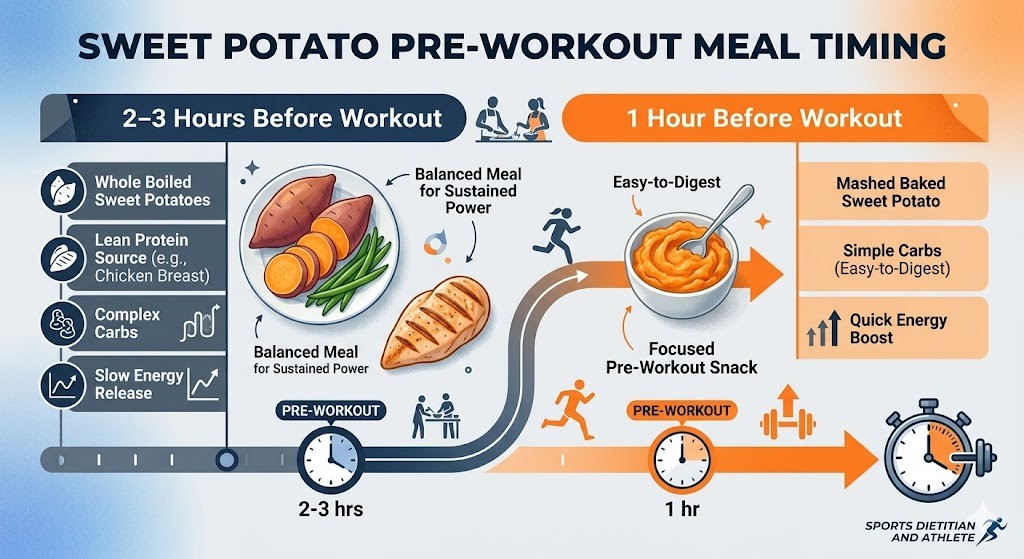
To make the most of your sweet potato pre-workout meal, you have to nail the timing and portion size. According to leading sports science organizations like the International Society of Sports Nutrition (ISSN), your pre-exercise carbohydrate needs scale directly with your body weight and workout duration.
To calculate your ideal pre-workout carb target (C, in grams), you can use this simple equation :
C=k.W
where W is your body weight in kilograms and k is a timing constant ranging between 1.0 and 2.0 (usually recommended when eating 3 to 4 hours before training). For example, a 70 kg (approx. 154 lbs) athlete would aim for 70 to 140 grams of pre-workout carbs.
Here is how to set up your sweet potato meal based on when you plan to hit the gym:
Pre-Workout Window | Recommended Cooking Method | Recommended Serving Size (Cooked Sweet Potato) | Carbohydrate & Protein Targets | Metabolic Focus & Objectives |
2 to 3 Hours Prior | Boiled or Steamed (Low-to-Medium GI) | 150g to 250g (Approx. 1 to 2 medium tubers) | 32g to 53g Carbohydrates paired with 20g to 30g Protein | Maximum glycogen storage; steady, slow-release blood glucose availability. |
1 Hour or Less | Baked, Mashed, or Pureed (High GI) | 80g to 100g (Approx. 1/2 to 1 small tuber) | 17g to 21g Carbohydrates with minimal fat, fiber, or protein | Rapid gastric emptying; immediate elevation of circulating glucose. |
Eating 2 to 3 Hours Prior: The Slow-Burn Strategy
When you have a few hours to digest, go with boiled or steamed sweet potatoes. The fiber will digest slowly, and when paired with a lean protein (like grilled chicken breast or egg whites), it provides a perfect, slow-releasing energy reserve to keep your muscles fueled.
Eating 1 Hour or Less Prior: The Rapid-Fuel Strategy
If your workout is right around the corner, you want fast-digesting energy to avoid cramping or feeling heavy. Opt for a smaller portion of baked or mashed sweet potato without the skin, as removing the peel lowers the fiber content and speeds up digestion.
Track Your Gym Carbs Stress-Free with VoCal
Let's face it: weighing your potatoes, hunting through endless food databases, and typing in macronutrient numbers is a major chore. It is the number one reason people give up on tracking their diet.
That is where VoCal steps in to save your sanity.
VoCal is an innovative, voice-based calorie and macro-tracking app designed to remove all the friction from dieting. Instead of searching for "boiled sweet potato" and trying to guess the portion size, you simply tap the microphone in the app and speak naturally :
"One hundred fifty grams of boiled sweet potato and one hundred grams of grilled chicken breast."
The app's built-in AI instantly transcribes your voice, calculates your exact calories, protein, carbs, and fats, and logs them in seconds. Plus, it has massive regional food databases and supports 11 different languages, including English, Hindi, Tamil, Telugu, Marathi, and more, making it perfect for tracking diverse home-cooked meals. It is the easiest way to ensure you are hitting your exact pre- and post-workout nutrition goals without the headache.
Is sweet potato better than white potato for the gym?
It depends on what you need! Sweet potatoes generally provide more fiber and have a lower glycemic index when boiled, which makes them awesome for sustained, slow-release pre-workout energy. However, regular white potatoes actually pack a bit more potassium and make a stellar post-workout recovery carb when you want to quickly spike your insulin and replenish glycogen.
Can I eat the skin of the sweet potato before a workout?
Yes, but timing matters. The skin is where a huge chunk of the fiber and antioxidants live. If you are eating 2 to 3 hours before your workout, definitely keep the skin on. But if you're eating within an hour of your gym session, peel the sweet potato to speed up digestion and prevent bloating during your workout.
Does a baked sweet potato provide the exact same energy as a boiled one?
They provide the same amount of total carbs and calories, but they affect your body differently. Boiling keeps the glycemic index low, giving you a slow, steady burn of energy. Baking raises the glycemic index significantly, causing a rapid spike in blood sugar that is perfect for immediate energy but less ideal for long-duration stamina.
Disclaimer: Consult a healthcare professional before making major changes to your diet, especially if you manage diabetes, kidney stones, or other metabolic conditions.