

We’ve all been there: It’s 12:30 PM, your calendar is packed, and you’re trying to stick to your healthy weight-loss goals. You grab a quick protein shake because it’s fast, convenient, and has a big shiny "30g of protein" stamped on the label.
But fast-forward one hour, and your stomach is playing the drums. You’re officially "hangry," daydreaming about the nearest vending machine, and wondering why on earth that shake didn't keep you full.
If you’re caught in the ultimate weight-loss battle of protein shake vs real food, you aren't alone. While sipping your lunch seems like an easy shortcut to hit a daily calorie deficit—which generally requires cutting 500 to 750 calories a day to lose 1 to 1.5 pounds per week—the physical form of your food matters a lot more than you think.
In fact, science shows that your brain and stomach treat liquids and solids completely differently. Let's dive into the fascinating psychology and biology of fullness, and discover why trading your straw for a fork might just be your ultimate weight-loss superpower.
The "Fullness" Security System: How Your Body Senses a Meal
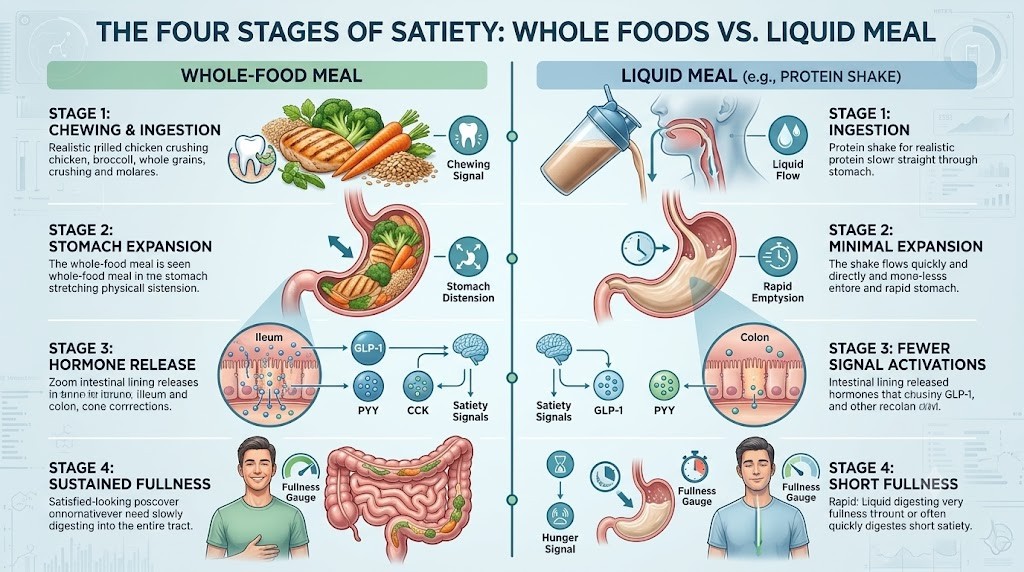
To understand why a liquid protein shake often leaves you searching the pantry, we have to look at how our bodies process hunger. Satiety—the scientific word for feeling comfortably full between meals—isn't just about the number of calories you swallow. It is actually a highly coordinated, four-phase security system managed by your gut and your brain, known as the satiety cascade:
Sensory Phase: Smelling, tasting, and chewing your food.
Cognitive Phase: Your brain recognizing that you are actively eating a meal.
Post-Ingestive Phase: Your stomach physically stretching to accommodate the food bulk.
Post-Absorptive Phase: Your small intestine releasing "I'm full!" hormones as nutrients are absorbed.
When you drink a protein shake, you essentially skip the first two security checkpoints. You gulp it down in seconds, your brain barely registers that you "ate," and the liquid slides right past the early stages of digestion.
Scientists actually tested this in a mind-blowing study where they had participants eat a solid meal of steamed chicken breast with a glass of water, and compared it to the exact same meal liquefied into a blended chicken soup.
Even though the calories, macronutrients, temperature, and total volume were identical, the solid chicken breast crushed hunger and reduced the desire to eat far better than the liquid version.
The fascinating results of this landmark satiety study are detailed in the table below:
Satiety Parameter | Solid Chicken Meal | Liquefied Chicken Meal |
Hunger Suppression (at 20 min) | 79 mm | 52 mm |
Hunger Suppression (at 115 min) | 61 mm | 44 mm |
Desire to Eat (at 115 min) | 31 mm | 53 mm |
Thirst Sensation (at 70 min) | 23 mm | 41 mm |
Why Your Stomach Acts Like a Slow-Cooker for Solid Food

The secret to solid food's staying power lies in how your stomach empties.
Think of your stomach as a smart blender. When you eat solid real food—like chicken, eggs, or tofu—it has to sit in your stomach for an extended period. Your stomach muscles actively grind the food down into tiny particles smaller than 1 to 2 millimeters before letting it pass through to the small intestine. This prolonged "holding pattern" keeps your stomach stretched, which continuously activates stretch receptors that tell your brain, "Hey, we’re still working down here, don't eat anything else!".
Liquids, on the other hand, bypass the velvet rope. Since a protein shake is already liquid, your stomach doesn't need to do any heavy lifting. It empties almost immediately, dropping straight into your duodenum. While this can cause a quick spike in fullness hormones, your stomach deflates like a popped balloon, causing your appetite to return with a vengeance shortly after.
In a trial comparing solid and liquid meal-replacement products of the exact same calorie count, researchers found that hunger immediately plummeted after both. However, within just one hour, the liquid group’s hunger levels rose rapidly. By hour four, the liquid group was actually 14% hungrier than they were before they ate! Meanwhile, the solid group’s hunger remained comfortably suppressed at 45% below their fasting baseline.
Chewing: The Original Brain-Training Hack
Did you know that the simple act of chewing—known scientifically as mastication—is a natural appetite suppressant?
When you chew, it sends direct electrical signals to the hypothalamus, the control center of your brain that regulates hunger. Chewing also helps quiet down the brain's "reward center," which is responsible for impulsive cravings and that nagging urge to grab a cookie after lunch.
When you drink a protein shake, you miss out on this sensory signaling. This is why liquid diets often leave you with what clinical nutritionists call "head hunger"—a persistent, annoying psychological desire to bite and chew something, even though you’ve consumed plenty of protein and calories.
The "Protein Package" Trap
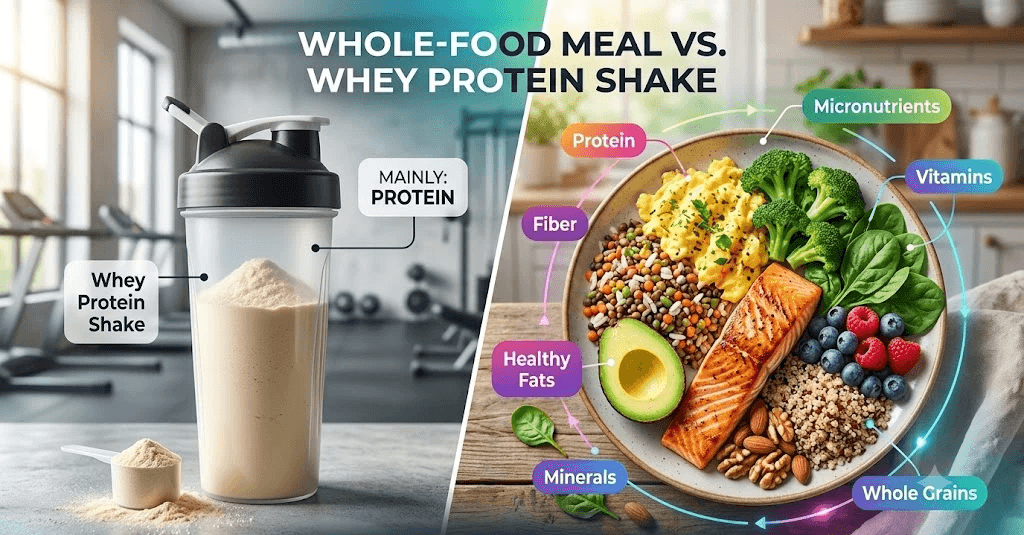
Another major reason real food wins the fullness game is because of what nutrition experts at Harvard call the "protein package".
In nature, protein doesn’t exist as an isolated powder. It comes bundled with fiber, healthy fats, and essential micronutrients.
Take fiber, for example. Fiber is your weight-loss MVP. It acts like a sponge in your stomach, absorbing water, expanding, and slowing down your digestion so your blood sugar stays stable.
Most standard whey protein shakes contain isolated protein with almost zero fiber or healthy fat. This means they are absorbed incredibly quickly, which can lead to a blood sugar crash and intense afternoon cravings.
To see this in action, look at a controlled clinical trial that put isolated whey shakes head-to-head against structurally complete meal replacements (which include added fiber and healthy fats) over four weeks:
Satiety and Weight Loss Metric | Balanced Meal Replacement (Fiber + Fat + Protein) | Whey Protein Shake (Isolated Protein Only) |
Average Weight Loss (4 Weeks) | 3.1 kg (6.8 lbs) | 1.4 kg (3.1 lbs) |
Satiety Score (3 Hours Post-Meal) | 6.8 / 10 | 3.5 / 10 |
Afternoon Crash/Rebound Eating | 12.5% of participants | 43.8% of participants |
Lean Muscle Retained | 95% | 82% |
The takeaway? If you want to lose weight and keep your muscle, the surrounding "nutrient package" is just as important as the protein itself.
Going Low-Carb? Watch Out for the "Keto Flu"
Many people use protein shakes to kickstart a low-carb or ketogenic diet, which limits carbs to force the body to burn fat for energy. When you drastically cut carbs, your insulin levels drop, signaling your body to start burning stored fat.
While low-carb diets are highly effective for weight loss, a sudden and severe drop in carbs can trigger some unpleasant side effects, including:
The "Keto Flu": Fatigue, headaches, bad breath, and muscle weakness as your body transitions to fat-burning mode.
Constipation: Removing high-carb foods often means cutting out gut-loving fiber, which can slow your digestion to a grinding halt.
To avoid these pitfalls, choose whole, fiber-rich, low-carb real foods like leafy greens, broccoli, cucumbers, and avocados. They will keep your digestion regular, ward off the keto flu, and keep you incredibly full.
What About Vegans and Vegetarians?
If you follow a plant-based diet, you have a massive satiety advantage: your protein sources—like lentils, black beans, chickpeas, and tofu—are naturally packed with fiber! A single half-cup of cooked lentils delivers a whopping 7.8 grams of dietary fiber, giving you excellent physical fullness.
However, the USDA notes that plant-based eaters do need to keep a few unique nutritional goals in mind:
Iron Bioavailability: Plant foods contain non-heme iron, which isn't absorbed as easily as the iron in meat. Because of this, vegetarian iron requirements are 1.8 times higher.
Vitamin B12: This crucial vitamin is found almost exclusively in animal foods, so strict vegans should look for fortified foods or a quality supplement.
Protein Completeness: Since some plant proteins lack certain essential amino acids, make sure to eat a diverse mix of grains, seeds, and legumes throughout the day.
The Verdict: How to Balance Shakes and Real Food
You don't have to throw your protein powder in the trash, but you should use it strategically:
Adopt a Food-First Mindset: Get the vast majority of your protein from solid, whole foods to keep your hunger locked down.
Save Shakes for Workouts: Drink a fast-absorbing whey or plant-based protein shake within 30 minutes of an intense workout to jumpstart muscle recovery.
Beef Up Your Liquid Meals: If you must have a shake for a meal, don't just mix powder with water. Blend in fiber (like chia seeds or spinach) and healthy fats (like almond butter) to slow down your digestion and stay full.
Ditch the Typing: Use VoCal to make tracking your favorite real foods as easy as telling a friend what you had for lunch.
Ready to conquer your weight-loss goals without the hunger? Speak your meals into existence and download VoCal today!
How VoCal Solves the Real Food Dilemma
So, if real food is the undisputed champion of keeping us full, why do we keep drinking protein shakes?
The honest answer: convenience.
Logging a multi-ingredient, home-cooked whole food meal into a traditional calorie-tracking app can feel like a part-time job. Typing in every single ingredient of your delicious Mediterranean grain bowl is tedious, so we default to the easily scannable, pre-packaged protein shake.
That’s where VoCal comes in.
VoCal is a voice-based calorie tracking app designed to remove the friction of logging real food. Instead of typing, tapping, and searching for 10 minutes, you simply speak naturally:
"For lunch, I had a cup of quinoa, five ounces of grilled tofu, half an avocado, and a handful of cherry tomatoes."
In seconds, the app logs your entire meal. By removing the chore of manual tracking, VoCal empowers you to prioritize the highly satisfying, weight-loss-friendly whole foods your body actually needs to succeed.
Frequently Asked Questions (FAQs)
Can a protein shake replace a whole meal?
A standard protein shake (just whey and water) usually lacks the fiber and healthy fats needed to keep your blood sugar stable, which can lead to afternoon crashes and "head hunger". If you must replace a meal on a busy day, opt for a fully formulated meal replacement shake or add fiber (like chia seeds) and healthy fats (like peanut butter) to your shake to slow down digestion.
What are the best whole-food protein sources for staying full?
Lean poultry (like chicken breast), wild-caught fish, eggs, and Greek yogurt are outstanding animal-based choices. For plant-based eaters, lentils, black beans, chickpeas, and tofu are highly satiating because they deliver high-quality protein packed with natural dietary fiber.
Why do I get hungry so fast after drinking a protein shake?
Liquids empty from your stomach much faster than solid foods because your stomach doesn't need to mechanically grind them down. Solid foods require chewing, which triggers satiety signals in your brain, and they physically stretch your stomach for a longer period, keeping hunger hormones suppressed.
Is it bad to drink protein shakes every day?
No, it is not bad! Protein shakes are highly convenient and work wonders as a post-workout recovery aid to support muscle growth. However, they are designed to supplement your diet, not replace nutrient-dense whole foods. A "food-first" approach is always best for long-term health and sustainable weight loss.
Disclaimer: This article is for informational purposes only and does not substitute for professional medical advice, diagnosis, or treatment. Always consult with a qualified healthcare provider before making significant changes to your diet, especially if you have pre-existing cardiovascular conditions, diabetes, or suspect you are a cholesterol hyper-responder.