

Picture this: it’s a beautiful Saturday morning. The sun is shining, your coffee is brewing, and you’ve got a hot skillet on the stove. You crack a couple of fresh eggs, toss in a generous handful of cheddar, and let it sizzle into a fluffy, gooey masterpiece.
It smells like absolute heaven. But if you are watching your waistline or trying to hit specific macro targets, a quick question might crash your breakfast party: how many calories are in scrambled eggs with cheese?
Whether you are keto, low-carb, or just trying to navigate weight loss management, understanding what actually goes onto your plate is a major key to avoiding accidental calorie traps. The good news? You don't have to give up your favorite morning comfort food.
Let's crack open the science behind this breakfast classic, break down the numbers, and see how you can fit it perfectly into your daily routine.
Cheesy Scramble: The Fast-Track Summary
Don’t have time to read the whole menu? Here is your quick-read breakfast blueprint:
The Magic Number: A standard home-cooked scramble made of two large eggs, one ounce of cheddar cheese, and one teaspoon of butter clocks in at about 294 calories.
Protein Powerhouse: That same two-egg plate delivers nearly 20 grams of high-quality protein to keep your muscles happy.
Glycemic Zero: With less than 1.5 grams of net carbs, this breakfast won’t spike your blood sugar, making it perfect for a low-carbohydrate diet.
The Fullness Effect: Thanks to egg protein and healthy fats, this dish triggers satiety hormones that can naturally shrink your lunch portion by over 130 calories.
Tracking Made Easy: Want to log this breakfast without the headache? A hands-free voice calorie tracker like Vo-cal.com lets you speak your meal and log it instantly.
Breaking Down the Breakfast Blueprint

To figure out your exact scrambled eggs calories with cheese, we have to look at the individual players on your plate.
A standard USDA Grade A large egg weighs in at roughly 61 grams. In its raw, naked state, it’s a lean, mean nutritional machine with only 72 calories, delivering 6.3 grams of highly bioavailable protein, 4.8 grams of fat, and a tiny fraction of a carb.
But once you bring dairy into the mix, the energy density shifts:
The Pan Prep: Melting one single teaspoon (5 grams) of unsalted butter into your skillet adds 36 calories and 4.1 grams of fat.
The Melty Goodness: Tossing in one ounce (28 grams) of full-fat cheddar cheese adds 114 calories, 9.4 grams of fat, and 7 grams of protein.
Because everyone scrambles their eggs a little differently, we calculated the most common breakfast configurations using precise USDA and NIH clinical preparation metrics.
Table 1: Standardized Nutritional Variations of Scrambled Eggs with Cheese
Culinary Configuration | Serving Weight (g) | Energy (kcal) | Protein (g) | Total Fat (g) | Saturated Fat (g) | Net Carbs (g) | Sodium (mg) |
1-Egg Scramble (Light Portion) • 1 large egg • 1 tsp unsalted butter • 0.5 oz cheddar cheese | ~105 g | 165 | 9.8 | 13.6 | 6.7 | 0.6 | ~150 |
2-Egg Scramble (Standard Portion) • 2 large eggs • 1 tsp unsalted butter • 1.0 oz cheddar cheese | ~190 g | 294 | 19.6 | 23.1 | 11.4 | 1.2 | ~300 |
3-Egg Scramble (Athletic Portion) • 3 large eggs • 2 tsp unsalted butter • 1.5 oz cheddar cheese | ~290 g | 459 | 29.4 | 36.7 | 18.1 | 1.8 | ~450 |
USDA FNDDS Survey Standard • Scrambled eggs cooked with fat and cheese | 142 g (5 oz) | 234 | 20.4 | 14.7 | 5.8 | 1.0 | 505 |
Home Prep with Standard Dairy • 2 large eggs, 2 tbsp (2% milk), 1 tbsp butter, 14 g cheddar | 159 g | 317 | 17.0 | 26.0 | 14.0 | 2.0 | 248 |
NIH Clinical Center Formulation • Standard 2-egg scrambles prepared with cheese | — | 284 | 22.0 | 19.0 | 8.0 | 0.0 | 528 |
The Hidden Calorie Overestimation Quirk
Here’s a fun piece of food science trivia: standard food databases might actually be overestimating your breakfast calories.
In a study comparing standard database entries to direct laboratory bomb calorimetry (where scientists literally burn food in a chamber to measure exact energy), researchers found that standard databases listed scrambled eggs at 148 calories per 100 grams, while the actual physical measurement was only 133 calories per 100 grams.
This means your physical plate might have about 11% fewer calories than your typical tracker tells you, largely due to moisture evaporating during cooking. Your protein levels, however, remain rock-solid and consistent.
Bottom Line: A standard home-cooked scramble of two large eggs and an ounce of cheddar cheese cooked in a single teaspoon of butter yields about 294 calories. It’s a nutrient-dense, low-glycemic meal that delivers massive metabolic value.
Satiety Science: Why Cheesy Eggs Keep You So Full
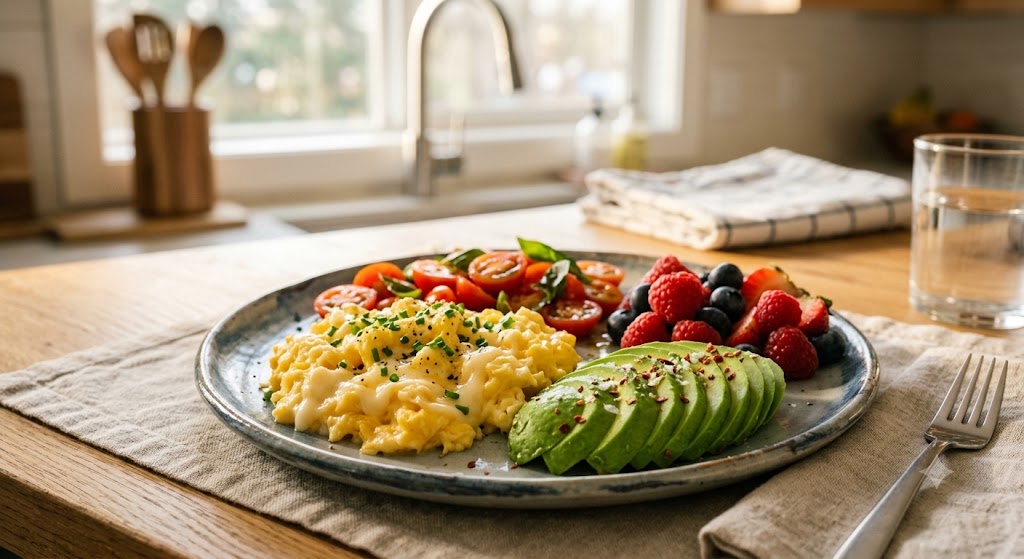
If you’ve ever eaten a high-carb breakfast like a bagel or sugary cereal, you know the drill: you’re absolutely starving again by 10:30 AM.
That is because carbs cause a quick spike and drop in blood sugar. But a high-protein breakfast built on eggs and cheese acts like a slow-burning log on your metabolic fireplace.
Our body regulates hunger using an internal team of hormones. Ghrelin is the loud, obnoxious alarm that tells your brain "I'm starving!". On the flip side, Peptide YY (PYY) is the polite, soothing hormone released by your gut that whispers "you are totally satisfied, put the fork down".
In clinical trials, researchers compared two completely identical calorie-matched breakfasts (513 calories each). One was a standard carb-heavy breakfast (73% carbs, 14% protein), and the other was protein-rich (38% protein, 49% carbs) featuring eggs.
Table 2: Impact of Breakfast Protein Density on Endocrine Satiety
Dietary Parameter / Post-Breakfast Metric | Normal-Protein Breakfast Condition | Protein-Rich Breakfast Condition | Physiological and Endocrine Outcomes |
Total Energy Content | 513 kcal | 512 kcal | Meals were completely isocaloric, preventing energy density bias. |
Macronutrient Distribution | 14% protein, 73% carbs, 13% fat | 38% protein, 49% carbs, 13% fat | The protein-rich condition incorporated whey and egg protein. |
Absolute Protein Mass | 18.1 g | 49.1 g | An additional 31 g of high-quality protein was delivered. |
Post-Prandial Peptide YY (PYY) | Baseline / Moderate Elevation | Significantly Elevated (r = 0.482) | High protein stimulates distal L-cells to release the appetite-suppressing hormone PYY. |
Post-Prandial Active Ghrelin | Standard Suppression | Prolonged Suppression | High-protein meals maintain lower ghrelin levels for a longer period of time. |
Subsequent Ad Libitum Lunch Intake | 503 kcal | 372 kcal | Participants consumed 131 kcal less at lunch without cognitive restriction. |
By shifting the endocrine scales—releasing more PYY and keeping ghrelin suppressed longer—participants who ate the egg breakfast naturally ate 131 fewer calories at lunch without even trying!
Even cooler: brain-imaging studies show that eating a protein-dense breakfast actually reduces activation in the reward centers of your brain (like the amygdala and hippocampus), meaning you’ll have significantly fewer cravings for evening snacks.
Bottom Line: Starting your morning with eggs and cheese fundamentally changes your brain biochemistry. It tames your hunger hormones and increases fullness, automatically reducing your subsequent daily food intake by over 130 calories per meal.
Low-Carb Dynamics: The Secret Behind the Scale
For anyone following a low-carbohydrate diet or going full ketogenic, cheesy scrambled eggs are a dream come true. When you restrict carbs to under 50 to 130 grams a day, your body undergoes some pretty fascinating metabolic shifts:
1. Squeezing the Glycogen Sponge
When you first cut carbohydrates, you often see a dramatic drop on the scale within the first week. While it feels like magic, this is primarily water weight.
Your body stores carbohydrates in your liver and muscles as glycogen. Each single gram of glycogen holds about 3 grams of water.
When you stop eating carbs, your body burns through its glycogen stores, releasing and flushing out all that bound water. Lower insulin levels also tell your kidneys to shed sodium, which carries even more water with it.
2. The Expensive "Bakery" (Gluconeogenesis)
Your brain still requires a small amount of glucose to function, but if you aren't eating carbs, where does it get it? Enter gluconeogenesis.
Your liver basically turns into an artisan bakery, taking non-carb ingredients (like the amino acids from your egg protein) and converting them into glucose. This process is highly inefficient and requires a ton of energy.
Your body literally "wastes" a portion of the calories you consume as heat, boosting your metabolic rate.
3. Sizzling Through the Thermic Effect
Your body has to work much harder to digest protein than fats or carbs. This is known as the Thermic Effect of Food (TEF).
While digesting carbs burns about 5% to 15% of their energy, digesting protein burns an astonishing 20% to 30%.
Clinical trials show that a high-protein, low-carb diet can boost your total daily energy expenditure by around 250 calories—which is the metabolic equivalent of walking or exercising for a full hour every day!
Bottom Line: A cheesy scramble supports fat loss by shedding glycogen-bound water weight, utilizing the metabolic inefficiency of gluconeogenesis, and leveraging the high thermic effect of protein to give your daily metabolism a natural boost.
Let’s Crack the Cholesterol Code
For years, eggs got a bad reputation because of the dietary cholesterol sitting in the yolk. People scrambled to throw away their yolks and eat only dry egg whites.
Fortunately, modern clinical science has completely cleared the egg's name! The USDA Dietary Guidelines completely removed the old 300 mg/day limit on dietary cholesterol.
Why? Because for the vast majority of healthy people, dietary cholesterol has virtually zero impact on blood cholesterol. Your liver simply makes less cholesterol when you eat it from food.
In studies comparing people who ate two whole eggs a day to those who ate an equal-calorie oatmeal breakfast, researchers found that while whole eggs did slightly raise both LDL ("bad") and HDL ("good") cholesterol, the crucial LDL/HDL ratio remained completely unchanged. Even better, eggs were shown to improve insulin sensitivity and reduce chronic inflammation in people with metabolic syndrome.
Plus, egg yolks are where the nutritional gold lives! They are a rare natural source of Vitamin D and contain lutein and zeaxanthin (which protect your eyes), along with choline, a vital nutrient for brain health and memory.
Customizing Your Cheese

You can easily customize the calorie and sodium levels of your scramble by choosing the right cheese. Here is a quick look at how the top favorites stack up:
Table 3: Nutritional Comparison of Cheese Varieties (Per 1 oz / 28g Serving)
Cheese Variety | Energy (kcal) | Protein (g) | Total Fat (g) | Saturated Fat (g) | Net Carbs (g) | Calcium (mg) |
Sharp Cheddar | 115 | 7.0 | 9.4 | 5.4 | 0.4 | 200 |
Part-Skim Mozzarella | 85 | 6.3 | 6.3 | 3.7 | 0.8 | 222 |
Whole-Milk Feta | 75 | 4.0 | 6.0 | 3.8 | 1.1 | 140 |
Swiss Cheese | 112 | 7.6 | 8.8 | 5.0 | 0.4 | 220 |
Low-Sodium Cheddar | 113 | 7.0 | 9.4 | 5.4 | 0.4 | 200 |
If you want to keep your meal ultra-light, swapping full-fat cheddar for whole-milk feta or part-skim mozzarella can shave off 30 to 40 calories per serving while keeping that rich, savory flavor and boosting your bone-healthy calcium intake.
Bottom Line: Whole eggs are a cardiovascular-safe superfood. Eating them whole does not negatively impact your lipid ratios, and it unlocks vital fat-soluble vitamins, brain-boosting choline, and eye-protecting antioxidants.
Try This Today!
Next time you cook a cheesy scramble, try swapping standard cooking butter for a quick spray of avocado oil and use a tablespoon of crumbled feta cheese. You'll cut down on saturated fats, drop the meal's energy count by about 75 calories, and add a delicious Mediterranean tang to your morning routine!
Say Goodbye to Database Friction: Try a Voice Calorie Tracker
Let's be honest: manual food tracking is a chore. Nobody wants to pull out a scale, weigh raw eggs, search for butter brands, and manually type in cheddar cheese values while their breakfast gets stone cold on the counter. This digital friction is one of the biggest reasons people quit their diets.
That is where a hands-free voice calorie tracker like VoCal completely changes the game.
Instead of typing, you simply say to your phone:
"Two scrambled eggs cooked in a teaspoon of butter with an ounce of sharp cheddar."
The app uses smart natural language processing to break down your sentence. It instantly maps your ingredients to standard, highly accurate USDA nutrition codes.
Within seconds, your breakfast is logged with 100% accuracy: 294 calories, 19.6g of protein, 23.1g of fat, and 1.2g of net carbs. It keeps your hands free, your food hot, and your tracking consistent.
Bottom Line: Managing your weight is all about consistency. Voice-activated logging with platforms like VoCal removes the friction of calorie tracking, making it easier than ever to build lasting, healthy habits.
Frequently Asked Questions (FAQs)
Is it okay to eat cheesy scrambled eggs on a weight loss diet?
Absolutely! While cheese and butter add calories, the high protein and fat content increases your satiety. This keeps you full for hours, which naturally prevents overeating later in the day. Just be mindful of your cooking fats and portion sizes to maintain a steady calorie deficit.
What is the healthiest cheese to add to scrambled eggs?
Part-skim mozzarella and whole-milk feta are fantastic low-calorie options. Feta adds a sharp, salty punch (meaning you can use less of it), while mozzarella gives you that perfect gooey stretch for fewer calories. If you are watching your salt intake, low-sodium cheddar or Swiss cheese are excellent alternatives.
Does scrambling eggs destroy their nutritional value?
Not at all! In fact, cooking eggs actually increases the bioavailability of their protein. Raw egg protein is only about 50% digestible, but cooking it structuralizes the proteins so your body can absorb up to 91% of them. Just avoid overcooking them at extreme heat to preserve their delicate vitamins.
Disclaimer: This article is for informational purposes only and does not substitute for professional medical advice, diagnosis, or treatment. Always consult with a qualified healthcare provider before making significant changes to your diet, especially if you have pre-existing cardiovascular conditions, diabetes, or suspect you are a cholesterol hyper-responder.