

Ah, the morning scramble. You drag yourself out of bed, zombie-walk to the kitchen, and stare blankly into the fridge. Your mission? Fuel your body, wake up your brain, and keep those fat-loss goals on track. But you quickly hit a fork in the road: do you whip up a couple of fluffy eggs, or do you microwave a warm, cozy bowl of oatmeal?
This eggs vs oatmeal breakfast comparison is a classic debate in the weight-loss world. On one side, you have the low-carbohydrate champion of protein and healthy fats. On the other, you have the slow-burning, complex-carbohydrate king of heart health and dietary fiber.
To help you decide which morning champion will get you to your weight goals faster, let’s dive into the science of protein versus fiber, see how they affect your hunger hormones, and find the perfect macronutrient balance for fat loss!
Eggs vs. Oatmeal Nutrition Facts
To see how these two stack up, let’s look at their nutritional makeup. But first, a quick kitchen caveat: dry oats expand significantly when you cook them in water or milk. While 100 grams of dry oats looks packed with nutrients, a cooked serving is actually much lighter because of all that water weight!
Here is how a standard 100-gram serving of each looks raw, straight from the USDA FoodData Central database:
Nutrient Parameter | Fresh, Raw Whole Hen Eggs | Whole Grain Rolled Oats (Dry) |
Energy (Calories) | 143 kcal | 389 kcal |
Protein | 12.6 g | 16.9 g |
Total Lipid (Fat) | 9.5 g | 6.9 g |
Saturated Fat | 3.0 g | 1.2 g |
Carbohydrate | 0.7 g | 66.3 g |
Dietary Fiber | 0 g | 10.6 g |
Glycemic Index (GI) | 0 | 55-59 |
Note: Remember, what you add to your breakfast counts! Cooking eggs in a mountain of butter or drenching your oatmeal in maple syrup can quickly throw your daily calorie budget out of whack.
Benefits of Eggs
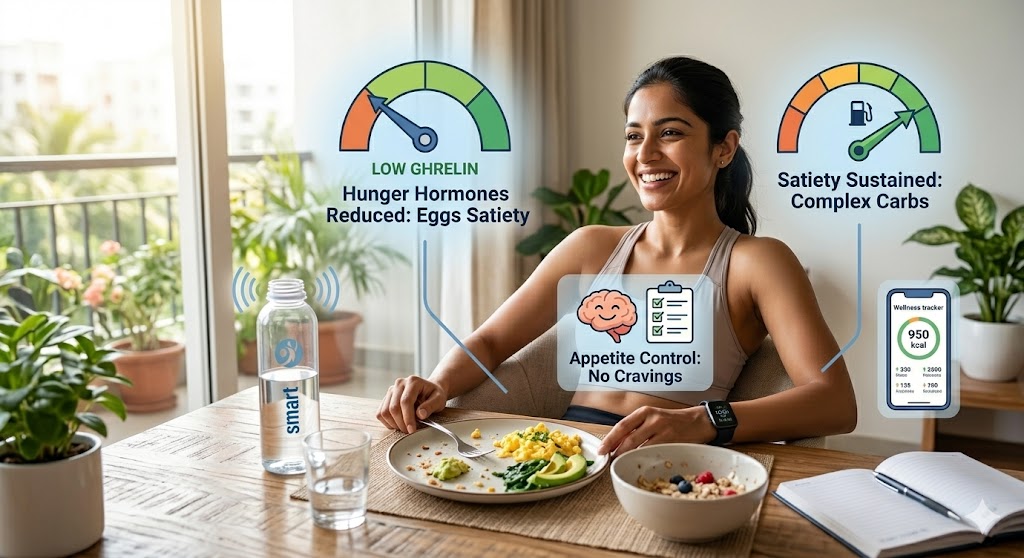
Let's talk about eggs. Far from being just a baking ingredient, whole eggs are nutritional powerhouses. They are widely considered one of the highest-quality protein sources on earth, boasting a perfect Biological Value of 100. This means your body easily absorbs and uses every single gram of protein they provide to build and protect lean muscle.
But how do eggs actually help you lose fat? It all comes down to appetite-controlling hormones.
When you eat eggs, their protein stimulates the release of satiety hormones like peptide YY (PYY) and GLP-1 (yes, the same hormone that weight loss drugs mimic naturally!). At the same time, eggs put the brakes on ghrelin, your body’s primary "I'm hungry" signal.
In fact, a randomized clinical trial from the University of Connecticut found that folks who ate two eggs per day for breakfast had significantly lower levels of ghrelin in their blood compared to when they ate oatmeal:
Plasma Ghrelin (Eggs): 553.0 ± 181.5 pg/mL
Plasma Ghrelin (Oatmeal): 577.8 ± 219.7 pg/mL
This lower level of hunger hormones translated directly to feeling more satisfied and eating less throughout the day.
Bottom Line: Eggs are protein anchors that curb your hunger hormones and make it easier to stay in a calorie deficit without feeling like you're starving.
Benefits of Oatmeal
If eggs are the high-protein heroes, oatmeal is the high-fiber champion. The secret weapon in oats is beta-glucan, a unique type of soluble fiber. When beta-glucan mixes with water in your stomach, it forms a thick, gel-like substance.
This gel acts like a slow-motion button for your digestive system. It physically slows down gastric emptying and delays the absorption of carbohydrates into your bloodstream. This prevents the dreaded "sugar spike and crash" and provides you with a steady, long-lasting stream of energy.
Oats are also fantastic for your heart! The FDA even has an official health claim for oats, noting that eating 3 grams of beta-glucan daily can help lower your LDL ("bad") cholesterol. In a 30-day self-trial, a board-certified immunologist noted that eating daily oats dropped their LDL cholesterol by 10%.
But a quick tip: the less processed your oats are, the better they work.
Steel-Cut Oats: Minimally processed, chewy, and have a low glycemic index (GI ≈ 42-52).
Rolled Oats: The classic breakfast bowl. Still great for fiber with moderate digestion speed (GI ≈ 55-59).
Instant Oats: Heavily processed, pre-cooked, and thin. They digest incredibly fast (GI > 75), meaning you’ll likely feel hungry again much sooner.
Bottom Line: Oatmeal uses soluble beta-glucan fiber to slow down digestion, keeping your blood sugar stable and your stomach physically full.
How to Choose the Better Option for You: Eggs or Oatmeal?

So, which one takes the crown for fat loss? The answer depends heavily on your metabolic goals and your personal lifestyle.
The Battle of the Satiety Index
In 1995, Dr. Susanna Holt developed the Satiety Index, a scale that ranks how full a 240-calorie portion of different foods keeps you compared to white bread (which sits at 100%).
Here is how oatmeal and eggs rank on the scale:
Oatmeal / Porridge: 209% Satiety Score
Whole Eggs: 150% Satiety Score
Because oatmeal absorbs so much water, it creates a larger physical volume in your stomach, which stretches your stomach walls and triggers physical fullness. However, oats are carbohydrate-rich. If you are focused on lowering insulin levels and sticking to low-glycemic morning meals to optimize fat oxidation, eggs are the clear winner.
To help you decide, let's look at this handy morning selection matrix:
Your Goal | The Winner | The Science Behind It |
Max Fat Loss & Insulin Control | Whole Hen Eggs | Negligible carbs; lowers ghrelin to stop late-morning cravings. |
Cardiovascular & Cholesterol Support | Steel-Cut Oats | Beta-glucan actively binds to and helps sweep away LDL cholesterol. |
Anti-Inflammatory & Diabetic Support | Whole Hen Eggs | Clinical trials show eggs can reduce systemic inflammation markers like TNF-alpha. |
Hard-core Workouts & Recovery | The Hybrid (Both!) | Protein to repair muscle tissue combined with complex carbs for workout fuel. |
How to Enjoy Eggs and Oatmeal: 5 Tips
Ready to master your breakfast? Follow these quick dietitian-approved tips to make your breakfast both delicious and fat-loss friendly:
1. Ditch the Sugar, Embrace the Spice
If you’re eating oatmeal, skip the brown sugar and maple syrup, which can turn a health food into a dessert. Instead, flavor your oats with warm spices like cinnamon, nutmeg, or a dash of vanilla extract.
2. Cook Your Eggs in Healthy Fats
Instead of scrambling your eggs in a large chunk of butter, use a teaspoon of heart-healthy extra virgin olive oil. Add some sauteed spinach, mushrooms, or tomatoes to boost the volume and micronutrient density.
3. Try the "Hybrid" Bowl
Why choose? Pair a single poached egg with a half-serving of steel-cut oats. This gives you the perfect protein versus fiber balance, creating a powerful, long-lasting satiety effect.
4. Choose Steel-Cut or Sprouted Oats
To get the absolute most out of your oats, go for minimally processed steel-cut oats. If you’re short on time, prepare them as overnight oats in the fridge the night before.
5. Crush the Food Logging Friction
Whether you go team egg, team oatmeal, or mix both, staying consistent with your weight-loss goals requires keeping track of what you eat. But let’s be honest: traditional breakfast calorie tracking can be a chore. Typing in "two eggs", looking up "cooked in olive oil", scrolling through endless search results... it’s enough to make anyone give up within a few weeks.
That is where voice-based calorie tracking with VoCal comes in. Instead of tapping and typing, you just tap the microphone and speak naturally: "For breakfast, I had two soft-boiled eggs and a cup of cooked rolled oats."
Using advanced artificial intelligence, VoCal instantly parses your voice, extracts the foods and exact portions, and logs them directly to the USDA database. It completely removes the tracking friction, making it incredibly easy to maintain the calorie deficit you need for fat loss.
The Takeaway
At the end of the day, both eggs and oatmeal are outstanding, nutrient-dense upgrades from sugary breakfast cereals or processed pastries. If your goal is ultimate blood sugar stability, muscle preservation, and craving control, leaning toward a high-protein egg breakfast is your best bet. If you need a high-volume, heart-healthy meal that fuels active workouts, go with steel-cut oats.
Whichever path you choose, keep your portions in check, log your meals with VoCal, and enjoy the journey to a healthier, happier you!
Frequently Asked Questions
Is it safe to eat eggs every day for weight loss?
Yes, for most healthy individuals, eating up to one egg per day (or about seven per week) is perfectly safe and won't harm your heart health. The cholesterol in eggs has a minimal impact on blood cholesterol for the average person; it's saturated and trans fats that you really want to watch out for.
Does oatmeal spike blood sugar?
It heavily depends on the type of oats you choose. Minimally processed steel-cut oats digest very slowly and have a low glycemic index, keeping your blood sugar stable. Instant oatmeal, on the other hand, is heavily processed and behaves more like white bread, causing rapid spikes and crashes.
Can I mix eggs and oatmeal together?
Absolutely! Nutritionists highly recommend a "hybrid" breakfast. Pairing the complete proteins of eggs with the rich, soluble fiber of oatmeal balances your macros perfectly and keeps you full for hours.
How does VoCal help with weight loss?
Food tracking is proven to double your weight-loss success, but manual entry apps are tedious and quickly abandoned. VoCal allows you to record your meals simply by speaking. It cuts tracking friction entirely, helping you stick to your goals long-term.
Disclaimer: The information in this article is intended for educational and informational purposes only. It is not a substitute for professional medical advice, diagnosis, or treatment. Always consult with a qualified healthcare provider, such as a doctor or registered dietitian, before making major changes to your diet or lifestyle.