

Picture this: your Chinese takeout arrives, the aroma fills the room, and the very first thing you reach for is that crispy, golden egg roll. That blistered, bubbly shell and savory filling make it one of America’s all-time favorite comfort appetizers.
Whether you are enjoying takeout on a Friday movie night or stocking up on frozen boxes for a busy weekday snack, it is completely natural to wonder about the calories in a eggroll.
The quick answer? A typical restaurant egg roll packs between 200 and 250 calories. But because recipes vary from kitchen to kitchen, the real total depends on what is rolled inside, how big it is, and whether it took a swim in a deep fryer or crisped up in an air fryer.
Here is everything you need to know about egg roll nutrition, wrapper calories, dipping sauces, and healthy ways to enjoy every crunchy bite.
What Exactly Is in an Egg Roll?
The modern American-Chinese egg roll is famous for its thick, sturdy wrapper made from wheat flour and egg. Inside, you will usually find a hearty blend of shredded green cabbage, celery, carrots, garlic, ginger, and scallions, often mixed with seasoned pork, shrimp, or chicken.
Because cabbage and celery are packed with water, they provide volume and gut-friendly dietary fiber. However, when an egg roll is submerged in hot frying oil, that water vaporizes into steam, creating microscopic channels that pull cooking oil right into the dough. That is why most of an egg roll’s energy comes from the outer shell and absorbed frying oil rather than the vegetables inside.
How Many Calories in an Egg Roll from Your Local Takeout Spot?
If you are wondering how many calories in an egg roll you are getting from a standard restaurant order, you can generally expect around 220 to 250 calories for a roll weighing roughly 90 to 100 grams.
A typical restaurant egg roll provides a balanced mix of carbs, fats, and a little protein:
Egg Roll Preparation (Standard Serving) | Weight (g) | Energy (kcal) | Protein (g) | Total Fat (g) | Carbohydrates (g) | Dietary Fiber (g) | Sodium (mg) |
Pork Egg Roll (Commercial Average) | 78–85 | 160–180 | 5.0–6.0 | 6.0–8.0 | 20.0–21.0 | 1.0 | 300–400 |
Vegetable Egg Roll (Prepared, Frozen) | 68 | 146 | 4.0 | 4.7 | 21.6 | 1.6 | 333 |
Restaurant Deep-Fried Roll (Pork/Shrimp) | 95–105 | 220–250 | 7.0–9.0 | 11.0–13.0 | 23.0–26.0 | 2.0 | 420–520 |
Mini Vegetable Appetizer Roll | 13 | 35 | 0.7 | 1.8 | 3.9 | 0.3 | 60 |
Air-Fried Pork Egg Roll | 80 | 120–135 | 5.5 | 3.0–4.0 | 19.0 | 1.0 | 310 |
According to United States Department of Agriculture (USDA) data, roughly 45% to 55% of the calories in a classic restaurant egg roll come from carbohydrates, 35% to 45% from cooking fats, and 10% to 15% from protein.
Bottom Line: A standard full-size Chinese restaurant egg roll clocks in at roughly 220 to 250 calories, mainly due to the thick wheat dough and absorbed frying oil.
Pork Egg Roll Calories: The Savory Takeout Classic
Pork egg rolls are the gold standard on American-Chinese menus. Minced pork delivers that classic savory bite, pairing up with aromatic spices, scallions, and shredded cabbage.
The calorie count of a pork roll depends heavily on how lean the ground pork is and whether the brand pre-fries the rolls before freezing. Here is how popular grocery store pork egg rolls compare according to USDA FoodData Central records:
Commercial Pork Egg Roll Brand | Portion Weight (g) | Energy (kcal) | Total Fat (g) | Saturated Fat (g) | Carbohydrate (g) | Protein (g) | Sodium (mg) |
Minh Pork Egg Roll | 78 | 180 | 8.0 | 2.5 | 20.0 | 6.0 | 400 |
World Menu Pork Egg Roll | 85 | 160 | 6.0 | 1.5 | 21.0 | 5.0 | 300 |
Tai Pei Pork Egg Roll | 85 | 150 | 6.0 | 0.5 | 19.0 | 5.0 | 320 |
Great Value Pork Egg Roll | 77 | 110 | 1.5 | 0.0 | 19.0 | 5.0 | 350 |
Packaged frozen pork egg rolls baked in the oven hover around 110 to 180 calories each. When you order from a restaurant, however, the calorie count usually reaches 200 to 240 calories because restaurant chefs often use juicier pork cuts and commercial fryers.
On the plus side, pork provides 5 to 6 grams of protein per roll, which helps slow down digestion and keeps you feeling satisfied longer.
Bottom Line: Expect 110 to 180 calories for frozen, oven-baked pork egg rolls, and around 200 to 240 calories for restaurant-fried versions.
Vegetable Egg Roll Calories: Is the Meatless Option Actually Lighter?
Opting for the veggie roll seems like an easy shortcut to save calories. These rolls swap meat for crunchy cabbage, carrots, bean sprouts, water chestnuts, and earthy mushrooms.
Surprisingly, vegetable egg rolls are not drastically lower in calories than pork rolls. According to the USDA Standard Release dataset for prepared vegetable egg rolls (FDC ID 172105, 68-gram serving), a single roll delivers:
Calories: 146 kcal
Carbohydrates: 21.6g
Total Fat: 4.7g
Protein: 4.0g
Dietary Fiber: 1.6g
Sugars: 4.1g
Sodium: 333mg
Why isn’t the difference bigger? Because the outer wheat wrapper and frying oil supply most of the calories. While you do save on saturated fat (only 0.77g per veggie roll) and consume zero dietary cholesterol, the carbohydrate load remains nearly identical to a meat-filled roll.
Bottom Line: A standard 68-gram vegetable egg roll contains roughly 146 calories. It is lower in saturated fat than pork, but the wrapper and frying oil keep its total calorie count close to meat versions.
The Wrapper Breakdown: How Many Calories Are in an Egg Roll Wrap?
If you enjoy making homemade appetizers, you might wonder about the baseline calories in egg roll wrap products before any cooking starts.
Egg roll wrappers are made from wheat flour, water, salt, and occasionally eggs or egg whites. Raw wrapper dough is naturally low in fat, but it is rich in complex carbohydrates.
Here is what the USDA FoodData Central reports for un-fried wrappers across various sizes:
Wrapper Dimension and Form | Total Weight (g) | Energy (kcal) | Carbohydrates (g) | Dietary Fiber (g) | Protein (g) | Total Fat (g) |
Standard 1 oz Wrapper Dough | 28 | 83 | 16.4 | 0.5 | 2.8 | 0.4 |
Full 7-Inch Square Egg Roll Wrapper | 32 | 95 | 18.7 | 0.6 | 3.2 | 0.5 |
Wonton Wrapper (3.5-Inch Square) | 8 | 24 | 4.7 | 0.1 | 0.8 | 0.1 |
100-Gram Reference Amount | 100 | 296 | 58.6 | 1.8 | 10.0 | 1.5 |
Before cooking, the calories in egg roll wrapper sheets come out to about 95 calories per standard 7-inch sheet, alongside 18.7 grams of carbs.
Cooking completely transforms that pastry shell. When deep-fried, the dough absorbs cooking oil like a sponge, adding roughly 8 to 10 grams of fat to the shell alone.
Processing State (7-Inch Wrapper, 32g Base) | Energy (kcal) | Total Fat (g) | Carbohydrates (g) | Fat Calorie Contribution (%) |
Raw / Un-Fried Wrapper | 95 | 0.5 | 18.7 | 4.7% |
Boiled / Steamed Wrapper | 95 | 0.5 | 18.7 | 4.7% |
Air-Fried Wrapper (1 tsp oil spray) | 135 | 4.5 | 18.7 | 30.0% |
Commercial Deep-Fried Wrapper | 180 | 10.0 | 18.7 | 50.0% |
Bottom Line: A raw 7-inch egg roll wrapper starts at 95 calories and 18.7 grams of carbs. Submerging it in hot frying oil nearly doubles its calories to around 180 through fat absorption.
Egg Roll Calories by Size: From Cocktail Minis to Giant Takeout Rolls
Egg rolls come in all shapes and sizes, from tiny party bites on holiday buffet tables to jumbo rolls that fill an entire takeout container.
Interestingly, smaller egg rolls have more outer surface area relative to their weight. That means bite-sized rolls soak up a higher percentage of frying oil per gram than big, thick rolls.
Format Category | Typical Unit Weight (g) | Energy Range (kcal) | Lipid Range (g) | Carbohydrate Range (g) | Structural Characteristics |
Mini Appetizer Roll | 13–25 | 35–65 | 1.8–3.5 | 3.9–7.0 | Highest wrapper-to-filling ratio; high relative oil uptake |
Retail Frozen Roll | 68–77 | 110–150 | 1.5–5.0 | 19.0–22.0 | Formulated for oven baking; controlled fat levels |
CommercialFoodservice | 78–85 | 160–180 | 6.0–8.0 | 20.0–21.0 | Standard restaurant size; balanced meat and vegetables |
Jumbo Restaurant Roll | 100–140 | 240–320 | 12.0–18.0 | 24.0–30.0 | Thick pastry casing; substantial oil retention |
A single 13-gram mini egg roll contains only about 35 calories and 1.8 grams of fat. However, party appetizers are easy to lose track of: eating four mini rolls adds up to 140 calories and over 7 grams of fat before you even reach for the dipping bowl.
On the opposite end, jumbo takeout rolls packed with meat can tip the scales at 320 calories each.
Bottom Line: Calorie counts scale directly with portion size, ranging from 35 calories for a cocktail mini roll up to 320 calories for an extra-large restaurant roll.
Deep-Fried vs. Air-Fried: How Cooking Changes the Calorie Count
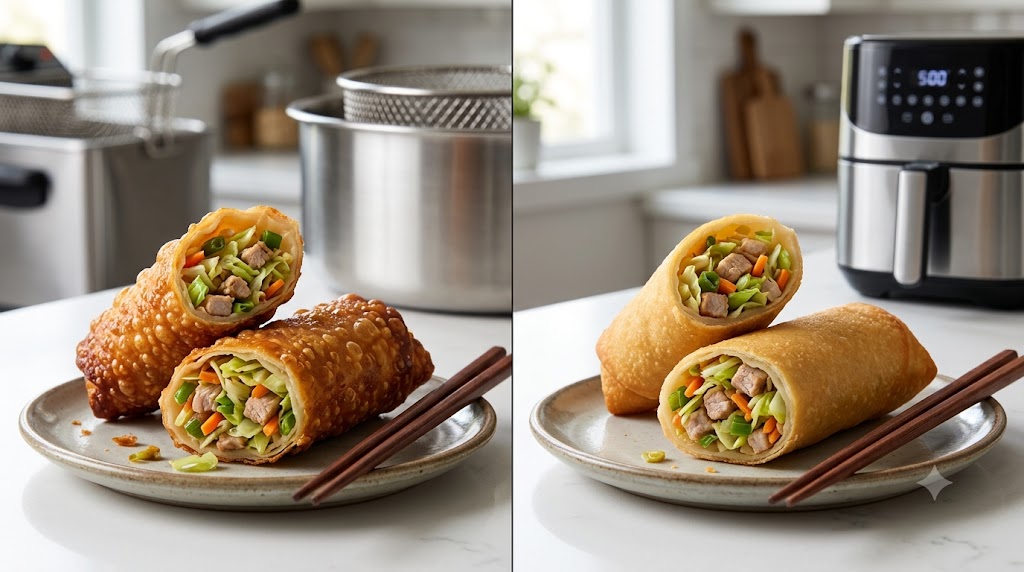
If you want to enjoy crispy egg rolls more often while hitting your fitness or wellness goals, your cooking method makes all the difference.
When an egg roll sits in a deep fryer at 350°F to 375°F, it soaks up oil as it cooks and cools. An air fryer, by contrast, uses rapid convection fans to circulate super-heated air around the roll. With just a quick mist of cooking spray, you get that craveable crunch with a fraction of the oil.
Take a look at how much you save over a 3-piece serving:
Nutritional Metric | Deep-Fried Method (3 Pieces) | Air-Fried Method (3 Pieces) | Total Reduction | Relative Percentage Savings |
Total Energy (kcal) | 420 | 255 | 165 kcal | 39.3% reduction |
Total Fat (g) | 22.0 | 8.0 | 14.0 g | 63.6% reduction |
Carbohydrates (g) | 44.0 | 42.0 | 2.0 g | Negligible change |
Protein (g) | 10.0 | 10.0 | 0.0 g | Unchanged |
Sodium (mg) | 780 | 760 | 20 mg | Minimal variation |
Air-frying slashes fat content by nearly 64% and cuts total calories by roughly 39%. For a single roll, switching from deep frying to air frying drops your calorie intake from around 220 down to roughly 135.
Bottom Line: Air-frying delivers that irresistible crispy crunch while cutting fat by over 63% and saving around 165 calories per 3-piece serving.
Dipping Sauces: The Sweet Calorie Sneak Attack
Let’s be honest: what is an egg roll without a delicious dip? But while sauces make the meal extra tasty, commercial condiments can sneak in lots of extra sugar and calories.
Sweet and sour duck sauces are typically made with apricot or plum puree, corn syrup, and cane sugar.
Condiment Variety | Serving Size | Energy (kcal) | Total Fat (g) | Carbohydrates (g) | Free Sugars (g) | Sodium (mg) |
Duck Sauce (Sweet & Sour) | 2 tbsp (30 ml) | 70 | 0.0 | 17.0 | 16.0 | 210 |
Commercial Sweet and Sour Sauce | 2 tbsp (30 ml) | 65 | 0.0 | 16.0 | 14.0 | 180 |
Hoisin Dipping Sauce | 2 tbsp (32 g) | 70 | 1.0 | 14.3 | 11.0 | 520 |
Hot Chinese Mustard | 1 tbsp (15 g) | 15 | 0.8 | 1.0 | 0.2 | 140 |
Traditional Soy Sauce | 1 tbsp (15 ml) | 10 | 0.0 | 1.0 | 0.1 | 880 |
Just two tablespoons of duck sauce add 70 calories and 16 grams of pure sugar. If you dunk two deep-fried restaurant egg rolls into four tablespoons of sweet sauce, your appetizer easily climbs past 580 calories.
If you want big flavor without the sugar rush, try pairing your egg rolls with spicy Chinese hot mustard or a quick splash of seasoned rice vinegar.
Bottom Line: Two tablespoons of sweet duck sauce contribute 70 calories and 16 grams of sugar. Use small dipping cups or try hot mustard to keep calories in check.
Heart Health: Keeping an Eye on Sodium and Saturated Fat
Beyond calorie counting, egg rolls deserve a little attention when it comes to sodium and saturated fat.
The 2020–2025 Dietary Guidelines for Americans recommend that adults keep sodium intake under 2,300 milligrams per day. Right now, the average American consumes around 3,400 to 3,600 mg daily, which can raise the risk for high blood pressure and cardiovascular strain.
Takeout egg rolls are seasoned with soy sauce, marinades, and garlic salt in both the filling and the dough. Here is how quickly sodium adds up:
Dish Component | Typical Sodium Content (mg) | Daily Value Contribution (% of 2,300 mg ceiling) |
1 Standard Restaurant Pork Egg Roll | 450 | 19.6% |
2 Tablespoons Hoisin Sauce | 520 | 22.6% |
Combined Appetizer Serving | 970 | 42.2% |
1 Tablespoon Standard Soy Sauce | 880 | 38.3% |
1 Commercial Retail Egg Roll (Un-Sauced) | 300 | 13.0% |
A single restaurant egg roll and a couple of spoonfuls of hoisin or duck sauce can hit almost 1,000 mg of sodium—nearly half of your daily allowance in just a few bites.
Furthermore, federal health guidelines recommend limiting saturated fats to under 10% of your daily calories (about 22 grams on a 2,000-calorie diet). While home-baked rolls have very little saturated fat, restaurant fryers often use heavy frying shortening that boosts saturated fats to 3 or 4 grams per roll.
Bottom Line: Between salty fillings, restaurant fryers, and rich dipping sauces, an egg roll appetizer can provide over 40% of your daily recommended sodium limit.
4 Easy Ways to Enjoy Egg Rolls on a Healthy Diet
You never have to banish egg rolls from your life to stay on track with your health goals. With a few simple tweaks, you can enjoy all the crunch with none of the stress:
Fire up the air fryer: Baking or air-frying frozen egg rolls at 375°F gives you all the crispy texture you love while saving up to 14 grams of fat per serving.
Measure your sauces: Rather than pouring duck sauce directly over your plate, pour one tablespoon into a dipping ramekin and lightly dip each bite.
Try an "Egg Roll in a Bowl": Love the flavors of an egg roll filling? Sauté lean ground turkey or pork with coleslaw mix (shredded green cabbage and carrots), ginger, garlic, and low-sodium tamari. You get all the flavor and protein while skipping the refined dough and frying oil completely.
Balance the rest of your plate: If you are enjoying a deep-fried takeout roll, pair it with steamed edamame, steamed broccoli, or chicken lettuce wraps rather than heavy fried rice or lo mein.
The Easiest Way to Track Egg Roll Calories: Meet VoCal
Let’s be honest: tracking mixed dishes like egg rolls can be frustrating.
In a traditional calorie-tracking app, you have to scroll through dozens of database entries, guess how much the roll weighs, figure out how much oil was absorbed in the fryer, and remember to log your duck sauce separately. It takes too many taps, and after a long day, it is easy to give up.
That is where VoCal steps in. Designed as the "World's easiest calorie tracking app," VoCal is a complete nutrition system built around how people actually eat in real life.
Instead of typing and scrolling, you just log your meals naturally by voice. When you sit down to lunch, you can simply say:
"I ate two air-fried vegetable egg rolls with a tablespoon of duck sauce."
VoCal automatically parses your speech, identifies the ingredients, factors in your cooking method (air-fried vs. deep-fried), and calculates the calories, carbs, fats, and protein instantly.
Prefer visuals? You can snap a photo of your plate and add a quick voice note explaining the details. Over time, VoCal provides daily clarity, uncovers your habit patterns, and delivers personalized health insights—helping you build long-term consistency without the burnout.
The Bottom Line
Crispy, golden egg rolls are a beloved culinary treat. While a standard deep-fried restaurant egg roll delivers between 200 and 250 calories and nearly 20% of your daily sodium allowance, you don't have to give them up.
By switching to convection air-frying, choosing lean fillings, being mindful of sweet dipping sauces, and logging your meals effortlessly with VoCal, you can fit your favorite appetizers into any healthy, balanced lifestyle.
Frequently Asked Questions
How many calories in an egg roll are from fat?
In a traditional deep-fried restaurant egg roll, about 100 to 120 calories come directly from fat (roughly 11 to 13 grams of total fat). In contrast, an air-fried or baked egg roll contains only 30 to 40 calories from fat (around 3 to 4 grams).
Are spring rolls lower in calories than egg rolls?
Yes, in most cases. Authentic spring rolls are wrapped in ultra-thin flour sheets or translucent rice paper, whereas egg rolls use a thick, egg-enriched wheat dough. A fresh, non-fried Vietnamese spring roll (summer roll) usually has only 70 to 100 calories, while a deep-fried egg roll averages 220 calories.
Can I eat egg rolls on a low-carb or keto diet?
Standard egg rolls are not ideal for strict keto diets because a single 7-inch wrapper contains roughly 19 grams of refined wheat carbohydrates. However, you can easily make keto-friendly "egg roll in a bowl" (crack slaw), which uses the exact same pork and cabbage filling without the high-carb wrapper.
How do I calculate the calories in homemade egg roll wrappers?
A single standard 7-inch square egg roll wrapper weighs about 32 grams and contains approximately 95 calories, 18.7 grams of carbohydrates, 3.2 grams of protein, and 0.5 grams of fat. If you use an app like VoCal, you can simply speak your recipe details to log both the wrappers and fillings automatically.
Disclaimer: This guide is intended for informational and educational purposes only and should not replace personalized medical advice, diagnosis, or dietary treatment from a licensed healthcare professional or registered dietitian.