

Few sounds in the culinary world are quite as satisfying as the loud, shatteringly crisp crunch of a freshly fried egg roll. Whether you are unpacking brown paper takeout bags on a cozy Friday evening or filling a plate at your neighborhood Asian buffet, egg rolls are an undisputed American-Chinese comfort staple.
Behind that bubbly golden pastry and savory filling, how do the numbers actually add up? If you are managing your weight, balancing macros, or simply curious about what goes onto your plate, calculating the total calories in a eggroll can feel like a guessing game.
Here is an evidence-backed guide to the calories in a chinese egg roll, comparing restaurant portions, wrapper styles, fillings, and dipping sauces, along with practical tips to enjoy them without derailing your health goals.
What Is an Egg Roll?
The Chinese egg roll is a classic twentieth-century American-Chinese creation inspired by traditional Cantonese dim sum pastries and spring rolls.
A standard egg roll consists of:
The wrapper: A thick pastry dough made from enriched wheat flour, water, and whole egg or egg solids.
The filling: Shredded green cabbage, celery, carrots, garlic, ginger, scallions, and proteins like ground pork, chicken, or shrimp.
The cooking method: Submersion in high-temperature vegetable oil until the outer crust turns deep golden-brown and develops signature crunchy blisters.
While delicious, that deep-frying bath allows the porous wheat wrapper to soak up cooking oil, which significantly drives up its energy density.
Calories in a Chinese Egg Roll by Variety
The total calories in an egg roll depend largely on its size and filling. According to the United States Department of Agriculture (USDA) FoodData Central, a standard commercial 64-gram roll contains around 160 to 180 calories, while larger restaurant takeout versions (around 85 to 100 grams) regularly exceed 215 calories.
A common misconception is that picking a vegetable egg roll automatically cuts the calories in half. Because shredded cabbage and cruciferous veggies release steam when exposed to high heat, internal moisture escapes and leaves microscopic void spaces that absorb frying oil. As a result, the calories saved by omitting meat are often replaced by extra oil absorption.
Here is how common varieties compare, based on USDA nutritional records:
Egg Roll Variety | Serving Size (g) | Calories (kcal) | Protein (g) | Total Fat (g) | Saturated Fat (g) | Carbs (g) | Fiber (g) | Sodium (mg) |
Pork & Beef (Standard Roll) | 64 | 177 | 5.9 | 9.3 | 1.6 | 17.7 | 1.3 | 246 |
Pork (Takeout / Large) | 85 | 215 | 7.5 | 11.2 | 2.1 | 21.5 | 1.8 | 410 |
Chicken or Turkey | 64 | 162 | 6.4 | 7.4 | 1.2 | 17.3 | 1.5 | 289 |
Vegetable / Meatless | 64 | 172 | 3.6 | 8.8 | 1.3 | 19.2 | 1.5 | 296 |
Pork & Beef (100g Base) | 100 | 277 | 9.2 | 14.5 | 2.5 | 27.7 | 2.0 | 385 |
Bottom Line: A standard restaurant or frozen egg roll contains roughly 160 to 215 calories, with fat accounting for nearly half of its energy content. Opting for poultry trims a few calories, but vegetable versions have a similar caloric load due to oil uptake.
Egg Rolls vs. Spring Rolls vs. Summer Rolls
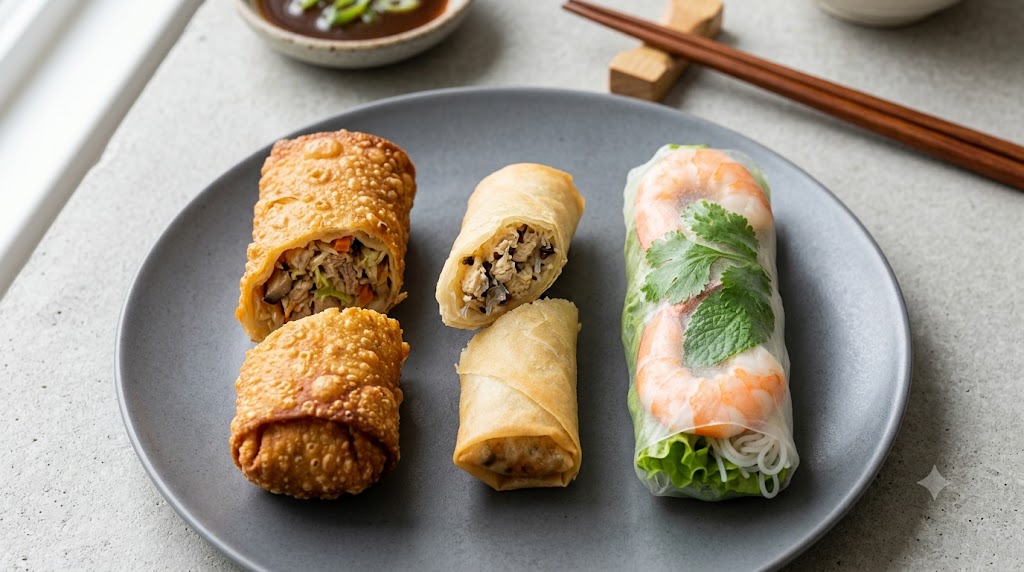
Not all rolls are created equal. Menu descriptions can be confusing, but wrapper ingredients and cooking styles create notable nutritional differences:
Egg Rolls: Wrapped in a thick wheat-and-egg dough, stuffed with meat and vegetables, and deep-fried until bubbly and thick-crusted.
Spring Rolls: Wrapped in paper-thin pastry made from flour and water (without eggs), usually filled with finely shredded veggies, and flash-fried to a light, flaky finish.
Summer Rolls (Gỏi Cuốn): Wrapped in delicate, un-fried translucent rice paper packed with fresh herbs, lettuce, cold rice vermicelli, and boiled shrimp or pork.
Air-Fried Egg Rolls: Standard egg roll ingredients cooked using high-velocity hot air and a light mist of cooking oil instead of deep immersion.
Roll Style | Wrapper Type | Serving Size (g) | Calories (kcal) | Total Fat (g) | Carbs (g) | Saturated Fat (g) |
Deep-Fried Chinese Egg Roll | Thick wheat & egg wrapper | 64 | 177 | 9.3 | 17.7 | 1.6 |
Deep-Fried Spring Roll | Ultra-thin wheat pastry | 45 | 105 | 4.8 | 13.5 | 0.8 |
Fresh Summer Roll | Hydrated rice paper (no fry) | 71 | 80 | 1.9 | 12.2 | 0.3 |
Air-Fried Egg Roll | Wheat & egg, oil spray | 64 | 128 | 3.8 | 17.5 | 0.8 |
Bottom Line: If you want a lighter alternative that keeps the crunch, spring rolls shave off about 70 calories per roll. If you are looking for maximum calorie savings, fresh Vietnamese summer rolls cut out frying fats entirely.
The Sauce Factor: Sneaky Liquid Calories
Dipping makes the experience complete, but condiments can quietly double your sugar and calorie intake.
Takeout sweet and sour sauce and classic orange duck sauce are primarily made of sugar, corn syrup, fruit puree, and starch thickeners. Because liquid sugars do not trigger your body’s fullness cues the way solid foods do, it is easy to dip away an extra 100 calories without realizing it.
Dipping Condiment | Typical Serving | Calories (kcal) | Sugars (g) | Carbs (g) | Sodium (mg) |
Duck Sauce (Plum Sauce) | 2 tbsp (32 g) | 80 | 18.0 | 20.0 | 140 |
Sweet & Sour Sauce | 2 tbsp (35 g) | 54 | 11.2 | 13.4 | 130 |
Chinese Hot Mustard | 1 tbsp (15 g) | 12 | 0.2 | 1.0 | 95 |
Brewed Soy Sauce | 1 tbsp (15 ml) | 9 | 0.1 | 0.8 | 879 |
Bottom Line: Dunking a single egg roll into two tablespoons of duck sauce adds roughly 80 calories and 18 grams of pure sugar. Switching to hot Chinese mustard brings strong flavor with almost zero sugar.
Are Egg Rolls Healthy?
Egg rolls fit comfortably into an overall balanced lifestyle, but like many fried appetizers, they come with trade-offs.
The Benefits
Cruciferous Vegetables and Fiber: Egg rolls are stuffed with cabbage, celery, and carrots. A single roll delivers 1.3 to 1.8 grams of dietary fiber, supporting gut digestion and steady glucose absorption.
Moderate Protein Boost: Thanks to fillings like minced pork, poultry, or shrimp, an egg roll provides between 4 and 8 grams of complete animal protein to support muscle maintenance.
The Downsides
High Sodium: The Dietary Guidelines for Americans recommend keeping daily sodium intake under 2,300 milligrams. Between soy sauce, wrapper salt, and savory seasonings, an order of two restaurant egg rolls can contain 600 to 900 milligrams of sodium—roughly a third of your daily limit before your entrée arrives.
Frying Oil and Saturated Fat: High-temperature commercial frying breaks down oils into oxidized fats and adds 7 to 11 grams of total lipids per roll.
Bottom Line: Egg rolls deliver real vegetable fiber and a small protein kick, but their sodium and frying oil mean they are best enjoyed as an occasional treat rather than an everyday staple.
How to Enjoy Egg Rolls and Stay on Track
You do not need to skip your favorite appetizers to maintain your health goals. A few simple adjustments can make a big difference:
Try the "Fork Dip" Technique: Instead of pouring sweet sauces over your food or dunking the whole roll into the cup, dip your fork tines into the sauce first, then take a bite. You get all the flavor with a fraction of the sugar.
Pair with a Broth-Based Soup: Start your meal with a cup of egg drop, wonton, or hot and sour soup. At just 70 to 100 calories per cup, warm soups promote early fullness and help curb the urge to eat multiple fried appetizers.
Balance Your Entrée: If you are having a deep-fried, carb-rich starter, pair it with a light, protein-packed main like steamed chicken with broccoli or shrimp with mixed vegetables rather than fried rice or sweet-and-sour pork.
Make Them in an Air Fryer: If you cook at home, brush store-bought egg roll wrappers with a teaspoon of sesame oil and air-fry at 385 F for 10 to 12 minutes. You will save 40 to 50 calories and over 50% of the fat while keeping the signature crunch.
Track Your Takeout in Seconds with VoCal
Logging composite restaurant meals like Chinese takeout can be frustrating. Traditional tracking apps often force you to scroll through dozens of contradictory database entries, while photo-based apps struggle to see what is hidden inside a crispy, golden wrapper.
That is why VoCal simplifies food logging through natural, voice-first tracking:
Just Speak Naturally: Instead of manually searching through generic databases, tap the mic and say:
"VoCal, I had two restaurant pork egg rolls with two tablespoons of sweet and sour sauce."
AI-Powered Macro Precision: VoCal breaks down your spoken meals into calories, protein, carbohydrates, and fats in real time, matching your food against reliable databases like USDA FoodData Central.
Zero Logging Fatigue: By eliminating typing and photo guesswork, VoCal makes it easy to stay consistent with your goals, whether you are eating homemade meals or weekend takeout.
Ready to make nutrition tracking frictionless? Explore VoCal and track your meals with your voice.
The Bottom Line
A single Chinese egg roll packs approximately 160 to 215 calories, 8 to 11 grams of fat, and upwards of 300 to 400 milligrams of sodium. The vegetable filling provides fiber and nutrients, while the meat delivers modest protein. However, the thick wheat wrapper absorbs considerable frying oil during cooking.
Enjoying an egg roll as part of a balanced diet is entirely possible. Watch your portion sizes, manage sugary dipping sauces, balance your plate with steamed greens, and log your meals effortlessly using VoCal to keep your wellness journey on track.
Just one thing
Try this today: The next time you order takeout, ask for duck sauce or sweet and sour sauce on the side and try the fork-dip trick. You will enjoy the flavor you love while saving up to 60 calories of pure sugar per roll.
Frequently Asked Questions
How many calories are in a standard Chinese restaurant egg roll?
A typical takeout pork egg roll weighing around 85 grams contains between 200 and 220 calories and 10 to 12 grams of fat. Smaller commercial versions (64 grams) contain roughly 177 calories.
Are vegetable egg rolls lower in calories than meat egg rolls?
Surprisingly, not by much. A standard meatless egg roll contains around 172 calories compared to 177 calories for pork and beef. High-moisture vegetables release steam during frying, leaving pockets that absorb additional oil, which balances out the calories saved from meat.
What is the difference between an egg roll and a spring roll?
Egg roll wrappers are thicker, made with wheat flour and eggs, and deep-fried until blistered and crispy. Spring roll wrappers are paper-thin, made without eggs, and typically hold only vegetables, resulting in a lighter roll with around 100 calories.
Is an egg roll suitable for a low-carb or keto diet?
Standard egg rolls contain 17 to 22 grams of carbohydrates per roll due to the wheat-flour pastry and cornstarch thickeners, which can make them difficult to fit into strict low-carb or ketogenic limits. Many low-carb eaters opt for "egg roll in a bowl" recipes, which sauté the cabbage, pork, and seasonings without the fried wrapper.
Disclaimer: This article is for informational and educational purposes only and does not constitute individual medical or dietary advice. Consult a healthcare professional or registered dietitian before making significant changes to your nutrition plan.