

First off—huge congratulations! Growing a tiny human is a real-life superpower. But let’s be honest for a second: between morning sickness, pregnancy fatigue, and craving weird food combinations at 2:00 AM, keeping tabs on your health can feel like a full-time job.
You’ve probably heard people tell you, "You're eating for two now!" or asked yourself if you really need a calorie tracker for pregnancy. The short answer? You definitely need to nourish your body, but you don't actually need to eat double the food!
In fact, tracking your calories and macros during pregnancy isn't about restricting yourself—it’s about making sure your growing baby gets the exact building blocks they need, without putting unnecessary stress on your body.
Let's dive into the science of pregnancy nutrition in plain English, break down how many extra calories you actually need, and look at why hands-free voice tracking with VoCal is a total game-changer for expectant mamas!
1. How Many Extra Calories Do You REALLY Need? (Spoiler: Not Double!)
The myth that pregnant women need double the calories is one of the biggest health misconceptions out there. Over the course of a full 40-week pregnancy, your body needs roughly 80,000 extra calories in total—which averages out to just around 300 extra calories a day!
Plus, those calorie needs aren't spread out evenly. Your baby grows in stages, and your diet should too:
First Trimester (Weeks 1–12): 0 extra calories per day. Your baby is the size of a poppy seed, so your standard pre-pregnancy calories (usually around 1,800 to 2,000 kcal/day) are plenty. Focus on getting your prenatal vitamins in!
Second Trimester (Weeks 13–27): +340 extra calories per day. Think of this as adding a healthy snack—like a bagel with cream cheese and a hard-boiled egg. Total daily target: ~2,200 to 2,340 kcal.
Third Trimester (Weeks 28–40+): +452 extra calories per day. Baby is having a major growth spurt! An apple with a bowl of oatmeal and peanut butter covers this extra energy boost. Total daily target: ~2,400 to 2,450 kcal.
Fourth Trimester (Lactation): Nursing a newborn? Breastfeeding burns a ton of energy! Plan for an extra +330 kcal/day for the first 6 months and +400 kcal/day after that.

Using a smart pregnancy calorie calculator inside a nutrition app takes all the guessing out of these trimester shifts!
Physiological State | Baseline Energy Requirement | Incremental Surplus | Daily Protein Target | Daily Complex Carbohydrate Target |
Non-Pregnant Baseline | ~1,800 – 2,000 kcal | N/A | ~46 g | ~130 g |
First Trimester | ~1,800 – 2,000 kcal | +0 kcal/day | ~60 g | Minimum 175 g |
Second Trimester | ~2,200 – 2,340 kcal | +340 kcal/day | ~60 – 71 g | Minimum 175 g |
Third Trimester | ~2,400 – 2,450 kcal | +452 kcal/day | ~60 – 71 g | Minimum 175 g |
Lactation (0–6 Months Postpartum) | Baseline + Surplus | +330 kcal/day | ~71 g | Minimum 210 g |
Lactation (6–12 Months Postpartum) | Baseline + Surplus | +400 kcal/day | ~71 g | Minimum 210 g |
The Takeaway: Quality matters way more than massive quantity. Extra calories shouldn't come from empty sugar rushes, but from nutrient-rich foods that feed your baby's brain and bones.
2. Macros & Micros: What Your Body Needs Most
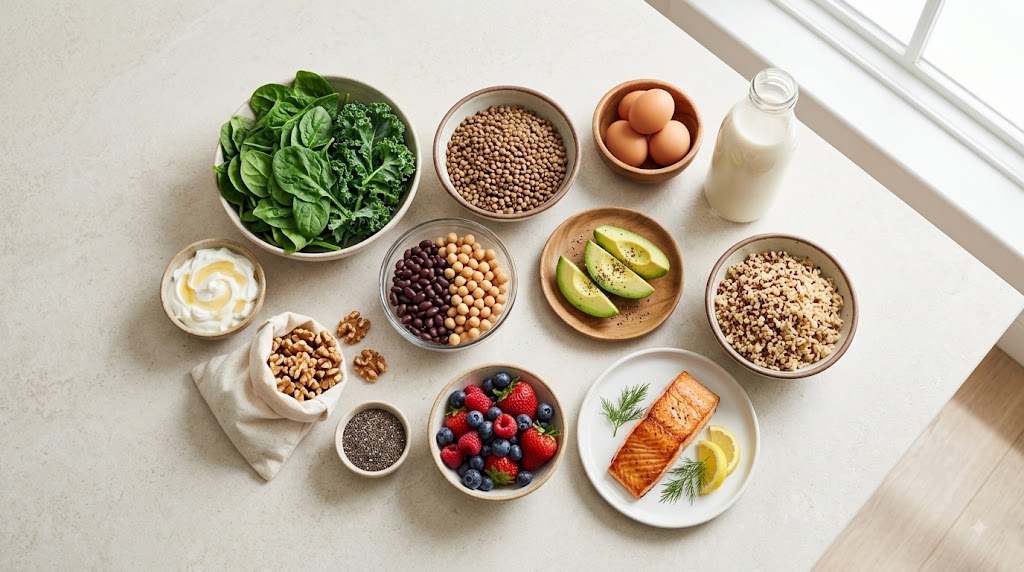
Calories keep your engine running, but macronutrients (carbs, protein, fats) and micronutrients (vitamins and minerals) build the engine itself!
Complex Carbohydrates (Minimum 175g/day)
Carbs are not the enemy during pregnancy! Your baby's developing brain runs strictly on glucose. Medical guidelines state you need at least 175 grams of complex carbs daily (like oats, brown rice, whole-grain bread, and sweet potatoes) to prevent ketosis and keep your energy steady.
Lean Protein (60 to 71g/day)
Protein builds new tissue, organs, and blood supply for your growing baby. You'll want to bump your protein up from non-pregnant levels (~46g/day) to at least 60–71 grams per day. Eggs, chicken, tofu, lentils, and Greek yogurt are awesome go-tos!
Essential Fats (20% to 35% of daily calories)
Healthy fats—especially Omega-3s like DHA—help build baby’s brain and eyes. Stock up on avocados, nuts, seeds, and low-mercury fish like salmon.
Plant-Based vs. Non-Vegetarian Pregnancy Diets
Are you a vegetarian or vegan mama? Good news: research shows that well-planned plant-based diets are just as safe and effective for pregnancy as omnivorous diets. Just make sure you’re keeping an eye on non-heme iron (pair it with Vitamin C for better absorption!), Vitamin B12, and zinc.
Micronutrient | Non-Pregnant RDA | Pregnant RDA | Primary Dietary Sources | Key Clinical Function |
Folate (B9) | 400 μg/day | 600 μg/day | Leafy greens, fortified grains, legumes | Neural tube closure & DNA synthesis |
Iron | 18 mg/day | 27 mg/day | Lean meats, lentils, spinach, beans | Hemoglobin production & anemia prevention |
Calcium | 1,000 mg/day | 1,000 mg/day | Dairy products, fortified plant milks, tofu | Fetal skeletal synthesis |
Vitamin D | 5 μg/day (200 IU) | 15 μg/day (600 IU) | Fatty fish, egg yolks, fortified dairy | Bone mineralization & calcium balance |
Vitamin B12 | 2.4 μg/day | 2.6 μg/day | Poultry, meat, dairy, fortified yeast | Neurological maturation & erythrocyte synthesis |
Zinc | 8 mg/day | 11 mg/day | Meat, seeds, nuts, legumes | Cellular division & immune development |
3. Recommended Gestational Weight Gain Targets
Weight gain during pregnancy is healthy, normal, and necessary! But how much weight you should gain depends on your starting pre-pregnancy Body Mass Index (BMI).
Public health data shows that about 50% of pregnant women gain more weight than recommended, while 20% gain less. Staying within clinical weight gain parameters helps prevent complications like preeclampsia, gestational diabetes, or low birth weight.
Pre-Pregnancy BMI Category | Pre-Pregnancy BMI Range (kg/m2) | Total Weight Gain (Single Pregnancy) | Rate of Gain in 2nd & 3rd Trimesters (Mean / Week) | Total Weight Gain (Twin Pregnancy) |
Underweight | < 18.5 | 28 – 40 lbs (12.5 – 18.0 kg) | 1.0 – 1.3 lbs (0.51 kg) | N/A |
Normal Weight | 18.5 – 24.9 | 25 – 35 lbs (11.5 – 16.0 kg) | 0.8 – 1.0 lbs (0.42 kg) | 37 – 54 lbs (17 – 25 kg) |
Overweight | 25.0 – 29.9 | 15 – 25 lbs (7.0 – 11.5 kg) | 0.5 – 0.7 lbs (0.28 kg) | 31 – 50 lbs (14 – 23 kg) |
Obesity (Class I–III) | ≥ 30.0 | 11 – 20 lbs (5.0 – 9.0 kg) | 0.4 – 0.6 lbs (0.22 kg) | 25 – 42 lbs (11 – 19 kg) |
Using a gestational weight gain tracker alongside daily food logging ensures you hit your target sweet spot without stressing.
4. Managing Gestational Diabetes (GDM) Without the Headache
Gestational Diabetes Mellitus (GDM) is carbohydrate intolerance that shows up during pregnancy, usually diagnosed between 24 and 28 weeks. If your doctor diagnoses you with GDM, don't panic! It is completely manageable through diet and lifestyle adjustments.
When tracking carbs for GDM, guidelines from the American College of Obstetricians and Gynecologists (ACOG) recommend:
Spread Out Your Carbs: Eat 3 meals and 2–3 small snacks daily to avoid blood sugar spikes.
Target Per-Meal Carbs:
Breakfast: 30–45 grams of complex carbs (morning cortisol makes insulin resistance higher!).
Lunch & Dinner: 45–60 grams of complex carbs.
Snacks: ~15 grams of complex carbs every 2–3 hours.
Keep Sugar Targets on Track:
Fasting blood sugar: < 95 mg/dL
1-Hour after meals: < 140 mg/dL
2-Hours after meals: < 120 mg/dL
A dedicated calorie counter for gestational diabetes helps you stay accountable to these meal breakdowns without losing your sanity!
5. Why Manual Tracking Sucks During Pregnancy (And Why VoCal Wins!)

Let's keep it real: traditional calorie tracker apps were not designed for pregnant women.
When you're dealing with first-trimester nausea, staring at a phone screen scrolling through endless dropdown menus of food databases can trigger instant morning sickness. And when pregnancy fatigue hits in the third trimester, who has time to weigh every ingredient and type out custom recipes?
That’s where VoCal changes the game.
VoCal is an AI-powered voice calorie tracker designed to make food logging completely hands-free and effortless. Instead of typing, tapping, and searching, you simply talk.
Why VoCal is the Best Calorie Tracker for Pregnancy:
100% Hands-Free Voice Logging: Just speak naturally! Say, "I had two scrambled eggs, a slice of whole-wheat toast with butter, and a cup of strawberries." VoCal parses your voice, measures the portions, and logs the calories and macros instantly.
GDM Carbohydrate Breakdown: Easily track your carbohydrate totals meal-by-meal to maintain smooth postprandial blood sugar levels.
Vegetarian & Non-Vegetarian Friendly: Whether you’re eating plant-based or omnivorous meals, VoCal understands complex recipes in seconds.
Capability / Feature | VoCal Voice Tracker | Traditional Manual Apps | Paper Food Logging |
Primary Input Method | Hands-free spoken voice input | Manual text search & drop-down menus | Handwriting |
Average Logging Time Per Meal | 3 to 5 seconds | 2 to 5 minutes | 2 to 4 minutes |
Usability During Nausea / Fatigue | High (No screen reading required) | Low (Triggers visual strain & fatigue) | Moderate |
GDM Carbohydrate Distribution | Real-time per-meal carb breakdown | Requires manual diary filtering | Manual aggregation |
Long-Term Gestational Adherence | High (Minimal daily friction) | Low (High early abandonment) | Low |
Quick Tips for Stress-Free Prenatal Tracking
Log Right After You Eat: Don't rely on end-of-day memory. Speak your meal into VoCal right after finishing so you never forget a snack.
Focus on Nutrient Density: Prioritize whole foods, fiber, and lean protein over empty sugary calories.
Stay Hydrated: Drink plenty of water throughout the day to support expanding blood volume and amniotic fluid.
Share Reports with Your OB-GYN: Export your VoCal calorie and macro summaries to show your doctor or dietitian during routine prenatal checkups.
Conclusion: Make Prenatal Nutrition Effortless
Pregnancy is a beautiful journey, but it comes with a lot of moving parts. Managing your diet shouldn't add extra stress to your day! By ditching manual typing and switching to hands-free voice logging with VoCal, you can keep your nutrition on point, hit your trimester targets, and focus on what really matters—preparing for your baby's arrival!
Frequently Asked Questions (FAQs)
Q1: Do I really need to track calories while pregnant?
Tracking calories during pregnancy isn't about restriction or losing weight. It’s about ensuring you meet your increased energy targets, get enough protein and macronutrients, and avoid excessive weight gain that could lead to gestational complications.
Q2: How does a voice calorie tracker work during pregnancy?
With VoCal, you simply open the app and speak your meal out loud (e.g., "I had a Greek yogurt bowl with chia seeds, blueberries, and honey"). The AI calculates the exact calories and macros automatically, saving you from tedious manual typing.
Q3: Is VoCal safe to use for Gestational Diabetes carb tracking?
Yes! VoCal allows you to monitor carbohydrate totals meal-by-meal. This helps you stick to recommended carbohydrate limits (like 30–45g for breakfast and 15g per snack) to maintain optimal postprandial glucose levels.
Q4: Can I use VoCal if I’m on a vegetarian or vegan pregnancy diet?
Absolutely! VoCal supports all dietary patterns. It parses plant-based ingredients like lentils, tofu, beans, and fortified plant milks, helping you ensure you hit your daily calorie and macronutrient targets.
Disclaimer: This is for informational purposes only. For medical advice or diagnosis, consult a professional.