

Who doesn't love a basket of golden, crispy, fresh-out-of-the-fryer french fries? Whether you're pulling through a drive-thru on a Friday night or sharing a side at your favorite diner, fries are the ultimate comfort food.
But if you’ve ever logged a meal and wondered why your daily goal suddenly vanished into thin air, you’re not alone. The truth is, estimating potato fry calories is one of the trickiest parts of staying on track with your nutrition. The potato itself isn't the calorie culprit—it's the sneaky thermal cooking oils and giant tubs of dipping sauce that turn an innocent vegetable into a calorie heavyweight.
In this guide, we’re peeling back the curtain on how french fry calories stack up, how deep-frying actually works, and how you can track every bite effortlessly!
Table of Contents
The Base Potato vs. The Deep-Fried Reality
Portion Sizes Matter: How Fast-Food Sizes Sneak Up on You
The Science of the Sponge: How Oil Sneaks Into Your Fries
Seed Oils vs. Beef Tallow: Does the Cooking Fat Matter?
Condiment Confessions: The Hidden Sauce Calorie Trap
5 Fun, Easy Hacks to Lower Your Fry Calorie Count
Track Hidden Calories Effortlessly with VoCal
Frequently Asked Questions (FAQs)
The Base Potato vs. The Deep-Fried Reality
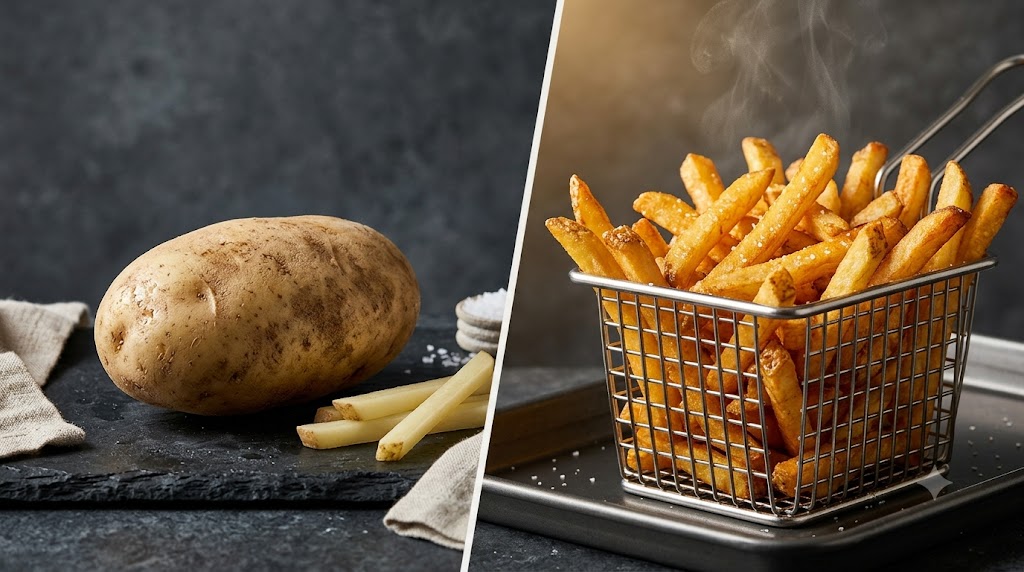
At its core, a plain white potato is about 77% water and loaded with great nutrients like potassium and vitamin B6. A 100-gram serving of simple boiled white potato has just 86 calories and practically zero fat.
So how does that same potato end up at over 300 calories per 100 grams once it becomes a french fry?
When cut into strips and dropped into hot frying oil, water evaporates out, and fat moves in. Because dietary fat carries 9 calories per gram (compared to just 4 calories per gram for carbs or protein), that added cooking oil skyrockets the total energy density of your food.
Here is how different potato cooking styles compare based on official USDA data:
Preparation Method | USDA FDC ID | Energy (kcal) | Total Fat (g) | Saturated Fat (g) | Carbohydrates (g) | Sodium (mg) |
Plain Boiled White Potato | 170440 | 86 | 0.10 | 0.03 | 20.08 | 6 |
Frozen Oven-Baked (Steak Cut) | 168445 | 148 | 3.76 | 0.74 | 26.20 | 373 |
Sweet Potato Fries (Oven/Fried) | 168482 | 161 | 5.95 | 1.10 | 28.57 | 202 |
Frozen Oven-Baked (Cottage Cut) | 170117 | 218 | 8.20 | 3.89 | 32.50 | 246 |
Fast-Food French Fries (Deep-Fried) | 170698 | 312 | 14.73 | 2.34 | 41.44 | 210 |
Data sourced from USDA FoodData Central reference entries.
Notice the difference? Deep-frying a potato multiplies its calories by more than 3.6 times and boosts its fat content by over 140 times!
Portion Sizes Matter: How Fast-Food Sizes Sneak Up on You
Let's be honest: almost nobody eats exactly 100 grams of fries. When you order a side of fries at a restaurant or drive-thru, portion scaling quickly changes the equation.
What looks like a modest cardboard container can contain a surprisingly large amount of hidden fat and calories:
Serving Size | Portion Weight | Energy (kcal) | Total Fat (g) | Sodium (mg) |
Small Fast-Food Fries | 71 g | 222 | 10.4 | 149 |
Medium Fast-Food Fries | 117 g | 365 | 17.2 | 246 |
Standard Restaurant Side | 150 g | 468 | 22.1 | 315 |
Large Fast-Food Fries | 154 g | 480 | 22.7 | 323 |
Calculated from USDA fast-food reference metrics.
If you are following a standard 2,000-calorie daily diet, just one large order of fast-food fries eats up nearly 25% of your daily calorie budget and over 33% of your daily fat limit—before you even touch a burger or a drink!
The Science of the Sponge: How Oil Sneaks Into Your Fries
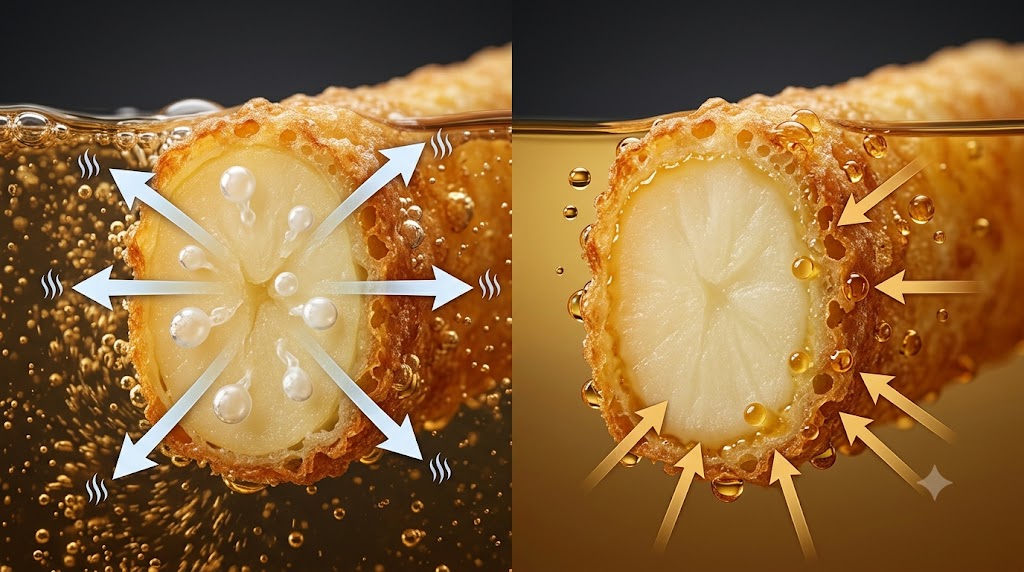
Have you ever wondered how fries soak up so much oil? It comes down to a few fascinating food science reactions that happen while cooking:
The Water Replacement Bubble Drop: Potatoes are packed with water. When thrown into fryer oil heated to 350 °F, that internal water boils instantly into steam. As steam rushes out, it leaves behind millions of tiny microscopic tunnels and open pores in the potato crust.
The Cooling Vacuum Effect: Here is a fun plot twist—fries don't absorb most of their oil while bubbling under the hot oil! They actually soak up fat after they are lifted out of the fryer. As the fry cools down on the tray, the steam inside condenses back into water droplets, creating a tiny internal vacuum that pulls surface oil straight into the crust.
Aged Oil Means Soggy Fries: When commercial fryer oil gets used repeatedly throughout the day, it breaks down into compounds called surfactants. Surfactants reduce the boundary between the oil and the fry, causing degraded oil to soak in much faster, leaving you with greasy, extra-caloric fries.
Seed Oils vs. Beef Tallow: Does the Cooking Fat Matter?
While most modern fast-food spots fry their potatoes in plant-based seed oils (like canola, soybean, or sunflower oil), classic diners and specialty fry joints often use traditional rendered animal fats like beef tallow.
Does changing the frying fat alter the calorie count? Let's check the numbers:
Fat / Oil Source | Energy (per tbsp / 14g) | Energy (per 100g) | Saturated Fat (g/100g) | Monounsaturated Fat (g/100g) | Polyunsaturated Fat (g/100g) |
Refined Canola / Soybean Oil | 120 kcal | 884 kcal | 7.36 | 63.30 | 28.10 |
Beef Tallow (Rendered Fat) | 115 kcal | 902 kcal | 49.80 | 41.80 | 4.00 |
Data compiled from USDA FoodData Central lipid profiles.
The Verdict: Calorie-wise, all cooking fats are remarkably close (~115–120 calories per tablespoon). However, beef tallow contains significantly higher levels of saturated fat, making it structurally stable at high heat, whereas vegetable seed oils contain more polyunsaturated fats. Regardless of which fat is used, deep frying oil absorption adds substantial calories.
Condiment Confessions: The Hidden Sauce Calorie Trap
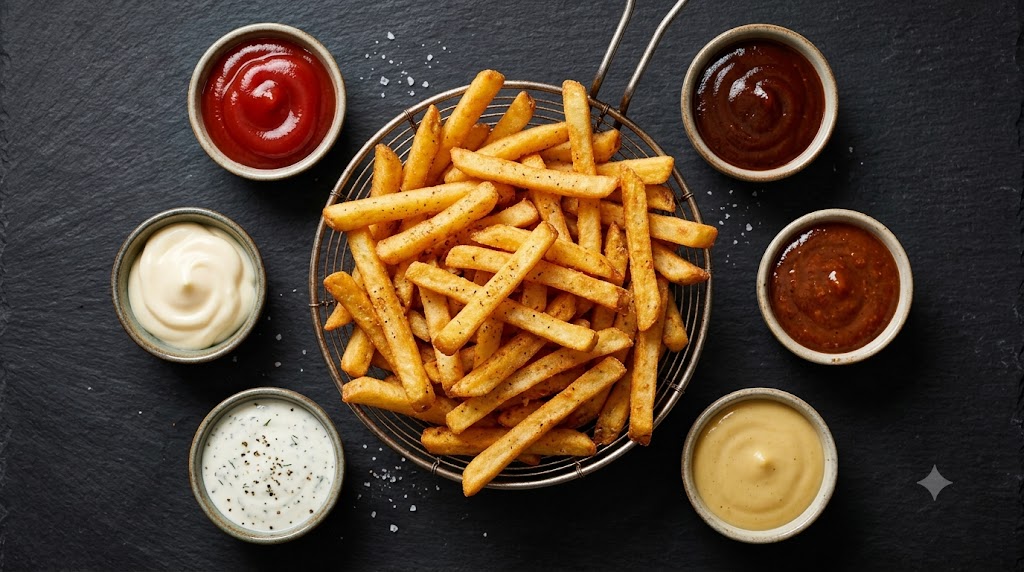
Here is where standard calorie logging often falls apart: the dipping sauces.
You might carefully log your medium order of fries, but forget to count those two or three little plastic condiment cups sitting on your tray. Sauce portions add up fast, introducing hidden calories from oils and added sugars.
Check out how much energy your favorite dips bring to the table:
Condiment / Sauce | Standard Serving | Energy (kcal) | Total Fat (g) | Sugar (g) | Sodium (mg) |
Tomato Ketchup | 2 tbsp (34 g) | 40 | 0.00 | 8.00 | 308 |
Barbecue (BBQ) Sauce | 2 tbsp (36 g) | 70 | 0.50 | 16.00 | 350 |
Honey Mustard Sauce | 2 tbsp (30 g) | 130 | 11.00 | 6.00 | 240 |
Ranch Dressing | 2 tbsp (30 g) | 140 | 14.50 | 1.00 | 260 |
Traditional Mayonnaise | 2 tbsp (28 g) | 200 | 22.00 | 0.00 | 180 |
Data compiled from USDA FoodData Central and product standards.
Sauce Math Alert: Dunking a large order of fries (480 kcal) into 4 tablespoons of Ranch Dressing (280 kcal) drives your side dish to 760 total calories and over 51 grams of fat! That’s more calories than many complete main meals.
5 Fun, Easy Hacks to Lower Your Fry Calorie Count
You don't have to give up crisp, delicious fries to stay on top of your health goals. Try these simple tweaks:
Go for Thick-Cut or Steak Fries: Thicker fries have less surface area relative to their volume compared to thin shoestring fries. Less surface area means less oil gets absorbed during cooking.
Bake or Air-Fry at Home: Air-frying or oven-baking frozen steak-cut fries can slash your fat intake by up to 75% while keeping that satisfying crunch.
Blanch Before Frying: Making fries from scratch? Boil raw cut potatoes in water for a few minutes before cooking. This seals the outer starch walls and cuts down oil uptake.
Swap Your Dips: Switch out mayo-based or oil-heavy dips (like ranch or garlic aioli) for light ketchup, hot sauce, or fresh salsa.
Share the Side: Order a large fry for the table and split it with friends so everyone gets a taste without overdoing the overall calorie load.
Track Hidden Calories Effortlessly with VoCal
Trying to calculate how much oil absorbed into your restaurant fries or figuring out how many tablespoons of dipping sauce you used can feel like doing high school math homework at the dinner table.
That's why we built VoCal —the ultimate voice-based calorie tracker designed to make logging your food completely hands-free and frictionless.
Instead of searching through confusing databases or manually measuring cooking oil, you simply speak into your phone naturally:
"I had a medium order of fast-food fries with two tablespoons of ketchup and a dip of ranch."
VoCal’s smart AI speech engine immediately breaks down your meal:
Identifies the baseline portion (Medium fries = 365 kcal).
Factors in absorbed cooking fats based on restaurant standards.
Adds sauce estimates automatically (2 tbsp ketchup + ranch dip = ~200 kcal).
No typing, no math, and no stress. Just tap, speak, and get on with your day while keeping your daily goals on track!
Frequently Asked Questions (FAQs)
How many calories are in a small order of french fries?
According to USDA data, a small fast-food french fry serving (71 g) contains approximately 222 calories, 10.4 grams of fat, and 149 mg of sodium.
Are air-fried fries significantly healthier than deep-fried fries?
Yes! Air-frying uses circulating hot air rather than deep submersion in oil. Oven-baked or air-fried fries typically contain around 148 to 218 calories per 100g, saving you over 100–150 calories per serving compared to deep-fried fast-food versions.
Why do sweet potato fries have similar calories to regular fries?
While sweet potatoes offer higher levels of Vitamin A and fiber, sweet potato fries served at restaurants are still deep-fried in cooking oil. A 100g serving of deep-fried sweet potato fries delivers around 161 to 230 calories, making their overall energy density very similar to white potato fries.
What is the lowest-calorie dipping sauce for fries?
Tomato ketchup (~20–40 kcal per serving) and hot sauce (~5 kcal per serving) are significantly lower in calories than oil- or cream-based sauces like ranch (140 kcal) or traditional mayonnaise (200 kcal).
How can I log fries accurately when eating out at local restaurants?
Because local spots use different cut sizes and frying times, estimating hidden oil can be tricky. Using a voice-powered tool like VoCal allows you to describe what you ate in plain language (e.g., "hand-cut diner fries with mayo"), and the app automatically estimates reasonable preparation fat and calorie totals for you!
Disclaimer: This is for informational purposes only. For medical advice or diagnosis, consult a professional.