

Few comfort foods hit the spot quite like gnocchi. Those warm, pillowy Italian dumplings practically melt in your mouth, whether they are tossed in bright basil pesto or floating in a creamy broth.
However, if you have ever sat down with a bowl and wondered, "How many calories are in these little potato pillows?", you are not alone. Because gnocchi is denser than standard pasta, serving sizes can be deceptive. A small-looking bowl can easily pack more energy and carbohydrates than expected.
Whether you are boiling traditional potato dumplings, grabbing a bowl of Olive Garden's famous soup, or stocking your freezer with Trader Joe's cauliflower gnocchi, this complete guide breaks down the calories, macronutrients, and simple culinary tweaks you need to enjoy gnocchi while hitting your health goals.
What Is Gnocchi, Really?
Traditional Italian gnocchi is made from cooked mashed potatoes, wheat flour, and occasionally a splash of egg or salt. Because potatoes form the backbone of the dough, gnocchi is primarily a complex carbohydrate food.
A standard 100-gram serving of boiled potato gnocchi delivers between 135 and 158 calories. Carbohydrates make up roughly 81% to 87% of those calories, while fat remains minimal and protein provides a modest contribution.
The Portion Size Trap: Grams vs. Cups
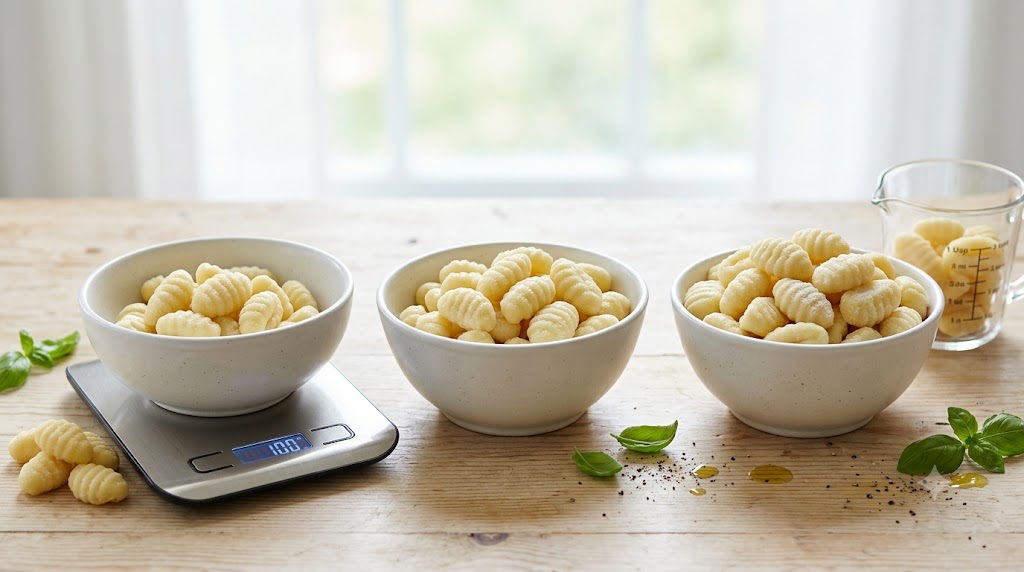
Visual estimation is where most people get tripped up. A loose 3/4-cup portion (about 120 grams) supplies 191 calories and 40 grams of carbohydrates. Pack that same gnocchi into a full 1-cup measure, and the weight climbs to roughly 188 grams, delivering 254 calories and 53 grams of carbs.
On the micronutrient side, gnocchi retains beneficial minerals from the potato, providing between 100 and 328 milligrams of potassium, alongside trace amounts of iron and B vitamins.
Nutritional Metric | Per 100 Grams (Cooked) | Per 3/4 Cup (120 Grams) | Per 1 US Cup (188 Grams) | % Daily Value (per 120g)* |
Energy (Calories) | 135–158 kcal | 191 kcal | 254 kcal | 10% |
Total Carbohydrates | 31.8–33.3 g | 40.0 g | 53.0 g | 15% |
Dietary Fiber | 1.8–3.0 g | 3.0 g | 3.8 g | 11% |
Net Carbohydrates | 29.8–30.3 g | 37.0 g | 49.2 g | — |
Total Fat | 0.8–1.3 g | 1.0 g | 1.6 g | 1% |
Saturated Fat | 0.0–0.5 g | 0.0 g | 0.3 g | 0% |
Protein | 2.4–4.3 g | 4.0 g | 5.5 g | 8% |
Sodium | 250–380 mg | 380 mg | 596 mg | 16% |
Potassium | 100–328 mg | 100 mg | 235 mg | 2% |
*Percent Daily Values (% DV) are based on a standard 2,000-calorie daily diet.
Gnocchi vs. Traditional Pasta: Which Fits Your Plate?
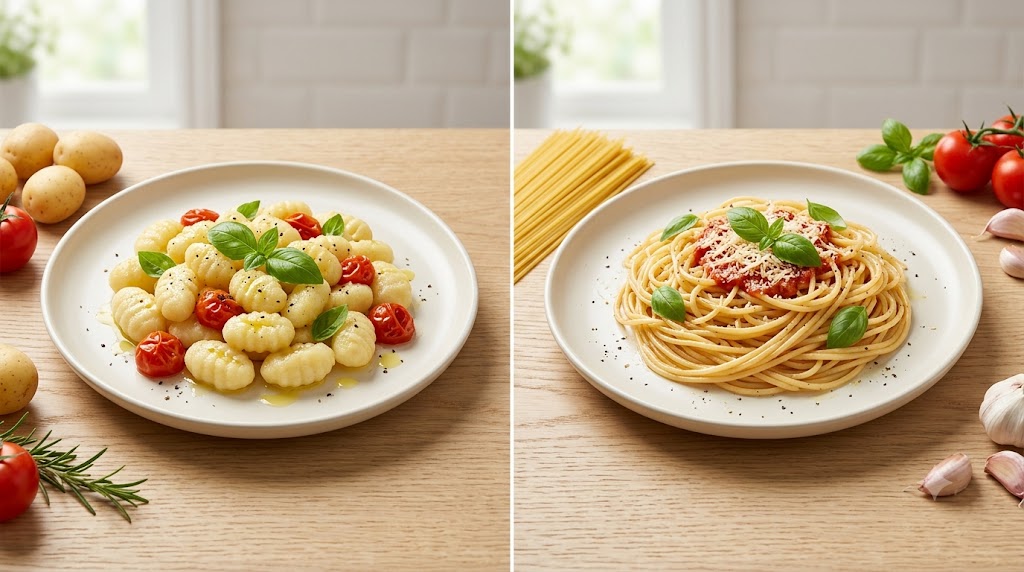
When choosing between gnocchi and classic durum semolina pasta (such as penne or spaghetti), the decision involves more than just total calories. The internal structure of the food dictates how full you feel and how quickly your body digests the starches.
1. The Glycemic Difference
Traditional semolina pasta features a dense protein matrix that slows down digestive enzymes, yielding a low-to-moderate glycemic index (GI 45–55). Potato gnocchi, on the other hand, consists of riced potatoes where the starches are already gelatinized and easily accessible. This produces a higher glycemic index (GI 70–80), meaning gnocchi causes a faster rise in blood sugar and insulin levels.
2. The Protein Advantage
Traditional pasta packs more protein than potato gnocchi—about 5.8 grams per 100 grams cooked compared to 2.4 grams in gnocchi. Higher protein stimulates satiety hormones like peptide YY (PYY) and cholecystokinin (CCK), which help keep between-meal cravings at bay.
3. Physical Density
Gnocchi is physically heavier than dry pasta shapes. A single cup of cooked gnocchi weighs roughly 188 grams, whereas a cup of cooked spaghetti sits at roughly 140 grams. Because gnocchi takes up less volume on the plate for the same weight, it is easy to accidentally pour out a double serving.
Nutritional Metric | Cooked Potato Gnocchi (100g) | Cooked Semolina Pasta (100g) | Net Variance |
Energy (Calories) | 135 kcal | 157 kcal | -14.0% |
Protein | 2.4 g | 5.8 g | -58.6% |
Total Carbohydrates | 31.8 g | 30.9 g | +2.9% |
Dietary Fiber | 1.8 g | 1.8 g | 0.0% |
Total Fat | 0.8 g | 0.9 g | -11.1% |
Total Sugars | 1.0 g | 0.6 g | +66.7% |
Glycemic Index (GI) | 70–80 (High) | 45–55 (Low–Moderate) | Higher Spike |
Weight per US Cup | ~188 g | ~140 g | +34.3% (Heavier) |
The Takeaway: Gnocchi gives you slightly fewer calories per 100 grams than regular pasta, but pasta delivers more hunger-curbing protein and a steadier blood sugar response.
Dining Out: Calories in Olive Garden’s Chicken & Gnocchi Soup
One of the most popular ways Americans encounter gnocchi is at Olive Garden, ordered alongside endless salad and breadsticks. The restaurant’s Chicken & Gnocchi Soup features tender potato dumplings, roasted chicken breast pieces, shredded carrots, and spinach swimming in a silky cream base.
A standard restaurant bowl (one serving) contains approximately 230 calories. While 230 calories makes it a relatively modest soup option, the dairy cream shifts its macronutrient profile substantially.
The chicken inclusions provide 11 grams of lean protein, which improves overall satiety. The primary element requiring attention is sodium: a single bowl contains 1,290 milligrams of sodium, accounting for more than 54% of the recommended 2,300-milligram daily allowance.
If you are pairing your soup with salted breadsticks or ordering multiple bowls from the unlimited soup menu, that sodium tally climbs quickly.
Nutritional Parameter | Standard Restaurant Serving (1 Bowl) | Target Daily Value % (2,000 kcal Base) |
Total Energy | 230 kcal | 11.5% |
Calories from Fat | 100–108 kcal | — |
Total Fat | 12.0 g | 15–18% |
Saturated Fat | 4.5–5.0 g | 23.0% |
Cholesterol | 55 mg | 18.0% |
Sodium | 1,290 mg | 54–56% |
Total Carbohydrates | 22.0 g | 7–8% |
Dietary Fiber | 1.0 g | 4.0% |
Net Carbohydrates | 21.0 g | — |
Total Sugars | 4.0 g | — |
Protein | 11.0 g | 22.0% |
Retail Showdown: Trader Joe’s Cauliflower vs. Stuffed Gnocchi
Over the past few years, Trader Joe’s turned gnocchi into a weeknight staple with modern, plant-forward twists. But how do these popular frozen bags compare to traditional potato dumplings?
Trader Joe's Cauliflower Gnocchi: The Volume-Eater's Pick
Made from cauliflower, cassava flour, potato starch, extra virgin olive oil, and sea salt, this fan-favorite offers a lower-calorie alternative to potato pasta.
Per 1-Cup Serving (140g): 140 calories, 3g fat, 22g total carbs, 6g fiber (16g net carbs), and 2g protein.
The Entire Bag (330g): 330 calories, 8g fat, 53g carbs, 15g fiber (38g net carbs), and 5g protein.
While it is significantly lighter than standard gnocchi and packs three times the dietary fiber, it is not strictly keto. The cassava flour and potato starch are necessary to prevent the dumplings from turning to mush, leaving you with 16 grams of net carbs per cup.
Trader Joe's Sweet Potato Gnocchi with Butter & Sage: The Indulgence Trap
On the other end of the grocery spectrum sits the Sweet Potato Gnocchi with Butter and Sage. Because this bag includes a pre-packaged butter sauce, the calories and saturated fats jump dramatically.
Per 1-Cup Serving (133g): 250 calories, 12g fat, 7g saturated fat, 27g carbs, 3g fiber, 13g sugars, and 5g protein.
The Catch: A single cup delivers 35% of your recommended saturated fat limit for the day. If you eat the full 14.1-ounce bag in one sitting, you will consume over 530 to 750 calories.
Product & Variety | Serving Metric | Calories (kcal) | Total Fat (g) | Sat. Fat (g) | Total Carbs (g) | Fiber (g) | Net Carbs (g) | Protein (g) | Sodium (mg) |
Generic Potato Gnocchi | 100 g | 135–158 | 0.8–1.3 | 0.2 | 31.8 | 1.8 | 30.0 | 2.4–4.3 | 250–380 |
TJ Cauliflower Gnocchi | 1 cup (140 g) | 140 | 3.0 | 0.5 | 22.0 | 6.0 | 16.0 | 2.0 | 460 |
TJ Cauliflower (Full Bag) | Entire Bag (~330 g) | 330–350 | 7.0–8.0 | 1.5 | 52.0–53.0 | 14.0–15.0 | 37.0–38.0 | 5.0 | 1,084–1,110 |
TJ Sweet Potato (Butter/Sage) | 1 cup (133 g) | 250 | 12.0 | 7.0 | 27.0 | 3.0 | 24.0 | 5.0 | 440 |
Olive Garden Chicken Gnocchi Soup | 1 bowl (1 cup) | 230 | 12.0 | 4.5–5.0 | 22.0 | 1.0 | 21.0 | 11.0 | 1,290 |
4 Smart Tips to Enjoy Gnocchi Without the Calorie Hangover
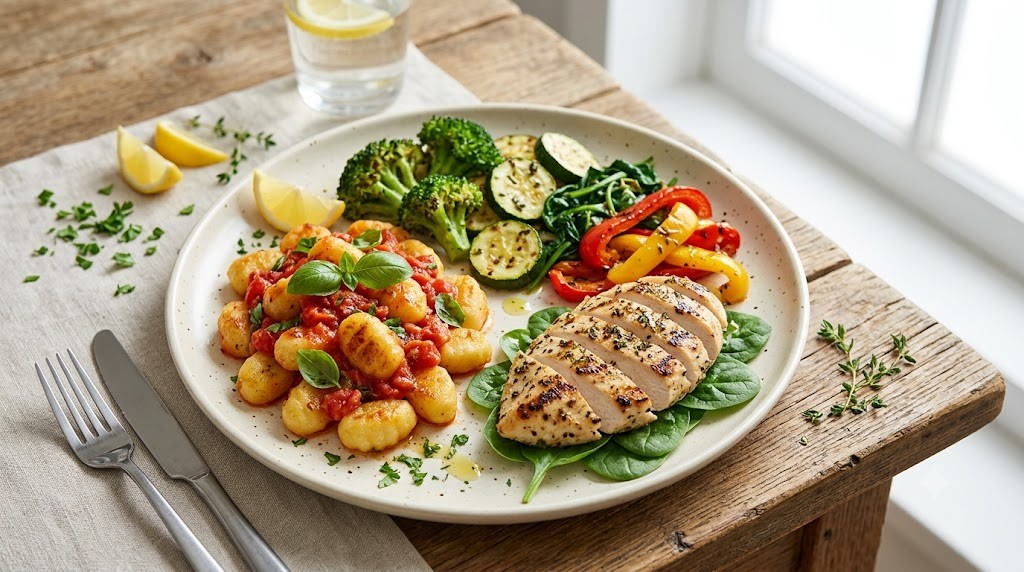
You do not need to give up Italian comfort food to maintain a healthy caloric deficit. Use these simple culinary strategies to optimize your meals:
1. Watch the Sauce Trap
Boiled potato gnocchi is naturally low in fat. What turns gnocchi into a high-calorie dish is almost always what you pour over it. Swapping heavy cream, gorgonzola cheese sauce, or pools of browned butter for crushed San Marzano tomato marinara can save you between 150 and 280 calories per serving.
2. Air-Fry for Texture Instead of Pan-Frying in Oil
Deep-frying or heavily oiling a skillet causes gnocchi's porous surface to soak up roughly 3.8 to 5.4 grams of oil per 100 grams, doubling the calorie count. Pop your gnocchi into an air fryer with a light spray of olive oil instead to get that crispy, golden exterior for a fraction of the fat.
3. The Reheating Hack (Resistant Starch)
Here is a practical food science shortcut: when you cook starchy potatoes and then let them cool in the refrigerator, their starch molecules realign into crystalline structures called resistant starch.
Resistant starch acts like soluble fiber, resisting digestion in the small intestine. Reheating previously cooked and cooled gnocchi results in a lower postprandial glucose and insulin response compared to eating it freshly boiled.
4. Build a Balanced Plate
Use the "Plate Method":
50% of your plate: Non-starchy vegetables (like sautéed spinach, roasted zucchini, or broccoli).
25% of your plate: Lean protein (such as grilled chicken breast or shrimp).
25% of your plate: Gnocchi.
This setup lets you enjoy the texture of gnocchi while keeping you satisfied for hours.
Preparation and Sauce Style | Gnocchi Base (150g) | Sauce / Cooking Fat Addition | Total Estimated Energy | Nutritional Impact |
Boiled + Fresh Marinara Pomodoro | ~210 kcal | ~45 kcal (Tomato Basil) | ~255 kcal | Low fat; high carbohydrate absorption |
Pan-Seared in Olive Oil (1 tbsp) | ~210 kcal | ~120 kcal (Healthy Fats) | ~330 kcal | +14g unsaturated fat; softens blood sugar spike |
Brown Butter and Crispy Sage | ~210 kcal | ~200 kcal (Butter) | ~410 kcal | +22g fat; substantial saturated fat load |
Creamy Gorgonzola / Alfredo Sauce | ~210 kcal | ~280 kcal (Heavy Cream & Cheese) | ~490 kcal | High saturated fat and sodium density |
Air-Fried TJ Cauliflower Gnocchi | ~150 kcal | ~40 kcal (Light Olive Mist) | ~190 kcal | High fiber (6.5g); low net carb load |
How to Track Gnocchi Without Losing Your Mind
Tracking restaurant meals and home-cooked mixed dishes can be frustrating. Open a traditional calorie app, search "potato gnocchi", and you will be met with dozens of conflicting entries—some saying 120 calories, others saying 400 calories. If you cooked it in olive oil, added marinara, and tossed in chicken breast, you have to search, weigh, and log each item separately.
This tracking fatigue is why so many people abandon logging.
That is where VoCal changes the game. Instead of typing, scrolling, and converting grams into cups, you simply speak naturally:
"VoCal, log one cup of pan-seared potato gnocchi with two tablespoons of marinara sauce and four ounces of grilled chicken breast."
Using intelligent natural language processing, VoCal recognizes the ingredients, estimates the portions, and logs your calories and macronutrients in under five seconds. It removes the friction from calorie tracking so you can focus on enjoying your meal.
Frequently Asked Questions
Is gnocchi higher in calories than regular pasta?
Weight for weight, boiled potato gnocchi has slightly fewer calories than cooked durum semolina pasta (around 135 to 158 kcal per 100 grams for gnocchi versus 157 kcal for pasta). However, gnocchi is physically denser, meaning a single cup of gnocchi weighs more and delivers more total calories than a cup of noodles.
Can I eat gnocchi on a low-carb or keto diet?
Standard potato gnocchi is not suitable for a strict low-carb or keto protocol, as a single cup contains around 40 to 53 grams of total carbohydrates. While Trader Joe's Cauliflower Gnocchi is lighter, it still contains cassava flour and potato starch, yielding 16 grams of net carbs per cup. If you are targeting under 50 grams of net carbs daily, keep portions small or pair with protein and greens.
Why does gnocchi cause a quick spike in hunger?
Boiled potato gnocchi has a relatively high glycemic index (GI 70–80) and lower protein and fiber content than whole grains or legumes. Starch is converted rapidly into glucose, causing an insulin spike followed by a drop in energy. To prevent this, pair your gnocchi with lean protein (like chicken breast or shrimp) and high-fiber vegetables.
Did the scale jump after eating gnocchi? Did I gain fat?
If the scale is up the morning after a gnocchi dinner, do not panic. Each gram of stored glycogen in your body binds approximately 3 grams of water. High-carb meals temporarily increase stored glycogen and fluid retention, and higher-sodium restaurant sauces can cause additional water holding. It is fluid balance, not instant body fat.
Disclaimer: This article is for educational and informational purposes only and does not constitute individual medical or dietary advice. Always consult a physician or registered dietitian before making significant changes to your dietary routine.