

It’s no secret that America runs on Dunkin'. Whether you’re grabbing an iced coffee on your morning commute or fueling up before a long workout, Dunkin’ is a go-to pit stop. But if you are watching your daily intake, figuring out dunkin' calories can feel a bit like a guessing game.
How does a warm croissant stack up against a toasted English muffin? Is a veggie option always lighter than bacon?
In this guide, we break down dunkin breakfast sandwich calories, macronutrients, and smart menu swaps—so you can enjoy your morning fast-food run without throwing your diet off track!
1. Bread Vehicles: The Calorie Foundation

Before you even pick your protein or cheese, your choice of bread sets the stage for the total calorie and fat content of your sandwich. Laminated breads like buttery croissants and tender biscuits get their irresistible texture from layers of butter or shortening, which means extra fat calories. On the flip side, yeast-based options like English muffins or multigrain thins give you plenty of volume with way less fat.
Here is how the base bread carriers compare:
Bread Carrier | Average Calories | Total Fat (g) | Saturated Fat (g) | Total Carbs (g) | Protein (g) | Primary Macro Profile |
Plain Bagel | 310 | 1.5 | 0.0 | 62 | 11 | High Carbohydrate / Low Fat |
Croissant | 330 | 17.0 | 10.0 | 38 | 6 | High Fat / High Saturated Fat |
Biscuit | 280 | 15.0 | 8.0 | 31 | 5 | Moderate-High Fat |
English Muffin | 140 | 1.0 | 0.0 | 26 | 5 | Low Calorie / Low Fat |
Multigrain Thin / Flatbread | 120 | 2.5 | 0.5 | 20 | 4 | High Fiber / Low Calorie |
The Takeaway: Swapping a croissant for an English muffin immediately cuts out 190 calories and 16 grams of fat before you even add eggs or bacon!
2. The Big Breakdown: Dunkin Breakfast Sandwich Calories Compared

When you add eggs, cheese, and breakfast meats, the total caloric range expands fast. Depending on what you order, a Dunkin’ breakfast sandwich can range anywhere from under 300 calories to over 700 calories!
Let's look at how popular full-sandwich builds compare across calories, fats, carbs, sodium, and protein:
Sandwich Build | Serving Size | Calories | Total Fat (g) | Sat. Fat (g) | Sodium (mg) | Total Carbs (g) | Protein (g) |
Egg & Cheese English Muffin | 1 Sandwich | 240–340 | 7.0–12.0 | 3.5–5.0 | 490–750 | 32.0 | 12–18 |
Ham, Egg & Cheese English Muffin | 1 Sandwich | 280–370 | 8.0–12.0 | 3.5–5.0 | 770–900 | 34.0 | 17–20 |
Bacon, Egg & Cheese English Muffin | 1 Sandwich | 298–400 | 12.2–15.0 | 5.2–7.0 | 750–950 | 29.0–31.0 | 18.3–20 |
Turkey Sausage English Muffin | 1 Sandwich | 460 | 22.0 | 7.0 | 1,120 | 39.0 | 26.0 |
Bacon, Egg & Cheese Croissant | 1 Sandwich | 560–587 | 37.2 | 18.0 | 1,229 | 38.3 | 23.8 |
Sausage, Egg & Cheese English Muffin | 1 Sandwich | 530–560 | 34.0 | 13.0 | 1,340 | 34.0 | 23.0–28 |
Big N' Toasted Sandwich | 1 Sandwich | 530–690 | 28.0–41.0 | 10.0–15.0 | 1,360 | 43.0 | 26.0–29 |
Sausage, Egg & Cheese Bagel | 1 Sandwich | 680 | 33.0 | 12.0 | 1,620 | 68.0 | 28.0 |
Sausage, Egg & Cheese Croissant | 1 Sandwich | 610–720 | 44.1–49.0 | 19.3–20.0 | 1,182–1,370 | 29.8–41.0 | 22.5–25 |
The Takeaway: Notice how choosing lean ham or bacon over savory pork sausage keeps your sandwich significantly lighter while still delivering plenty of filling protein!
3. Veggie & Plant-Based Choices: Are They Always Healthier?
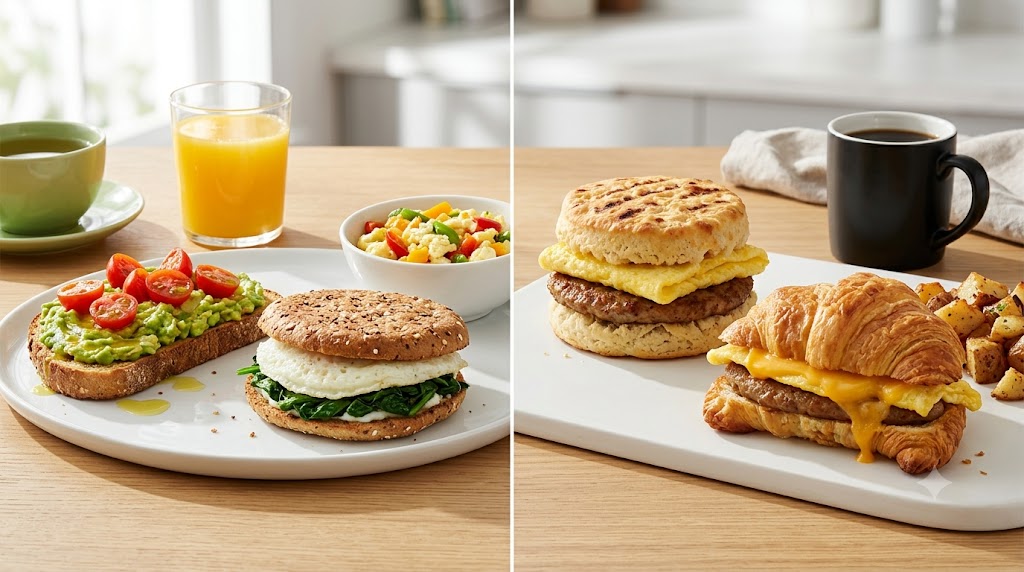
It is easy to assume that skipping meat automatically makes a fast-food order low-calorie. While plant-based sausage options match meat in protein output, they often use plant oils and binders that keep total fats and sodium fairly high. Whole-food veggie options and egg-white builds are your best bet for lightweight fuel.
Vegetarian / Plant-Based Item | Calories | Fat (g) | Sat. Fat (g) | Sodium (mg) | Carbs (g) | Fiber (g) | Protein (g) |
Avocado Toast | 240 | 14.0 | 2.0 | 390 | 24.0 | 6.0 | 6.0 |
Veggie Egg White Thin / Flatbread | 280–290 | 9.0 | 4.5 | 690 | 33.0 | 4.0 | 15.0 |
Egg White Bowl | 250 | 11.0 | 3.5 | 540 | 14.0 | 3.0 | 14.0 |
Power Breakfast Sandwich | 360–420 | 15.0 | 6.0 | 840 | 36.0 | 4.0 | 24.0 |
Beyond Sausage Sandwich | 480–510 | 24.0 | 8.0 | 1,100 | 42.0 | 3.0 | 24.0 |
The Takeaway: The Veggie Egg White Thin packs 15 grams of protein for under 300 calories! On the other hand, heavy plant-based meat substitutes carry similar caloric and sodium profiles to traditional sausage builds.
4. What About Sodium and Saturated Fat?
While keeping an eye on total dunkin' calories is great for weight management, overall nutrition also includes saturated fat and sodium.
Saturated Fat: Official US health guidelines recommend limiting saturated fat intake to less than 20 grams per day (based on a standard 2,000-calorie diet). Ordering a heavy Sausage, Egg & Cheese Croissant hits around 19 to 20 grams of saturated fat, fulfilling almost your entire daily limit in one meal!
Sodium: Guidelines suggest capping daily sodium at 2,300 mg. Processed breakfast meats, cheeses, and biscuits are naturally sodium-dense. For example, the Sausage, Egg & Cheese Bagel packs 1,620 mg of sodium, which is over 70% of your suggested daily cap!
Staying aware of these numbers helps keep your heart as happy as your tastebuds!
5. Smart Swaps to Cut Calories at Dunkin'
You don't have to give up your favorite drive-thru routine to meet your wellness goals. Try these quick customization hacks to slash calories in seconds:
Swap the Bread: Choose an English muffin or multigrain flatbread instead of a bagel or croissant to automatically cut 170 calories.
Pick Lean Meat: Swap pork sausage for sliced ham or crisp bacon to save around 185 calories while keeping high protein.
Hold the Cheese: Asking to skip American cheese saves 60 calories and 4.5 grams of fat.
Watch Your Coffee: Pair your sandwich with unsweetened black coffee, tea, or a latte made with skim milk to avoid extra liquid sugars and syrups.
6. Track Your Custom Dunkin Order Effortlessly with VoCal
Customizing fast food is awesome for your health, but logging complex modifications in traditional diet apps can be a hassle. Searching through endless database items to log "Ham, Egg & Cheese on an English Muffin, but with egg whites and no cheese" takes time you don't have during a busy morning.
That's where VoCal comes in!
VoCal is an AI-powered, voice-based calorie tracking app designed to eliminate tracking friction. Instead of typing and searching, you simply speak your order out loud:
"I had a Dunkin ham, egg, and cheese on an English muffin, but made with egg whites and no cheese."
VoCal understands your spoken voice, calculates the exact calorie and macro adjustments in real-time, and logs it directly into your daily journal. It's fast, flexible, and hands-free!
The Takeaway
Managing your dunkin breakfast sandwich calories doesn't mean skipping breakfast out of town. By making simple base swaps, opting for lean protein sources, and tracking your daily intake effortlessly using VoCal, you can enjoy convenient morning meals that keep you feeling energized and on track!
Frequently Asked Questions (FAQs)
What is the lowest calorie breakfast sandwich at Dunkin'?
The lowest calorie core options are the Egg & Cheese English Muffin (approx. 240 calories) and the Veggie Egg White Thin (approx. 280 calories).
Is a Dunkin' croissant higher in calories than a bagel?
While a plain bagel has slightly more total mass and carbs (310 calories), a croissant (330 calories) contains much more saturated fat due to its butter-laminated layers. When paired with fillings like sausage and cheese, croissant sandwiches often reach 600 to 720 calories.
How many calories are in a Bacon, Egg & Cheese English Muffin from Dunkin'?
A Dunkin' Bacon, Egg & Cheese English Muffin contains roughly 298 to 400 calories, making it a well-balanced, high-protein breakfast option compared to heavy biscuit or croissant builds.
Can I eat Dunkin' breakfast sandwiches on a weight loss diet?
Yes! By making smart menu adjustments—such as opting for lean meats (ham or bacon), light breads (English muffins or flatbreads), and tracking your daily meals accurately—you can easily fit Dunkin' into a calorie-conscious lifestyle.
Disclaimer: This is for informational purposes only. For medical advice or diagnosis, consult a professional.