
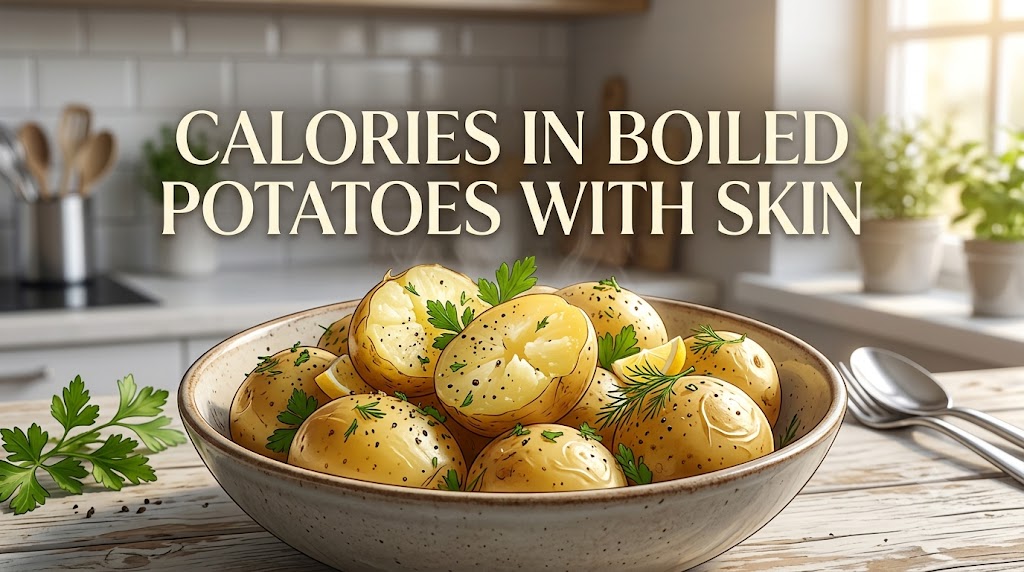
Potatoes have had a rough time in diet culture. Between low-carb trends and French fry guilt, spuds often get blamed for everything from afternoon brain fog to stubborn weight gain.
Here is the truth: the potato was never the villain—the deep fryer was.
When prepared simply, boiled potatoes are one of the most nutrient-dense, appetite-crushing foods on the planet. Leaving the peel on makes them even better.
If you are watching your energy intake, let’s peel back the curtain on the calories in boiled potatoes with skin, explore the science behind why they keep you full for hours, and see how easy it is to track them in your daily routine.
Table of Contents
The Quick Breakdown: Calories in Boiled Potatoes With Skin
Boiled Potatoes vs. Other Common Carbs
Why You Should Keep the Skin On
The Hunger Crusher: Why Boiled Potatoes Rank #1 for Fullness
The Meal-Prep Hack: Resistant Starch
The Topping Trap: Where Extra Calories Sneak In
Effortless Tracking with VoCal
Frequently Asked Questions
The Quick Breakdown: Calories in Boiled Potatoes With Skin
Boiled potatoes are mostly water—roughly 77% to 79% of their total weight. That means you get a generous portion on your plate for surprisingly few calories.
According to USDA FoodData Central data, 100 grams of boiled potato with skin contains just 87 calories.
Here is how the numbers stack up across standard serving sizes:
Serving Metric | Raw Mass Equivalent | Cooked Mass | Calories | Net Carbs | Dietary Fiber | Protein | Total Fat |
Per 100 g | 100 g | 100 g | 87 kcal | 18.1 g | 2.0 g | 1.9 g | 0.1 g |
Small Tuber | ~100 g | ~95 g | 83 kcal | 17.2 g | 1.9 g | 1.8 g | 0.1 g |
Medium Tuber | ~173 g | ~167 g | 145 kcal | 30.3 g | 3.3 g | 3.2 g | 0.2 g |
Large Tuber | ~300 g | ~290 g | 252 kcal | 52.5 g | 5.8 g | 5.5 g | 0.3 g |
Nutritional values derived from USDA FoodData Central entries for boiled potatoes cooked with skin.
The Takeaway: A standard medium spud delivers only about 145 calories. That easily fits into almost any daily calorie budget while providing real, slow-burning fuel.
Boiled Potatoes vs. Other Common Carbs
Many people assume a cup of rice or pasta is a "lighter" choice than a potato. However, looking at energy density—how many calories are packed into each gram of food—boiled potatoes come out ahead.
Because boiled potatoes hold so much natural water, they give you a much larger volume of food for fewer calories than grains.
Starch Source (Cooked) | Energy Density | Water Content | Digestible Carbs (per 100 g) | Fullness Score |
Boiled Potatoes (Skin-On) | 0.87 kcal/g | 77.8% | 15.2 g | Very High |
Cooked Brown Rice | 1.11 kcal/g | 73.1% | 23.0 g | Moderate |
Cooked White Rice | 1.30 kcal/g | 68.4% | 28.1 g | Moderate |
Cooked Durum Pasta | 1.31 kcal/g | 68.9% | 25.0 g | Moderate |
White Bread | 2.65 kcal/g | 36.4% | 46.1 g | Baseline |
The Takeaway: Swapping out 200 grams of cooked pasta or white rice for 200 grams of boiled potatoes cuts around 80 to 90 calories from your meal while significantly increasing portion volume.
Why You Should Keep the Skin On
Peeling potatoes might be a kitchen habit, but leaving that skin intact offers major nutritional benefits.
While the inner flesh contains plenty of potassium and vitamin C, the skin acts as a protective shield. When you boil peeled, diced potatoes, up to half of their water-soluble potassium can leach out into the cooking water. Boiling them with the skin on locks those essential minerals inside.
Leaving the skin on also provides:
Extra Fiber: The skin supplies insoluble fiber (cellulose and hemicellulose) that supports digestion, slows down gastric emptying, and keeps you full longer.
Potassium Power: A medium skin-on potato packs around 620 mg of potassium—more than a medium banana—helping balance fluids and support healthy blood pressure.
Polyphenols & Antioxidants: The outer periderm is rich in chlorogenic acid, an antioxidant that helps blunt post-meal blood sugar spikes.
Nutrient Breakdown | Boiled With Skin (Medium, ~167 g) | Boiled Peeled (Medium, ~167 g) | Why It Matters |
Dietary Fiber | 3.3–3.8 g | 2.1–2.4 g | Slows digestion and prevents energy crashes |
Potassium | ~620 mg | ~470 mg | Crucial electrolyte for muscle function and heart health |
Vitamin C | ~14 mg | ~10 mg | Antioxidant that stays trapped inside the unpeeled skin |
Chlorogenic Acid | 35–80 mg | <5 mg | Concentrated polyphenol found mainly in the outer skin |
The Takeaway: Skip the peeler! Keeping the skin on preserves vitamins, nearly doubles your fiber intake, and saves meal prep time.
The Hunger Crusher: Why Boiled Potatoes Rank #1 for Fullness
Have you ever wondered which food keeps you full the longest? Researchers at the University of Sydney put this question to the test by creating the Satiety Index.
They fed participants 240-calorie portions of 38 common foods and measured hunger and subsequent calorie intake over two hours. White bread was set as the baseline score of 100%.
Boiled potatoes scored an astonishing 323%—the highest rating of every food tested.
Food Item (Equal 240 kcal Portions) | Satiety Index Score (%) | Serving Weight | Calories Needed to Match Potato Fullness |
Boiled Potatoes | 323% | 282 g | 240 kcal |
White Fish (Ling) | 225% | 231 g | 344 kcal |
Oatmeal | 209% | 417 g | 371 kcal |
Beef Steak | 176% | 143 g | 440 kcal |
Brown Rice | 132% | 195 g | 587 kcal |
White Pasta | 119% | 185 g | 651 kcal |
White Bread | 100% (Baseline) | 98 g | 775 kcal |
Croissant | 47% | 48 g | 1,649 kcal |
Holt et al. Satiety Index study values.
Why did boiled potatoes outperform steak, fish, and whole grains?
It comes down to volume and stomach stretch. Because boiled potatoes are packed with water and fiber, a 240-calorie portion weighs nearly 300 grams. That physical mass expands your stomach lining, sending signals along the vagus nerve directly to your brain that say, "We are full; stop eating".
The Takeaway: If you struggle with hunger or afternoon snacking during a calorie deficit, adding a boiled potato with skin to your meal is one of the most effective ways to stay satisfied.
The Meal-Prep Hack: Resistant Starch
Here is an easy kitchen trick backed by metabolic science: cook your potatoes, put them in the fridge overnight, and eat them cold or gently reheated.
When you boil a potato, the starches absorb water and swell (a process called gelatinization), making them easy to digest. But when they chill in the refrigerator, the starch molecules rearrange into tightly packed structures called Type 3 Resistant Starch.
This cooling process provides three clear benefits:
Fewer Absorbable Calories: Regular starch provides roughly 4 calories per gram, but resistant starch yields only about 2 calories per gram because your small intestine cannot fully break it down.
A Steadier Glycemic Response: Resistant starch slows glucose release into your bloodstream, avoiding sharp blood sugar spikes and crashes.
A Healthier Gut: Resistant starch moves into the colon intact, where beneficial bacteria ferment it into short-chain fatty acids like butyrate, supporting gut health and natural fullness hormones (GLP-1 and PYY).
The Takeaway: Meal-prepping boiled potatoes for potato salads or light reheated bowls naturally lowers their net calories and improves digestion.
The Topping Trap: Where Extra Calories Sneak In
A plain boiled potato has virtually no fat (less than 0.2 grams). However, its soft texture readily absorbs added fats.
Adding rich toppings is where a low-calorie side dish can quickly turn into an accidental calorie bomb:
Potato Dish & Add-Ins | Total Portion | Total Calories | Total Fat | Why It Adds Up |
Plain Boiled with Skin | 167 g | 145 kcal | 0.2 g | Ultra-clean, high satiety |
With 1 tbsp Butter | 181 g | 247 kcal | 12.0 g | One pat of butter adds ~102 calories |
Mashed with Whole Milk & Butter | 210 g | 237 kcal | 8.9 g | Dairy liquids increase calorie density |
Loaded (2 tbsp Butter + Sour Cream + Cheese) | 250 g | 510 kcal | 28.5 g | Toppings now contain 3x more calories than the potato |
French Fries (Fast Food) | 117 g | 365 kcal | 17.0 g | Deep frying replaces water with vegetable oil |
How to Season Boiled Potatoes Without the Calorie Surge
To keep your potato high in volume and light on calories, swap heavy fats for bold seasonings:
Coarse sea salt, freshly cracked black pepper, and garlic powder
Fresh chopped chives, parsley, dill, or rosemary
Smoked paprika or hot pepper sauce
A tablespoon of nonfat plain Greek yogurt instead of sour cream
A light splash of red wine vinegar or whole grain mustard
The Takeaway: Boiled potatoes are naturally light and fat-free. Keep an eye on butter and oils to keep the meal lean and filling.
Effortless Tracking with VoCal
Logging whole foods should not feel like tedious homework.
Scrolling through endless search results trying to choose between "potato, raw", "potato, boiled without skin", or "potato, flesh only" creates unnecessary tracking fatigue. And if you add a dash of salt or a teaspoon of olive oil, calculating grams and fractions by hand gets old fast.
That is where VoCal makes nutrition simple.
With VoCal, you don't have to type, search databases, or scroll through confusing portion lists. Just tap the microphone and speak naturally:
"I ate one medium boiled potato with skin, a pinch of sea salt, and five ounces of grilled chicken breast."
VoCal’s AI recognizes your voice, detects the exact cooking method, looks up the verified USDA nutritional entry, and logs your calories, protein, carbs, and fats in seconds.
Whether you are aiming for fat loss, tracking macros, or building balanced eating habits, tracking your meals should be as effortless as having a conversation.
Frequently Asked Questions
Are boiled potatoes good for weight loss?
Yes! Boiled potatoes have a low caloric density (87 kcal per 100g) and score highest on the Satiety Index (323%), making them exceptionally effective at curbing hunger while maintaining a calorie deficit. Clinical trials show that when total calories are kept equal, diets containing whole potatoes produce weight loss equivalent to diets centered on beans or whole grains.
Is it safe to eat potato skins?
Yes, potato skins are safe and nutritious, provided the potato is thoroughly washed and not green. The skin supplies fiber, potassium, and antioxidants. However, avoid eating potatoes or peels that show green patches, which indicate the presence of solanine, a natural bitter compound that can cause stomach upset.
Do sweet potatoes have fewer calories than white boiled potatoes?
No, their calorie counts are almost identical. A 100-gram serving of boiled sweet potato has approximately 76 to 80 calories, compared to 87 calories for boiled white potatoes. Sweet potatoes provide higher amounts of vitamin A (beta-carotene), while white potatoes provide more potassium and vitamin C.
Can I reheat cooled boiled potatoes and keep the resistant starch?
Yes. While cooling creates Type 3 resistant starch, gently reheating your potatoes (steaming or lightly warming in a pan) preserves most of those newly formed starch crystals. Just avoid extremely high heat or long re-cooking times.
Disclaimer: This content is for informational purposes only and does not constitute individualized medical or dietary advice. Always consult with a qualified healthcare professional or registered dietitian before making significant changes to your diet.